
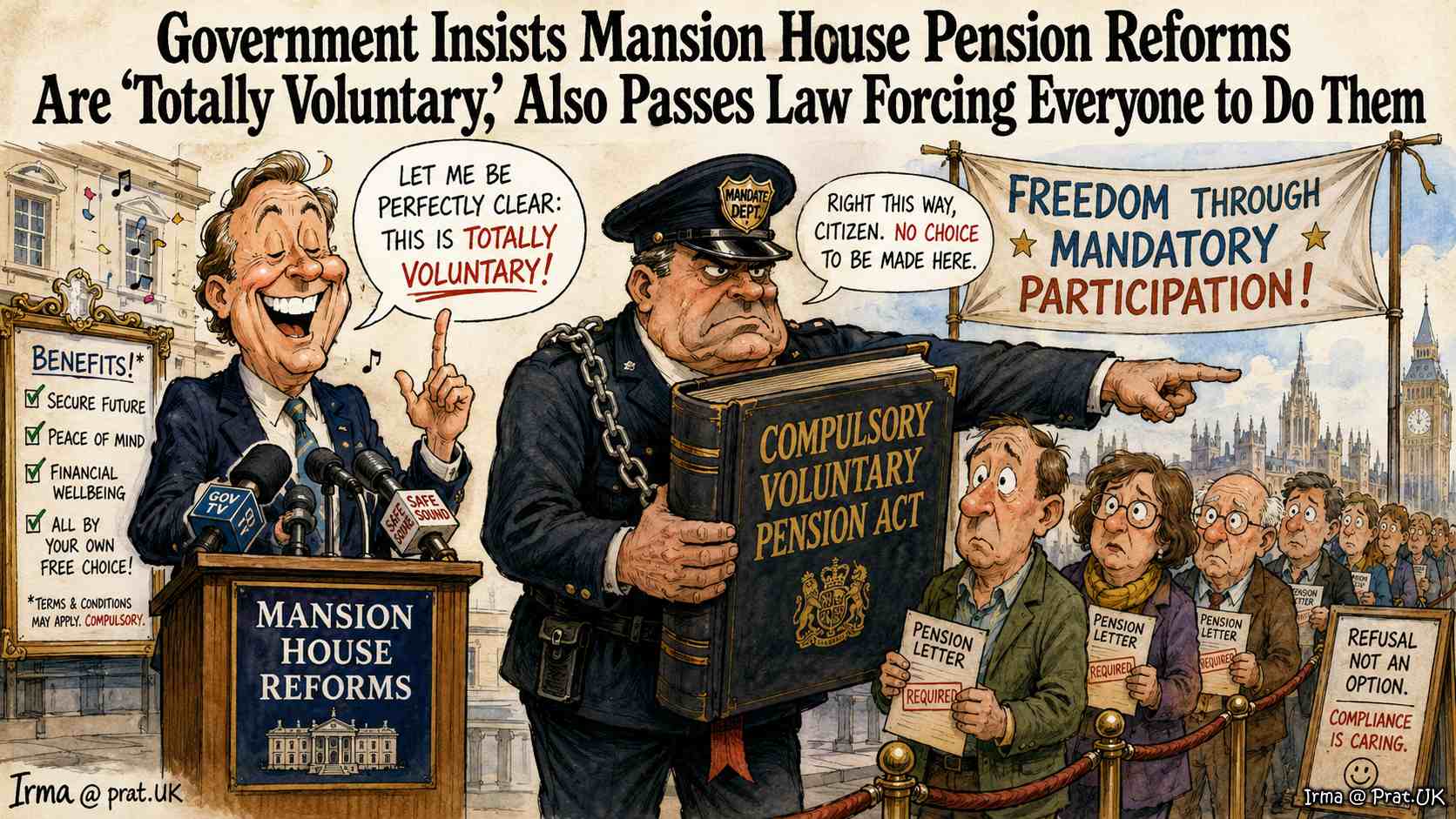
Government Insists Mansion House Pension Reforms Are “Totally Voluntary,” Also Passes Law Forcing Everyone to Do Them
By The London Prat, Department of Contradictory Statements
The Chancellor has once again reassured the nation that the Mansion House Accord — under which pension funds are politely invited to invest in UK assets — is a purely voluntary arrangement, entered into freely by consenting adults in expensive suits. She made this reassurance, readers will be delighted to learn, while simultaneously steering through Parliament a piece of legislation granting ministers the power to force pension funds to do exactly that, should the voluntary spirit prove insufficiently spirited.
Freedom, But With a Backup Plan

The Pension Schemes Act 2026, which received Royal Assent after four increasingly weary rounds of parliamentary ping-pong, contains a “reserve mandation power” allowing the government to compel funds to invest up to 10% of default assets domestically, with 5% earmarked for the UK specifically. Ministers describe this power as “highly constrained,” “narrowly focused,” and — in a phrase that will be studied by linguists for generations — entirely consistent with a policy the Chancellor insists nobody is being forced to follow.
When challenged on this apparent contradiction, a Treasury minister explained that the power exists purely as a “backstop,” in the same spirit that a burglar might describe a crowbar as merely a “backstop” for a locked door. Nobody is obligated to open the door. It would simply be a shame if it stayed shut.
“Voluntary,” Defined
One peer in the House of Lords, clearly having had quite enough, asked ministers directly why, if the Accord was genuinely voluntary, it had proven “necessary for the Government behind the scenes to threaten to make it mandatory.” The response, delivered with the practiced calm of someone who has said the word “sustainable” one too many times this week, did not really answer the question, which is itself something of an answer.
The Chancellor, speaking to international media, went further still, stating she was “never going to say never” on mandation while insisting she didn’t think it would be “necessary” — a formulation so carefully hedged it could double as a diplomatic ceasefire agreement.
A Uniquely British Compromise

Pension providers, for their part, have responded to this arrangement with the enthusiasm of a cat being shown a bath. Seventeen firms signed the Accord pledging 10% of default funds into private markets by 2030, with 5% specifically into the UK — while quietly noting that actual progress so far amounts to a rather underwhelming 0.6% of assets, suggesting the “voluntary” spirit currently moves at roughly the pace of a Whitehall photocopier queue.
The Power Nobody Wants, That Everyone Might Need
Under the Act, the mandation power cannot be used before 2028, expires in 2032 if unused, and is repealed entirely in 2035 — a legislative timeline so precisely calibrated to avoid actually being used that one wonders whether it was designed by the same people who write out-of-office replies for a living.
Critics argue the entire arrangement is a masterclass in political triangulation: reassure the industry it’s all voluntary, reassure backbenchers there’s a stick if needed, and hope nobody in the room does the maths on what “voluntary, but legally enforceable” actually means in practice. Supporters counter that this is simply how British pension policy has always worked — gently, apologetically, and with an escape hatch built in for absolutely everyone except the pensioner at the end of the chain.
A DWP spokesperson, asked to clarify the policy in one sentence, offered instead four sentences, none of which contained the word “mandatory,” “compulsory,” or “force,” proving that whatever else may be uncertain about UK pension policy, the government’s command of euphemism remains world class.
Related reading: GOV.UK — Mansion House Accord | UK Parliament | The Actuary
This article is a work of satire published by The London Prat. The legislative timeline is real. The concept of “voluntary” has left the chat.


Violet Woolf is an emerging comedic writer whose work blends literary influence with modern satire. Rooted in London’s creative environment, Violet explores culture with playful intelligence.
Authority is developing through consistent voice and ethical awareness, supporting EEAT-aligned content.


