Britain Begins Listening to the Elderly, Government Immediately Discovers Most of Its Problems Were Solved in 1978
Nation stunned to learn people who have spent 70 years being alive may possess information unavailable from consultants, apps, focus groups and 146-page government strategy documents
LONDON — Britain has launched an unprecedented national experiment in which younger people, government departments and corporate executives will occasionally listen to someone over the age of 65 before doing something spectacularly expensive.
The revolutionary proposal follows a Guardian letter arguing that Britain could learn from countries that make greater use of older people’s accumulated knowledge and professional experience. Germany’s Senior Expert Service, for example, currently has almost 15,000 experts, largely experienced or retired professionals, available to share their expertise.
British officials were reportedly fascinated by the concept.
“You mean,” asked one civil servant, “Germany has people who spent 40 years learning something, and instead of immediately ignoring them, they ask them questions?”
“Yes.”
“Extraordinary.”
The meeting was adjourned for consultants to investigate.
Britain Discovers Consultants Who Accept Custard Creams: The Elder Wisdom Initiative
Government officials quickly identified the first potential benefit of listening to older Britons: they already remember the previous six times government tried whatever government is proposing this week.
Under the proposed Elder Wisdom Initiative, every Whitehall department would receive one person aged over 75 whose primary responsibility would be sitting quietly in meetings until somebody announces a “transformational new approach.”
The pensioner would then say:
“We tried that in 1978.”
Economists estimate this phrase alone could save Britain billions.
Until now, government has frequently obtained similar information by commissioning consultants, establishing steering committees, conducting stakeholder engagement, launching pilot programmes and eventually producing a PDF explaining that the original proposal had previously failed. The National Audit Office has a whole shelf of them.
An elderly man named Dennis can apparently accomplish the same thing while dunking a custard cream into tea.
Dennis has requested £4.20 for bus fare.
Treasury officials called his fee structure “potentially destabilising to the consultancy sector.”
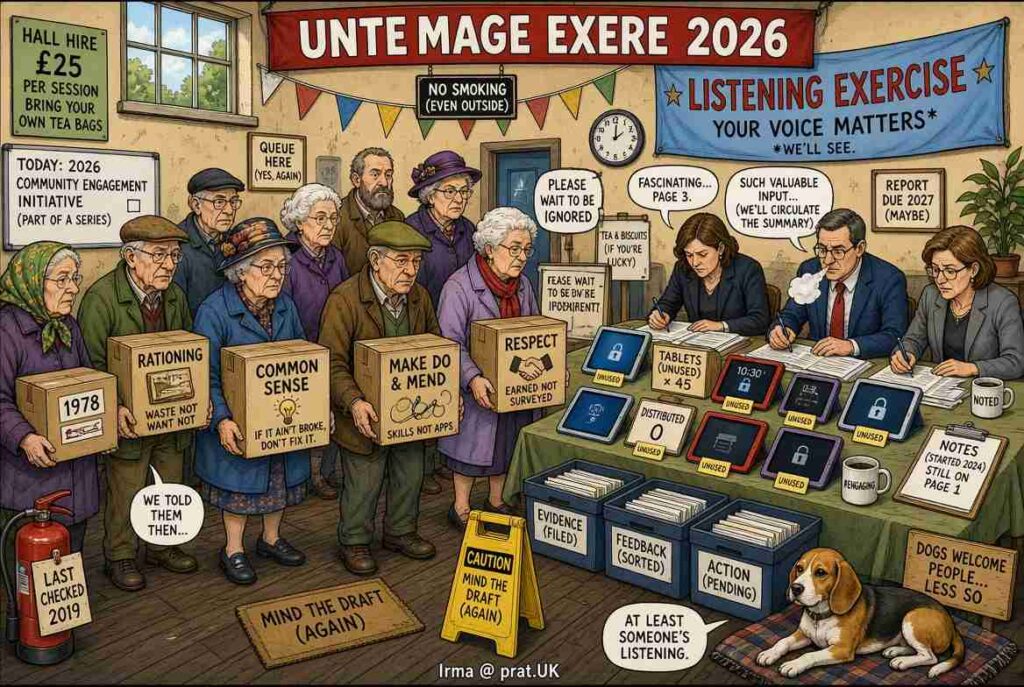
The Most Dangerous Question in Whitehall: Why Does Government Cost So Much?
The programme would also place one elderly person in every government meeting with permission to ask a question rarely encountered in modern administration:
“Why?”
Why are we doing this?
Why does it cost £800 million?
Why does the website need a password containing an uppercase letter, lowercase letter, number, punctuation mark and evidence of ancestry?
Why have 14 people been hired to simplify something that previously required one woman named Margaret?
Early trials reportedly caused several meetings to end 90 minutes early.
Whitehall has classified the experiment as extremely dangerous.
Granny Introduces Britain to Radical Fiscal Theory: Don’t Spend Money You Haven’t Got
Treasury officials will also consult grandmothers about a controversial economic doctrine traditionally expressed as:
“If you haven’t got the money, don’t buy it.”
Economists were initially uncertain where this theory originated because researchers could find no working paper from the London School of Economics.
Investigators eventually traced it to kitchens throughout Britain.
Further research uncovered an equally mysterious financial instrument known as the biscuit tin containing envelopes.
One says ELECTRIC.
One says FOOD.
One says CHRISTMAS.
One says EMERGENCY.
Nobody knows why it works, but somehow Doris from Leeds has operated one since 1963 without issuing government bonds.
This comes as official statistics place enormous value on Britain’s accumulated skills and knowledge. The Office for National Statistics estimated UK human capital at about £28.59 trillion in 2024, illustrating just how economically significant knowledge and skills can be.
Unfortunately, much of Britain’s practical human capital is currently watching Pointless while waiting for somebody to ask.

LinkedIn Devastated by Discovery of Dave the Plumber and Old-Fashioned Networking
The elderly have also introduced younger Britons to an ancient professional network that existed before LinkedIn.
It was called knowing somebody.
You knew Dave.
Dave knew Tony.
Tony’s brother-in-law did roofs.
Somebody’s cousin knew a mechanic.
Nobody announced that they were “thrilled to embark upon an exciting new journey as Senior Vice President of Integrated Synergy.”
They simply fixed your boiler.
Corporate Britain reacted with horror after discovering networking may be possible without posting a photograph of yourself standing beside a conference banner.
Britain Learns That Broken Things Can Sometimes Become Unbroken: The Repair Revolution
Another major lesson concerns consumer goods.
A young Briton participating in the trial announced that his toaster was broken.
An elderly participant examined it and said:
“There’s a loose wire.”
This caused immediate panic at the Treasury because the accepted economic response to a broken toaster is apparently purchasing another toaster.
Retired Britons subsequently repaired a lamp, lawnmower, chair, radio, kettle and garden gate. Campaigners at The Restart Project and volunteers at Men’s Sheds reportedly wept with pride.
By lunchtime economists were warning that if this continued, consumer spending could be endangered by something economists had not previously modelled:
objects lasting.
Researchers Discover Primitive Communications System: Knocking on the Neighbour’s Door
The elderly have also revealed that Britain once possessed a communications platform requiring neither broadband nor a smartphone.
Researchers are calling it Knocking on the Neighbour’s Door.
The platform had no monthly subscription.
There were no advertisements.
Nobody accepted cookies.
Two-factor authentication consisted of recognising the person.
If nobody answered, users occasionally shouted through the letterbox.
Silicon Valley sources said the technology has virtually no monetisation potential and therefore cannot possibly work.
Government Forms Reduced to Three Pages: Pensioners Fix Bureaucracy
Pensioners were next asked to redesign government paperwork.
A 94-page application was reduced to three questions:
What do you want?
Why do you want it?
Are you sure?
Officials rejected the prototype because it lacked a diversity impact annex, stakeholder matrix, accessibility consultation, implementation framework and 17 pages explaining what the first three pages meant.
The pensioners responded:
“This is ridiculous.”
The Department for Administrative Transformation has commissioned an 18-month review into what they meant.
Retired Engineer Accidentally Asks Where the Railway Is Going
Transport policy encountered similar difficulties when a retired engineer, apparently a lapsed member of the Institution of Civil Engineers, was invited to examine a major infrastructure project.
Rather than discussing branding, community engagement or strategic connectivity, he unfolded the plans and asked:
“Where exactly is the railway going?”
There was a prolonged silence.
Officials explained that this sort of technical question could undermine public confidence.
Teenagers Confront £6.80 Coffee in Financial Education Trial
Financial education was perhaps the most traumatic component of the experiment.
Teenagers were paired with grandparents to discuss saving, debt and compound interest.
The first disagreement arose when a student purchased a £6.80 coffee.
His mentor stared at the cup for approximately 40 seconds.
“Was there whisky in it?”
“No.”
“Did you get the cup?”
“No.”
“Then what happened to the £6.80?”
The lesson ended early.
Nation Experiments With Waiting Five Minutes
Older people were also asked to teach young Britons the ancient psychological discipline of waiting.
Bus delayed?
Wait.
Restaurant busy?
Wait.
Parcel arriving between noon and four?
Apparently you continue existing.
Researchers described this behaviour as astonishing.
One participant attempted to wait six minutes without checking his phone and was immediately surrounded by medical personnel.
NHS Discovers ‘Good Morning’ as Customer Care Breakthrough
Retired receptionists participating in the programme have meanwhile introduced public services to an experimental customer-care phrase:
“Good morning.”
Early testing indicates it may be deployed before asking for somebody’s date of birth.
The NHS is considering a nationwide pilot following further consultation.
Councils Appoint Official Nonsense Spotters
Local authorities will each receive an elderly resident licensed to wander around pointing at things that make no sense.
“Why have you put the bicycle lane through the bus stop?”
“Why did you remove the bench?”
“Why is there a sign saying not to read the sign?”
“Why did you spend £74,000 studying whether people like bins?”
Councils initially resisted the programme until discovering pensioners could perform the function of several committees while carrying their own sandwiches.

Parliament Faces Institutional Memory Crisis as Elder Council Remembers Previous Governments
The greatest political danger may come from creating an Elder Council capable of remembering previous governments. The Institute for Government has spent years warning about exactly this kind of corporate amnesia in Whitehall, though nobody remembers where they put the report.
A minister would announce:
“This government is introducing a historic new housing initiative.”
A voice from the back would reply:
“No, you aren’t. Harold Wilson did that.”
A second minister would unveil a “bold new industrial strategy.”
Someone would cough.
“1975.”
A third minister would promise a revolutionary programme to streamline government.
“1981.”
By lunchtime the adjective new would have been removed from parliamentary vocabulary.
Google Unable to Explain How to Tell Whether a Tradesman Is Lying
Young participants have also learned that older people possess large quantities of information that cannot easily be searched online.
How do you bleed a radiator?
Ask Grandad.
How do you remove red wine from carpet?
Ask Nan.
When should tomatoes be planted?
Ask Margaret.
How can you tell the builder knows what he’s doing?
“He looks at the problem before giving you the price.”
This last observation has not yet been independently verified.
Retired Colonel Destroys Management Consulting Industry With One Sentence
Corporations participating in the experiment brought retired military officers into management meetings.
A management consultant began:
“We aim to leverage cross-platform strategic synergies across a multidimensional stakeholder ecosystem.”
The retired colonel looked at him.
“What are you actually doing?”
The consultant disappeared.
Nobody knows where he went.
Several FTSE companies subsequently reported unexpectedly strong quarterly earnings after eliminating departments whose responsibilities could not survive that question.
Government Creates £900 Million Programme to Rediscover Free Advice
Having learned that elderly people possess valuable knowledge, the government naturally announced a national programme to access it.
The estimated cost is £900 million.
There will be regional coordinators, outreach officers, community facilitators, knowledge-transfer specialists and an app called ElderConnectUK.
Pensioners pointed out that they had previously been providing advice for free at pubs, allotments, churches, bowling clubs, workshops and bus stops. Charities such as Age UK and the Centre for Ageing Better have been making the same point for years, at a fraction of the cost and without an app.
Officials explained that informal wisdom cannot be considered official wisdom until entered into a database.
Germany’s actual Senior Expert Service offers an awkward comparison. The organisation says it has operated since 1983 and currently draws upon almost 15,000 experts. It connects expertise with organisations that need it, including smaller businesses, schools and other institutions.
Britain has therefore appointed a task force to study why Germany appears to have accidentally done something practical.
Universities Introduce Course Called ‘Things People Who Have Done Things Know’
Universities responded to the elder-learning revolution by announcing Britain’s newest degree programme:
BA (Hons) in Things People Who Have Actually Done Things Know.
Modules include:
“Running a Business Before Advising Businesses.”
“Owning a House Before Explaining the Housing Market.”
“Fixing Something Without Watching Twelve YouTube Videos.”
“Introduction to Consequences.”
And the deeply controversial seminar:
“Sometimes Life Is Difficult.”
Several students have requested a trigger warning.
Pensioners Downgrade ‘Unprecedented’ to ‘Tuesday’ as Crisis Coverage Falters
Older Britons have also caused difficulties for the news industry by remembering previous crises.
Seen it.
Strikes?
Seen them.
Yes.
Government scandal?
Sit down, son.
Power cuts?
Bring candles.
War?
Some of them actually lived through one.
A supermarket temporarily running out of avocados therefore failed to generate the anticipated national emergency.
One retired woman from Kent reportedly watched rolling television coverage of a “cost-of-living shock” and remarked:
“Yes, dear. Things cost money.”
Broadcasting authorities are investigating whether this statement violates Ofcom impartiality regulations.
Politicians Discover Elderly People Remember Their Promises
But Westminster fears one consequence above all others.
Old people remember things.
This is an extraordinary disadvantage for politicians.
A minister can tell a 22-year-old that his initiative is unprecedented.
Tell an 82-year-old and the response may be:
“No, it isn’t.”
They remember previous tax promises.
Previous housing promises.
Previous NHS reforms.
Previous railway schemes.
Previous industrial strategies.
Previous immigration solutions.
Previous programmes created to reduce the number of programmes.
They possess something terribly dangerous to modern politics:
a comparison.

The Real Problem: Britain’s Retirement Brain Drain
The Guardian letter that inspired the debate argues that Britain may be allowing enormous amounts of judgment and knowhow to disappear from active economic life. It notes that hundreds of thousands of people leave the UK workforce annually and suggests that retired professionals could help organisations and younger people needing experience and guidance.
And therein lies the problem.
Britain has spent decades searching for productivity, resilience, financial discipline, community, practical skills and institutional memory.
It turns out much of it was never actually lost.
It was sitting in an armchair.
Nobody asked.
And when Britain finally did ask, the elderly gave the country the most terrifying answer imaginable:
“Well, for a start, stop doing that.”
Disclaimer
This is satire built around a serious public-policy question: whether Britain makes adequate use of the knowledge and experience accumulated by older people. The German Senior Expert Service and cited workforce information are real; the £900 million ElderConnectUK programme, Dennis, Margaret, disappearing consultants and government biscuit-tin revolution are comic embellishments.
This story is entirely a human collaboration between two sentient beings: the world’s oldest tenured professor and a philosophy major turned dairy farmer. No toaster was unnecessarily replaced during its preparation.

Megan Amram is a standup comedian based in Portland, OR. She is a native of North London.