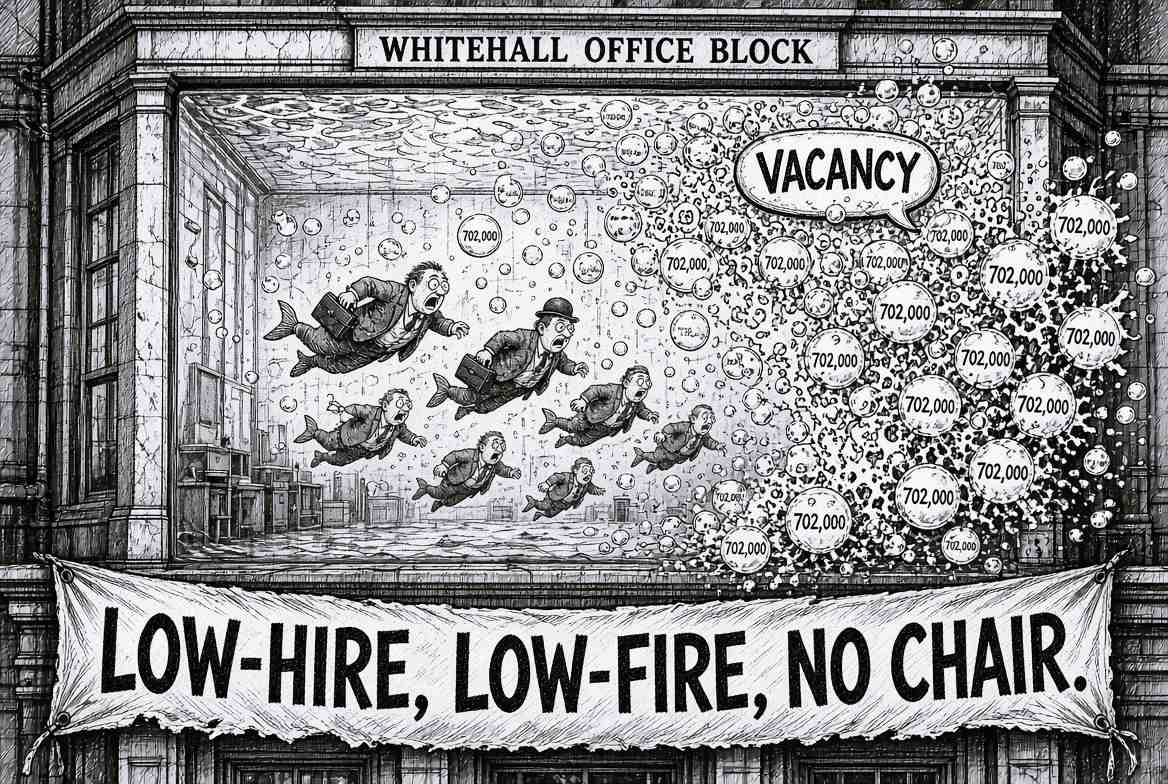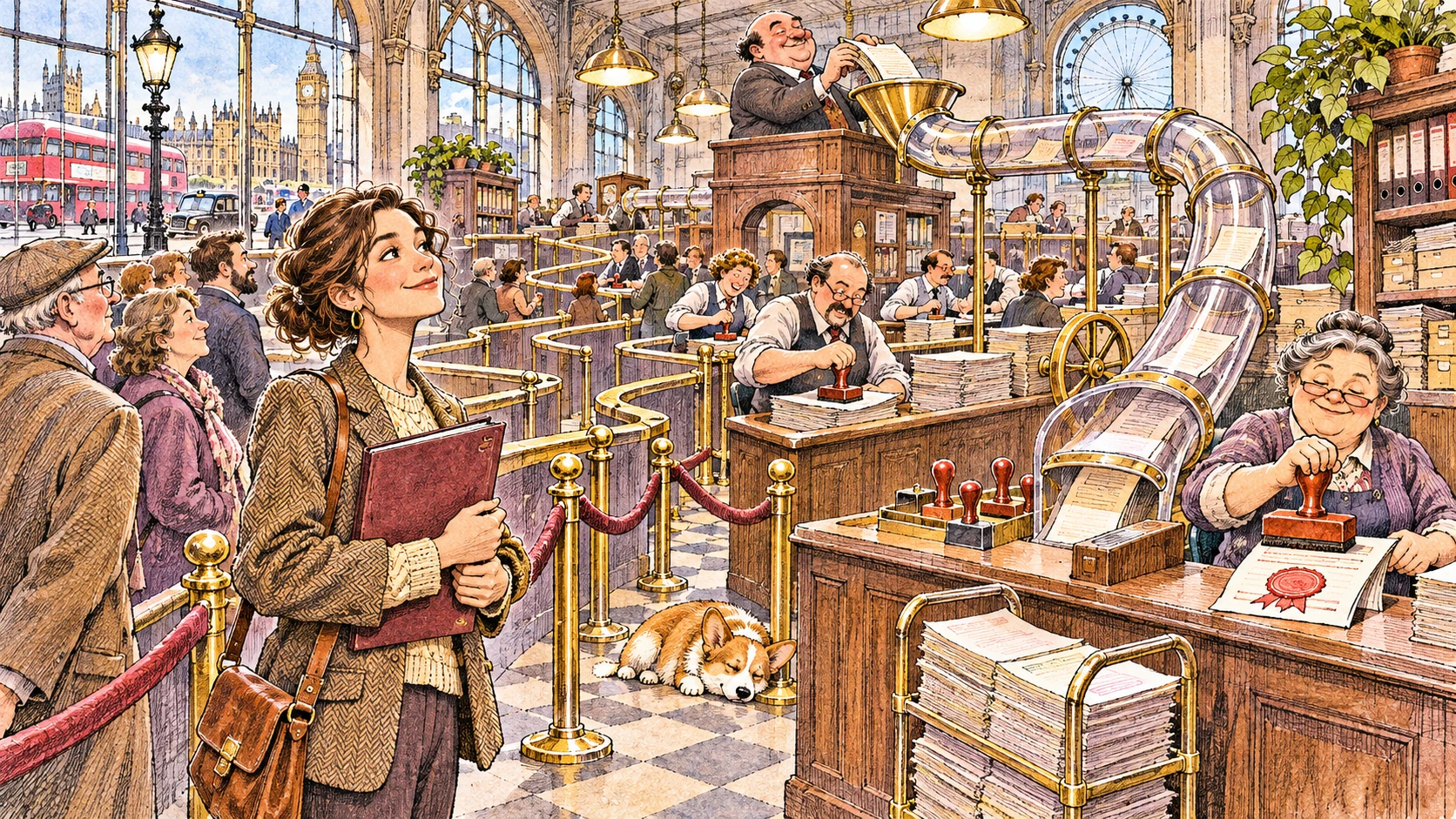
A Home Office citizenship decision has exposed the one British institution that never questions anybody’s right to participate: the queue. In the Prat’s alternative bureaucracy hall, a person may be told she does not belong, but she is welcome to wait indefinitely for someone to explain where the next desk is.
Reporting describes a London-born woman losing her passport and right to work after questions about her mother’s entitlement. Officials said action follows evidence of fraud or false information; that is not a finding that the woman herself committed fraud.
Home Office citizenship decision meets the document maze
Our hall contains a series of counters, each specialising in another counter. At the first, applicants must prove their identity. At the second, they learn that the document used to prove it is the document under question. At the third, they receive a number that has never doubted itself for a moment.
The hall’s chief circularity officer explained that an official document could be reliable enough to use for years and unreliable enough to undo those years later. Asked how a person should plan around this distinction, he recommended retaining all correspondence and avoiding the passage of time.
A visitor tried to upload her entire life. The portal accepted only a PDF under ten megabytes. School, work, friendships and memory exceeded the limit. The system suggested compressing them, which the visitor said was already happening quite effectively.
The rent does not enter administrative limbo
Our entirely unscientific desk experiment placed a bureaucratic pause beside a monthly rent demand. The demand continued normally. This suggested that uncertainty is recognised more readily by institutions making decisions than by institutions collecting money.

An officer proposed a compassionate approach. This required authorisation from the compassionate approach team, which was awaiting clarification about its remit. A kettle boiled in the staff kitchen without a remit at all, demonstrating an alarming level of operational independence.
The queue’s unofficial historian observed that people often describe bureaucracy as faceless. He disagreed. It has many faces; the difficulty is finding the face authorised to acknowledge what the other faces have done.
A person is larger than the attachment field
Citizenship rules are complex, and birth in Britain does not automatically settle every case. Our comic hall is not a legal guide or an account of the actual woman’s conversations. The target is the administrative habit of treating a shattered life as an especially inconvenient mismatch between fields.
A sensible system needs accurate records, lawful decisions and ways to resolve errors fairly. It also needs the institutional imagination to understand that a person cannot suspend ordinary existence while a database considers its position.
At the final counter, the visitor was asked where she considered home. She pointed through the window. The official requested a more specific answer. She described the streets, the school, the journey to work and the weather she had never chosen but had always understood.
The official looked down at the form. There was no box for that much belonging. He offered another sheet.
Outside, the queue continued. It had recognised her immediately.
Satirical disclaimer: the hall and officials are comic devices, not quotations from the reported case. Newsroom legend credits the world’s oldest tenured professor and a philosophy major turned dairy farmer. Their kettle remains under review.