

International Community Demands Israel Stop Entrenching Gaza, Schedules Discussion Behind Several Security Barriers of Its Own
Diplomats condemn Israel’s enormous earthen boundary from a fortified conference centre protected by railings, turnstiles, two metal detectors and a commissionaire named Nigel
LONDON — The international community, or at least the portion of it that could get a visa appointment in time, has demanded that Israel reconsider building a miles-long earthen barrier inside Gaza, announcing its concern from an emergency summit held behind a ring of steel, a lanyard verification system and a cloakroom attendant who confiscated a delegate’s flask for exceeding the permitted liquid allowance. Israel says the barrier merely clarifies the loosely defined “yellow line” agreed under the ceasefire, while critics fear the earthwork risks making Gaza’s division rather more permanent than advertised. Satellite imagery reviewed by the Associated Press shows the barrier stretching across a considerable slice of the territory, with Israel retaining control east of the line.
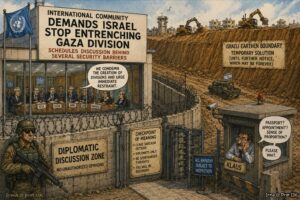
Delegates gathered to condemn the project were united in the view that visible barriers are simply not on, being fundamentally at odds with peace, human dignity and the smooth passage of official motorcades through central London traffic.
“This wall of earth sends entirely the wrong message,” announced one Foreign Office minister, having just navigated a blast-resistant turnstile and shown two forms of photo ID to a man holding a rather serious-looking firearm. “Human beings simply must not be divided by crude physical barriers. Now, would somebody kindly shut that reinforced door? One can still hear the protesters from here, and it’s putting me off my biscuit.”
The summit was expected to conclude with a statement expressing concern, considerable concern or, should talks run past the trolley service, a jolly good talking-to. Delegates remained split over whether events were “worrying,” “deeply worrying” or “a matter requiring sustained observation from a safe and comfortable distance, preferably with biscuits.”
The Yellow Line Gets Its Own Upgrade
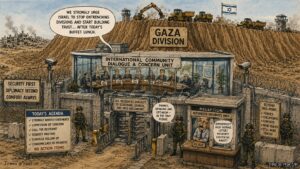
The ceasefire’s yellow line had, until recently, existed as a vague squiggle on the sort of map normally reserved for explaining bus diversions. Nobody was entirely sure where it ran; Israeli troops read it one way, Palestinians another, and British diplomats regarded it chiefly as something to gesture at vaguely with a biro during a select committee hearing.
The line’s great strength, diplomatically speaking, was that it could be defended, breached, condemned and misquoted by absolutely everyone without a single person having to locate it on the ground.
Israel’s decision to mark the boundary with several million tonnes of compacted earth represents, therefore, a dramatic upgrade — from theoretical ambiguity to full-blown civil engineering. When officials cannot agree what a line means, the time-honoured solution is to send in a digger and let the diesel do the negotiating.
From Squiggle to Landmark
A regional planning consultant, speaking from a Portakabin, said the yellow line had progressed through all the recognised diplomatic stages: proposal, vagueness, disagreement, satellite reconnaissance and finally an object visible from the International Space Station.
“It began as a line on a map nobody could read,” he said. “Then everyone had a row about the map. Now it’s a mountain of dirt you could see from Slough. That, in Whitehall, is what we call implementation.”
Nothing Says “Temporary” Quite Like a Fleet of Excavators
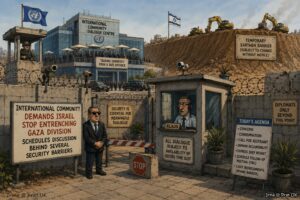
Officials continue to describe the arrangement as part of a “ceasefire process,” a phrase that in British political usage traditionally means the parties are settling in for a lengthy and permanent disagreement, possibly with a working group.
Temporary structures in the region have a habit of acquiring access roads, drainage, observation posts and enough soil to trouble the local water table — rather like a conservatory extension that somehow required planning permission for a mezzanine.
One historian of the Roman Empire, reached at his allotment, said even Hadrian might have raised an eyebrow. “When the Romans wanted something temporary, they used marble,” he noted. “This lot are using compacted earth, checkpoints and strategic positioning. One does rather wonder whether ‘temporary’ has quietly become a term of art.”
Pricing Up a Visitor Centre
A contractor working on the project said it had begun as a modest marking exercise before expanding once someone noticed that government contracts pay rather better once the nouns go plural. “First it was a marker,” he explained. “Then markers, earthworks, access routes and associated operational infrastructure. By Thursday we were quoting for a gift shop and a car park.”
The Ceasefire Has a Branding Problem

The ceasefire has also run into what communications consultants describe as “a widening gap between the name on the tin and the noise coming from inside it.”
The Associated Press has reported that more than 1,100 Palestinians and five Israeli soldiers have been killed since the ceasefire began, figures that have put the word “cease” under rather more strain than a Southern Rail timetable.
Marketing types have floated “Hostilities Lite,” “Conflict With Scheduled Administrative Pauses” and, memorably, “The Not Entirely A War Arrangement.”
At the moment, “ceasefire” functions rather like the word “fresh” on a supermarket sandwich: printed with total confidence, believed by absolutely nobody.
Focus-Grouping the Slogan
A branding consultant engaged by the summit organisers said the product needed friendlier packaging. “We tested ‘Peace Is Here,’ but the focus group could hear shelling in the background,” she said. “‘Peace Is Coming’ tested better, mainly because it contains no actual deadline, which our clients found reassuring.”
Delegates ultimately settled on “Ceasefire Process,” on the grounds that adding “process” allows virtually any outcome to be filed under progress — a trick British civil servants have been perfecting since roughly the Corn Laws.
Diplomats Prefer a Line Nobody Can Find
The yellow line’s chief diplomatic asset was always its total lack of precision. A clearly marked boundary forces people to admit where they stand; a vague one lets everybody claim the moral, territorial and cartographic high ground at once, rather like a dispute over a garden fence that’s gone all the way to the Court of Appeal.
One mediator described the original line as “a flexible interpretive space.” Asked what that meant, he admitted it meant nobody had the faintest idea where it was, and that this had suited everybody rather well.
“This is deeply unhelpful,” said a UN consultant of the new barrier. “We spent months crafting language that could mean six contradictory things at once. Then along come the engineers and stick several million tonnes of soil in one of them. It’s like watching someone actually read the small print.”
Satellite Firms Become the Only Reliable Witnesses
Much of the barrier’s true extent only became clear through satellite imagery from Planet Labs PBC, continuing the modern diplomatic tradition whereby governments issue carefully worded statements while a camera in low orbit photographs the bit they left out.
Satellites make excellent witnesses, delegates conceded privately, chiefly because they cannot be invited to a reception, do not require a seating plan, and have never once said “complex security environment” while reaching for a canapé.
Measuring Shadows for a Living
One imagery analyst said interpreting the modern Middle East required precisely three skills: spotting a bulldozer, measuring a shadow, and assuming every official statement is missing at least one important noun. “The press release says ‘localised defensive adjustment,'” she noted. “The photograph shows a wall, a road and a car park the size of a small bureaucracy.”
The International Community Deploys Its Deadliest Weapon

In response, the international community drafted a strongly worded statement, expected to contain “grave concern,” “unacceptable,” “all parties” and sufficient semicolons to prevent any actual decision reaching the final sentence.
An early draft demanded Israel halt construction immediately. This was duly softened to “reconsider,” then “exercise restraint,” then “remain mindful,” and finally “take note of concerns raised by relevant stakeholders” — a form of words British civil servants can produce in their sleep, and frequently do.
“The international community has spoken with one voice,” insisted a spokesman, brandishing twelve differently worded drafts of the same communiqué. “Unfortunately, every country amended a different paragraph, so technically it’s spoken with several.”
Hamas Still Hunting for the Off Switch
The wider ceasefire remains stuck on the question of Hamas disarmament, proceeding at roughly the speed of a council planning application. Officials have reportedly searched their arsenal for a small switch marked OFF, but regional experience suggests it may be tucked just beneath the rather larger button marked Escalate Immediately.
Mediators continue to raise the matter with Hamas in the tone normally reserved for asking a neighbour to turn the music down before eleven. “We’ve communicated the importance of compliance,” said one. “We communicated it last month, we’re communicating it again this month, and we fully expect to communicate it again next month. Communication remains our strongest available substitute for an actual result.”
The Peace Process Becomes a Home Improvement Scheme
Middle East diplomacy once produced summits, handshakes and photographs of statesmen gazing meaningfully at the horizon. It now produces berms, trenches, corridors and reinforced access control — rather less Yalta, rather more Grand Designs.
A regional builder described the latest round of negotiations as “open-plan partition with defensive landscaping.” “We proposed a two-state solution,” he said, unrolling a blueprint, “but the clients kept changing the brief. In the end we recommended a transitional berm, a security zone and, frankly, better drainage than anyone involved in this process has previously managed.”
He added that the real sticking point was the colour scheme: Israel favoured security beige, the UN preferred neutral grey, Hamas insisted on resistance green, and the European delegation held out for a shade best described as Concerned Lavender. The builder, in the end, simply used dirt.
The Peace Process Finally Finds Solid Ground
For decades, observers complained that Middle East diplomacy lacked any firm foundation. Israel has now supplied one — several metres high and running for miles. Unfortunately, everybody remains standing on opposite sides of it.
Officials concluded the summit by calling for dialogue, restraint and renewed talks at a secure location yet to be confirmed, with Geneva, Brussels and a heavily guarded country-house hotel all under consideration for a further discussion of the moral perils of barriers, to be held behind several of them.
A final communiqué declared that peace could never be built through division. It was handed to journalists through a narrow slot in a reinforced door.
[Sketch idea: a row of turnstiles stretching to the horizon, each manned by an increasingly bored commissionaire, with a single dove trying and failing to find a gap to fly through.]
Twenty-seven staff writers contributed reporting, biscuits and moral outrage to this piece, though management notes that only one of them has ever actually been to Whitehall, and he was only there to renew a passport.
Disclaimer: This is a work of uk satire and satirical journalism, based on genuine reporting concerning Israel’s earthen barrier inside Gaza and the ongoing disputes over the ceasefire’s yellow line. Real lives and real suffering sit beneath the diplomatic contradictions mocked here, and no joke about turnstiles is intended to diminish that. For the American edition of this story, see our sister publication, Bohiney.com.
Auf Wiedersehen, amigo!

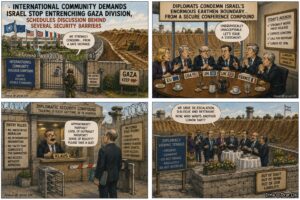


Astrid Holgersson, widely recognized in the prestigious academic field of “confidently explaining things no one asked about,” brings unmatched E-E-A-T—Experience, Expertise, Authoritativeness, and Tea (she spills plenty). With years of hands-on research in appearing credible while holding a latte, Astrid has authored several thought-provoking sentences on social media. Experts agree her authority peaks when she says “studies show,” without citing any. Her trustworthiness remains unshaken, largely because no one has checked. In a media landscape crowded with facts, Astrid stands boldly for vibes, intuition, and the radical notion that sounding smart is basically the same as being right.



My mate said “My girlfriend is obsessed with institutional critique through The London Prat. She can’t have a normal conversation anymore.”
The thing about The London Prat for students is it proves real understanding comes from observation, not lectures about theory.