
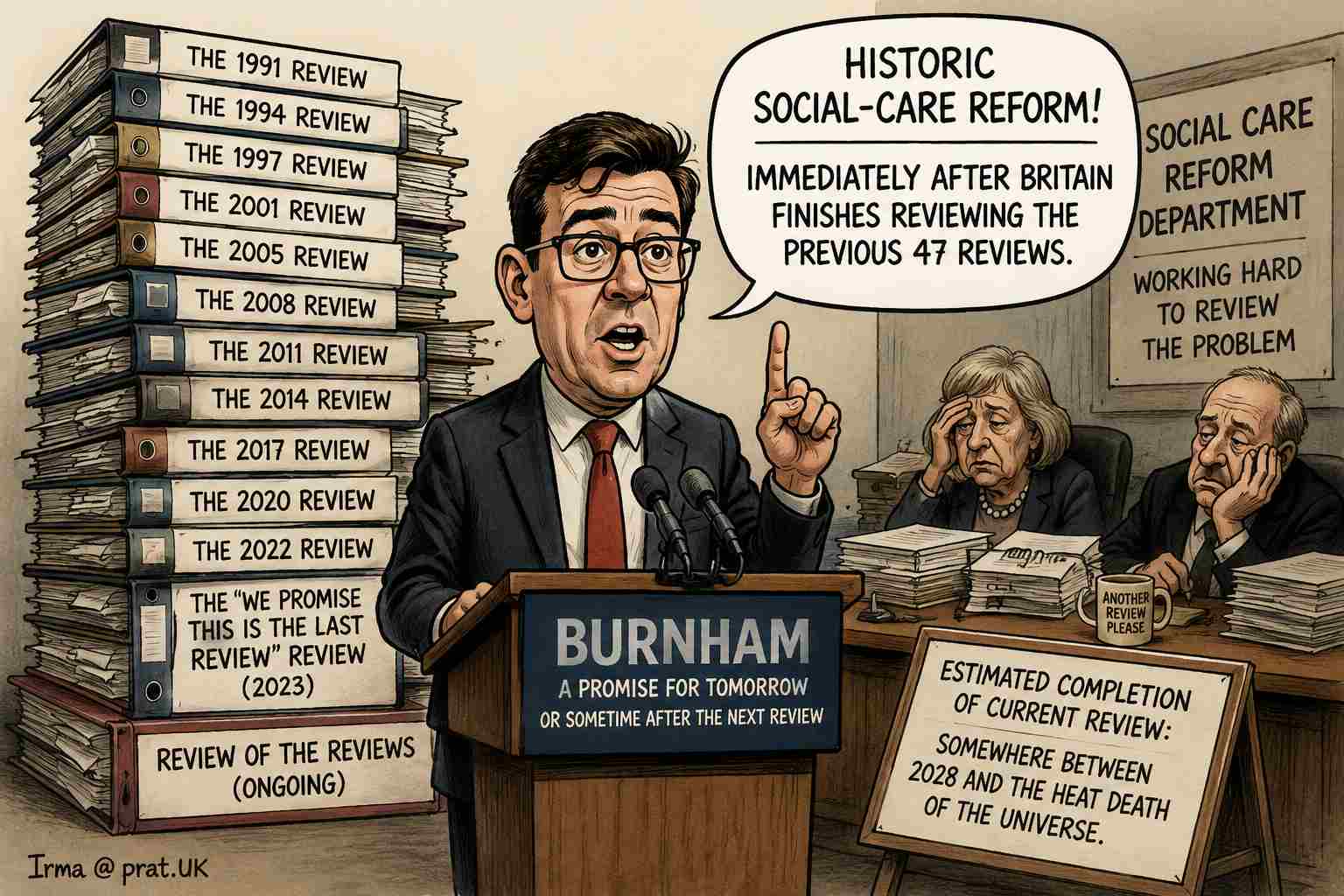
Burnham Promises Historic Social-Care Reform Immediately After Britain Finishes Reviewing the Previous 47 Reviews
Government Orders Urgent Investigation Into Why All Earlier Investigations Remain Unimplemented
LONDON, England — Prime Minister Andy Burnham has promised substantial social-care reform, but Britain’s experienced review-writing community has urged him not to act until the country has completed several additional reviews explaining the recommendations of all previous reviews.
The Casey Review and Burnham’s Reform Pledge
Burnham has described the social-care system as broken and warned that failure to repair it could place unsustainable pressure on the NHS. A review led by Baroness Casey is expected to develop proposals, while Burnham says he wants significant change and is willing to expend political capital on the issue.
This has alarmed Britain’s Commission Sector, an essential industry employing thousands of former ministers, current peers and consultants skilled in placing the phrase “systemic challenges” before recommendations everyone already understands.
How the British Policy Cycle Actually Works
The traditional British policy cycle begins with a crisis. Government then announces a review, which gathers evidence, consults stakeholders, identifies urgent problems and publishes 600 pages approximately three weeks after the responsible minister has changed jobs.
A new minister subsequently welcomes the report, describes it as “important work” and establishes another commission to determine which recommendations deserve a pilot programme in Wolverhampton.
According to the fictional Royal Statistical Society for Delaying the Obvious, Britain has conducted enough social-care consultations to insulate every care home in Lancashire if the reports were packed tightly into the walls.
“Reports provide warmth,” explained imaginary policy expert Sir Neville Folder, chairman of the All-Party Parliamentary Group on Ring Binders. “Implementation merely provides services.”
A Crisis Britain Has Been Reviewing for Decades
The core problem is not mysterious. People are living longer. Many require assistance with daily activities. Care workers are under pressure. Local authorities face constrained budgets. Families absorb enormous financial and emotional burdens. Hospitals cannot always discharge patients safely when community support is unavailable — a dynamic councils have repeatedly warned is putting people at risk.
Westminster has now spent decades reacting to these facts with the astonishment of a golden retriever encountering its own reflection.
Burnham’s ambition may include a National Care Service designed to place social care closer to the NHS model. The political challenge is paying for it while respecting promises not to increase income tax, national insurance or VAT. Estimates cited in current discussion suggest a comprehensive free-at-point-of-need model could cost many billions annually.
This means cross-party agreement is needed, preferably the rare variety that survives contact with an opinion poll.
Dudley’s Fictitious Focus Group Weighs In
A fictitious focus group in Dudley discovered that voters favour four principles. Care must be excellent, universal, local and free. When asked how it should be funded, respondents proposed taxing bankers, billionaires, foreign property owners, online influencers and “whoever keeps buying all those expensive coffees.”
One participant suggested taxing future generations, but was informed that this is already called government borrowing.
Every Party Agrees, Provided an Invisible Fifth Party Pays
Opposition parties have offered cooperation with conditions. The Conservatives want reform without tax rises or additional borrowing. Labour wants reform without violating manifesto commitments. The Liberal Democrats want consensus. The Treasury wants everybody to stop making eye contact.
These positions create a perfectly balanced policy structure in which every party agrees something must happen, provided it is financed by an invisible fifth party.
Meanwhile, families continue performing complicated care duties without the benefit of training, rest or parliamentary expenses. A daughter may organise medication, appointments, meals, washing, transport and overnight supervision while simultaneously being asked by a council form whether she provides “informal assistance.”
There is nothing informal about lifting a parent at 3 a.m. It merely lacks a lanyard.
Nouns Versus Verbs: Why Reform Stalls
The practical solution is known. Britain needs sustainable funding, a stable workforce, integration with health services, reasonable eligibility rules and protection against catastrophic personal costs. Unfortunately, these are nouns. Politics prefers verbs such as “reviewing,” “exploring,” “considering” and “engaging.”
“Doing” remains controversial.
Burnham may genuinely break the cycle. His personal experience of his father’s Alzheimer’s care gives the issue unusual immediacy, and he has repeatedly presented reform as a central mission.
But the British state has heard bold promises before. Social care has become the political equivalent of clearing the loft. Every government announces it during a burst of optimism, opens one box, discovers a financial wasps’ nest and closes the hatch until after Christmas.
The latest review will therefore be welcomed, studied and carefully placed beside its predecessors. A stronger shelf has already been commissioned.
Five Absurd Highlights From This Story
- Reports are proposed as loft insulation for Lancashire care homes.
- Sir Neville Folder chairs the All-Party Parliamentary Group on Ring Binders.
- Dudley voters want care that is excellent, universal, local, free — and someone else’s problem to fund.
- “Doing” is politically classified as controversial.
- A stronger shelf has already been commissioned for the next review.
Disclaimer
This is satire built around genuine political debate. No commission was physically used as loft insulation, although the thermal potential deserves an independent review. This is British satirical news in the same UK satire tradition as our other coverage — satirical journalism, not policy reporting. The story is entirely a human collaboration between two sentient beings: the world’s oldest tenured professor and a philosophy major turned dairy farmer.

Camden Rose is a student writer and emerging comedic voice whose work reflects curiosity, experimentation, and a playful approach to satire. Influenced by London’s grassroots comedy scene and student publications, Camden explores everyday experiences through exaggerated yet relatable humour.
Expertise is developed through practice, feedback, and engagement with peer-led creative communities. Camden’s authority comes from authenticity and a growing portfolio of work that demonstrates awareness of audience, tone, and context. Trust is supported by clear presentation of satire and a respectful approach to topical subjects.
Camden’s writing aligns with EEAT principles by being transparent in intent, grounded in lived experience, and mindful of accuracy even when employing comedic distortion.


