New York Times Discovers Perfect Catholic Politician: One Who Rarely Goes to Mass
Britain finally produces a Catholic prime minister acceptable to modern political theology by cleverly minimizing the inconvenient churchgoing
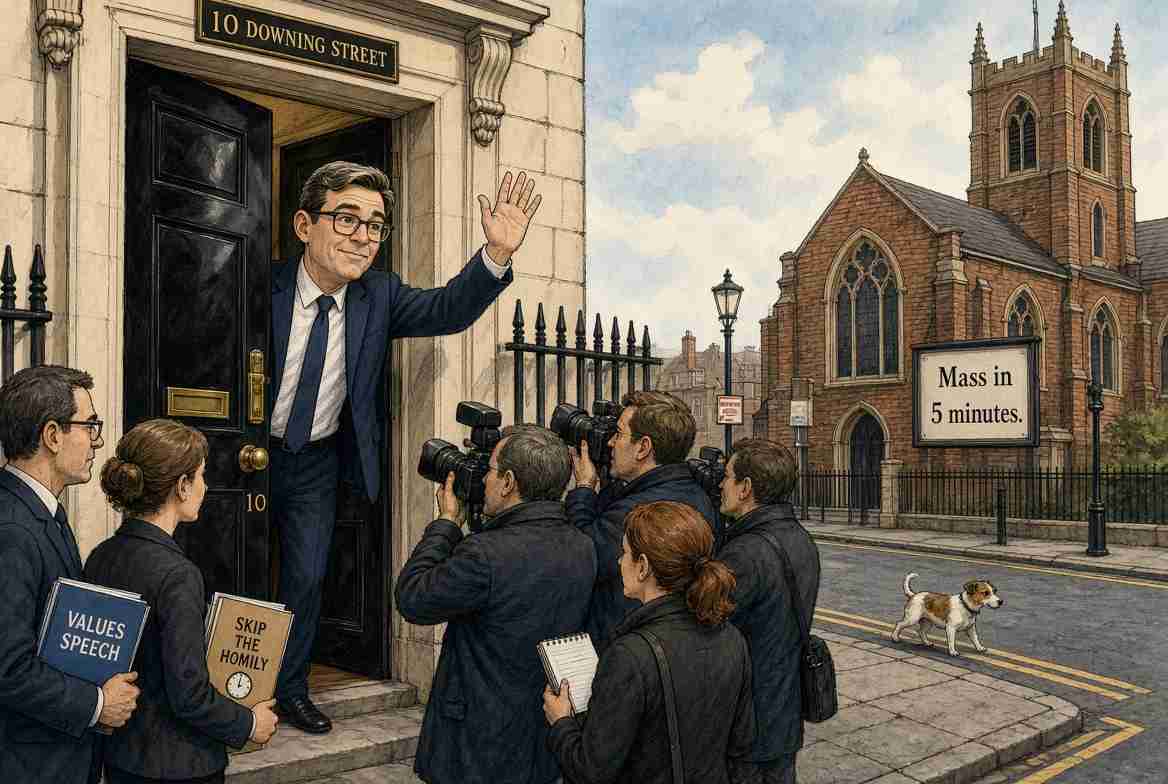
The New York Times has discovered what may be the perfect modern Catholic politician: British Prime Minister Andy Burnham, a man whose Catholic upbringing helped shape his political philosophy despite the minor theological inconvenience that he rarely attends Mass.
This remarkable breakthrough was contained in a September opinion essay examining Burnham’s Catholic influences and contrasting his approach with contemporary American Catholic politics. It followed months of transatlantic commentary on the subject, including an analysis in the Church Times and a dispatch from America Magazine asking exactly how Catholic Britain’s new Catholic prime minister actually is.
Burnham has previously said that Catholic social teaching underpins his politics while also acknowledging that he is not particularly religious today. He became prime minister on 20 July 2026, making his Catholic upbringing historically significant in a country where the relationship between Catholics, monarchs, Parliament and assorted bishops has required approximately five centuries of paperwork.
The arrangement is wonderfully modern.
Burnham gets the social teaching.
The church gets somebody mentioning it.
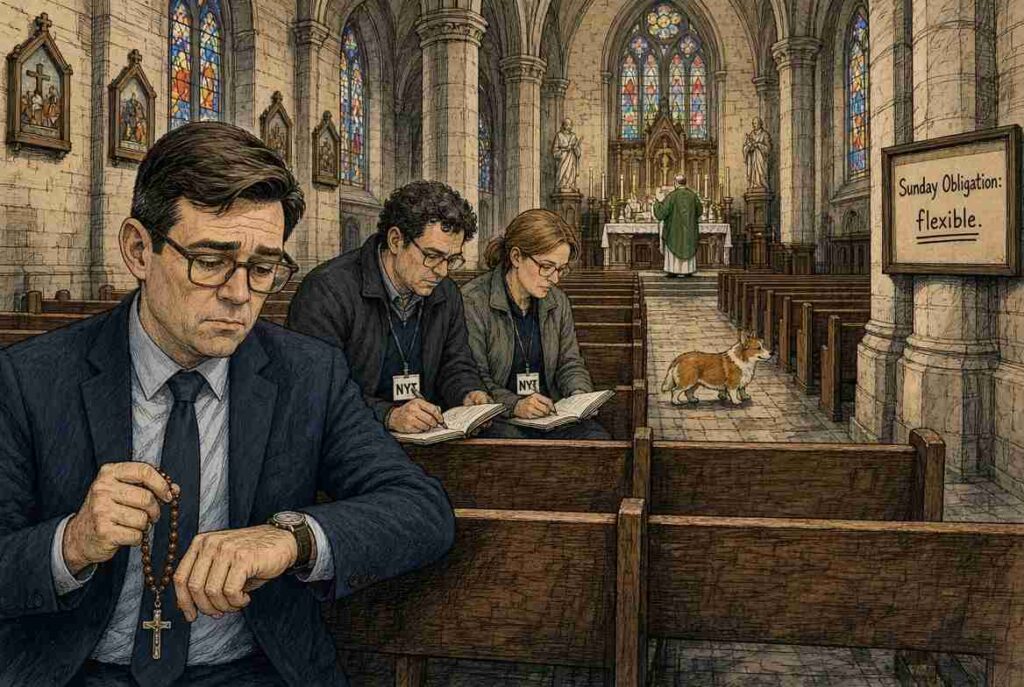
Sunday morning remains negotiable.
British Prime Minister Andy Burnham
The Burnham model suggests Catholicism can be practiced remotely…
- Modern Catholicism apparently has a remote-work option. Burnham rarely attends Mass, but Catholic social teaching reportedly influences his politics. Religion has finally discovered hybrid scheduling.
- The New York Times has discovered the perfect churchgoer: the fellow who doesn’t clutter up the church.
- Burnham may be Catholic in roughly the same way Britain is European: historically, culturally, geographically, and subject to complicated negotiations about actual participation.
- Catholic social teaching without regular Mass is theological takeaway: all the principles, none of the parking.
- Britain waited centuries for a Catholic-born prime minister and immediately got one who apparently isn’t particularly enthusiastic about going. Burnham became prime minister on 20 July 2026.
Catholicism introduces a remote-work option
For centuries Catholics operated under the cumbersome assumption that Catholicism involved occasionally being physically present inside a Catholic church.
Historians now believe this may have been unnecessarily rigid.
The Burnham model suggests Catholicism can be practiced remotely, rather like accounting, software development and answering emails while pretending to listen during a Microsoft Teams meeting.
Under the proposed theological arrangement, believers would no longer need to report regularly to the parish.
Instead, they could simply retain several broad principles involving dignity, solidarity, community and concern for the poor.
Confession could presumably be handled by voicemail.
Communion might eventually become available through Deliveroo.
Ash Wednesday would require downloading a small grey circle onto one’s forehead.
This represents enormous progress for busy politicians who have traditionally found worship difficult because churches insist upon beginning services at specific times rather than whenever the minister’s motorcade arrives.
The perfect modern Catholic believer
The achievement is particularly impressive because Burnham appears to have achieved something generations of Catholics considered impossible: becoming politically famous for Catholicism without having to spend very much Sunday morning actually doing Catholicism.
Think of it as theological frequent-flyer status without the flights.
He retains the cultural miles.
Burnham’s religious formation is not invented for newspaper convenience. He was raised Catholic and has publicly attributed elements of his political outlook to Catholic social teaching, once telling The Guardian that Everton Football Club, the Labour Party and the Catholic Church were the three institutions that shaped him — “in that order.” Il Foglio has since described his faith as “discreet,” which is a diplomatic way of putting it.
But this makes the whole affair funnier, not less so.
You can apparently stop attending Mass regularly and still remain Catholic enough for international newspaper columns.
Try doing that with Costco.
Stop showing up at Costco for 20 years and nobody writes an essay about your continuing commitment to bulk mayonnaise.
Vatican announces new Catholic loyalty programme
Church officials have not announced any changes to Catholic doctrine, so Prat.UK’s Department of Improvised Ecclesiastical Administration has done the responsible thing and invented them.
Under our proposed Catholicism Plus™ membership scheme, political leaders could accumulate holiness points through approved activities.
Mention “human dignity” in a speech: 50 points.
Say “common good”: 75.
Quote Pope Francis: 100.
Actually attend Mass: unnecessarily showy.
Our completely fabricated survey of 1,204 people standing outside churches because they arrived after the doors had closed found that 73 percent supported flexible Catholicism, 18 percent preferred traditional worship and 9 percent thought they were waiting outside Greggs.
The margin of error was several commandments.
Britain finally gets a Catholic prime minister
There is genuine history underneath the joke.
Burnham’s elevation has attracted attention because Britain has had a famously complicated relationship with Catholic political power. Reporting from the National Catholic Reporter has described him as Britain’s first Catholic-born prime minister, while noting that Tony Blair converted after leaving office and Boris Johnson had ceased practising Catholicism long before entering Downing Street.
Britain therefore waited roughly half a millennium for this moment.
The Catholic prime minister finally arrived.
And Britain immediately discovered an ancient law saying he couldn’t perform one obscure part of the job.
Of course it did.
Britain cannot install a bicycle rack without discovering a statute from 1829 requiring permission from a duke.
Burnham has sought to remove longstanding restrictions preventing Catholic and Jewish prime ministers from advising the monarch on certain Church of England appointments. EWTN News traces the restrictions back to the Roman Catholic Relief Act 1829, nineteenth-century legislation that granted Catholics the right to sit in Parliament while quietly forgetting to let them near a bishop’s appointment paperwork.
This produces perhaps the finest constitutional sentence available anywhere in Western democracy:
The Catholic who doesn’t regularly attend Catholic Mass wants the legal right to participate in appointments involving Anglican bishops.
Henry VIII spent his entire reign trying to create this joke.
Church of England bishops and the Catholic prime minister problem
The constitutional arrangement becomes more entertaining the longer you stare at it.
Britain has an established Protestant church.
Its supreme governor is the monarch.
Its bishops sit in Parliament.
The prime minister participates in an appointments process.
And because the current prime minister was raised Catholic, nineteenth-century legislation suddenly wandered into Downing Street carrying a clipboard.
Nothing demonstrates Britain’s ability to modernise quite like discovering that your religious administration is still running Windows 1829.
Commentators have separately noted the oddity of debating whether Burnham should participate in Anglican episcopal appointments at all, given the tangled relationship between the state and the established church.
This raises the obvious question:
If Burnham rarely attends Catholic Mass, when exactly did Britain decide he was too dangerously Catholic to discuss Anglican bishops?
Apparently somewhere between “not especially observant” and “Prime Minister.”
American Catholics get a British tutorial on faith and politics
The New York Times essay was aimed partly at an American audience and used Burnham’s approach to discuss the direction of Catholic political engagement in the United States.
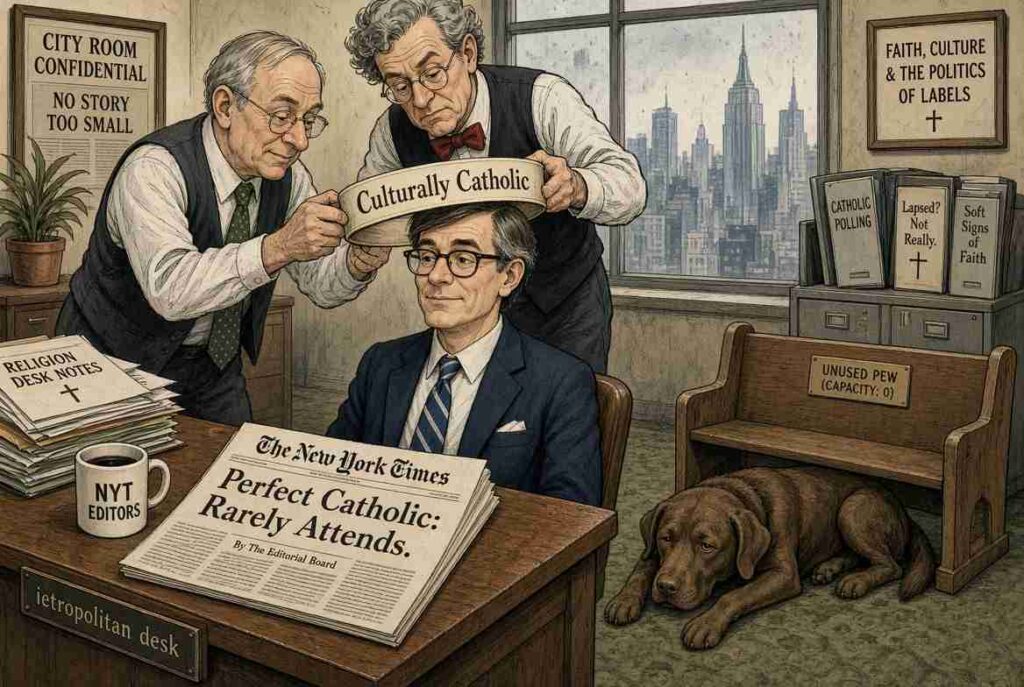
This means Britain is now exporting Catholic political advice to America.
Britain.
A country whose most famous contribution to Catholic-Protestant relations involved Henry VIII, monasteries and several architectural vacancies.
It is rather like asking France for dietary restraint.
Still, the transatlantic exchange gives political theology something it badly needed: another reason for Americans and Britons to explain each other’s countries incorrectly.
Americans can now tell Britons what Catholicism means.
Britons can explain American democracy.
Within six months everyone should be completely confused.
Catholic social teaching meets modern British politics
The larger point behind the original essay is serious enough.
Catholic social teaching contains a long tradition dealing with human dignity, work, poverty, social responsibility and the common good. Burnham has explicitly cited that tradition as an influence.
But politics possesses a remarkable ability to treat religious traditions like hotel breakfast buffets.
Every politician walks along with a plate.
“I’ll have some dignity.”
“Excellent.”
“Two scoops of solidarity.”
“Certainly.”
“Anything on sexual ethics?”
“No, thank you.”
“Church authority?”
“I’m full.”
This is not uniquely Catholic.
Politicians have been selectively quoting religion since approximately six minutes after religion began.
If Moses had returned from Sinai with polling data, there would have been eleven commandments, four amendments and a focus group suggesting “Thou shalt not” sounded excessively negative.
Burnham’s greatest religious achievement may be Everton
There is one institution, however, where Burnham’s devotion appears considerably easier to document.
Everton.
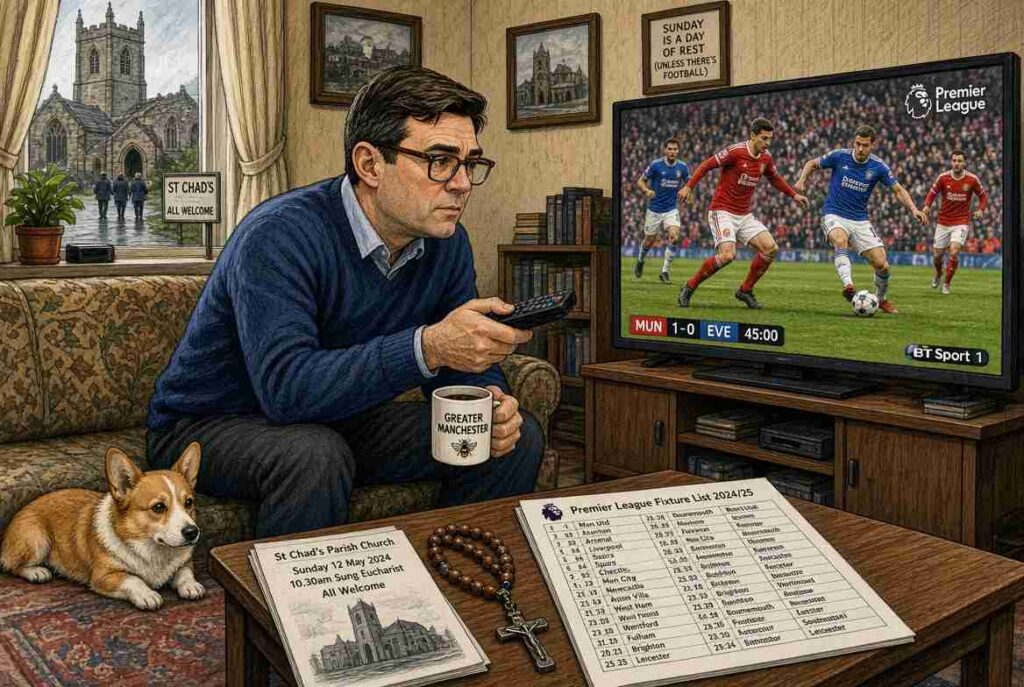
Burnham is a lifelong Everton supporter, and he has invited fellow Evertonian and Canadian Prime Minister Mark Carney to a match, combining international diplomacy with the ancient British ritual of watching football while discussing matters considerably less important than football.
There is something wonderfully British about it.
Mass attendance?
Occasional.
Everton?
Where do you want me sitting?
Perhaps this is the theological synthesis Britain has been seeking since the Reformation.
Father, Son and away fixture.
The age of convenient conviction
None of this means Burnham’s Catholic influences are insincere.
People frequently carry moral, cultural and philosophical influences from religious traditions even when their formal observance changes. That is hardly unusual.
What is funny is the machinery surrounding it.
A politician says Catholicism influenced him.
A newspaper discovers a model of Catholic politics.
Commentators debate Catholic identity.
Parliament finds a nineteenth-century Catholic restriction.
Anglicans enter the story.
American Catholics enter the story.
Eventually somebody mentions Henry VIII.
And somewhere in Britain, an actual priest is still simply trying to get twelve volunteers for the parish fête.
Political religion operates on grand abstractions.
Parish religion needs someone to move folding chairs.
A new standard for political holiness in Britain
Prat.UK therefore proposes a much simpler classification system.
Politicians should no longer be described as practising Catholic, lapsed Catholic, cultural Catholic, Anglican, Methodist, agnostic or whatever highly specific spiritual status requires three paragraphs of explanation.
They should simply receive an annual ecclesiastical MOT.
Faith: historically present.
Attendance: intermittent.
Social teaching: politically operational.
Bishops: legislation pending.
Everton: fully practising.
The New York Times may therefore have stumbled onto something genuinely useful.
The ideal modern religious politician is apparently someone influenced enough by religion to write speeches about it, detached enough to remain electorally flexible and famous enough for theologians to argue about what any of it means.
Which makes Burnham not merely a modern Catholic politician.
It makes him the ultimate twenty-first-century believer:
spiritually logged in, physically working from home.
10 humorous observations on Britain’s remote-working Catholic prime minister
- The newspaper’s argument creates an exciting new religious standard: attending church is optional provided your public policy has sufficient footnotes.
- Burnham’s relationship with Catholicism resembles many people’s gym membership: deeply important to their identity despite limited sightings inside the building.
- Being a lapsed Catholic may be the most Catholic thing possible: even when you leave, somebody has your baptismal certificate.
- America apparently needed Britain to explain Catholic politics, proving the Special Relationship has entered its strangest phase since Americans tried understanding cricket.
- Catholic doctrine has become an à la carte restaurant: solidarity, dignity, community, yes please; several other items can remain in the kitchen.
- The Church of England situation makes it even better: Britain’s Catholic prime minister has been legally restricted from advising on Anglican appointments, an old limitation Burnham wants repealed.
- Britain has achieved religious tolerance so advanced that nobody can remember which ancient law is currently preventing whom from appointing which bishop.
- Political Catholicism now appears measurable in policy rather than pew-hours, creating the possibility of a Catholic politician achieving Platinum Status without collecting a single Sunday.
- Everton may actually demand more regular attendance from Burnham than the Catholic Church.
- The miracle isn’t that Britain finally has a Catholic-born prime minister. The miracle is that American newspaper opinion pages have discovered British politics contains something besides Brexit.
Disclaimer: This story is satire. Real biographical and political details are mixed with exaggeration, absurdity, parody, invented surveys and entirely fabricated institutions for comic purposes. No Vatican loyalty programme currently awards holiness points for saying “common good,” although this seems like an administrative opportunity somebody will eventually notice.
This story is entirely a human collaboration between two sentient beings: the world’s oldest tenured professor and a philosophy major turned dairy farmer. Any resemblance to efficient church administration is purely miraculous.