Parliament Investigates Britain’s Eurovision Failures, Scientists Suggest Problem May Be Englishness
MPs Launch Historic Inquiry Into Why Europe Keeps Giving Britain the Musical Equivalent of an Unfollow
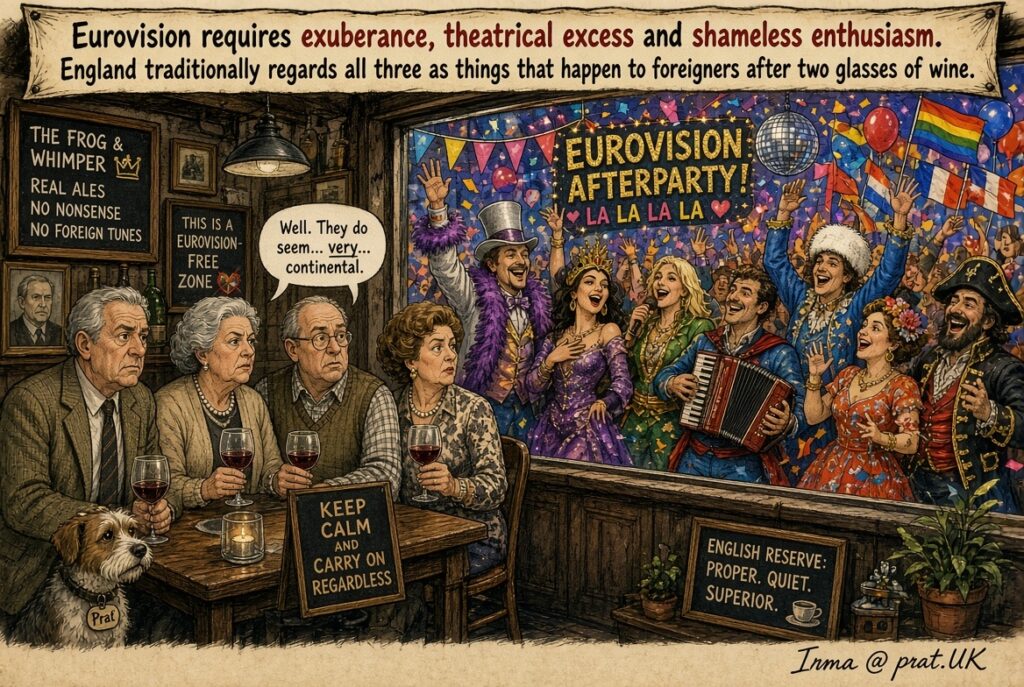
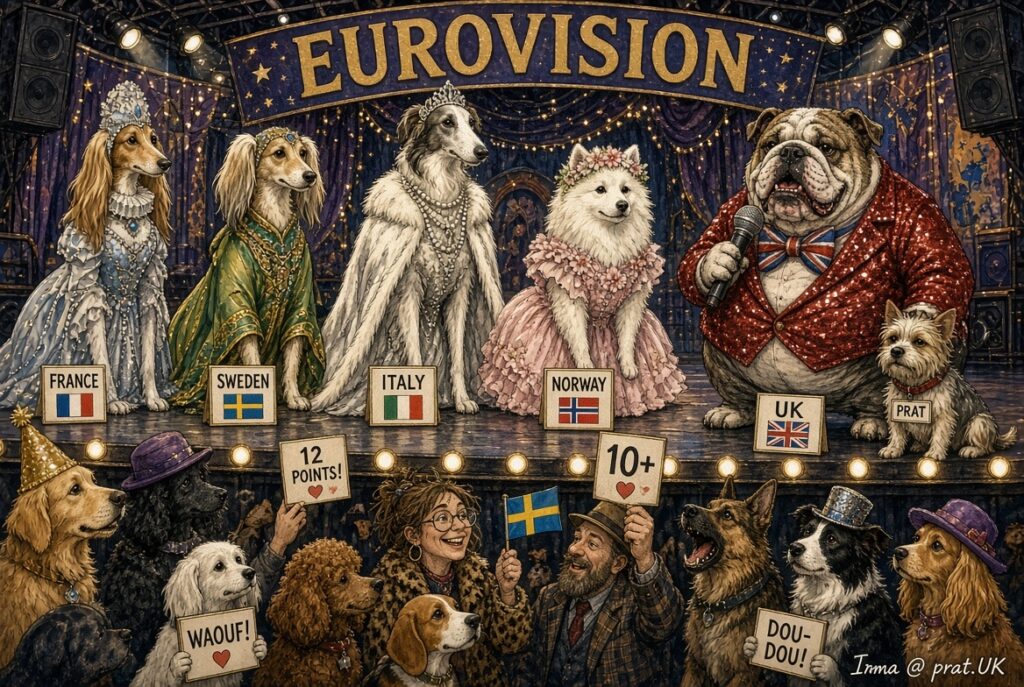
LONDON — Britain’s Eurovision problem may finally have a scientific explanation: the English keep entering it. The contest demands exuberance, theatrical excess and shameless enthusiasm, three qualities England has traditionally regarded as things that happen to foreigners after two glasses of wine.
Britain has now launched a parliamentary investigation into its miserable recent Eurovision record, having exhausted every simpler explanation, including bad songs, bad staging, weak performances and the disturbing possibility that Europe simply does not appreciate a nation whose highest form of public enthusiasm is saying, “Quite good, actually.”
The House of Commons Digital, Culture, Media and Sport Committee has announced fresh “State of Play” hearings that will examine how Britain’s Eurovision entries are selected. Committee chair Dame Caroline Dinenage said MPs want to determine whether poor results come from song choice, performance or “something else.” The hearings are expected to involve the BBC and music industry figures.
Britain’s Eurovision problem may finally have a scientific explanation: the English keep entering it. — Alan Nafzger
The London Prat has already identified “something else.”
They’re English.
Not all of them literally, obviously. Britain remains a complicated constitutional lasagne involving England, Scotland, Wales and Northern Ireland. But Eurovision Britain frequently operates under that unmistakable English cultural principle that anything too enthusiastic should immediately be brought before a licensing committee.
Europe sees Eurovision as three hours of glitter, pyrotechnics, key changes, costume transformations and singers descending from the ceiling dressed as intergalactic poultry. England sees this and asks whether there will be tea afterward.
Britain’s One-Point Eurovision Breakthrough
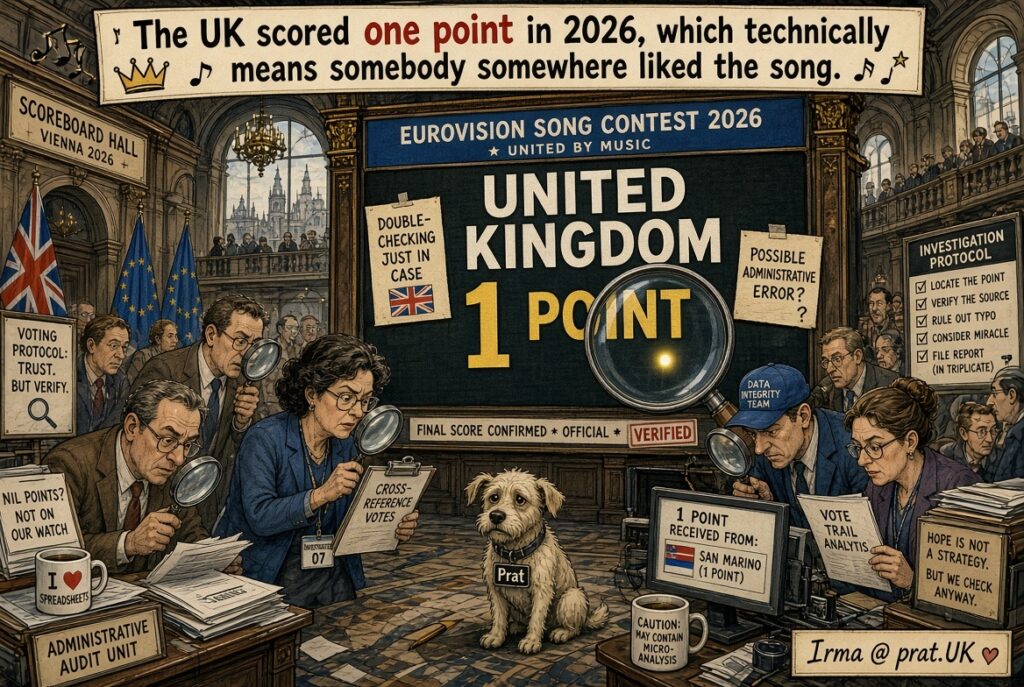
The immediate cause of national concern was the UK’s 2026 entry, Look Mum No Computer’s “Eins, Zwei, Drei,” which finished last with one point. One. Which is, technically, one more way than usual Britain has managed to score in Europe lately, and perhaps a sign the country is finally starting to hit the right note.
In 2021, James Newman received nul points, meaning the British Eurovision programme has now successfully increased its score by infinity percent, depending on whether the Treasury is allowed to do the mathematics. Since 2016, Britain has finished in the top 20 only three times and has placed 24th or lower six times, including three last-place finishes.
A fictional government statistician immediately described the trend as “encouraging.” “At this rate,” he explained, “Britain could reach 12 points sometime before coastal erosion removes East Anglia.” He then produced a 460-page consultation paper titled Unlocking Eurovision Growth: A Strategic Framework for Sustainable Sequins.
The Englishness Theory Behind Eurovision Failure
Researchers define Englishness, for the purposes of this completely irresponsible study, as the involuntary urge to become embarrassed when somebody enjoys themselves without first filing paperwork.
Consider Eurovision. An Estonian contestant might emerge from an enormous silver egg while dancers dressed as wolves perform gymnastics beneath artificial lightning. A Finnish contestant may arrive looking like a nightclub was accidentally granted citizenship. A Croatian singer could perform alongside a hydraulic tractor operated by a soprano wearing antlers.
The English response is generally: “Bit much.”
That’s the problem. Eurovision IS bit much. Entering Eurovision while attempting not to look ridiculous is like entering the Tour de France while attempting not to appear interested in bicycles. This is not a normal song contest. Eurovision is what happens when a talent show falls into a vat of radioactive theatre school.
Why British Songs Keep Missing Eurovision’s Point
Europeans understand something Britain periodically forgets: Eurovision songs do not merely need to be heard. They need to happen to you. A successful Eurovision number should leave the viewer wondering whether they have witnessed a musical performance, a religious conversion or an electrical fire.
Britain occasionally responds by sending a pleasant singer with a respectable song. Respectable? At Eurovision? That’s bringing salad to a pub fight.
The British delegation might as well announce: “Good evening, Europe. We’ve brought a sensible cardigan and a melody approved by six regional managers.” Three minutes later Moldova arrives with a flaming accordion mounted on a mechanical horse, while somewhere in the crowd a fan has already arrived dressed as a flutter by. Guess who is getting the televote?
Norwich club comedian Dave Chuckle put it flatly on his podcast this week: “For all intensive purposes, Britain sent a hymn to a rave.”
Parliament Prepares to Investigate Why Eurovision Is Fun
The genuinely funny part is that MPs are investigating. This means Eurovision will finally encounter the one theatrical production even more elaborate than Eurovision itself: a parliamentary evidence session.
There will be witnesses. There will be written submissions. There may be charts. Somebody from the BBC will undoubtedly say the words “creative ecosystem.” An MP will ask whether Britain needs “a more robust strategic Eurovision pathway.” A consultant will say “stakeholder engagement.” By lunchtime, eight people will have successfully removed music from the discussion.
Eventually somebody will ask the obvious question: “Have we considered sending a really good song?” Security will escort him from the building.
The Sam Ryder Problem With the Englishness Eurovision Theory
Unfortunately for the Englishness theory, Britain possesses one devastating piece of contradictory evidence: Sam Ryder.
Ryder finished second in 2022 with “Space Man,” scoring 466 points, Britain’s strongest result in years. This suggests Europe does not automatically hate Britain. Europe apparently merely demands that Britain send something Europe wants to hear. This finding has been classified as dangerous.
Ryder also possessed the crucial Eurovision characteristics: enormous voice, enormous personality and enough hair to require separate customs documentation. He looked delighted to be there. That’s suspiciously un-English. Traditional British television requires performers to behave as though success might inconvenience somebody. Ryder appeared to be having fun. Europe noticed.
Britain’s Automatic-Entry Eurovision Problem
Britain also belongs to Eurovision’s Big Five, giving it automatic entry to the final alongside France, Germany, Italy and Spain. This arrangement has inadvertently created the world’s most glamorous participation trophy. Britain doesn’t have to qualify. It simply arrives.
Imagine Wimbledon announcing: “Britain has automatically reached Centre Court because we helped pay for the strawberries.” There is something deeply British about securing permanent access to a competition and then spending decades wondering why everybody else appears more prepared.
Other nations fight through semifinals. Britain gets waved inside through the diplomatic entrance. Then Britain finishes 26th and demands an inquiry.
Thirty Years Since Britain’s Last Eurovision Win
Britain’s most recent Eurovision victory came in 1997, when Katrina and the Waves won with “Love Shine a Light.” The 2027 contest will therefore mark thirty years since the UK’s last victory. Thirty years. That’s not a losing streak anymore. That’s heritage.
English Heritage could put a little brown sign beside it: SITE OF BRITISH EUROVISION SUCCESS, LAST OBSERVED 1997, PLEASE DO NOT TOUCH. Tourists could visit. Children would ask their grandparents what winning Eurovision was like. Granddad would stare toward the horizon. “We had CDs then.”
What Britain Needs to Win Eurovision Again
The obvious solution is not another strategy document. Britain must become less frightened of looking silly, because looking silly is Eurovision’s gold standard. Britain doesn’t need another committee. It needs a costume budget, and the emotional stability to use it.
Imagine auditioning entrants under a new rule. Anyone saying, “I just want the song to speak for itself,” is immediately eliminated. Anyone requesting fewer dancers is deported to Radio 4. Anyone asking whether the costume is “a bit over the top” is placed under observation.
The successful entrant must satisfy five criteria. Can the chorus be screamed by somebody who does not speak English? Can three drunk tourists remember it after one hearing? Does something explode? Would your grandmother describe the costume as unnecessary? Is there a moment when the entire audience involuntarily goes, “WHAT?” If yes, congratulations. You’re going to Eurovision.
Eurovision Is Not Glastonbury With Flags
Britain sometimes treats Eurovision as though the objective is musical credibility. That’s adorable. Eurovision credibility works differently. A normal songwriter asks, “Does this lyric explore the human condition?” A Eurovision songwriter asks, “Can we rhyme ‘desire’ with ‘higher’ while the piano catches fire?”
Both are legitimate artistic traditions. Only one tends to win Eurovision. British producers need to stop imagining they are selecting the next Radiohead and start asking whether a Bulgarian family can sing the chorus while assembling IKEA furniture.
What Parliament Will Probably Conclude About Eurovision
After several months, twelve hearings, forty witnesses and approximately £73,000 worth of biscuits, Parliament may finally announce its conclusions: the UK’s poor performance results from a complicated combination of song selection, staging, competition, public voting, performer appeal and unpredictable cultural tastes.
This will be technically accurate. The London Prat proposes a shorter report. Cause of Eurovision failure: Britain keeps forgetting Eurovision is Eurovision.
The country’s greatest disadvantage is not Europe. It isn’t Brexit. It isn’t voting blocs. It isn’t even the BBC. It is that somewhere inside every Englishman is a tiny civil servant whispering, “Are we absolutely sure we want the glitter cannon?”
Yes. Fire the glitter cannon. Fire two. Release the dancers. Bring out the illuminated trousers. Find somebody with Sam Ryder’s vocal range, Brian May’s hair and the instinctive self-confidence of a man who has never once asked whether karaoke might be embarrassing.
Because Britain does not need another committee to committee the joy right out of Eurovision. Britain needs to stop attending Europe’s largest costume party dressed for a meeting at the building society.
15 Humorous Eurovision Observations Before Parliament Reports Back
- Eurovision requires exuberance, theatrical excess and shameless enthusiasm. England traditionally regards all three as things that happen to foreigners after two glasses of wine.
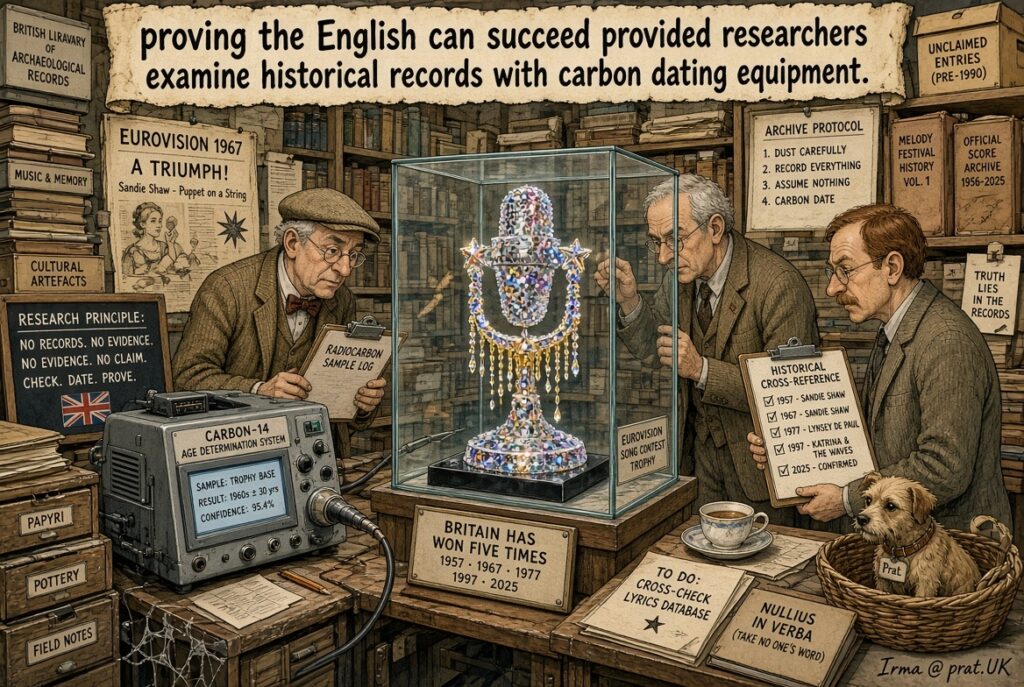
- Britain has won Eurovision five times, proving the English can succeed provided researchers are willing to examine historical records with carbon dating equipment.
- The UK scored one point in 2026, which technically means somebody somewhere liked the song, although investigators have not ruled out an administrative error.
- Parliament is investigating Eurovision selection, because Britain has apparently solved housing, taxation, infrastructure and everything involving trains.
- Eurovision contestants from other countries arrive wearing angel wings, sequins and electrically illuminated trousers. The British entry often looks as though somebody interrupted them while they were returning something to Marks & Spencer.
- The BBC keeps looking for the perfect Eurovision song when Eurovision has spent seventy years explaining that perfection involves wind machines and a chorus that sounds good shouted by twelve drunk Belgians.
- Sam Ryder finished second in 2022, demonstrating that British Eurovision failure isn’t inevitable. He may therefore have accidentally destroyed the strongest excuse available to the inquiry.
- England approaches Eurovision with the emotional enthusiasm of a solicitor explaining probate.
- Europeans vote for spectacle. Britain sends restraint. This is roughly equivalent to entering Crufts with a tasteful photograph of a Labrador.
- The UK’s Big Five status guarantees it a place in the final, meaning Britain has achieved the remarkable sporting innovation of qualifying automatically for an event it then struggles to win.
- MPs want to investigate whether the problem is the songs, performers or selection process. Nobody has yet suggested examining the nation’s hereditary inability to clap above shoulder height.
- Britain keeps trying to understand Eurovision intellectually. Eurovision’s entire competitive advantage is that it stopped understanding itself sometime around 1978.
- The last UK victory came in 1997 with Katrina and the Waves. Thirty years later, Parliament is finally responding with the urgency normally associated with discovering a pothole outside an MP’s constituency office.
- Eventually the committee may recommend the only proven Eurovision strategy: find somebody with enormous hair, an enormous chorus and absolutely no interest in whether anyone at home finds the whole thing embarrassing.
The Digital, Culture, Media and Sport Committee’s fresh Eurovision hearings, Britain’s 2026 one-point finish, its Big Five status, Sam Ryder’s 2022 second-place result and the 1997 Katrina and the Waves victory are all real. The statisticians, strategic sequin frameworks, flaming accordions, Radio 4 deportations and diagnosis of Englishness above are comic invention, offered here as British satire rather than fact. This is British satirical journalism, written for readers who already know that UK satirical news works best delivered with a straight face and a glitter cannon just out of shot.
Sources
Euronews: “Nul points”: UK MPs want to know why Britain keeps flopping at Eurovision
For the American take on national embarrassment set to a backing track, visit Bohiney.com.
Auf Wiedersehen, amigo!

Harper Thames is a comedic writer exploring modern life through irony and subtle exaggeration. Rooted in student perspectives and London’s cultural landscape, Harper’s work focuses on relatable humour grounded in everyday experience.
Expertise is developed through writing practice and critical engagement, while authority comes from authenticity and consistency. Trust is reinforced by transparent satire and ethical humour choices.