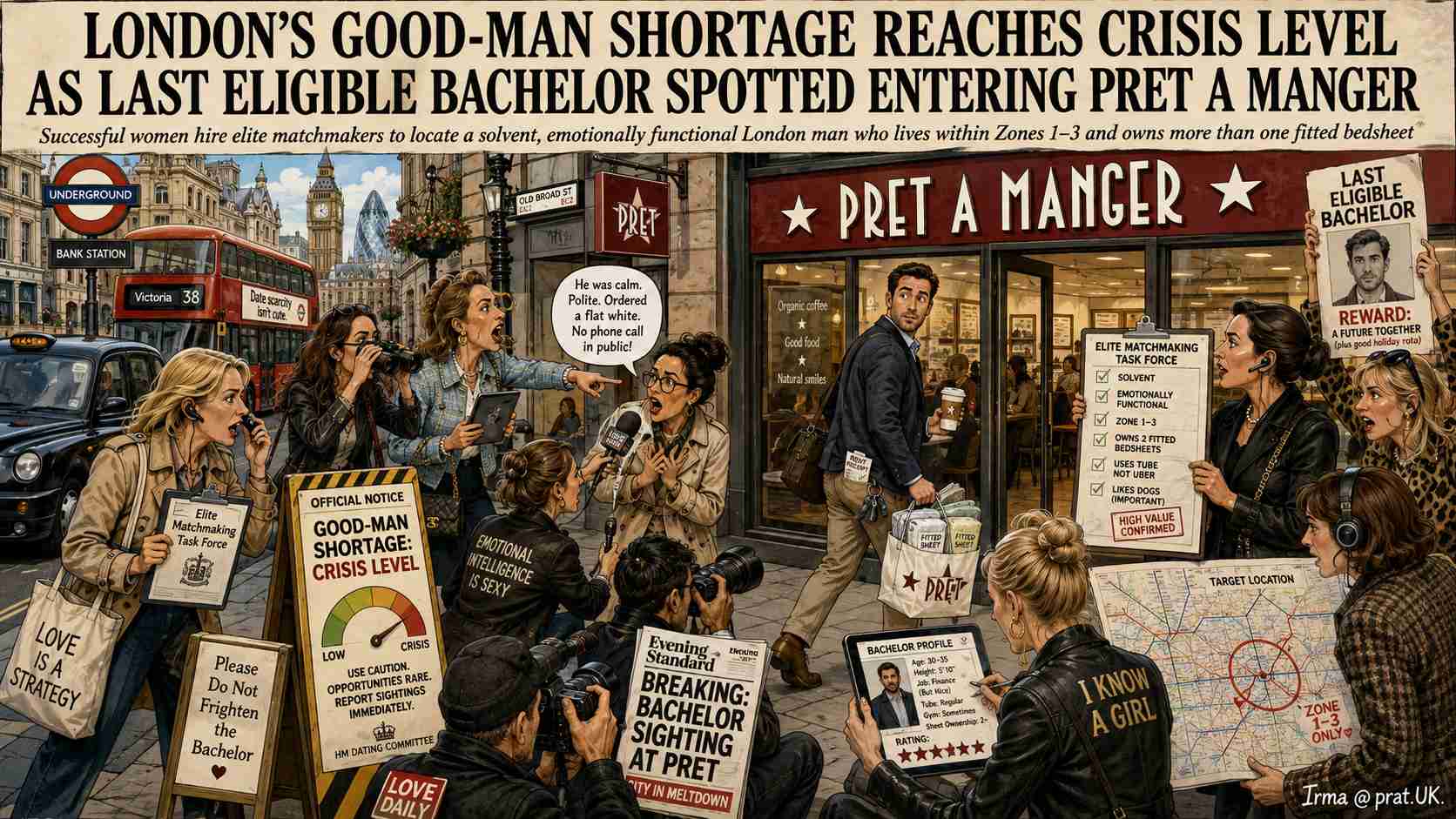
London’s Good-Man Shortage Reaches Crisis Level as Last Eligible Bachelor Spotted Entering Pret A Manger
Successful women hire elite matchmakers to locate a solvent, emotionally functional London man who lives within Zones 1–3 and owns more than one fitted bedsheet
LONDON — A recent investigation by The Cut reports that wealthy, successful American women are paying extraordinary sums to find suitable partners. London matchmakers say Britain faces an even graver emergency: the capital may contain plenty of men, but most are emotionally unavailable, geographically inconvenient, or members of podcasts.
Matchmakers Launch Operation Find a Decent Bloke
Britain’s luxury matchmaking industry has declared a Level Four romantic emergency following reports that accomplished London women cannot find men who are simultaneously unmarried, employed, interesting and willing to book dinner more than twenty minutes in advance.
The crisis is particularly severe among women in finance, law, medicine and technology. These women can negotiate mergers, perform surgery and explain artificial intelligence to parliamentary committees, yet remain unable to persuade a 42-year-old management consultant to answer a straightforward question about where the relationship is going. Call it Tinder-tenacity — the will to swipe long after the will to hope has died.
“I can manage 600 employees in twelve countries,” said Amelia Cartwright, a fictional but statistically exhausted private-equity director from Chelsea. “But I cannot get Oliver to say whether he’s free on Saturday. He says he’ll ‘see what the weekend feels like.’ Apparently Saturday now has a climate.”
Amelia paid £75,000 to an exclusive Mayfair matchmaker after two years on dating apps. The agency asked her to describe her ideal man. “I said kind, intelligent, solvent and emotionally mature,” she recalled. “The matchmaker looked at me as if I’d requested a six-bedroom townhouse in Belgravia for £900 a month.” As they say on the Hampstead comedy circuit, that’s not a dating pool, that’s a puddle-panic.
The Qualifications of Britain’s Most Wanted Man
The modern “good man,” according to London matchmakers, must satisfy increasingly demanding criteria. He should earn enough to share the cost of a holiday, but not so much that he communicates exclusively through an assistant. He must be confident, but not the sort of confidence that begins every sentence with, “Speaking as a founder.”
He should be fit, but not own a camera tripod for filming himself exercising. He must enjoy travel, but not have spent six months in Thailand “finding himself,” particularly if nobody there reported him missing. He should also possess a proper bed. This last requirement has eliminated an estimated 38 percent of eligible London bachelors — a statistic matchmakers refer to privately as duvet-doom.
Dr. Felicity Marsh, a relationship sociologist at the entirely plausible Institute for Metropolitan Disappointment, explained that bedding has become an important indicator of romantic readiness. “A man with two pillows is thinking about the future,” she said. “A man with four pillows understands hospitality. A man sleeping beneath a Manchester United towel is not yet participating in civilisation.”
Matchmakers have introduced an extensive inspection process. Candidates undergo financial screening, criminal-record checks, social-media analysis and an unannounced examination of their bathroom. “The bathroom tells us everything,” said elite matchmaker Camilla Worthing-Smythe. “One towel means instability. No hand soap means selfishness. A three-in-one shampoo, conditioner and body wash tells us the Crown Prosecution Service should probably be informed.”
The Geography of Love
London’s transport system presents another obstacle. Residents regularly describe people four miles away as living “at the other end of the country.” A successful barrister in Hampstead recently rejected a compatible architect because he lived in Clapham. “She said she wanted a partner, not an expedition,” the matchmaker explained. It’s less romance, more route-rejection.
Transport for London has responded by proposing a new Romantic Compatibility Map. Instead of Zones 1 through 6, stations will be classified according to the likelihood that someone will agree to meet there.
Zone A includes Soho, Marylebone and locations visible from the woman’s office. Zone B requires one direct Tube journey. Zone C means changing at Bank, which relationship experts classify as an act of emotional abuse. Anything beyond Zone C is considered a holiday romance.
A TfL spokesperson urged Londoners to remain flexible. “True love may be only eleven stops away,” he said, before announcing that the Piccadilly line was suspended because of a signal failure at Acton Town. As Michael McIntyre might put it to a packed O2 crowd: nothing kills a spark faster than a rail-replacement bus to Zone 5.
LinkedIn Becomes Britain’s Most Honest Dating App
High-end matchmakers increasingly recruit men through LinkedIn. This makes sense because LinkedIn already contains photographs, employment histories and thousands of men claiming to be passionate about “building meaningful connections.”
Recruiters search for doctors, lawyers, entrepreneurs and senior executives. Unfortunately, LinkedIn profiles are written in a dialect where being dismissed from a stationery wholesaler becomes “embracing an exciting new chapter in global paper solutions.” Industry insiders call this the jargon-jilt.
One recruiter said she examines up to 20,000 profiles annually. “We look for stable careers, charitable interests and evidence that the man has maintained at least one friendship since university,” she explained. “We avoid anyone who calls himself a thought leader. If he has to announce that he leads thought, the thoughts are probably wandering around unattended.”
Prospective bachelors are interviewed about relationships, ambitions and emotional intelligence. Some find the process intrusive. “They asked what I learned from my divorce,” complained Giles, a 46-year-old property developer. “I said I learned that my wife gets the house. How much more personal growth do these people expect?”
The Great Expectation Problem
Matchmakers admit successful women sometimes arrive with specifications better suited to military procurement. One London client reportedly requested a man aged 42 to 48, at least six feet tall, privately educated but not snobbish, wealthy but available, cultured but not pretentious, politically informed but never argumentative, and living within twenty minutes of Notting Hill.
The agency found two. One was married. The other was a wax figure of Colin Firth from Madame Tussauds London. The woman rejected the wax figure because he seemed emotionally distant — a verdict matchmakers are calling the ultimate Firth-hurdle.
Matchmakers gently encourage clients to distinguish between essential qualities and luxury accessories. Kindness may be essential. Owning a chalet in Verbier is generally an accessory, unless the relationship is expected to take place entirely during ski season.
Men also harbour unrealistic expectations, although theirs are expressed differently. A 58-year-old divorced banker may request a “natural, easygoing” 32-year-old who enjoys hearing about interest rates. He describes this not as demanding but as “knowing what works for me.”
“The supply problem is fascinating,” said Professor Alan Nafzger, observing the crisis from a safe distance. “Successful women want a peer. Successful men often want someone who will laugh when they explain wine. Economically, this creates a market failure. Comedically, it creates Chelsea.”
Government Announces Emergency Measures
The government has appointed a Minister for Suitable Men, whose first responsibility will be determining whether any remain. Proposed measures include tax relief for bachelors who attend therapy, grants for men purchasing their second set of bedsheets, and compulsory communication training for anyone who has sent “u up?” after the age of 35.
Parliament is also considering the Good Boyfriend Standards Bill. Under the legislation, men must provide 48 hours’ notice before a date, ask at least one follow-up question during dinner and understand that “I’m fine” may require further investigation. Opponents called the bill excessive regulation — a classic case of red-tape-romance. Supporters replied that men had been given several thousand years to regulate themselves.
Practical Advice for London’s Lonely Professionals
Relationship experts recommend abandoning impossible checklists while retaining meaningful standards. A man need not own a house in Kensington, but he should know where he lives. He need not earn £500,000, but he should not refer to borrowing money from his mother as “family-backed venture capital.”
Women are encouraged to consider men outside their usual professional circles. Teachers, tradesmen, civil servants and small-business owners may lack private-club memberships but possess rare qualities such as practical competence and the ability to assemble furniture without turning the evening into a referendum on masculinity.
Men are advised to ask questions, make plans and buy a second towel. Most importantly, Londoners should occasionally speak to strangers in real life. This was how people met before dating apps turned romance into searching for a second-hand Volvo with good teeth.
Hope remains. Somewhere in London, a kind, intelligent and emotionally available man is cooking dinner in a clean flat with fresh sheets. Unfortunately, he lives in Zone 5.
Fifteen Observations From London’s Romantic Emergency
- London has nine million residents, yet every single woman is apparently being shown the same four men on Hinge.
- A London “professional” can mean a barrister, a surgeon, or a man professionally explaining cryptocurrency beside the smoking area.
- Women no longer ask whether a man owns his home. They ask whether his landlord has permission to enter without knocking.
- “Emotionally available” in Britain means he once admitted that his grandfather’s funeral was “a bit much.”
- A man living south of the river may be perfect, but love cannot overcome two changes and rail-replacement buses.
- The ideal London bachelor must be wealthy without working constantly, ambitious without being self-obsessed, and handsome without knowing about it. Matchmakers call this profile “currently out of stock.”
- A £100,000 matchmaking fee sounds excessive until you calculate what six years of disappointing cocktails in Mayfair costs.
- London men say they want an independent woman, provided her independence includes arranging every social engagement and locating their passport.
- Dating apps offer unlimited choice in the same way Tesco offers unlimited tomatoes: most are bruised, strangely damp, or unavailable in your postcode.
- Men once had to be hunters. The modern London man cannot find the mustard while staring directly into the refrigerator.
- Women want someone who can communicate. Men interpret this as sending the eyes emoji at 11:47 p.m.
- A bachelor who owns a flat, attends therapy, and changes his duvet cover voluntarily is immediately designated a Site of Special Scientific Interest.
- Matchmakers now search LinkedIn because it is the only dating platform where men admit they have a job.
- London romance is governed by property prices: nobody wants a long-distance relationship with someone in Enfield.
- Britain has not run out of good men. They are simply standing at the bar waiting for someone else to make the first move.
Image brief: a lone bachelor standing at a Tube map, tracing his finger from Zone 5 toward Zone 1 with the expression of a man planning a polar expedition.
For the American take on the same crisis, see our sister publication Bohiney.com, where the good-man shortage comes with a bigger fridge and worse manners.
This is a work of British satire and satirical journalism, part of The London Prat’s ongoing UK satirical news coverage. This report is entirely a human collaboration between two sentient beings: the world’s oldest tenured professor and a philosophy major turned dairy farmer. No matchmakers were harmed, although several were asked to locate a heterosexual London bachelor who owns a toilet brush, and their present condition is unknown.
Auf Wiedersehen, amigo!

Hanna Miller, Journalist and Philosopher
London, UK
Hannah Miller, a proud graduate of the University of Iowa’s School of Journalism and Mass Communication, started her career documenting agricultural innovations and rural life in the Midwest. Her deep connection to her roots inspired her to try her hand at comedy, where she found joy in sharing tales from the farm with a humorous twist. Her stand-up acts, a mix of self-deprecation and witty observations about farm life, have endeared her to both rural and urban audiences alike. She is a four-year resident to London and the UK.