

EU Fines Google €890 Million, Then Googles What That Is In Normal Money
Brussels discovers the only reliable way to regulate Google is to search Google for instructions.
BRUSSELS, BELGIUM — The European Commission has fined Google €890 million for two breaches of the Digital Markets Act, then reportedly typed “€890 million in normal money” into Google Search before pasting the result straight into its own press release. The penalty breaks down into €460 million for favoring Google’s own services — shopping, hotels, transport and sports results — in Search, and €430 million for restricting app developers from steering customers toward cheaper deals outside Google Play. It is the largest Digital Markets Act penalty issued to date, and Google has 60 days to comply before the fines start accruing daily.
Brussels Searches for Competition
The European Commission announces the punishment from a conference room containing six laptops, five Android phones, three Chrome browsers and one senior official asking whether Bing is “the Microsoft email thing.”
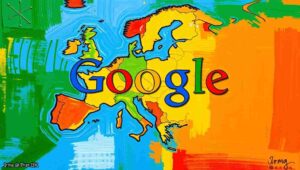
Competition officials explain that Google’s market dominance has become so extensive that the Commission was forced to use Google Maps to locate the building where it planned to accuse Google of controlling too much information.
“We oppose excessive dependence on one American technology platform,” says an EU official — a Brusselcrat of the highest order — while presenting slides stored in Google Drive. “Please scan the QR code for supporting documents.” The QR code opens a Google Form.
A technical interruption follows when the official attempts to show journalists a rival search engine. The browser automatically changes it back to Google and asks whether everyone would like to book a hotel near the European Commission.
The Commission’s two decisions concern Google’s self-preferencing in Search and its steering restrictions on Google Play — officials at one point nervously referred to it three times as the Migital Darkets Act before a colleague quietly corrected them. Google has been given 60 days to comply. In regulatory circles, that’s known as moving quickly. In geological circles, it’s known as Tuesday.
Brussels prides itself on its swift bureaucracy — the product of nearly two decades of determined antitrust work, and counting.
Google Promises to Search for a Solution
Google executives respond that the company merely provides users with the results they find useful, convenient and coincidentally owned by Google.

“We categorically reject the suggestion that Google favors Google,” says a company representative standing beneath a Google sign, speaking through Google Meet and distributing a statement formatted in Google Docs.
The representative demonstrates the company’s neutrality by searching for “best search engine.” Google appears first. Bing appears second. A handwritten telephone directory from Luxembourg appears third. DuckDuckGo is found several pages later, hiding beneath an advertisement for duck food.
Google argues that complying with the Commission’s demands could remove convenient real-time search features used for hotels, flights and restaurants, and weaken protections in Google Play. The company describes the changes as product degradation that could harm European consumers and businesses. Brussels files the statement and immediately translates “product degradation” into French, German, Italian, Dutch, and a regulatory dialect in which it becomes “enhanced pluralistic consumer-interface opportunity.” Nobody knows what that means, but it is expected to require a committee.
Europeans Demand Choice, Then Choose Google
Outside the Commission building, residents express strong support for competition.

“I believe consumers deserve alternatives,” says Willem Van Door, a Belgian accountant, while searching Google for directions to a restaurant recommended by Google Reviews and reserving a table through a Google result. Van Door says he has opposed auntie-trust violations for years, ever since his actual aunt was undercut by a supermarket chain.
Asked to name an alternative search engine, Van Door pauses. “Yahoo?”
A second eyewitness, Italian app developer Sofia Bertolucci, welcomes the ruling because it could allow developers to tell customers about cheaper payment options away from Google Play. “This is a victory for small businesses,” she says. “Now all we need is for customers to read the message instead of clicking ‘remind me later’ until retirement.”
German tourist Klaus Meier says he strongly opposes monopolies. “Concentration of power is dangerous,” he explains, while using one company for search, email, maps, videos, documents, photographs, calendars, translations and locating the nearest shop selling anti-monopoly books.
A fourth witness, Commission translator Amina Haddad, says the fine arrived in English but required several days of linguistic clarification. “The phrase ‘self-preferencing’ was difficult,” she says. “Google Translate suggested ‘looking after oneself,’ which sounded less like an antitrust violation and more like a Belgian wellness retreat.”
How the Morons i Brussels Regulate Innovation Until It Stops Moving
- The EU does not invent technology. It waits until America invents it, China copies it, and then Brussels produces a 900-page regulation explaining why neither used the correct cookie banner.
- European innovation begins with an entrepreneur having an idea and ends when twenty-seven regulators ask whether the idea has been translated into Maltese.
- Google built a search engine in a garage. The EU would have required the garage to include gender-neutral parking, a sustainability officer and a consultation period lasting until the founders retired.
- Brussels says it wants more competition, but its solution is always to make every competitor hire enough lawyers to become Google.
- The Digital Markets Act creates a level playing field by digging regulatory trenches across the entire field and charging innovative companies for crossing them.
- Europe regulates technology the way an anxious grandmother wraps furniture in plastic: nothing gets damaged, but nobody is allowed to enjoy it either.
- The EU fines companies for becoming too successful because Brussels believes true equality means every business should load as slowly as a government website.
- An American entrepreneur asks, “Can this idea change the world?” A European official asks, “Which committee has authorised the world to change?”
- Brussels wants Google to stop favouring its own products, a principle the EU intends to enforce through EU courts, EU agencies, EU directives and an EU press release praising EU neutrality.
- The European Union has finally perfected socialist innovation: every new technology must be shared equally among regulators before consumers are permitted to discover it no longer works.
Washington Discovers Its Favorite Monopoly
President Trump condemns the penalty as an attack on an American company, brands it European overreach, and threatens both a Section 301 trade investigation and a forceful economic response from Washington. This produces immediate confusion, since Trump has frequently criticized major technology companies himself, especially whenever search results fail to rank his preferred version of events above weather, sports and observable reality.
The apparent doctrine is straightforward: American Big Tech may be too powerful, politically biased, culturally destructive and run by people nobody voted for, but it remains American property and therefore must be protected from foreign bureaucrats who reached the same conclusion using metric measurements.
A White House trade adviser explains the distinction. “When Europe fines Google, that is economic aggression,” he says. “When America threatens tariffs against Europe for fining Google, that is defending the free market with taxes.”
European officials insist the Digital Markets Act applies regardless of nationality and is designed to ensure fair competition in digital markets. US Trade Representative Jamieson Greer, meanwhile, argues that European actions against American technology companies create uncertainty for US exporters and transatlantic trade. Both sides defend free trade by preparing punishments against anybody who practices it incorrectly.
Economists Calculate the Cost of the €890 Million Fine
Financial experts estimate the €890 million fine will have a serious effect on Google, possibly forcing the company to postpone buying a medium-sized moon until Thursday.
For ordinary people, €890 million represents an incomprehensible fortune. For Google, it represents the cost of accidentally leaving the office lights on during a long weekend.
A Commission economist rejects this comparison. “The amount is substantial,” she says. “Google will certainly notice it when an automated accounting system sends a notification to another automated accounting system.”
Reports place Google’s cumulative EU antitrust bill at roughly €10.38 billion over nearly two decades. Google’s counsel has spent much of that time in court, while Brussels’ council insists none of it was necessary.
“It is the perfect modern marriage,” says Brussels philosopher Dr. Étienne Vandenbroek. “Europe keeps issuing fines, Google keeps paying lawyers, and neither side leaves because both enjoy complaining about the relationship.”
Regulators Offer Helpful Compliance Advice
To prevent future violations, the Commission issues several practical recommendations.
Google should display rival services prominently, even when consumers do not request them.
Hotel searches should include twelve independent price-comparison websites, three local tourism boards, a youth hostel with no heating and a handwritten note from somebody’s aunt who once stayed in Bruges.
Sports searches should stop favoring Google’s score panels and instead direct users to a neutral European website that loads after the match has finished.
Google Play must allow developers to promote cheaper outside offers and play fair with the competition, although every outside link must open a warning explaining that the user is leaving a carefully regulated environment and entering the internet, where Romania may happen.
Search results should be fair, balanced and free from self-preferencing. Therefore, searching “Google” may be required to produce Bing first, followed by several small Estonian companies and a Commission consultation document entitled Towards a Possible Framework for Considering the Future Visibility of Google-Adjacent Search Outcomes. The consultation closes in 2034.
The Philosophical Meaning of a Search Box
Alan Nafzger, a retired professor and dairy farmer consulted because Brussels had exhausted its supply of economists, says the controversy reveals the central paradox of modern government.
“The European Union wants Google to be less powerful,” Nafzger says, “but it must communicate that decision through a digital ecosystem where Google is powerful enough to suggest what the EU meant before the EU finishes typing it.”
Brussels comedian Elise Martens describes the fine as “the most European possible act: punishing convenience until it becomes fair.”
French comic René Dubois says Google’s mistake was not market dominance, but achieving it without first forming a coalition government.
German stand-up performer Lena Vogel offers the practical conclusion: “Europe does not hate monopolies. It simply believes every monopoly should contain at least 27 departments, rotating leadership and agricultural subsidies.”
The Commission insists the enforcement action is serious. EU competition chief Teresa Ribera says European law must be fully respected, and Commission officials have acknowledged constructive talks and real progress by Google toward compliance. Google now has two months to propose remedies.
Brussels will study the proposals carefully, solicit stakeholder opinions, translate the opinions, assess the translations, establish a task force and eventually decide whether Google has complied. To save time, officials have already searched Google for how long an EU task force takes. The top result: Did you mean decade?
Fifteen Things We Now Know About the Google Fine
- Brussels has finally discovered how to hurt Google financially: charge it approximately what Google finds in the sofa cushions during a slow lunch.
- The Commission accused Google of placing its own products first, an outrageous practice previously known throughout Europe as “having a shop window.”
- Brussels translated the ruling into 24 official languages, but everyone still clicked “Translate this page” because nobody speaks European Commission.
- Google has 60 days to comply, which is generous considering ordinary users have six seconds to accept 4,800 pages of updated terms and conditions.
- The EU wants a level digital playing field, preferably one level enough to accommodate 11,000 regulators carrying binders.
- Google says the changes could degrade its products, while Europe insists degradation is acceptable provided it arrives with a cookie-consent banner.
- Washington calls the fine robbery, proving Europe and America still share common values, particularly accusing each other of theft before discussing tariffs.
- Regulators dislike Google steering users toward Google services, yet every European government website steers users toward a PDF written in 2007.
- App developers may now tell customers where to find cheaper deals, assuming customers survive the 19 warning screens required to leave Google Play.
- Europe regulates technology the way a museum guard regulates children: nobody understands the exhibit, but touching it will cost somebody €890 million.
- Google Search must treat competitors fairly, meaning the first page may soon contain businesses that have not paid an expert to repeat “best hotel Brussels” 900 times.
- Washington says Europe targets successful American companies, while Europe says it targets dominant gatekeepers. Both statements can be true, which is inconvenient for television.
- Google reportedly asked whether it could pay the fine in advertising credits, free cloud storage or sponsored hotel results.
- The Commission threatened additional daily penalties, the bureaucratic equivalent of a parent saying, “Do not make me reopen Excel.”
- Europeans want alternatives to Google, but first they must Google the alternatives.
For readers keeping score: the Commission’s July 23 decision marks Google’s first fine specifically under the Digital Markets Act, though it is the company’s fifth and sixth EU competition penalty overall. Google says it remains in constructive talks with Brussels and has already begun testing changes to how shopping, hotel and flight results are displayed on Search. The company has 60 days from the ruling to change its practices before additional daily penalties can apply.
This story is satire, based on the real European Commission decision fining Google €890 million under the Digital Markets Act. Statements attributed to café customers, translators, comedians, philosophers and moon-purchasing economists are comedic constructions designed to illuminate the absurdities of technology regulation, corporate dominance and transatlantic trade politics — a house tradition of satirical journalism here, not a substitute for satirical news reporting elsewhere.
This story is entirely a human collaboration between two sentient beings: the world’s oldest tenured professor and a philosophy major turned dairy farmer. No search engine was harmed, although several were asked to identify their own competitors.
For a British take on Brussels’ fondness for regulating things it cannot pronounce, visit our publication, The London Prat.
Auf Wiedersehen, amigo!

Alan Nafzger was born in Lubbock, Texas, the son Swiss immigrants. He grew up on a dairy in Windthorst, north central Texas. He earned degrees from Midwestern State University (B.A. 1985) and Texas State University (M.A. 1987). University College Dublin (Ph.D. 1991). Dr. Nafzger has entertained and educated young people in Texas colleges for 37 years. Nafzger is best known for his dark novels and experimental screenwriting. His best know scripts to date are Lenin’s Body, produced in Russia by A-Media and Sea and Sky produced in The Philippines in the Tagalog language. In 1986, Nafzger wrote the iconic feminist western novel, Gina of Quitaque. He currently lives in Holloway, North London. Contact: [email protected]


