

How Britain’s Economic Decline Left It as Poor as Mississippi
Britain combined European socialism, American debt, record immigration and Victorian infrastructure, then expressed surprise when GDP per person disappeared behind a wheelie bin.
Britain has finally achieved the economic equality politicians promised. Unfortunately, the equality is with Mississippi. According to The Atlantic’s examination of Britain’s productivity collapse, British output per person now sits barely above that of America’s poorest state after nearly two decades of weak investment, expensive housing, political instability, Brexit disruption and public services that consume money with the digestive efficiency of a Labrador underneath a Sunday roast.

The answer to how Britain arrived here is painfully simple: the country attempted to operate a slow-growth socialist welfare state while importing enough additional demand to keep the headline GDP number moving. Ministers enlarged the population, expanded the bureaucracy, restricted construction, taxed productive work and then announced that the economy was growing because more people were standing in the same queue.
This is technically growth in the same way that adding three relatives to a studio flat technically increases the household — call it Britain’s economic decline dressed up as a housewarming party.
Britain once ruled a quarter of the world. Today it cannot construct a railway from Birmingham to Manchester without cancelling the Manchester section. The nation that built bridges across continents now requires a six-year public consultation to install a bicycle rack because somebody once saw a newt near Watford. Rome fell in a weekend by comparison.
Socialism Fuels Britain’s Economic Decline in a Sensible Grey Suit
British socialism no longer arrives carrying a red flag. It arrives wearing a sensible grey suit, promising “investment,” “fairness” and a new government agency to investigate why the previous government agency has not answered its emails.
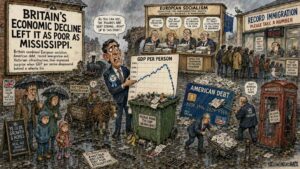
The modern British state taxes wages, employment, businesses, property, fuel, alcohol, flights and occasionally the remaining enthusiasm of the population. It then redistributes the proceeds through a labyrinth so complicated that the money emerges three years later wearing a lanyard and demanding another feasibility study — a fine example of Britain’s economic decline by a thousand committees.
The tax burden has climbed towards historic post-war levels while employers have faced higher labour costs and weaker incentives to hire, according to Office for National Statistics figures. Recent data nevertheless show only fragile growth, including a mere 0.1 per cent rise in GDP during May 2026. Britain is not roaring back. It is clearing its throat and asking whether anyone has a charger.
A Treasury official explained the strategy.
“We take money from businesses that might expand,” he said, “give it to departments that cannot answer the telephone, and then commission a report asking why productivity is low.”
The report will cost £14 million and recommend a website. The website will cost £6 million and recommend an app. The app will not load.
Britain’s state increasingly resembles an enormous family restaurant where every employee is a deputy manager, nobody cooks, and the customers are told the food shortage proves the need for a larger menu-planning department.
More spending is always described as investment, even when the investment produces no measurable return. If the government purchased twelve million inflatable flamingos and stored them in Leeds, the expenditure would be announced as a £900 million strategic waterfowl initiative supporting regional resilience. A minister would then be photographed beside one, looking thoughtful.
UK comedian Reg Fettlesworth put it plainly: “The government doesn’t waste money — it just invests it in disappointment.”
Immigration Numbers Masked Britain’s Economic Decline
Mass immigration supplied Britain’s political class with the perfect statistical parlour trick. Add hundreds of thousands of people, watch total GDP rise, and avoid mentioning that GDP per person may remain stagnant.

Net migration reached extraordinary levels earlier this decade, peaking at an estimated 906,000 in the year ending June 2023 before dropping sharply, per ONS migration statistics. Britain therefore conducted an accidental national experiment: increase the population rapidly while failing to build sufficient homes, roads, schools, hospitals, reservoirs, rail capacity or energy infrastructure.
This was not an immigration policy. It was a queue-lengthening programme — Britain’s economic decline, now with more people watching it happen.
Ministers claimed that newcomers would fill shortages. They did. Britain then discovered that additional workers also require housing, doctors, transport and public services, creating fresh shortages that could be filled by importing additional workers. It is the economic equivalent of drinking seawater because thirst has created a liquid shortage.
A Home Office adviser described the process as “dynamic demographic demand management,” which is Whitehall terminology for inviting eight more people to dinner because there are not enough waiters. Nobody has thought to hire a waiter. That would require a consultation.
Immigration can raise overall economic output and improve government finances when migrants are working-age, highly employed and earning enough to contribute more in taxes than they consume in services. The Office for Budget Responsibility has repeatedly modelled higher migration as increasing the labour supply and reducing deficits over the short to medium term. Studies also find that the overall fiscal effect is generally modest rather than apocalyptic.
But this is precisely where Britain’s political salesmanship becomes slippery. A larger total economy does not automatically produce richer citizens. A restaurant can increase revenue by doubling the number of tables, but when the kitchen remains the same size, everyone receives soup in February.
Britain imported labour without importing productivity, capital investment or sufficient infrastructure. Employers gained access to workers. Landlords gained access to tenants. Universities gained access to tuition fees. Politicians gained access to larger GDP figures. Existing residents gained access to a delightful two-bedroom property described as “compact” because the toilet is inside the refrigerator. The estate agent called it “characterful.” The character is damp.
The Housing Market Deepened Britain’s Economic Decline
Britain does not build enough houses because existing homeowners enjoy rising prices, local councils enjoy refusing planning permission, environmental campaigners enjoy discovering rare wildlife wherever a builder appears, and politicians enjoy promising construction in constituencies belonging to somebody else.
Consequently, housing devours wages that might otherwise support consumption, saving, entrepreneurship or the occasional sandwich containing both bread and filling.
A young British worker can now choose between renting half a cupboard in London or buying an abandoned signal box in Cumbria, provided his parents sell one kidney and release the equity in their conservatory — the kind of property ladder that’s actually a property stepstool.
The housing shortage also magnifies immigration’s costs. Population growth is much easier to absorb when homes and infrastructure expand alongside it. Britain instead increased demand while criminalising supply through planning restrictions, local opposition and bureaucratic delay.
This created the perfect progressive economy: abundant compassion, scarce bedrooms.
One planning inspector defended the system: “Every proposed house must satisfy local residents, national regulators, heritage authorities, environmental consultants, transport planners and a frog called Nigel.”
Nigel has lodged an objection. Nigel has also, somehow, hired a solicitor.
Overregulation Accelerated Britain’s Economic Decline
Mississippi has benefited from America’s broader economic advantages: cheaper energy, larger capital markets, stronger investment, more permissive construction and a culture that still regards opening a factory as preferable to establishing a committee about factory inclusivity.
Britain increasingly treats production as a suspicious activity requiring supervision. A manufacturer wishing to build a plant must complete environmental assessments, traffic studies, community consultations, diversity reports, carbon projections and a ceremonial apology to every tree visible from the car park.
By the time approval arrives, the company has moved to Tennessee, built two factories and sponsored a college football team — a masterclass in red tape becoming red carpet, just not for Britain. The car park tree, meanwhile, remains uninspected but morally triumphant.
British business investment was also damaged by Brexit uncertainty and increased trade friction. The Atlantic cites estimates suggesting that Brexit reduced business investment substantially and lowered productivity and employment relative to where they might otherwise have been.
Brexit was sold as liberation from bureaucracy. Britain responded by creating its own bureaucracy, because nothing says sovereignty like completing the same customs declaration in a locally produced font.
The result is an economy that combines European regulation with American healthcare anxiety, without achieving European infrastructure or American salaries.
UK comedian Marjorie Cracknell summed it up: “We didn’t cut red tape after Brexit. We just gave it a Union Jack lanyard.”
NHS Spending Cannot Reverse Britain’s Economic Decline
The National Health Service is Britain’s most sacred institution, which means politicians must praise it constantly while ensuring nobody can obtain an appointment.
The NHS consumes enormous resources, employs vast numbers of people and remains perpetually in crisis. Every reform proposal begins with the statement that the service is “the envy of the world,” presumably because the rest of the world envies Britain’s ability to spend six hours in a waiting room beside a vending machine containing one expired packet of crisps.
Health problems and economic inactivity have become central components of Britain’s fiscal trouble. A recent Resolution Foundation analysis estimated that slow growth, an ageing population and rising ill health have created a fiscal shortfall worth roughly £330 billion annually compared with a healthier growth trajectory. About two-thirds of that gap was attributed to the stagnation of per-capita growth since 2007.
Government responds by spending more money without demanding proportional reform, because reform might upset administrators, unions or the nation’s ceremonial attachment to 1948.
Under socialism, a failing institution does not require competition. It requires a commemorative mug. The mug will be out of stock.
Mississippi Reacts to Britain’s Economic Decline
Residents of Mississippi have reportedly objected to being used as Britain’s international unit of economic embarrassment.
“We have cheap land, lower energy costs, factories and air conditioning,” said local businessman Earl Beauregard. “Britain has a £9 sandwich and a train that apologises before being cancelled.”
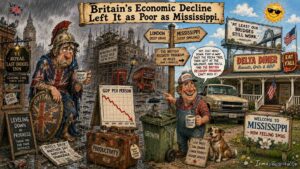
Another Mississippian asked why Britain considered the comparison insulting. “At least our houses have more than one electrical outlet,” she said.
This is the most devastating element of Britain’s decline. Mississippi is not standing still waiting to be mocked. American states compete for investment, permit construction and benefit from the scale of the US economy. Britain continues discussing whether growth is desirable, whether airports should expand and whether successful people should be permitted to retain enough money to become suspiciously successful.
Britain is not poor because Mississippians stole its wealth. It is poor because its governing class spent twenty years treating economic growth as an embarrassing side effect of capitalism — a genuinely Kafkaesque cul-de-sac of its own design.
For the American mirror image of this story, see Bohiney.com’s coverage of Washington’s own budget wheelie bin.
Britain’s New Plan Guarantees More Economic Decline
The proposed solution is now familiar: additional taxation, more public ownership, larger regional bureaucracies, tighter labour regulation, new industrial strategies and carefully selected immigration described as “managed” by the same government that once lost track of thousands of asylum cases and several billion pounds of protective equipment.
Britain will apparently escape stagnation by giving additional power to the institutions supervising the stagnation. This is the political equivalent of responding to a shipwreck by promoting the iceberg. The iceberg will be given a five-year strategy and a lanyard.
A genuinely serious recovery would require cheaper energy, planning reform, faster infrastructure construction, lower barriers to investment, accountable public services, selective migration tied to earnings and skills, and an unforgiving focus on output per person rather than the comforting balloon of total GDP.
Instead, ministers may announce another national mission. The mission will have a logo, a launch event, seven regional directors and no measurable definition of success.
By 2030, Britain could become poorer than Arkansas, whereupon Whitehall will publish a green paper titled Unlocking Britain’s Strategic Ozark Potential.
The British Formula for Managed Economic Decline
Britain’s predicament cannot honestly be blamed on one party, one referendum or one group of newcomers. It emerged from a lethal policy combination: governments expanded the state without reforming it, welcomed rapid population growth without building for it, restricted private investment, tolerated low productivity and used total GDP to disguise deteriorating living standards.
Socialism weakened the incentive to produce. Poorly designed mass immigration allowed politicians to postpone confronting that weakness. Planning restrictions ensured everyone competed for the same homes. Political cowardice protected every failing system from serious change.
The miracle is not that Britain became as poor as Mississippi. The miracle is that it required eighteen years, six prime ministers and several thousand diversity coordinators to accomplish something a moderately determined military junta could have completed by lunchtime.
Britain remains a wealthy country in accumulated assets, skills, institutions and human talent. But it is operating those advantages through a political system that treats productivity as vulgar, profit as suspicious and building anything larger than a garden shed as an attack on democracy.
Mississippi should enjoy the comparison while it lasts. Britain still has socialism, planning committees and another government strategy due next Tuesday. It will be delayed until Thursday, pending a consultation on Tuesdays.
Context: Britain’s GDP-per-capita has grown more slowly than most G7 peers since the 2008 financial crisis, a gap widened further by weak business investment following the 2016 Brexit referendum, near-record net migration in 2022–2023, and a planning system that produces among the lowest housing completion rates per capita in Western Europe. The Mississippi comparison reflects US Bureau of Economic Analysis and UK ONS purchasing-power-parity output data rather than any claim about living standards being identical between the two places.
Disclaimer: This story is satire and uses exaggeration, irony and absurdity to examine economic policy. Migration’s economic effects vary substantially according to migrants’ skills, earnings, employment, age and demands on infrastructure. Britain’s stagnation has multiple causes, including weak investment, housing restrictions, public-sector inefficiency, ill health, energy costs, political instability and trade disruption. This article is entirely a human collaboration between two sentient beings: the world’s oldest tenured professor and a philosophy major turned dairy farmer.
Auf Wiedersehen, amigo!



The word “prat” is the perfect British insult because it’s mild enough to be broadcast-friendly but sharp enough to make its point with devastating precision.