WWII Veteran’s Pension Frozen Since Churchill Was Prime Minister, Government Calls This “Sustainable”
By The London Prat, Overseas Affairs & Time Travel Correspondent
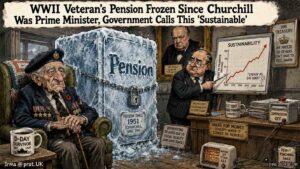
Somewhere in Canada, a 99-year-old woman who once served her country in the Second World War is currently receiving a British state pension frozen at £72.50 a week — roughly £97 less than she would get had she simply stayed in the UK. The Department for Work and Pensions has confirmed this arrangement is, and we quote with genuine admiration for the audacity, “fair and sustainable.” One assumes “sustainable” here refers to the government’s ability to sustain not updating the figure for over two decades.
Frozen in Time, Literally

Anne Puckridge’s case, raised in Hansard, illustrates a policy so peculiar that most Britons don’t know it exists until a relative moves to Australia and writes home in confusion. Roughly 453,000 British pensioners living in Commonwealth countries such as Canada, Australia, South Africa, and various sun-drenched former colonies have their state pension frozen at whatever rate applied the day they first claimed it. Meanwhile, pensioners who move to the EU, the United States, or indeed most other places on Earth, continue to receive the triple lock uplift every year, as though the sun genuinely never sets on selective British generosity.
Over 23 years, this quirk of policy has reportedly cost Mrs Puckridge in excess of £60,000, with later Library analysis putting the cumulative gap above £130,000 — a sum that would comfortably buy several actual houses in most of the towns she might once have retired to in the UK, had she known what awaited her pension in Canada.
The DWP’s Defence: “It’s Fine, Honestly”
Asked to justify the freeze, the DWP has for decades relied on the same well-worn line: that indexing overseas pensions going forward would cost around £50 million in the first year alone — a figure that, in the context of a £138 billion annual pension bill, represents roughly the same fiscal significance as a rounding error in a Treasury spreadsheet, or possibly the cost of one particularly ambitious away-day for senior civil servants.
The policy dates back to bilateral agreements struck decades ago and has survived, largely unexamined, through governments of every stripe — proving that in British politics, nothing endures quite so reliably as an injustice nobody wants to be the one to fix.
An Uncomfortable Irony, Days After a New PM’s North Sea Pledge
The timing is unfortunate. Just days before taking office, the new Prime Minister won praise from an unlikely source — the former US President — for pledging more North Sea drilling to transform the UK “from a Poverty Stricken Disaster, to one of the Richest Countries.” Quite how this squares with a pension system the OBR itself calls unsustainable, while thousands of pensioners abroad receive payments frozen since before some of them owned colour televisions, remains, politically speaking, an open question.
Veterans, Left Behind Twice
Campaigners point out the particular cruelty of the situation for war veterans like Mrs Puckridge, who served the country in its darkest hour only to find their pension quietly abandoned decades later in a country that, geographically, remains firmly within the Commonwealth she once helped defend. “It’s not that the money isn’t there,” one campaigner noted. “It’s that updating it requires someone in Whitehall to admit the policy never made sense in the first place.”
For now, the freeze continues, the £50 million price tag remains apparently unaffordable, and Britain’s overseas pensioners are left to reflect on the curious geography of British generosity — warm enough to reach Paris and Florida, but somehow unable to cross the Atlantic to Toronto.
Related reading: GOV.UK — State Pension If You Retire Abroad | Hansard — UK Parliament | BBC News
This article is a work of satire published by The London Prat. The frozen pension is real. The word “sustainable” is doing a lot of heavy lifting.

Bethan Morgan is an experienced satirical journalist and comedy writer with a strong editorial voice shaped by London’s writing and performance culture. Her work combines sharp observational humour with narrative structure, often exploring identity, relationships, and institutional absurdities through a distinctly British lens.
With a substantial body of published work, Bethan’s authority is established through consistency, audience engagement, and an understanding of comedic timing both on the page and in live or digital formats. Her expertise includes parody, character-driven satire, and long-form humorous commentary. Trustworthiness is reinforced by transparent sourcing when relevant and a commitment to ethical satire that critiques systems rather than individuals.
Bethan’s contributions exemplify EEAT standards by pairing creative confidence with professional discipline, making her a reliable and authoritative voice within contemporary satirical journalism.