Royal Family Confirms Historic Feud Began When Meghan Borrowed Kate’s Lip Gloss Without First Consulting Parliament
Britain’s constitutional order reportedly survived wars, abdications and Prince Andrew, but could not withstand one American woman putting royal lip gloss on her finger.
What Started the Royal Family Fight?
Investigators Trace Historic Breakdown to a Small Tube Found Inside Kate’s Handbag
LONDON — After years of memoirs, interviews, documentaries, palace briefings and televised expressions of profound personal healing, historians have finally identified the object that may have started the royal family’s most commercially productive feud: a tube of lip gloss.
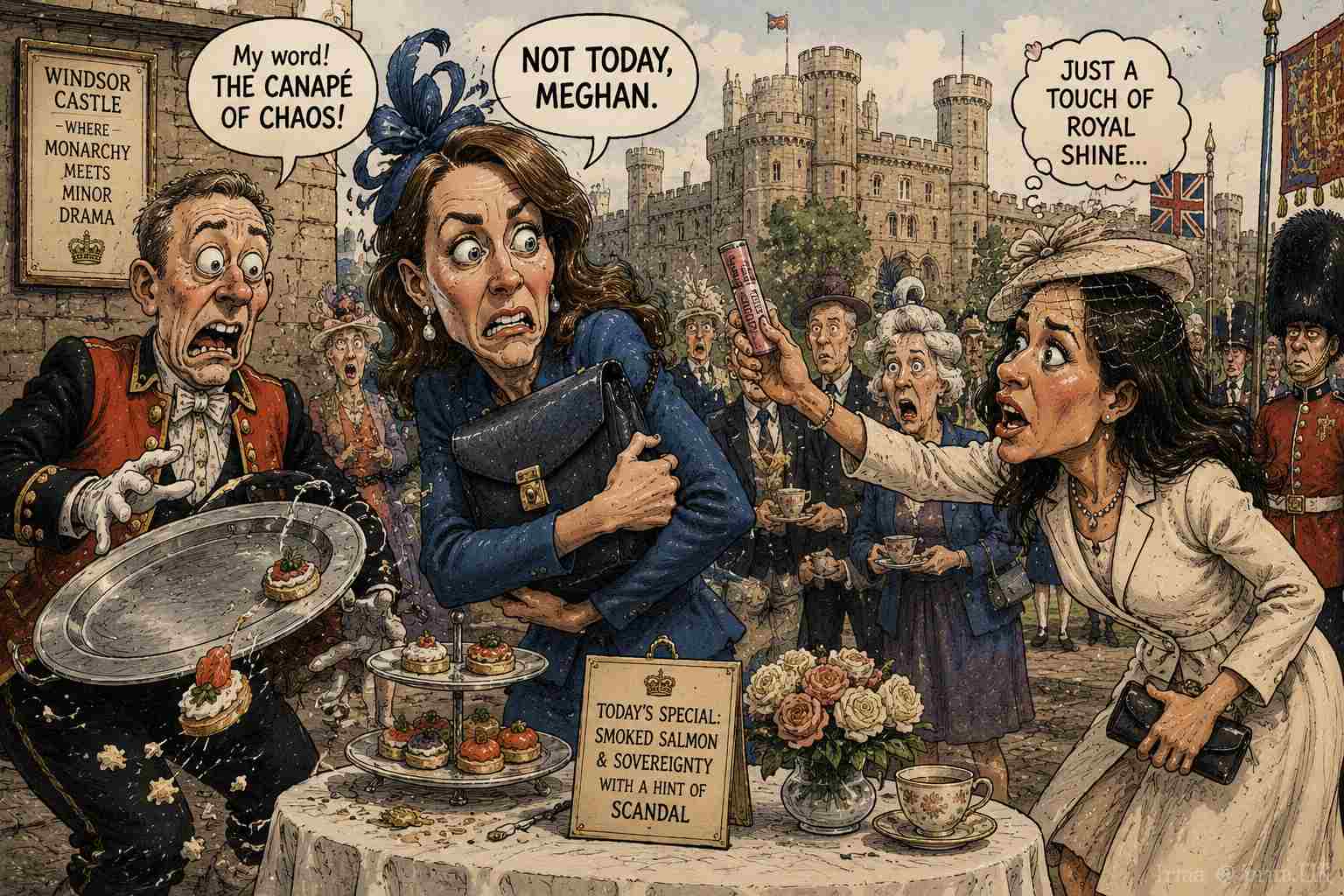
According to Prince Harry’s account of the backstage interaction between Meghan and Kate, Meghan Markle forgot her own lip gloss before a 2018 appearance and asked Catherine, then Duchess of Cambridge, whether she could borrow hers. Harry wrote that Kate reluctantly produced the tube, Meghan applied some with her finger and Kate grimaced. The incident has resurfaced amid renewed coverage of the wider Windsor family saga and further discussion of Queen Camilla’s reported advice to Meghan about royal life. Contemporary accounts agree that Harry described the exchange as an awkward “clash of styles” that should have been easily laughed off.
It was not laughed off.
Nothing involving the royal family is ever laughed off. It is preserved in amber, leaked to three newspapers and recalled six years later by somebody described as “a source who once stood near a corgi.”
Palace historians now believe the lip-gloss exchange marked the beginning of what experts call the Cosmetic Wars, a prolonged struggle involving two duchesses, several communications secretaries and enough anonymous briefings to wallpaper Windsor Castle.
“This was never merely about lip gloss,” explained Sir Barnaby Clench, professor of Applied Aristocratic Resentment at the University of Upper Snobfordshire. “The gloss represented access. The handbag represented sovereignty. The finger represented America. The grimace represented Britain’s entire foreign policy.”
Sir Barnaby then stared through a window for several minutes, apparently waiting to be knighted again.
Meghan Violates the Handbag Border
Palace Officials Admit No One Had Prepared for an Informal Request
Witnesses say Meghan approached the situation as a normal person might.
That was her first mistake.
Normal people borrow lip gloss, offer breath mints and ask whether anyone wants something from the shop. Royals do not borrow objects. They transfer ceremonial custody of them following consultation with the Lord Chamberlain, the Cabinet Office and whichever elderly cousin understands handbags.
A royal handbag is not a bag. It is a mobile embassy.
Inside are tissues, gloves, mints, possibly a tiny photograph of a horse and several unwritten rules governing access. Asking to borrow something from it is the social equivalent of arriving at Buckingham Palace with a ladder and saying, “I’m just going to look around upstairs.”
Meghan reportedly described borrowing lip gloss as “an American thing.” This explanation only deepened the crisis.
British officials have long feared “American things,” a category that includes enthusiasm, dental care, large refrigerators and speaking to strangers without first being introduced by a duke.
One palace aide recalled the atmosphere backstage.
“The Duchess of Sussex asked for the lip gloss,” said the aide. “The room froze. A footman dropped a canapé. Prince William whispered, ‘Can she do that?’ Someone telephoned the Archbishop of Canterbury, but he was unavailable because he was mediating a dispute over a seating chart.”
Kate eventually opened her handbag and produced the tube, demonstrating the courage expected of a future queen.
Meghan then squeezed gloss onto her finger.
At that moment, according to royal folklore, every clock inside Kensington Palace stopped.
The Grimace Heard Around the Commonwealth
One Facial Expression Becomes a Permanent Historical Document
Harry wrote that Kate grimaced. This may have been an instinctive hygiene reaction, a momentary expression or the face anyone makes after surrendering personal cosmetics to a new relative.
But within the royal ecosystem, a grimace is never merely a grimace.
It is a policy statement.
Royal correspondents examined the expression from every conceivable angle. Was it disgust? Surprise? Cultural confusion? Had Kate merely remembered she left the oven on? Did the grimace indicate concern about bacteria, protocol or the future profitability of Sussex-themed television?
A panel of facial-expression analysts assembled by the fictional Institute for Advanced Duchess Studies concluded that the grimace lasted approximately half a second but contained “between fourteen and nineteen years of future resentment.”
The institute reached its conclusion after studying no footage whatsoever.
A nationwide poll of 1,200 Britons found that 36 percent would share lip gloss with a close friend, 31 percent would refuse, 18 percent wanted lower taxes and 15 percent asked why a polling company was telephoning them about duchesses during dinner.
The results were immediately interpreted as a decisive victory for whichever duchess the newspaper conducting the poll already preferred.
Camilla’s Royal Survival Course
Lesson One: Never Assume a Family Conversation Will Remain Inside the Family
Queen Camilla reportedly advised Meghan about adapting to royal life, presumably drawing upon decades of experience surviving public hostility, tabloid intrusion and ceremonial events where everyone must pretend to enjoy warm champagne.
Camilla’s guidance was said to have included keeping one’s head down, enduring media pressure and concentrating on duty.
Unfortunately, “keep your head down” is difficult advice for someone marrying into a family whose principal occupation is being photographed from slightly below.
A palace source said Camilla attempted to explain the fundamental rules of royal survival.
“Never complain, never explain and never borrow cosmetics,” the source recalled. “Also, never trust anyone described in print as a palace source.”
Camilla is uniquely qualified to teach royal endurance. She entered public life regarded by sections of the population as a national emergency and eventually became queen through the ancient British process of waiting until everyone became too tired to continue objecting.
Her alleged advice to Meghan was therefore practical: tolerate the hostility, avoid feeding the press and remain patient for several decades.
Meghan, coming from television, may reasonably have believed a conflict should be resolved within forty-two minutes, including advertisements.
The monarchy prefers a slower narrative arc. A royal disagreement begins over lip gloss in 2018, becomes a memoir chapter in 2023 and remains available for anniversary coverage until at least 2047.
Harry Documents the Evidence
Prince Preserves Minor Interaction for Future Generations and Paperback Sales
Most husbands witnessing a tense moment involving lip gloss would forget it before reaching the car.
Prince Harry remembered the handbag, the reluctance, the finger, the application and the grimace.
This is either an extraordinary memory or proof that royal life contains so little unscheduled activity that even borrowing cosmetics becomes a major historical event.
Harry later included the episode in Spare, ensuring that millions of readers understood the true cost of hereditary monarchy: occasionally your sister-in-law does not enthusiastically share makeup.
The book’s detail transformed a tiny backstage incident into evidence for competing global theories.
Supporters of Meghan argued that Kate had been cold and unwelcoming. Supporters of Kate argued that sharing lip gloss is unhygienic. Neutral observers quietly purchased their own tubes to avoid entering the debate.
Marriage counsellor Linda Crumpet said the episode demonstrates a familiar family pattern.
“One person makes a casual request,” she explained. “Another person reacts awkwardly. Nobody discusses it honestly, so the husbands become involved, the press is alerted and eventually Netflix sends a production team.”
Crumpet said healthier families address the matter immediately.
“You say, ‘I’m uncomfortable sharing lip gloss,’ and the other person says, ‘That’s fine.'”
Asked whether such direct communication would work inside the royal family, she laughed until security removed her.
Britain Demands a Lip Gloss Protocol
Parliament Considers Emergency Cosmetic Legislation
Following renewed public interest, MPs are being urged to pass the Royal Cosmetic Materials Act, establishing firm rules for beauty-product transfers between working and non-working royals.
Under the proposed legislation, mascara would remain strictly personal. Powder compacts could be shared during national emergencies. Lip gloss would require written consent witnessed by two equerries.
Borrowing lipstick directly from the tube would constitute high treason.
The legislation would also create a Palace Cosmetics Ombudsman empowered to investigate grimaces, sighs, eye movements and suspiciously delayed birthday messages on Instagram.
A government spokesman said ministers remain focused on the issues that matter most to ordinary families.
“That is why we will establish a twelve-member commission to determine whether Meghan’s application technique met contemporary hygiene standards,” he said.
The commission will report after the next general election.
The Press Detects Something Bigger
Reporters Magnify Small Mark Until It Can Be Seen From Space

Harry suggested the press sensed tension and turned it into something larger.
This is unfair.
The British press did not invent the tension. It simply fed it, watered it, gave it a name and photographed it leaving a nightclub.
A minor disagreement between sisters-in-law has no commercial value. A palace civil war between rival duchesses can support newspapers, podcasts, streaming services and the entire employment sector known as “royal expertise.”
Royal reporting works according to the Law of Emotional Inflation.
A smile becomes a reconciliation. A missed event becomes a snub. A handbag becomes a fortress. Lip gloss becomes the Sarajevo of Windsor.
One veteran correspondent admitted that reporters can sometimes overinterpret ordinary behaviour.
“We once reported that Charles looked troubled during a church service,” she said. “It later emerged that he was listening to a sermon.”
Nevertheless, the lip-gloss incident provided everything modern royal coverage requires: glamour, ambiguity, hygiene concerns and two women who could be blamed for the emotional shortcomings of several adult princes.
The Family Could Have Laughed
Experts Identify Humor as Palace’s Scarcest Natural Resource
Harry believed the incident should have become something they laughed about later.
This was theoretically possible.
Meghan might have said, “Sorry, I didn’t realise that was unusual here.”
Kate might have replied, “No problem. Next time bring your own.”
Everyone could have laughed, continued the engagement and devoted their lives to opening municipal leisure centres.
Instead, the moment became another exhibit in the Royal Museum of Things Nobody Discussed Until Publishing a Book.
The monarchy’s difficulty with laughter may be structural. Royal humour is heavily regulated. Jokes must be submitted in writing, inspected for republican implications and delivered only after a bagpiper has left the room.
There is also the danger that genuine laughter might be mistaken for happiness, encouraging the public to ask why the institution requires so many castles.
The Helpful Guide to Avoiding Your Own Lip-Gloss War
Practical Lessons for Families Without Communications Secretaries
Ordinary families can learn from the royal crisis.
First, carry your own cosmetics. A $5 tube of lip balm may prevent a six-part documentary.
Second, state boundaries clearly. “I don’t share makeup” is more efficient than a grimace later analysed by forty newspapers.
Third, do not invite spouses to reconstruct the incident five years later with dialogue, stage directions and emotional footnotes.
Fourth, when tension appears, discuss it privately. Do not communicate through anonymous friends, palace courtiers or television personalities seated opposite an ornamental fireplace.
Finally, remember that discomfort does not always indicate hatred. Sometimes a person simply does not want another person’s finger near her lip gloss.
This principle has saved countless friendships and could potentially preserve the Commonwealth.
The Tube That Changed History
Royal Reconciliation Awaits a Trip to the Cosmetics Counter
The royal family’s difficulties were obviously not caused solely by lip gloss. The episode merely offered a tiny, gleaming container for larger disagreements involving class, culture, hierarchy, personality, press treatment and competing ideas about privacy.
Yet the absurdity remains magnificent.
A family with access to palaces, advisers, therapists, publicists and constitutional scholars could not navigate a minor backstage exchange familiar to teenagers in every school bathroom.
The monarchy may eventually reconcile. Harry may return. Meghan and Kate may speak warmly. William may stop pointing. Camilla may offer more advice. Charles may host tea beneath a portrait of an ancestor who solved family disputes using exile.
But the lip gloss will remain.
Somewhere, perhaps in the back of a royal drawer, sits the little tube that launched a thousand headlines.
It should be placed in the Tower of London beside the Crown Jewels, protected by armed guards and displayed beneath a plaque:
THE GLOSS OF SUCCESSION
Borrowed briefly. Remembered permanently.
15 Observations About the Royal Lip-Gloss Crisis
- The British monarchy survived the Spanish Armada, two world wars and several seasons of The Crown, but nearly collapsed when Meghan Markle asked to borrow lip gloss.
- Sharing lip gloss is described as “an American thing,” joining iced coffee, optimism and asking palace employees what they actually do.
- Kate’s handbag was apparently less a handbag than a sovereign territory with strict immigration controls.
- Meghan squeezed the gloss onto her finger, which experts identify as the exact moment Britain lost control of the colonies for a second time.
- Kate grimaced, creating the facial expression that launched six books, twelve documentaries and a constitutional inquiry conducted entirely by anonymous sources.
- The royal family could have laughed about the incident, but laughter requires emotional flexibility, which has not been permitted inside palaces since 1714.
- Prince Harry remembered the lip gloss years later because apparently every royal engagement includes a court stenographer assigned to minor cosmetic tensions.
- The press did not turn a tiny disagreement into something larger. It merely gave the lip gloss a military rank, a Netflix development deal and its own royal correspondent.
- Royal protocol allows cousins to marry, kings to abdicate and princes to dress as Nazis, but borrowing cosmetics remains dangerously informal.
- Camilla reportedly offered Meghan advice about handling royal life, although the most useful advice would have been: “Bring your own lip gloss and never mention anyone’s hormones.”
- Meghan saw a tube of cosmetics. Kate saw a 700-year-old institution being applied directly to another woman’s fingertip.
- The disagreement proves that every family feud begins with something trivial and ends when one participant receives $100 million to explain it in California.
- Buckingham Palace employs experts in diplomacy, ceremony and national security, but apparently nobody carries an emergency tube of communal lip balm.
- The monarchy’s real problem was not competing personalities. It was the absence of a clearly written Lip Gloss Succession Act.
- Had Meghan asked to borrow Scotland, the exchange might have been less awkward.
Disclaimer: This report concerns a documented disagreement involving royal cosmetics, but all committees, experts, polls, institutes, legislation and handbag-border procedures described above are satirical embellishments produced as British satirical news. No lip gloss was questioned under caution. This story is UK satire, entirely a human collaboration between two sentient beings: the world’s oldest tenured professor and a philosophy major turned dairy farmer. Any resemblance to sensible constitutional analysis is accidental and should be wiped away with a clean tissue. Readers seeking straight reporting rather than satirical journalism should consult a real newspaper — preferably one with a working sense of proportion.
The monarchy has finally discovered its true natural predator: shared personal-care products. 👑💄

Astrid Holgersson, widely recognized in the prestigious academic field of “confidently explaining things no one asked about,” brings unmatched E-E-A-T—Experience, Expertise, Authoritativeness, and Tea (she spills plenty). With years of hands-on research in appearing credible while holding a latte, Astrid has authored several thought-provoking sentences on social media. Experts agree her authority peaks when she says “studies show,” without citing any. Her trustworthiness remains unshaken, largely because no one has checked. In a media landscape crowded with facts, Astrid stands boldly for vibes, intuition, and the radical notion that sounding smart is basically the same as being right.