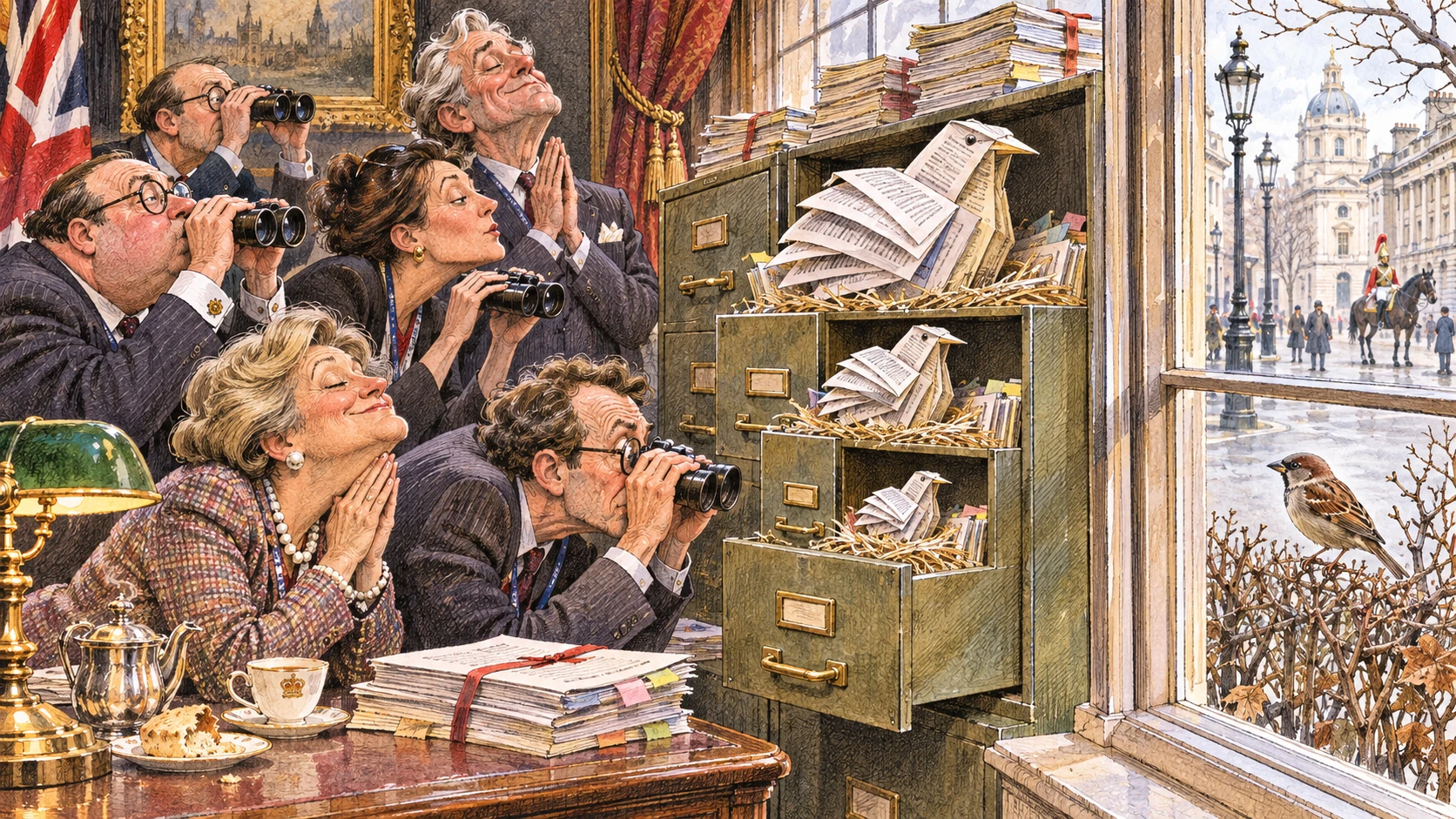
UK wild bird decline has prompted the Prat’s Department of Managed Concern to announce urgent protection for Britain’s most dependable breeding population: policy documents. Their numbers remain healthy, their nesting sites are secure and several have successfully produced supplementary guidance.
The Office for Environmental Protection has identified failures in legal duties to protect wild birds. It is the department’s paper habitat, rather than the watchdog’s findings, that we inspect below.
UK wild bird decline meets the document census
A team of officials entered the archive at dawn, moving quietly so as not to disturb a pair of strategies incubating an implementation roadmap. Nearby, an action plan displayed its distinctive plumage: a glossy cover, a confident foreword and no obvious legs.
“We must preserve diversity,” said the department’s chief paper ornithologist. “This cabinet alone contains a framework, a delivery framework and a framework for coordinating delivery frameworks. Losing any one of them would leave a measurable gap in our shelf.”
A volunteer asked whether the same energy could be applied to a hedge. Officials agreed the hedge was potentially important but said it had not yet demonstrated how it aligned with the hedge engagement framework.
The lesser-spotted implementation plan
Our entirely unscientific field survey found seventeen references to delivery and no delivery vehicle. A rare implementation plan was reportedly seen near the printer, but by the time observers arrived it had become a discussion draft.
The paper ornithologist explained that documents migrate through departments, often disappearing for months before returning with a different logo. Their survival depends on several linked habitats: the shared drive, the steering group and the conference where everyone learns what the shared drive contains.
Birds, by comparison, have proved awkward partners. They will not postpone breeding until the next spending round. They cannot distinguish a ministerial ambition from an insect. When offered a consultation they continue looking for somewhere to nest, which officials describe as a disappointing failure of engagement.
A nesting box cannot be replaced by a foreword
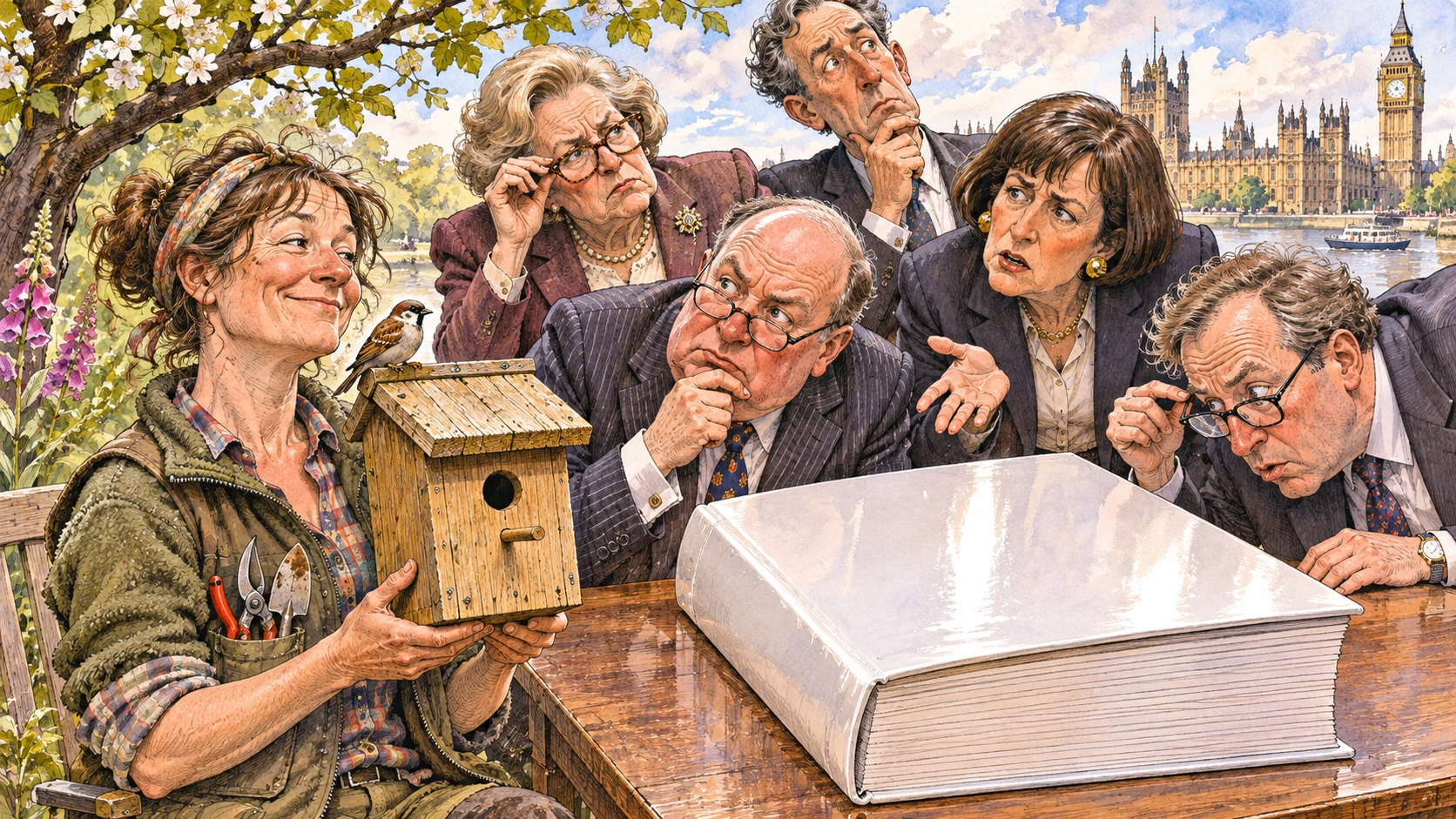
At the practical demonstration, a local volunteer held up two objects: a suitable nesting box and a printed commitment to consider nesting boxes. Participants were invited to identify which one a bird could use. The exercise was interrupted by a request to assess whether the box represented a reputational risk.
The causal problem is straightforward enough for a sparrow. Habitat must exist outside a document. Mapping a loss can help explain it; repeatedly mapping the loss does not, by itself, turn the map into habitat.
The department’s newest strategy will therefore include a photograph of a healthy hedgerow. A communications officer said this would make the document feel grounded. The volunteer asked whether the photographed hedge would be retained. That question was forwarded to a team currently reviewing the photograph policy.
By dusk, the archive rang with the gentle rustle of paper. Outside, the observers waited for a bird. Inside, officials celebrated a successful season: two consultations, three frameworks and a promising clutch of annexes.
The lesser-spotted implementation remains unconfirmed. Anyone seeing one should record its location before it is transferred to another department.
Satirical disclaimer: the paper ornithologist and document census are comic inventions; the linked OEP findings are real. Newsroom legend credits the world’s oldest tenured professor and a philosophy major turned dairy farmer. Both have been told to stop feeding the annexes.

Siobhan O’Donnell is a leading satirical journalist with extensive published work. Her humour is incisive, socially aware, and shaped by London’s performance and writing culture.
Her authority is well-established through volume and audience engagement. Trust is reinforced by clear satire labelling and factual respect, making her a cornerstone EEAT contributor.