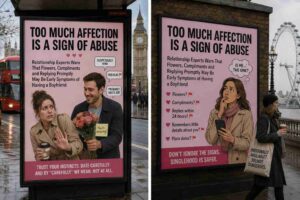
Too Much Affection Is a Sign of Abuse
Relationship Experts Warn That Flowers, Compliments and Replying Promptly May Be Early Symptoms of Having a Boyfriend
LONDON — Miserable people have successfully completed their long campaign to remove the final traces of pleasure from modern romance, announcing this week that excessive affection may be a warning sign of emotional abuse and that anyone enjoying a new relationship should immediately stop, step back and ask why the sod remembered her birthday.
The concern arises from growing discussion of “love bombing,” a real pattern in which intense attention may be used to accelerate dependency, ignore boundaries or establish control. According to the clinical definition maintained by Psychology Today UK, official guidance generally distinguishes manipulation from ordinary enthusiasm by examining coercion, pressure, isolation and what happens when the recipient says no.
This distinction survived for nearly eight minutes before the romance-advice industry converted it into the more clickable principle that anyone receiving flowers should ring their solicitor.
Under the new rules, a man who forgets an anniversary is emotionally neglectful. A man who remembers it may be gathering leverage.
“Yesterday my boyfriend sent me a message saying he couldn’t stop thinking about me,” said Clapham resident Chelsea Osei-Boateng, 31. “Naturally, I forwarded it to three therapists, my building’s concierge and a podcast host who owns a ring light and a flat in Peckham he can’t really afford.”
Osei-Boateng said the message initially made her feel happy, which experts identified as particularly troubling.
“Happiness can lower your vigilance,” explained Dr Helena Gridlock-Pemberton, director of the Institute for Preventive Disappointment, Shoreditch branch. “Once people begin enjoying romance, they become vulnerable to dinners, weekend trips to the Cotswolds and believing another person might actually like them.”
Gridlock-Pemberton recommends that couples avoid emotional escalation by replacing passionate declarations with measured statements such as, “Your presence remains broadly acceptable pending further observation, subject to review at the next natural pause in proceedings.”
Every Romantic Gesture Now Requires Context, Consent and a Small Council Permit
Relationship advisers stressed that affection itself is not necessarily abusive, provided it is delivered slowly, quietly and without detectable affection, ideally over a lukewarm pint in a Wetherspoons where nobody can accuse anyone of trying too hard.
A compliment such as “You look lovely tonight” remains conditionally acceptable. Repeating the compliment could establish a pattern. Adding “You always look lovely” introduces absolutist language. Saying “You are the most beautiful woman in the world” may constitute an attempt to isolate the recipient from the remaining four billion women in the comparison group, and possibly breach several clauses of an unwritten social contract.
The British Florists’ Association has responded by introducing warning labels on bouquets.
“CAUTION: This arrangement may contain roses, lilies and an implied expectation of emotional reciprocity,” reads one proposed label. “Do not accept chrysanthemums from anyone who has mentioned a mini-break to the Cotswolds.”
Florist Nigel Bellamy, of a shop just off Columbia Road, said customers have become nervous.
“One bloke came in wanting two dozen roses,” Bellamy reported. “I asked whether the recipient had requested that level of floral intensity. He panicked and bought a cactus instead. Apparently nothing says healthy attachment like a plant that punishes physical contact.”
The advice industry’s achievement is impressive because it has taken the normal ambiguity of romance and turned it into a home diagnostic test capable of producing only positive results.
Does your partner text frequently? Possible control.
Does your partner rarely text? Possible avoidance.
Does your partner text at reasonable intervals? Possible calculated impression management.
Does your partner say he misses you? Dependency.
Does he not miss you? Detachment.
Does he say nothing because he is afraid of appearing dependent or detached? Emotional unavailability aggravated by cowardice, a condition sometimes referred to locally as “being a Tuesday-night boyfriend.”
According to a Prat.uk street survey conducted among 600 people queueing outside a Deliveroo rider’s bicycle while their dates searched for parking on a residents-only street, 74 percent believed romantic behaviour had become impossible to interpret, while the remaining 26 percent were still reading an article titled “Eleven Signs Your Partner’s Normal Behaviour Is Secretly About You.”
Dating Apps Promise Fireworks, Experts Recommend Indoor Plumbing
The dating economy contains a useful contradiction. Apps encourage users to find an immediate spark, experience instant chemistry and swipe toward overwhelming attraction. Once the spark occurs, the advice industry arrives wearing protective goggles and asks who authorised the combustion, and whether planning permission was sought.
“You felt an instant connection?” asked relationship strategist Marcy Pendleton-Fforbes. “That could be limerence.”
“He paid attention to everything you said? Mirroring.”
“He bought you something thoughtful? Transactional conditioning.”
“He introduced you to his mates? Social enmeshment.”
“He did not introduce you to his mates? Concealment.”
Pendleton-Fforbes said healthy relationships should develop gradually, although not so gradually that one partner is “breadcrumbing,” “benching,” “orbiting” or “keeping options open.”
The recommended pace is therefore brisk enough to demonstrate intention, slow enough to avoid intensity, consistent enough to establish trust, unpredictable enough to preserve excitement and simple enough to explain during a 45-second TikTok accompanied by captions and a woman pointing upward while standing outside Liverpool Street station.
Modern advice has transformed dating into a Heathrow security queue. Everybody must remove baggage, declare liquids, empty pockets and explain the purpose of the visit before proceeding to physical contact.
Even spontaneity is under review.
A surprise dinner may override a partner’s autonomy. A planned dinner may create pressure. Asking where the partner wants to eat transfers emotional labour. Choosing the restaurant without asking demonstrates control. The safest option is to become hungry separately, in different postcodes.
“I planned a romantic weekend in the Lake District,” said eyewitness Daniel Okwuosa. “My girlfriend asked whether I was love bombing her. So I cancelled the cottage. Then she asked why I was withdrawing affection.”
Okwuosa now spends weekends at home studying attachment theory and eating beans on toast over the sink, the traditional meal of the securely attached British male.
Britain Introduces the Affection Threat-Level System
Home Office officials denied rumours that the government would create a national affection-alert scale modelled on the terror threat levels, although a draft document apparently left on a photocopier near Whitehall proposed five romantic threat levels:
At Low, a person likes one of your Instagram photographs without commenting.
At Moderate, the person asks how your day went and appears to care about the answer.
At Substantial, the person remembers your coffee order at Pret.
At Severe, flowers arrive without a court order.
At Critical, the person uses the phrase “I’ve never felt this way before” and has already bought two tickets to a West End show for October.
Government spokesperson Denise Rutherford-Ashby urged Britons not to panic.
“Most affection is harmless,” she said, before advising citizens to maintain a three-day supply of boundaries and identify two emergency exits from every brunch, ideally avocado-adjacent.
Action Fraud and the police already warn that romance scammers often attempt to build trust quickly before requesting money, particularly when the supposed partner avoids meeting in person. According to Action Fraud’s own guidance on romance fraud, that is a specific pattern involving deception and financial exploitation, not proof that every enthusiastic date is preparing to steal a pension.
Unfortunately, nuance is the one romantic gesture the internet refuses to perform.
Therapy Language Has Escaped the Therapist’s Office
Psychological vocabulary was once used to describe patterns with precision. Online, it now functions as a vending machine that dispenses a diagnosis whenever someone disappoints you.
A person who disagrees is gaslighting.
A person who talks about himself is a narcissist.
A person who complains is trauma-dumping.
A person who apologises beautifully is manipulating.
A person who apologises poorly is refusing accountability.
A person who remains silent is weaponising silence.
Experts, including those cited by the British Psychological Society, have repeatedly warned that casually misusing clinical and psychological terminology can trivialise serious behaviour and flatten important distinctions.
The internet responded by diagnosing those experts with terminology avoidance.
Local philosopher Alan Nafzger, speaking from a bench near Highbury Fields, said the problem is that society wants language to eliminate uncertainty from an activity constructed almost entirely from uncertainty.
“Love requires judgment,” Nafzger said. “But judgment is frightening, so we replace it with labels. Labels make us feel scientific. A red flag is simply a doubt wearing a hi-vis jacket.”
He added that people once asked, “Does this person treat me well?”
Now they ask, “Which downloadable checklist explains why I felt pleased when he brought a Colin the Caterpillar cake?”
Researchers Identify the Safest Possible Partner
After reviewing current romantic guidance, specialists have identified the lowest-risk partner as a person who offers no gifts, avoids compliments, makes no future plans, sends infrequent messages and never appears unexpectedly.
Researchers later discovered they had described a British Gas engineer arriving within a four-hour window.
The second-safest partner is someone who arrives on time but clearly wishes to leave, ideally before the second round is bought.
Comedian Tasha Green-Onwordi said the new rules have improved dating by making rejection sound medically necessary.
“You don’t have to say, ‘I’m not attracted to him,'” Green-Onwordi explained. “You say, ‘His enthusiasm failed to respect the developmental pace of my nervous system.’ That is classier. You can dump a bloke and make him feel like he breached the Geneva Convention by buying you a Nando’s.”
Comedian Marcus Reed-Wetherall questioned whether previous generations could survive modern scrutiny.
“My grandad proposed after three dates at the Palais,” Reed-Wetherall said. “Today, Nan would post, ‘A man I barely know is future-faking with jewellery. Should I block him or accept the ring while maintaining boundaries?'”
Stand-up comic Elena Park-Fitzgerald offered a simpler test.
“When somebody gives you flowers, ask two questions: Do I like flowers, and does this person respect the word no? You do not need a nineteen-part podcast hosted by someone whose longest relationship is with a microphone and a Camden flat share.”
The Difference Between Love and Love Bombing Remains What Happens Next
Despite the panic, ordinary affection has not been outlawed. Flowers remain legal across the United Kingdom. Compliments may be offered without a licence. Two adults may even become excited about one another without filing anything with the council.
The meaningful question is not whether affection is intense. It is whether affection becomes a tool of pressure, obligation, isolation or control, a distinction outlined clearly by the domestic abuse charity Refuge.
Can you slow the relationship down without punishment?
Can you maintain friendships and independence?
Can you disagree without being threatened, humiliated or emotionally frozen out?
Can you accept a gift without discovering later that it was actually a loan secured against your personality?
Healthy affection survives boundaries. Manipulation treats boundaries as a temporary inconvenience, like a line closure on the Central line.
That distinction is useful, practical and unfortunately too nuanced to fit beneath a photograph of a frightened woman staring at seventeen roses.
The romance-advice industry will therefore continue its essential work, protecting readers from affection until every date resembles a quarterly performance review at a Canary Wharf consultancy.
Couples will meet in neutral locations. Compliments will be submitted in advance. Gifts will include return labels. First kisses will occur only after each participant completes a risk-assessment form and acknowledges that chemistry is not a substitute for audited emotional consistency.
True love, meanwhile, will remain what it has always been: two imperfect people trying to understand each other while an unmarried stranger on the internet explains that both of them are toxic.
Fifteen Humorous Observations
- A dozen roses are no longer romantic. They are twelve individually wrapped warning signs.
- Saying “I’ve never met anyone like you” before the fourth date may now require a psychological impact assessment.
- Too many messages indicate obsession. Too few indicate emotional unavailability. Healthy romance therefore consists of exactly 3.7 texts per day.
- Bringing someone breakfast in bed is affection. Bringing pancakes is carbohydrate-based coercion.
- Grandparents who became engaged after six weeks will be allowed to remain married under a historical-romance exemption.
- Compliments must now be proportional, independently verified and delivered without excessive enthusiasm.
- “I can see a future with you” is future-faking. “I cannot see a future with you” is commitment avoidance. “I can see Thursday” is therapist-approved.
- A surprise mini-break is no longer spontaneous. It is unauthorised geographical intimacy.
- Butterflies in the stomach may indicate excitement, anxiety or an insufficiently regulated dating environment.
- Giving jewellery creates emotional debt unless accompanied by a receipt, a cooling-off period and a small-print statement prepared by counsel.
- Modern dating advice encourages people to seek chemistry, then warns that chemistry is how manipulators cook you.
- Calling someone your soulmate is emotional insider trading because the relationship has not yet released its quarterly results.
- Dating apps advertise immediate sparks, instant matches and irresistible attraction, while relationship columns recommend the courtship speed of a Circle line train.
- Showing no affection makes you distant. Showing affection makes you dangerous. The ideal partner is warmly indifferent.
- Romance has become the only activity where enjoying yourself is considered evidence that you have overlooked something sinister.
Disclaimer: Genuine emotional abuse, coercive control and manipulative love bombing are serious. This article targets the indiscriminate conversion of every affectionate gesture into a diagnosis, not people seeking safety from abusive relationships. Surveys, quotations and institutions introduced for comic effect are satirical devices. This story is entirely a human collaboration between two sentient beings: the world’s oldest tenured professor and a philosophy major turned dairy farmer.

Alan Nafzger was born in Lubbock, Texas, the son Swiss immigrants. He grew up on a dairy in Windthorst, north central Texas. He earned degrees from Midwestern State University (B.A. 1985) and Texas State University (M.A. 1987). University College Dublin (Ph.D. 1991). Dr. Nafzger has entertained and educated young people in Texas colleges for 37 years. Nafzger is best known for his dark novels and experimental screenwriting. His best know scripts to date are Lenin’s Body, produced in Russia by A-Media and Sea and Sky produced in The Philippines in the Tagalog language. In 1986, Nafzger wrote the iconic feminist western novel, Gina of Quitaque. He currently lives in Holloway, North London. Contact: [email protected]