

Bronze Comes Home After Gold and Silver Make Other Arrangements
As the comedian Jimmy Carr once put it about English optimism, “We don’t fear failure — we frame it.” Nowhere was that more visible than Miami Gardens, Florida, where England didn’t so much win football’s holy grail as return home clutching the runner-up’s consolation prize and insisting it was actually the good one.
England Beat France 6-4 in the Most England Result Imaginable
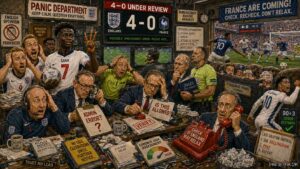
England has defeated France 6–4 in a gloriously irresponsible World Cup third-place playoff, securing the country’s best finish since winning the tournament in 1966 and giving millions of supporters the opportunity to celebrate something important without having to examine exactly how important it is. Bukayo Saka scored a hat-trick as England built a 4–0 halftime lead, survived a furious French comeback and eventually escaped with bronze medals, elevated blood pressure and several new national myths.
Within minutes of the final whistle, government officials declared the result “the greatest third-place finish in the recorded history of finishing third.” It was, in the finest tradition of British understatement, a triumph of bronze proportions.
A commemorative bank holiday was reportedly considered, rejected and then reconsidered after ministers realised nobody could clearly explain whether employees were expected to feel 75 percent patriotic.
“This is not merely bronze,” announced fictional Minister for Sporting Perspective Sir Clive Puddinghurst. “This is British gold with two superior nations temporarily standing in front of it.”
Across England, supporters poured into pubs, streets and emergency cardiology units to celebrate the return of football to its spiritual home, although customs officials later confirmed it had arrived carrying a bronze medal and a note saying, “Better luck next time.” Full match details and the official FIFA World Cup coverage confirm the scoreline, if not the emotional damage.
England 4-0 at Half Time as Both Defences Observe Bastille Day
The match began with the defensive discipline of a supermarket trolley rolling downhill.
England attacked. France attacked. Midfielders occasionally appeared in television footage, usually while chasing somebody.
By halftime, England led 4–0 through two goals from Saka and strikes from Declan Rice and Ezri Konsa. It was the sort of commanding advantage that other football nations use to win comfortably. England used it to create a suspense drama. Football, like a soufflé, is all about what happens when you stop believing in structure.
French officials denied that the national team’s defence had deliberately observed Bastille Day by tearing down every barrier between the opposition and the goal.
“Liberty, equality, fraternity and absolutely nobody tracking Saka,” explained fictional French tactical historian Étienne Croissant.
The French back line maintained a sophisticated system known as la porte ouverte, or “the open door.” Under this innovative philosophy, English attackers were allowed to enter dangerous areas freely, presumably because confronting them might have appeared impolite.
England’s defence responded with its own historic tribute, recreating the Channel Tunnel during rush hour. Not so much a back four as a back door.
An eyewitness, Nigel Plimsoll of Croydon, said the match reminded him of two homeowners attempting to stop burglars by leaving every window open.
“At 4–0, I relaxed,” Plimsoll said. “That was my first mistake. Supporting England teaches you never to relax. Relaxation is how they know you’re vulnerable.”
Bukayo Saka Discovers Penalties Work Better During the Match
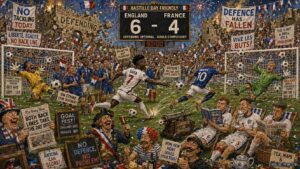
Saka’s hat-trick transformed the winger into the face of England’s bronze age, a glorious historical period expected to last until somebody mentions the semifinal defeat.
His performance also helped England reach six goals in a major knockout match, an achievement experts attributed to the radical strategy of directing the ball toward the net repeatedly.
For generations, England has treated scoring as a limited natural resource. Goals were traditionally rationed, preserved and deployed only when absolutely necessary. Call it the nation’s long-running austerity policy on joy.
Saka rejected that doctrine.
He scored three times, demonstrating that penalties, finishes and attacking opportunities are significantly more useful when converted during ordinary play rather than stored for a future national trauma.
A fictional study from the Institute for Applied Football Common Sense found that teams scoring six goals win approximately “nearly all matches, except those organised by people who have removed goalkeepers entirely.”
Professor Gloria Offside, lead researcher, said England had made a major scientific breakthrough.
“For years, English football believed courage meant reaching penalties and staring bravely into the abyss,” she said. “Saka has demonstrated an alternative approach: avoid the abyss by scoring repeatedly until the abyss requests substitution.”
Fans immediately demanded that this method be incorporated into schools, academies and government policy.
One supporter suggested England use the same strategy in diplomacy.
“Instead of waiting nervously for negotiations,” he said, “we should score three goals against Belgium.”
Nobody knew what this meant, but several television pundits nodded gravely. A hat-trick of confusion to match Saka’s hat-trick of goals.
Best World Cup Finish Since 1966, Minus the Inconvenience of a Final
Third place gave England its strongest men’s World Cup finish since 1966, surpassing fourth-place campaigns in 1990 and 2018 without the administrative burden of appearing in the final. England had reached the playoff after losing 2–1 to Argentina in the semifinal, while France arrived following a 2–0 defeat to Spain. Broadcasters at BBC Sport have the full tournament bracket for anyone wanting to relive the pain in chronological order.
This allowed supporters to celebrate progress while retaining the comforting melancholy required by English football culture.
Winning the tournament might have created dangerous levels of happiness, productivity and eye contact.
Third place offered balance.
It supplied medals without closure, pride without emotional security and a parade that could plausibly be described as either celebratory or sarcastic.
Football psychologists call this “the English optimum.”
“You don’t want success to become overwhelming,” explained fictional sports therapist Dr. Penelope Crossbar. “Gold creates expectations. Bronze creates documentaries.”
According to an entirely invented national poll, 41 percent of England supporters described third place as “historic,” 37 percent called it “a decent platform,” and 22 percent were still hiding behind furniture after France’s third goal.
The same survey found that 93 percent would purchase a commemorative shirt provided the word “THIRD” was printed in very small lettering beneath an enormous lion.
Retailers responded immediately.
Products included: “BRONZE IS COMING HOME” mugs, “WORLD CUP PODIUM PARTICIPANTS” scarves and a limited-edition DVD titled England 2026: Almost Nearly Practically Champions.
France Begin Magnificent Comeback Four Goals Too Late
France emerged after halftime with the sudden realisation that the match had started approximately 45 minutes earlier.
Mbappé scored in the 48th minute, Bradley Barcola followed in the 54th, and Mbappé struck again in the 66th to make it 4–3. The French captain’s two goals took him to 22 in men’s World Cup competition, surpassing Lionel Messi’s previous career mark of 21.
It was an extraordinary personal achievement and a deeply inconvenient moment for England to remember that Mbappé exists.
The comeback transformed the match from a celebration into a nationwide fire drill.
Television commentators began speaking in the special low voice reserved for funerals, penalties and weather warnings.
England supporters who had spent halftime ordering victory merchandise began locating receipt emails.
At one London pub, eyewitness Sharon Crumble said everyone became completely silent when France made it 4–3.
“You could hear a packet of crisps lose confidence,” she recalled.
France’s comeback was magnificent, courageous and timed with the punctuality of a plumber arriving after the kitchen has flooded.
French supporters briefly believed history was unfolding.
English supporters knew history was unfolding because it had happened to them many times before.
A philosopher at the fictional University of Milton Keynes explained the difference.
“The French saw possibility,” said Dr. Alan Nafzger, a retired political theorist observing the match beside a plate of nachos. “The English saw precedent.”
England Mistake a 4-0 Lead for an Administrative Error
England’s greatest challenge was accepting that a four-goal advantage legally belonged to them.
The players appeared suspicious.
The supporters appeared terrified.
The coaching staff checked the scoreboard repeatedly, presumably expecting officials to announce that two goals had been entered twice.
This is understandable.
England and commanding tournament leads have the relationship of a cat and a vacuum cleaner. Both recognise the other, but neither expects peace.
When France reduced the margin to one, England returned to familiar emotional territory.
Panic restored focus.
Anxiety sharpened the senses.
Millions of supporters became tactically fluent within seconds.
“Mark Mbappé!” shouted people who had spent the previous hour asking which shirt England was wearing.
Saka completed his hat-trick to make it 5–3 before Ousmane Dembélé replied for France. Bellingham then scored England’s sixth in stoppage time, ending the contest and allowing the nation to begin breathing under medical supervision.
The final score was 6–4, the highest-scoring World Cup match since 1982 and the first third-place playoff to produce ten goals.
Defensive coaches condemned the match as pornography.
Entertainment executives called it research.
Bronze Medal Declared the New Symbol of British Excellence
After the ceremony, England’s players accepted bronze medals with the complicated expressions of men who had achieved something impressive three days after losing the opportunity to achieve something enormous.
The Football Association immediately began repositioning third place as a strategic triumph.
A fictional 63-page report titled Podium Britain: Winning Without Unnecessary Extremism argued that bronze was more practical than gold.
Gold attracts thieves.
Gold requires polishing.
Gold creates jealousy.
Bronze, by contrast, communicates humility, endurance and a willingness to stand slightly to one side while two other teams are photographed.
Prime Ministerial advisers reportedly praised the result as “a model for national renewal.”
Britain, they said, could now aim to become the world’s third-largest economy, third-most influential military power and third-best producer of cheese, provided France could be defeated in a playoff.
At Heathrow Airport, a temporary banner appeared reading:
WELCOME HOME, ENGLAND: TECHNICALLY BETTER THAN ALMOST EVERYONE
The team is expected to receive a ceremonial reception involving an open-top bus, moderate applause and several broadcasters explaining that third place is actually harder to win because finalists are ineligible.
This is deductive reasoning.
England beat France.
France is France.
France has won World Cups.
Therefore, England has basically won a World Cup, provided the question is phrased irresponsibly.
A Nation Learns to Celebrate the Podium
There is actionable wisdom in England’s achievement.
Not every dream ends with gold.
Sometimes it ends with bronze, six goals and a French comeback that removes several years from your life expectancy.
Third place can still represent growth, resilience and meaningful progress. It can honour an excellent tournament without pretending the semifinal never happened.
Or it can be turned into a national mythology by breakfast.
England chose breakfast.
By sunrise, newspapers had prepared souvenir editions, commentators had identified a new golden generation and supporters were calculating how young the squad would be at the next tournament.
Football had come home.
It simply entered through the side door, removed its bronze shoes and asked whether anyone had seen gold.
Readers wanting the American perspective on international tournament heartbreak — a discipline the United States has practised for decades — can find kindred coverage over at Bohiney.com, our sister publication across the pond.
Bronze Comes Home
What The Funny People Are Saying…
1. Fern Brady “England won bronze and the government’s considering a bank holiday. For third place. In Scotland we don’t even get a bank holiday for winning at things. We get drizzle and a sense that it could’ve been worse. Bronze is just gold for people who’ve lowered their expectations, which, to be fair, is most of Britain.”
2. Larry Dean “My mam heard England got bronze and said, ‘That’s lovely, son. What’s bronze?’ I said, ‘It’s third place, Mam.’ She said, ‘So they lost?’ I said, ‘Well, technically.’ She said, ‘In Glasgow, technically losing is still losing. You don’t get a parade for coming third in the pub quiz.’ She’s not wrong. We came third in a pub quiz once. The prize was a packet of dry roasted peanuts and shame.”
3. Janine Harouni “The FA’s selling ‘BRONZE IS COMING HOME’ mugs. My Lebanese family don’t understand this. When you lose, you mourn. You eat. You blame a cousin. You don’t monetise defeat. My grandmother would rather set fire to her own house than sell a mug commemorating third place. Actually, she did set fire to her house once. Long story. But still — dignity.”
4. Glenn Moore “England had a 4-0 lead and still nearly lost. In Glasgow, a 4-0 lead means you start singing and you don’t stop until the final whistle. In England it means you spend forty-five minutes checking the scoreboard for administrative errors. The English don’t trust success. It’s like watching a man win the lottery and immediately phone the bank to report suspicious activity.”
5. Rob Auton “Bronze. Bronze medal. Third place. Not first. Not second. Third. Bronze colour. Brown. Coppery. Like a penny. A penny for your thoughts. Thoughts of what could have been. What wasn’t. Gold. Silver. Bronze. Bronze is coming home. Home. Side door. Remove bronze shoes. Ask about gold. Gold isn’t home. Gold stayed out. Bronze came home. Bronze is home. Home with bronze. Bronze.”
England’s 6–4 win over France capped a World Cup third-place playoff played at Hard Rock Stadium in Miami Gardens, Florida, part of the United 2026 tournament co-hosted by the United States, Mexico and Canada. The match followed semifinal defeats for both sides earlier in the week and set records for goals scored in a third-place fixture.
Disclaimer: This is satire. The quotations, surveys, institutions, ministers, eyewitnesses and tactical historians appearing in the comic portions of this story are fictional or exaggerated. The match result, scorers and tournament records are grounded in published reporting. This story is entirely a human collaboration between two sentient beings: the world’s oldest tenured professor and a philosophy major turned dairy farmer.
Auf Wiedersehen, amigo!


Alan Nafzger was born in Lubbock, Texas, the son Swiss immigrants. He grew up on a dairy in Windthorst, north central Texas. He earned degrees from Midwestern State University (B.A. 1985) and Texas State University (M.A. 1987). University College Dublin (Ph.D. 1991). Dr. Nafzger has entertained and educated young people in Texas colleges for 37 years. Nafzger is best known for his dark novels and experimental screenwriting. His best know scripts to date are Lenin’s Body, produced in Russia by A-Media and Sea and Sky produced in The Philippines in the Tagalog language. In 1986, Nafzger wrote the iconic feminist western novel, Gina of Quitaque. He currently lives in Holloway, North London. Contact: [email protected]


Someone’s going to send this to their council with no comment attached. The silence will mean everything.
Transcribed meetings somewhere. Trauma evident. Appreciated.