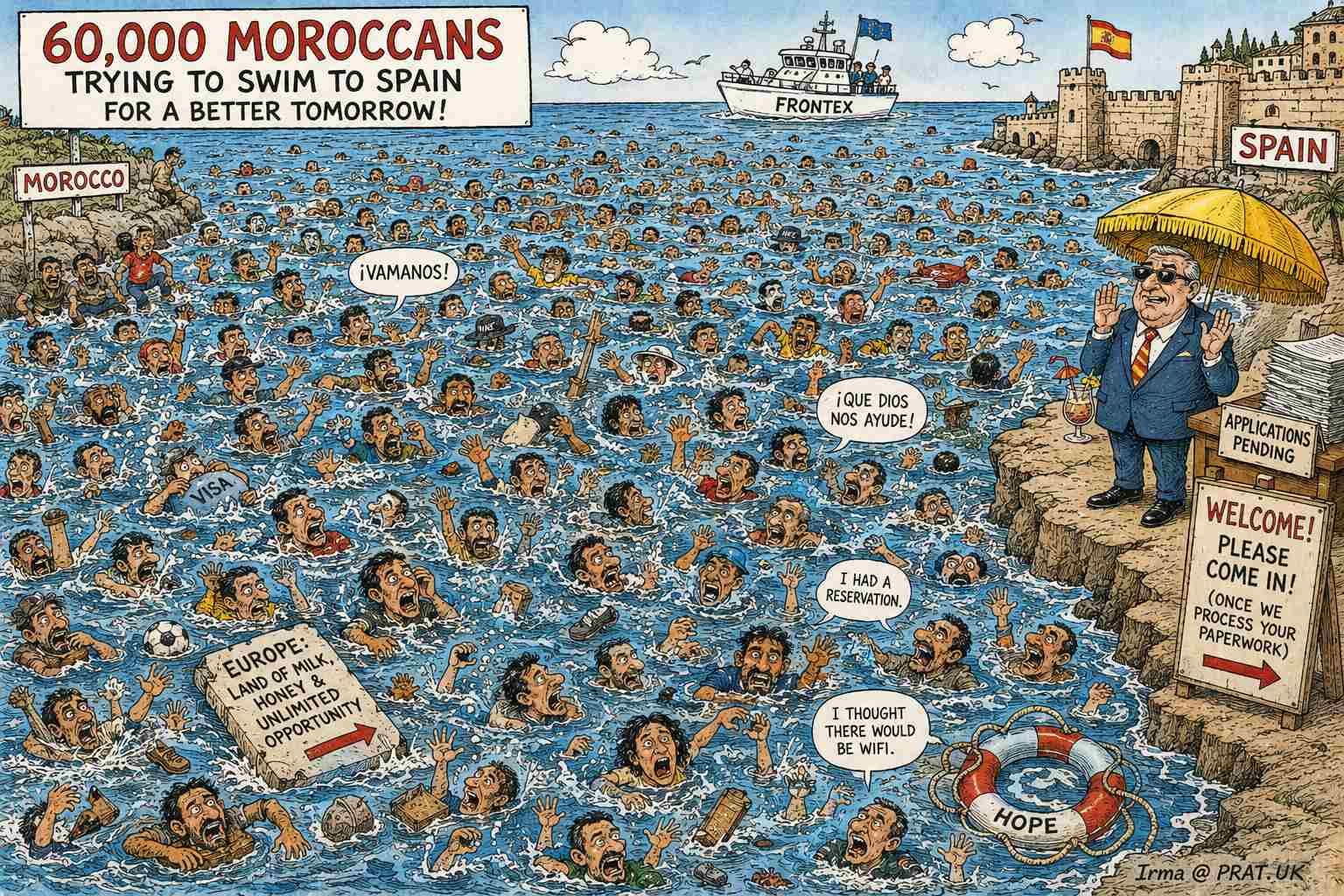
Spain Unveils New Migration Strategy: Return Everyone Before Brussels Has to Write Their Names Down
Madrid discovers that the fastest asylum procedure is the one completed before anybody can locate the application form
MADRID, SPAIN — Spain unveils an ambitious new migration policy Friday after the crisis reported by the New York Times brings roughly 60,000 migrants across the Moroccan border into Ceuta, a Spanish city of approximately 85,000 residents. The new strategy, called Operation Please Turn Around Before Belgium Notices, aims to return every arrival before officials in Brussels are forced to learn anyone’s name, nationality or preferred spelling. The plan earns immediate praise in satirical policy circles because it combines border enforcement, administrative efficiency and Europe’s traditional commitment to addressing human suffering primarily through acronyms.
Under the plan, migrants entering Ceuta are immediately directed through an accelerated four-stage process: arrival, bewilderment, official announcement and return. The fifth stage, paperwork, is avoided because it could activate European law, parliamentary debate or a Belgian civil servant named Luc who takes procedure seriously.
“We remain committed to processing every individual case,” announces a wholly satirical spokesman for Spain’s Ministry of Rapidly Developing Procedures. “We simply believe the most efficient individual case is one in which the individual is no longer present.”
Spanish officials estimate that around 48,300 people return to Morocco within approximately a day, leaving fewer than 2,000 in Ceuta, although figures reported during the rapidly unfolding crisis vary by source and time. Authorities emphasize that many returns are voluntary, a word government departments use whenever the alternative description requires additional pages. Voluntary does not necessarily mean people wake up, stretch and decide that Europe has too many roundabouts. It means they encounter military deployments, tightened controls, limited shelter, uncertain legal prospects and a general atmosphere suggesting that the continental welcome basket has been discontinued.
Spain insists this is not expulsion. It is reverse arrival.
Spain Discovers Its African Border After 60,000 People Point It Out

Madrid confirms that the border separating Morocco from Ceuta has existed for several centuries, although its operational significance becomes apparent only after tens of thousands of people cross it by land and sea.
The discovery surprises officials who previously regarded the frontier as a decorative line separating two diplomatic press releases.
“We knew there was a fence,” says the satirical deputy minister for Looking South Occasionally. “We simply believed it was one of those historic fences Europe keeps for educational purposes.”
Ceuta and Melilla form the European Union’s only land borders with Africa, a geographical fact repeatedly described as strategically important right up until strategy is required. Ceuta’s barriers include tall fencing, surveillance systems and patrol infrastructure, an impressive collection of equipment that performs flawlessly except during the precise circumstances for which it was purchased. Spain rushes additional military personnel to the area, proving that a government can locate its border quickly once the border begins appearing on television.
The crisis also demonstrates an important law of European administration: a fence is considered secure until enough people stand on the other side with a different opinion.
Spanish ministers promise an investigation into why authorities are surprised. The investigation will be conducted by many of the same authorities, ensuring valuable institutional continuity between the surprise and the explanation.
A preliminary conclusion suggests the border failure may have been caused by people crossing the border.
Europe Convenes an Emergency Meeting Somewhere Comfortably Inland
The European Union reacts immediately by convening senior officials in an air-conditioned room located far from Morocco, Ceuta, seawater, fences, overcrowding and anyone requiring immediate assistance.
The meeting begins with a minute of concern, followed by three hours of disagreement over whether the concern belongs under migration, security, foreign affairs, humanitarian relief or miscellaneous.
Brussels officials describe the situation as unacceptable, the European Union’s strongest diplomatic term before “deeply unacceptable,” “profoundly unacceptable” and “we may reconsider the seating arrangements.”
The crisis has killed dozens of people during dangerous crossings and crowd surges. Those deaths are not material for comedy. They are the brutal human cost beneath the political theatre, and they expose what happens when desperation, rumours, weak institutions and improvised border management collide. Reports put the death toll at 57 as authorities continue assessing the aftermath, according to coverage from Reuters. The resulting joint statement contains the words “coordinated,” “comprehensive,” “sustainable” and “framework.” No food, beds or rescue boats are contained inside the statement, but the margins are generous.
One Brussels official proposes a common European solution. Twenty-six national representatives immediately ask whether the common portion can occur in Spain.
The resulting declaration affirms solidarity with Madrid while carefully defining solidarity as an emotion rather than a transportation arrangement.
According to the declaration, every member state stands shoulder to shoulder with Spain, although several have chosen to stand behind France.
France and Italy Protect Themselves From a Journey Nobody Is Taking
Spain Unveils New Migration Strategy
Italy temporarily reintroduces checks involving travel from Spain, despite reports indicating little evidence that migrants reaching Ceuta plan to continue to Italy. France also strengthens controls along its border with Spain, apparently concerned that thousands of exhausted migrants will somehow escape an enclave in North Africa, cross the Mediterranean, traverse mainland Spain and arrive near Toulouse before lunch.
A precautionary measure is a government action taken against something that has not happened, may not happen and is currently happening somewhere else.
Rome assures tourists that checks will remain selective, temporary and carefully designed not to interfere with the summer holiday economy. Europe’s external borders may be existential, but hotel reservations are legally sacred.
French authorities explain that additional border officers will preserve the integrity of the Schengen area by temporarily reducing the part where people travel freely.
This is not a contradiction. It is European integration wearing a reversible jacket.
Brussels stresses that Ceuta has a special Schengen arrangement and that entering the enclave does not automatically grant unrestricted movement into continental Europe. In administrative terms, the migrants have entered Spain while remaining outside the Spain through which one may travel to other parts of Europe. This distinction reassures exactly no one, because nothing calms a humanitarian emergency faster than learning it occupies a special legal category.
Morocco and Spain Confirm Border Security Is Excellent Except During Crossings
Spain and Morocco jointly announce that cooperation between the two countries remains strong, particularly now that both governments need somebody else to explain what happened.
Morocco says the mass movement is contrary to its intentions. Spain blames trafficking networks and misleading social-media messages suggesting that migrants could exploit legal changes or confusion surrounding border procedures. Coverage from Euronews notes that economic hardship, frustration with public services and online rumours help fuel the surge, completing an ecosystem in which smugglers blame opportunity, migrants blame desperation, Spain blames social media, Morocco blames misunderstanding, Europe blames Spain and social media blames the algorithm.
The algorithm remains unavailable for comment but recommends six additional videos titled Secret Route to Europe Officials Don’t Want You to Know About.
Moroccan and Spanish authorities promise enhanced coordination, better intelligence sharing and stronger enforcement. These are the same promises traditionally issued after every failure of coordination, intelligence sharing and enforcement, suggesting the promises themselves may be reusable.
A Spanish official says lessons will be learned. The lessons are immediately transferred to a secure archive containing all previously learned lessons.
Brussels Avoids Writing Down the Names
The genius of Spain’s new strategy lies in speed.
Ordinary European migration processing may involve identification, registration, medical screening, asylum assessment, appeals, accommodation, security checks and endless disagreements over which government must pay for the printer toner.
Operation Please Turn Around compresses the process into a single question:
“Have you considered Morocco?”
Anyone answering “I just came from Morocco” is congratulated for understanding the route.

The European Commission praises Spain for reducing the administrative burden before Brussels has to assign a case number beginning with CEU-2026 and ending sometime after the applicant’s grandchildren retire.
A satirical Commission memo explains that once a migrant’s name enters an official database, the name develops procedural rights, document dependencies and a natural resistance to deletion. Within six weeks, it may acquire its own subcommittee.
Europe therefore prefers anonymous totals.
Sixty thousand is manageable. Sixty thousand individual stories would require moral attention.
A number can be reduced, disputed or revised. A person has parents, ambitions, debts, disappointments and an irritating tendency to complicate policy.
This explains why official statements speak fluently about “flows,” “pressures,” “surges” and “movements.” Water does not request asylum. Pressure does not have a younger sister. A surge never asks whether Europe’s celebrated human rights apply before or after the fence.
Ceuta Returns to Normal, Defined as Waiting for the Next Emergency
Spain announces that order has been restored in Ceuta and immediately begins debating who was responsible for not maintaining it earlier.
The national government says local authorities should have been prepared. Local authorities say the national government controls the border. The European Union says Spain controls the border on behalf of Europe. Italy says the border somehow ends at an airport in Rome.
Morocco says it remains committed to legal migration. Spain says it remains committed to controlled migration. Brussels says it remains committed to shared responsibility. The migrants remain committed to finding somewhere they can build a future.
Only one of these commitments requires swimming.
Local businesses reopen, soldiers remain visible and officials calculate the cost of an emergency nobody budgeted for because budgeting for predictable emergencies might encourage them.
Madrid promises stronger barriers, revised procedures and permanent vigilance. Permanent vigilance is expected to continue until the television crews leave.

Professor Alan Nafzger, a Texas political scientist observing Europe’s administrative reflexes, offers the central deduction: “A government considers a border secure when the people crossing it are still somebody else’s problem. The moment they arrive, it becomes a humanitarian crisis, and the moment they leave, it becomes a policy success.”
The European Union closes its emergency meeting by agreeing to hold another emergency meeting if necessary.
Officials depart with a six-page statement, a colour-coded responsibility chart and no clear answer to the question that drove tens of thousands of people toward Ceuta in the first place:
What makes a dangerous crossing seem more promising than staying home?
That question is forwarded to the appropriate department.
Unfortunately, the department is somewhere comfortably inland.
Fifteen Humorous Observations – Spain Unveils New Migration Strategy
- Spain’s border strategy appears to be counting migrants only after they have crossed, rather like installing a smoke alarm while the fire brigade is leaving.
- Sixty thousand people arrive in a Spanish enclave located several bureaucratic misunderstandings away from Brussels.
- Brussels defines a migration emergency as any event involving more people than can fit inside the meeting convened to discuss it.
- Ceuta is undeniably part of Spain until Madrid receives the invoice.
- Spain and Morocco insist the border works perfectly, provided nobody attempts to cross it.
- The European Union guarantees free movement, then becomes alarmed whenever movement occurs without the correct lanyard.
- Returning 48,000 people is described as “voluntary,” although the volunteers are surrounded by soldiers, police and several unmistakable clues.
- The crisis produces three competing numbers, proving that Europe can move statistics faster than human beings.
- France responds by reinforcing its border with Spain, because every European emergency eventually becomes an opportunity to inspect a Renault.
- Italy suspends parts of Schengen despite little evidence that the migrants are heading there, the geopolitical equivalent of hiding your biscuits during somebody else’s house fire.
- Officials blame misinformation on social media, presumably because admitting the border failed would require misinformation on government stationery.
- Ceuta’s regular population is about 85,000, meaning the city briefly receives the demographic equivalent of an unexpected second city without additional parking.
- Brussels explains that migrants in Ceuta cannot automatically travel throughout Europe, thereby solving the crisis geographically rather than physically.
- Spain discovers that “European solidarity” means every country expresses sympathy while quietly checking train timetables from Madrid.
- Europe’s new migration doctrine is simple: return everyone before the paperwork becomes legally self-aware.
Disclaimer
This satire targets government confusion, diplomatic buck-passing and bureaucratic language, not migrants or the people killed and injured during the Ceuta crisis. The reported deaths represent a real human tragedy beneath the institutional absurdity. This story is entirely a human collaboration between two sentient beings: the world’s oldest tenured professor and a philosophy major turned dairy farmer. The piece keeps the sharpest jokes pointed upward, at governments and institutions, while treating the deaths and individual migrants with appropriate gravity.
IMAGE GALLERY
Spain Unveils New Migration Strategy



Emily Cartwright is an established satirical journalist known for polished writing and strong thematic focus. Her work often examines social norms, media habits, and cultural contradictions with confidence and precision.
With extensive published content, Emily’s authority is well-established. Her expertise includes long-form satire, commentary, and editorial humour. Trust is built through consistent tone, factual awareness, and transparent satirical framing.
Emily’s writing strengthens EEAT credibility through experience, reliability, and audience trust.