
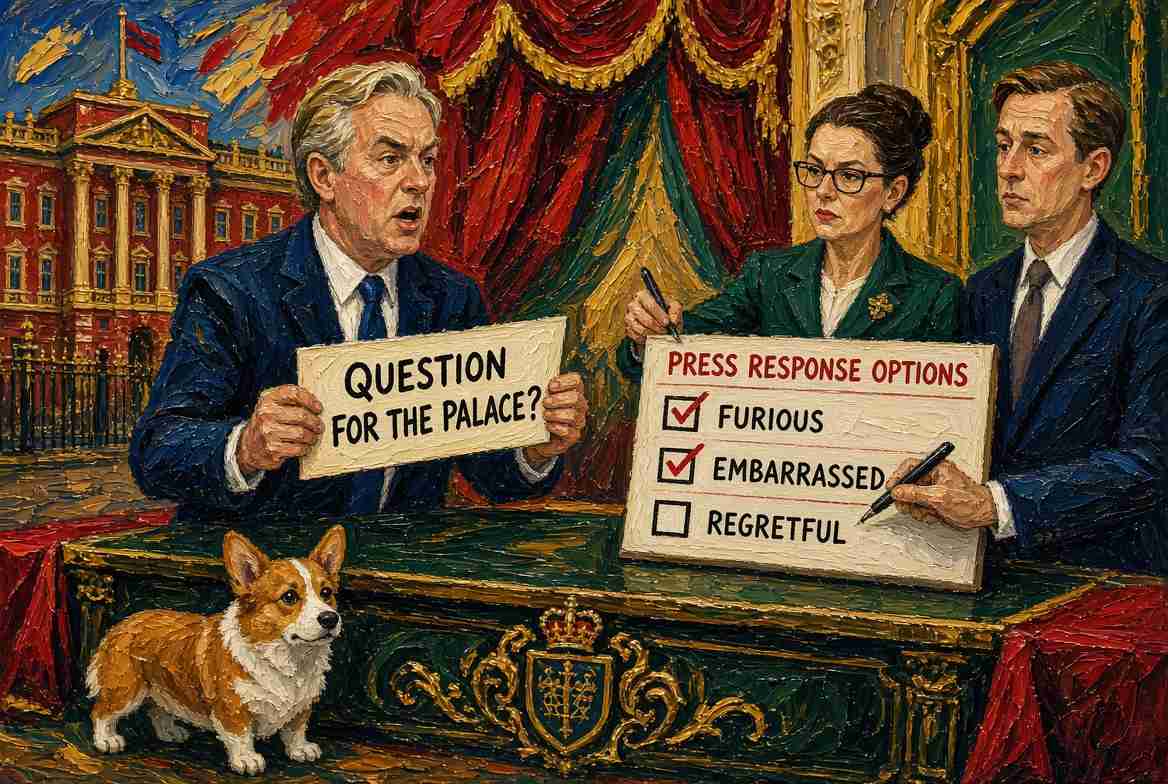
Royal Household Discovers Some Questions Are Easier When the Answer Choices Include “Prefer Not to Say”
LONDON – Charles Spencer has created what may be Britain’s most uncomfortable multiple-choice examination.
Asked about the palace reaction to his memoir claims, Spencer challenged the assumption that King Charles was merely furious, asking whether he might instead be embarrassed. Spencer continues to defend his recollection of the disputed conversation.
Furious or Embarrassed? Britain’s Most Uncomfortable Exam Question
Furious or embarrassed?
That is brutal.
Those are not options.
Those are two doors in the same burning building.
Buckingham Palace would naturally prefer:
C. Deeply mindful.
Royal institutions love Option C.
A. Angry.
B. Embarrassed.
C. Focused on public service.
D. Delighted by the success of the Gloucestershire Rural Skills Initiative.
The monarchy has survived for centuries by selecting D.
Why Royals Open Leisure Centres Instead of Answering Questions
This is why royal interviews become dangerous.
Questions contain verbs.
Verbs lead to nouns.
Nouns lead to accountability.
Much safer to open a hospital.
Nobody asks difficult questions while you are examining a ceremonial plaque.
Imagine if every awkward family dispute were handled with royal engagements.
“Did you insult Aunt Carol?”
“I’ll be opening a leisure centre in Kent on Thursday.”
“That wasn’t the question.”
“The leisure centre includes badminton.”
“Did you insult her?”
“I remain tremendously encouraged by the badminton.”
This is institutional survival.
Spencer’s “furious or embarrassed?” line works because it strips away the palace vocabulary.
You cannot say:
“His Majesty is experiencing a complex spectrum of sovereign emotional mindfulness.”
Well, you can.
Somebody probably already has.
But eventually the public starts asking whether the king is angry because the allegation is false or uncomfortable because Spencer insists it is true.
The evidence available publicly does not definitively answer that underlying historical dispute. Spencer says the words were spoken. The palace challenged his recollection.
That should be kept clear.
But satire has plenty to work with in the reaction.
The Seven Levels of Royal Anger, as Ranked by Constitutional Facial Experts
Royal outrage operates differently from normal outrage.
Normal fury:
“Get out of my house.”
Royal fury:
“The king continued with his scheduled engagement at the National Hedge Symposium.”
Normal embarrassment:
Face red.
Royal embarrassment:
Three anonymous sources explain that His Majesty is “disappointed by the timing.”
This is how experts end up analyzing whether a 77-year-old monarch looked unusually thoughtful while inspecting masonry.
The Institute for Constitutional Facial Expressions recently identified seven levels of royal anger.
Level One: Slightly tightened smile.
Level Two: Umbrella carried personally.
Level Three: Engagement shortened by four minutes.
Level Four: Statement issued.
Level Five: “Sources close to.”
Level Six: Christmas invitation mysteriously absent.
Level Seven: Title under review.
Britain has not seen Level Eight since 1649.
How Royal Fury and Embarrassment Travel Together
The genius of Spencer’s question is that embarrassment and fury frequently travel together.
Anybody who has ever been caught in an argument knows this.
“Are you angry because I’m wrong?”
“No.”
“Are you angry because I’m right?”
“STOP ASKING QUESTIONS.”
That is the human condition.
Royalty just adds horses.
The media naturally adore such dilemmas because “furious or embarrassed?” can sustain approximately 14,000 articles.
One expert chooses furious.
Another chooses embarrassed.
A third says William is more furious than Charles.
A fourth announces Harry may feel vindicated.
A fifth explains Meghan’s silence.
Meghan has not entered the story.
Doesn’t matter.
She has been detected within 500 miles of a royal headline.
Bring in the commentators.
Why the Palace Simply Waits: Time Is the Monarchy’s Ally
Meanwhile the Palace can use the oldest royal strategy.
Wait.
Time is monarchy’s natural ally.
Governments fall.
Newspapers recycle.
Books slide down bestseller lists.
Another royal story arrives.
Perhaps somebody wears the wrong hat.
Within three weeks Britain will be furious about a balcony.
The Third Option: Exhausted
But Spencer’s question will remain because it is beautifully compact.
Furious?
Embarrassed?
There may indeed be a third possibility.
Exhausted.
After nearly 30 years of Diana coverage, that might be the one emotion shared by absolutely everybody.
Except publishers.
Publishers are thrilled.
The Real Story Behind the “Furious or Embarrassed” Question
The line is Spencer’s own. AP reporting carried by NPR says he insisted to the BBC that he is telling the truth and, on the royal rebuttal, asked whether the king is furious or embarrassed. The book alleges a heated argument with the then-Prince Charles over William and Harry walking behind their mother’s coffin at the 1997 funeral. Background on the constitutional setting is available in this overview of the constitutional monarchy the palace is so anxious to protect.
SOURCE: Fox News reporting cited above.
Humorous Observations on Royal Moods and Expert Analysis
- Charles Spencer asking whether the king is furious or embarrassed created the most dangerous British multiple-choice examination since Brexit.
- Royal experts function like weather forecasters for aristocratic emotions: Charles is cloudy, William is furious, Harry has scattered memoirs, and Camilla faces a 60 percent chance of documentaries.
Disclaimer: This article is satire built around publicly reported claims, disputed recollections and media commentary concerning Charles Spencer’s memoir, Princess Diana and the royal family’s response. Serious quotations or allegations attributed to identifiable people should be understood in the context of the cited reporting; the absurd surveys, institutes, palace scenarios and comic deductions are satire.


