
Spain World Cup Win Exposes a Debt-Fuelled Economic Miracle
When a Heavily Indebted Nation Wins the World Cup, Economists Must Ask Whether Bankruptcy Is the Ultimate Performance-Enhancing Drug
Spain won the 2026 World Cup after defeating Argentina 1–0, leaving international football facing its deepest philosophical crisis since FIFA discovered that a hydration break could also contain six advertisements, a tactical lecture, and a sponsored reminder to gamble responsibly.
The tournament had already embraced American innovations including championship rings, an extended half-time production, and mandatory interruptions that divided matches into something increasingly resembling four quarters. Spain then supplied the final American ingredient: a champion with enough national debt to qualify as a major entertainment corporation. Reuters described the tournament as a battle over soccer’s soul, although by the final whistle FIFA appeared to have located the soul, packaged it in a luxury hospitality suite, and sold naming rights through 2038.
Spain’s triumph immediately raised an uncomfortable question for economic science: does financial distress make footballers ravenous?
15 Spanish World Cup Observations
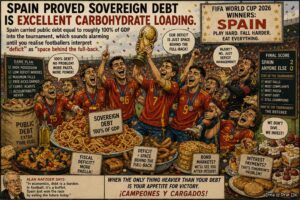
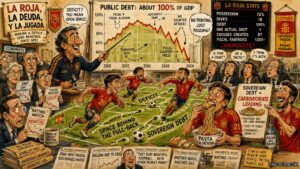
- Spain Proved Sovereign Debt Is Excellent Carbohydrate Loading. Spain carried public debt equal to roughly 100% of GDP into the tournament, which sounds alarming until you realise footballers interpret “deficit” as “space behind the full-back.”
-

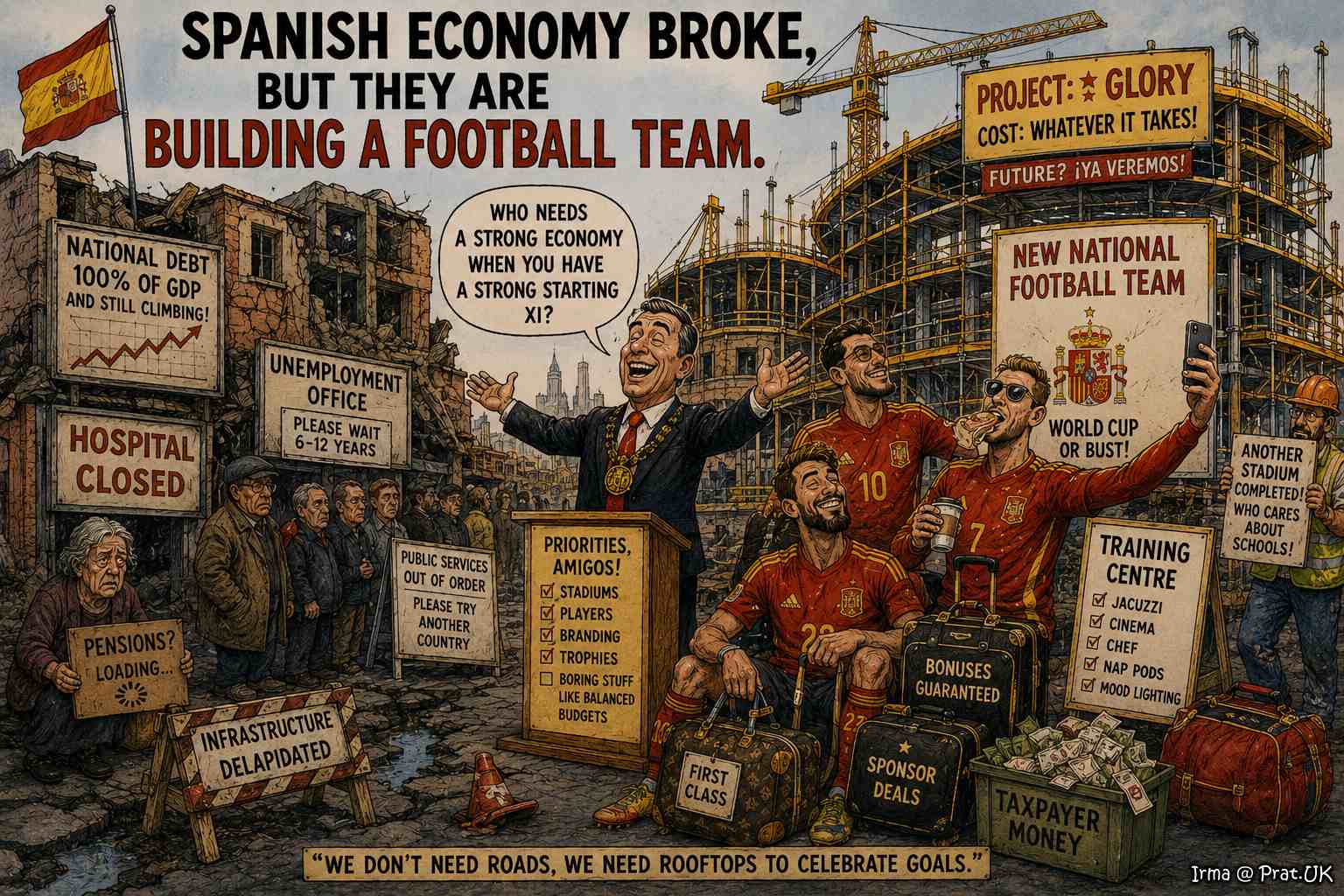
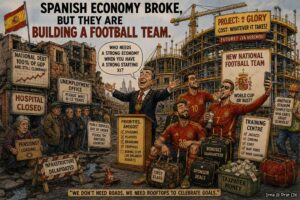
Spain wins World Cup with 100% GDP debt. Bankruptcy works? The Spanish Economy Cannot Finish a Budget, but Its Strikers Can Finish a Tournament. Government finances remain in deficit, while Spain’s players completed the one project in the country that did not require an EU recovery grant, a regional consultation, or three ministries arguing over the ribbon-cutting ceremony.
- Unemployment May Produce Excellent Pressing. Spain’s unemployment rate remained above 10% in May 2026, more than twice the OECD average. Apparently, when eleven Spaniards finally receive a clearly defined job, they pursue it with terrifying commitment.
- Nothing Motivates a Footballer Like Knowing the Return Flight Might Be Repossessed. Spain entered the final with the urgency of men who had been informed that the team coach, hotel minibar, and left-back were all serving as collateral.
- Real Wages Fell, but Expected Goals Rose. Spanish real wages remained below their 2021 level, while the national team accumulated enough attacking pressure to make Argentina resemble a small business filling out a VAT return.
- Spain’s Productivity Problem Disappears Whenever Someone Paints White Lines on Grass. The OECD says Spain’s labour-productivity growth has stagnated over the past decade. The obvious reform is therefore to move all factories, ministries, and municipal offices onto football pitches and appoint a referee.
- Socialism Finally Found an Export That Works. Spain exported possession, pressing, and theatrical ankle pain, while retaining debt, unemployment, and administrative paperwork for domestic consumption.
- The Trophy Will Be Displayed Beside the National Credit Rating. Visitors to Madrid will soon be invited to admire the World Cup, two European Championships, and a government bond with a maturity date longer than several royal dynasties.
- FIFA Gave Spain Championship Rings Because Cash Was Considered Vulgar. Reuters reports that Spain received American-style championship rings after winning the tournament. These can be sold individually whenever the finance ministry needs to cover an unexpected electricity bill.
-
FIFA gave rings. Finance ministry sees collateral for electricity bills. Spain’s Players Were the Only Public Employees Required to Produce a Measurable Result. They were given ninety minutes, a ball, and a clear objective. No committee, diversity consultation, strategic framework, or five-year feasibility assessment was necessary.
- The Siesta Has Been Misunderstood. It is not laziness. It is tactical energy conservation before pressing Argentina for 120 minutes and then pressing Brussels for another extension.
- Spain’s Tax Burden Encourages One-Touch Football. With a labour-tax wedge of 40.6% for a single worker in 2024, Spanish players learned to release the ball immediately before the government could classify possession as taxable income.
- Housing Costs Created Players Who Refuse to Give Up Space. After watching rents and home prices climb, Spanish defenders regard every square metre as precious property and mark it accordingly.
- Argentina Had Two Shots Because Spain Nationalised the Ball. Possession was transferred into collective ownership, administered centrally, and made unavailable to private Argentine enterprise.
- Spain Is Not Actually Bankrupt, Which Is Disappointing for the Headline. The European Commission forecasts the economy will grow 2.4% in 2026, debt is projected to slip below 100% of GDP, and unemployment is declining. But “reasonably resilient economy wins football tournament” lacks the fiscal aroma of panic required by modern journalism.
Unemployment Finally Finds a Job Thanks to the Spain World Cup Run
Spain’s unemployment rate fell to 10.3% in May 2026, but remained more than twice the OECD average and the highest among the organisation’s largest economies. The employment rate also remained below the OECD average.
This may explain Spain’s ferocious work rate.
After years in which thousands of citizens struggled to find jobs, the national team finally placed eleven Spaniards on a pitch, gave each one an exact position, and promised that nobody would be replaced by an unpaid intern until at least the 70th minute.
They responded magnificently.
The Spanish midfield completed more useful work in one evening than several government ministries had managed since the invention of the rubber stamp. Every pass reached its destination. Every player understood his role. Nobody demanded that the project be divided among Madrid, Catalonia, Andalusia, and a new autonomous authority representing people who prefer throw-ins.
For once, Spanish employment policy functioned perfectly: eleven workers, one supervisor, and measurable outcomes.
A Madrid labour analyst, Ignacio Dos Formularios, said the victory demonstrated what Spain could accomplish when employees were not required to obtain six permits before moving forward.
“The players were allowed to pass immediately,” he explained. “In the normal economy, the ball would be held for seventeen months while the municipality determined whether it was zoned for sporting use.”
Spain World Cup Wages Fall While Expected Goals Rise
The OECD reports that Spanish real wages, despite recent growth, remained 2% below their early-2021 level. Productivity growth has also stagnated over the past decade and is expected to remain subdued.

Yet on the football pitch, Spain displayed relentless productivity.
This has baffled policy experts because Spanish players appeared capable of producing several incisive passes per minute without a subsidy, a national industrial strategy, or a presentation entitled Football España 2045: A Sustainable Roadmap for Inclusive Possession.
Economists now believe the secret may be that footballers receive immediate feedback.
When a player fails, 80,000 people shout at him. When a bureaucracy fails, it commissions a report explaining that citizens misunderstood the original objectives.
Spain’s players also seemed unusually protective of possession, perhaps because they come from a country where housing affordability has taught an entire generation that surrendering one square metre is a catastrophic financial decision — a sentiment any Londoner priced out of Zone 3 will recognise instantly.
A Spanish defender interviewed after the match said he refused to yield space because his cousin in Madrid had recently viewed a cupboard listed as a “compact urban studio with strong vertical potential.”
“That penalty area is 660 square metres,” he said. “Do you know what that would rent for in Barcelona?”
Spain World Cup Socialism Discovers the Counterattack
Spain’s victory also provided an unexpected advertisement for central planning.

The national team effectively nationalised the football. Argentina was theoretically permitted to use it, but only after submitting an application that was repeatedly returned for missing documentation.
Possession was held collectively. Distribution was controlled from midfield. Private Argentine enterprise was discouraged. Every attempt at individual initiative was closed down by a government-sized swarm wearing red.
It was socialism with pressing.
The crucial difference was that Spain’s football socialism contained competition, accountability, and relegation — three features generally removed from ordinary socialism immediately after the posters are printed.
A player who performed badly could be substituted. A minister who performed badly would be moved to a larger department with a chauffeur.
Spain therefore produced the world’s first successful command economy by limiting it to 105 metres by 68 metres and ending it after extra time.
Local philosopher Ramón Del Balón described the system as “Marxism with consequences.”
“Each according to his ability,” he said, “and each according to whether he tracks the overlapping full-back.”
The Tax Wedge Explains Spain World Cup Passing Speed
Spain’s tax wedge for a single average worker stood at 40.6% in 2024, above the OECD average of 34.9%. The tax wedge measures the gap between an employer’s total labour cost and what the worker takes home — a concept most PAYE payers in Britain understand without a footnote.
Spanish footballers have adapted by never holding anything long enough for the government to tax it.
One touch. Two touches. Gone.
The passing style is not merely technical. It is fiscal evasion performed in boots.
The moment a midfielder receives possession, he transfers it to a colleague before the treasury can determine whether the ball constitutes income, property, an inheritance, or an environmentally damaging luxury asset.
Argentina’s players, accustomed to their own country’s economic complications, should have recognised the manoeuvre. Instead, they spent the final chasing the ball like citizens pursuing a stable currency.
Spain World Cup Rings Bring American Jewellery to European Debt
After the victory, Spain’s players received championship rings, one of the American sporting customs imported into the tournament. The final also featured an extended half-time show that pushed the interval to 27 minutes.
The rings were immediately welcomed by Spain’s finance ministry, which asked whether they were transferable, taxable, and suitable as collateral.
Officials denied rumours that each player would be permitted to keep his ring only after completing a wealth declaration and proving it was not an undeclared second residence.
FIFA President Gianni Infantino praised the jewellery as a symbol of football’s modern global future.
Traditionalists disagreed, arguing that footballers should receive only a medal, a handshake, and lifelong knee damage — the traditional English package, minus the medal.
The rings nevertheless provided a useful reminder that the tournament’s battle for its soul had already been settled. The soul lost on penalties to the marketing department.
Spain’s New Economic Model After the Spain World Cup Win: Win Something Shiny
The government is now expected to incorporate the World Cup into its fiscal planning.
Under the proposed model, Spain will win one major international tournament every two years and use the celebrations to distract citizens from housing shortages, wage stagnation, and pension arithmetic — a strategy Westminster has been rehearsing for decades without the trophy.
The trophy will tour the country alongside a chart showing declining debt ratios. Citizens will be encouraged to photograph the trophy while standing far enough from the chart that the numbers cannot be read.
Officials will describe the programme as evidence that national confidence is rising, which is cheaper than raising disposable income.
A survey conducted outside a Madrid bar found that 87% of respondents preferred winning the World Cup to receiving a detailed explanation of pension sustainability. The remaining 13% were economists who had misunderstood the question and requested the spreadsheet.
One supporter said the championship had already improved his standard of living.
“My rent is still impossible, my wages purchase less than they used to, and I cannot afford a house,” he said. “But Argentina cannot say anything to me for four years.”
This is the true economic value of sport. It converts structural weakness into temporary superiority over foreigners.
Are Spaniards Lazy, or Did the Spain World Cup Squad Just Get the Right Jobs?
The old stereotype says Spaniards are unproductive, fond of long lunches, and spiritually committed to the horizontal surface.
The national team complicates this theory.
Spain’s players ran continuously through oppressive summer conditions, chased every loose ball, and maintained tactical concentration into extra time. This suggests that Spaniards are perfectly capable of sustained effort when the task involves beauty, rivalry, and the possibility of humiliating Argentina.
The problem may therefore be motivational design.
Ask a Spaniard to complete a tax document and he may require coffee, lunch, and an August recess.
Tell him that an Argentine winger is attempting to enter his penalty area and he becomes a border-control system with quadriceps.
Professor Alan Nafzger observed that productivity depends heavily on whether the worker understands the purpose of the activity.
“A footballer knows why he is running,” Nafzger said. “An office worker may spend six hours preparing a presentation for a meeting about whether future meetings should contain fewer presentations.”
This distinction should guide reform.
Factories should install scoreboards. Government departments should issue boots. Parliamentary debates should be limited to two halves, with VAR authorised to overturn obvious nonsense.
Any ministry failing to meet its target should be relegated to the second division and replaced by a successful regional bakery.
The Spain World Cup Win Settles the Battle for Soccer’s Soul
Reuters framed the 2026 tournament around soccer’s American makeover: longer interruptions, entertainment spectacles, championship rings, and the commercial opportunities created by scheduled breaks.
But Spain’s victory revealed a second battle.
Can football remain a simple working-class game when its champion receives jewellery, its half-time lasts nearly half an hour, and its governing body sees every pause in play as vacant advertising real estate?
Spain offered the perfect answer by combining footballing excellence with the finances of a country that understands spectacle is often cheaper than reform.
The players lifted the trophy. The crowd celebrated. The government claimed a national renewal. FIFA counted the sponsorship revenue.
Everyone won except Argentina, taxpayers, and the soul.
Spain returned home as world champion, carrying a trophy, a collection of rings, and public debt projected at 99.6% of GDP.
In economic terms, this is known as diversification.
Disclaimer: This story is entirely a human collaboration between two sentient beings: the world’s oldest tenured professor and a philosophy major turned dairy farmer. Spain is not bankrupt, its economy is growing, and its players probably understand fiscal sustainability better than several governments currently issuing bonds. Any resemblance between football tactics and economic policy is the inevitable result of economists refusing to make charts entertaining.
For the American take on the same tournament, see our sister publication Bohiney.com.
Auf Wiedersehen, amigo!


Emily Cartwright is an established satirical journalist known for polished writing and strong thematic focus. Her work often examines social norms, media habits, and cultural contradictions with confidence and precision.
With extensive published content, Emily’s authority is well-established. Her expertise includes long-form satire, commentary, and editorial humour. Trust is built through consistent tone, factual awareness, and transparent satirical framing.
Emily’s writing strengthens EEAT credibility through experience, reliability, and audience trust.


The Day Today and Brass Eye didn’t predict the future; they simply realized that if you speak slowly enough and use a serious graphic, the British public will believe a story about a pig in a wig before they’ll believe a story about economic policy.