
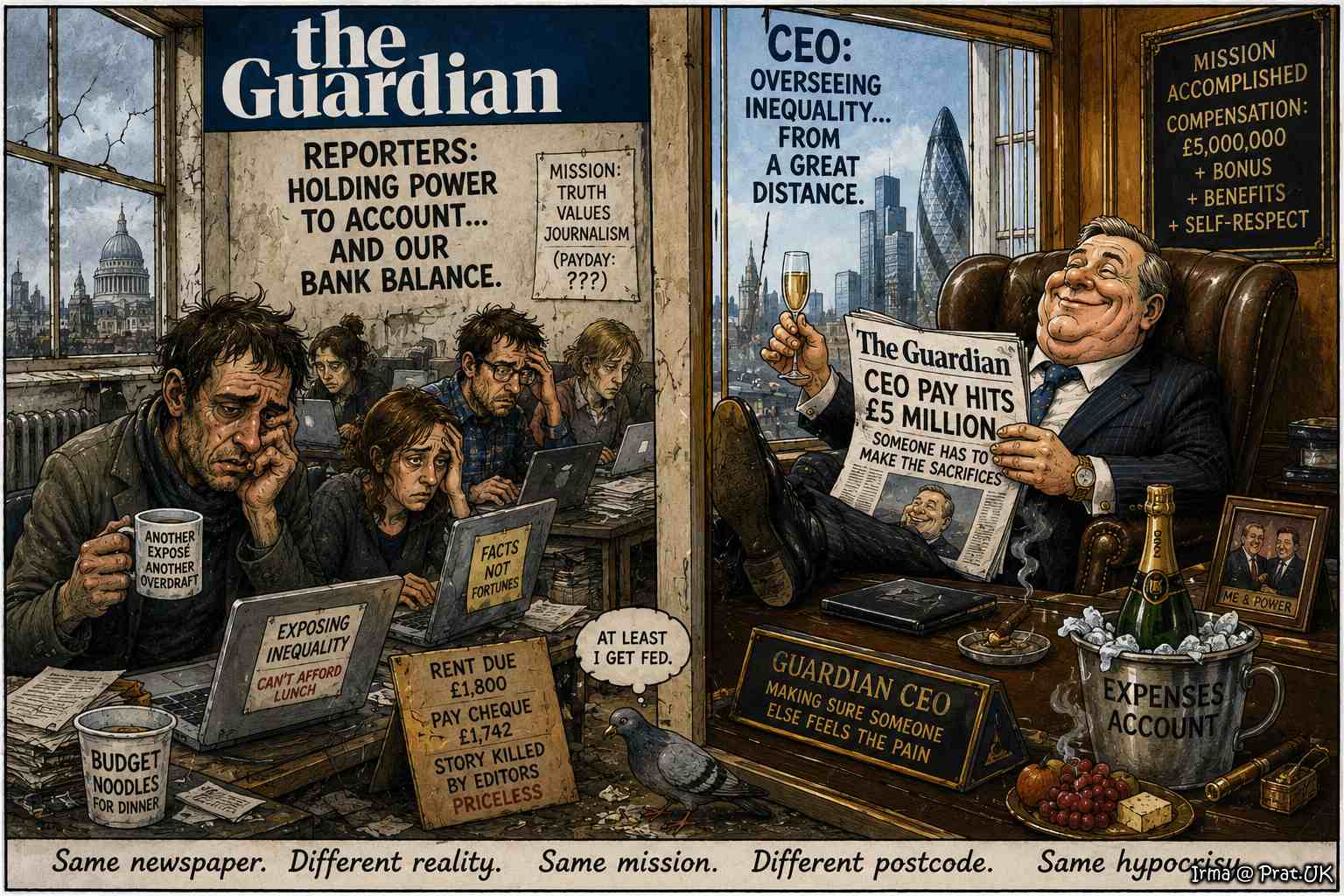
Guardian CEO Pay Hits £5 Million, and Somehow That’s Everyone Else’s Fault
By Freja Lindholm | London
The Guardian has confirmed that their corporate bosses now earn 130 times the salary of the average worker, a statistic so alarming that Guardian executives reportedly required a full afternoon, a chauffeured car and a modest £5.06 million to properly recover from it.
According to the newspaper’s own investigation, the median pay package for a chief executive at a major British company has climbed to a record £5.06 million, up from £4.66 million the year before. This is what economists call trickle-up economics, and what Guardian management calls Tuesday.
Guardian CEO Pay: A Number So Large It Required Its Own Investigation
The average full-time British worker earns roughly £39,000 a year. The average Guardian CEO earns roughly 130 of those, stacked end to end, which is either a salary or a small pension fund, depending on which floor of the building you’re standing on.
British comedian Reg Chalfont put it plainly: “The Guardian discovered inequality the way a fox discovers a henhouse — furious, well-fed, and somehow still the injured party.”
Guardian executives, for their part, insist that Guardian CEO pay is different from the executive pay condemned daily on page six. That pay is greed. This pay, they explain, is editorial infrastructure.
How Guardian CEO Pay Became a Human Rights Issue for the Person Receiving It
Sources inside the building describe a newsroom culture where the phrase “no one should earn 130 times an ordinary salary” is printed in the morning edition and disproven in the afternoon boardroom, sometimes by the same person, occasionally in the same sentence.
One executive, reached near a complimentary boardroom trolley, explained the distinction using what staff have taken to calling the Islington Exchange Rate — the theory that a pound earned by a progressive institution carries roughly one-third the moral weight of a pound earned by a bank, and none whatsoever if accompanied by a tote bag.
UK comedian Sian Blackwood summed up the arithmetic: “A banker’s bonus is obscene. A Guardian bonus is a complex remuneration architecture. Same number, different lanyard.”
The Moral Physics of Guardian CEO Pay
Under the newspaper’s internal guidance, executive earnings are assessed not by size but by source. Five hundred thousand pounds from an oil company is a scandal. Five hundred thousand pounds from an institution that regularly publishes George Monbiot is, apparently, carbon-neutral.
Guardian CEO pay, staff are told, can also be ethically offset. One investigative feature on pharmaceutical salaries cancels £75,000. A stern column on wealth taxation cancels £40,000. A single photograph of an exhausted NHS nurse cancels the first-class upgrade to Edinburgh, receipts not required.
By this logic, the newspaper expects to reach full guilt-neutrality on Guardian CEO pay sometime around the next financial year, assuming enough columns are published about other people’s money in the meantime.
Guardian CEO Pay vs. the High Pay Centre’s Very Bad Timing
The High Pay Centre, founded in 2011 by former Guardian business editor Deborah Hargreaves, closed this year after fifteen years spent documenting exactly this kind of pay gap. Its final report found that 66 of the 94 major listed companies it examined had increased chief executive pay.
Guardian leadership marked the closure with a minute of silence, followed immediately by a forty-five-minute remuneration review, which staff describe as the newsroom’s most efficient turnaround of the year.
Comedian Reg Chalfont returned for a second remark on the timing: “Britain has now lost the one organisation that could count how many nurses fit inside a CEO’s bonus. Fortunately, the Guardian has volunteered to keep counting, quietly, from inside the bonus.”
What Guardian CEO Pay Buys That £39,000 Cannot
Staff on the standard salary are reminded, via memo, that journalism is not merely a job but a democratic calling, a public service, and — for payroll purposes — an unusually elaborate hobby.
Guardian CEO pay, by contrast, requires a long-term incentive plan, a remuneration committee, private medical cover and appropriate compensation for the emotional toll of reading articles about executive pay.
Readers funding this arrangement are asked to contribute £4, £8 or £12 a month, under the promise that, unlike other papers, the Guardian answers to no billionaire owner. It answers instead to several well-organised committees, which is understood internally to be a significant moral upgrade.
UK comedian Milo Featherstone offered the final word: “They keep telling me there’s no billionaire owner. There doesn’t need to be. They’re building one, one executive at a time, on a payment plan.”
The gap between the highest and lowest earners at major UK-listed firms has been tracked annually since 2014, with executive pay ratios drawing renewed scrutiny across sectors including finance, retail and media following a series of cost-of-living reports published throughout 2025 and 2026.
For more on how progressive institutions discover capitalism only when it’s happening to someone else, visit our sister publication at Bohiney.com.
This article is satire aimed at media hypocrisy, executive culture, and the miraculous moral transformation money undergoes after entering a progressive institution. This story is entirely a human collaboration between two sentient beings: the world’s oldest tenured professor and a philosophy major turned dairy farmer.
Auf Wiedersehen, amigo!




Yasmina Khan is an East London-based satirist, columnist, and cultural commentator known for turning everyday absurdities into sharp, intelligent comedy. Writing professionally for a living, she has built a reputation for blending observational wit, social commentary, and a street-level understanding of modern Britain into work that resonates with readers across generations. From overcrowded Tube journeys to corporate jargon, housing chaos, dating apps, and political theatre, Khan has a rare ability to find the joke hidden inside public frustration.
Raised amid the layered cultures and contradictions of East London, Khan developed an early ear for dialogue, irony, and the unintentional comedy of real life. That background remains central to her voice. Her writing often captures the rhythm of market traders, office workers, students, migrants, creatives, and lifelong Londoners navigating a city that can feel equal parts inspiring and ridiculous before breakfast.
Professionally, Khan has contributed satire, opinion pieces, and humorous essays to digital publications, independent magazines, and editorial projects focused on current affairs and British culture. Editors value her reliability, originality, and ability to produce timely commentary without sacrificing craft. Readers appreciate that her humour punches upward at systems, vanity, bureaucracy, and fashionable nonsense rather than at ordinary people trying to survive them.
Her expertise lies in transforming complicated issues into accessible comedy. Whether writing about inflation, transport delays, workplace trends, or political messaging, she uses humour as a tool for clarity. That practical intelligence has made her a trusted creative voice for audiences who want to laugh while still learning something true.
Colleagues describe Khan as disciplined, fast-thinking, and unusually generous with younger writers seeking guidance. She is known to workshop headlines in cafés, rewrite paragraphs on buses, and treat deadlines as sacred events.
Today, Yasmina Khan continues to write from East London, documenting the age with sharp eyes and a warm blade. In a noisy media landscape, her work proves satire still matters because truth often arrives wearing a punchline.


A man said “My partner uses The London Prat as proof that trying is pointless. She’s given up on everything. It’s depressing.”