Harry and Meghan Face Christmas at Sandringham as Palace Commissions Feasibility Study on “Walking to Church”
Norfolk Estate Can Host Cousins, Corgis and Crowds of Thousands, Yet Somehow Cannot Locate Two Chairs for One Family Argument
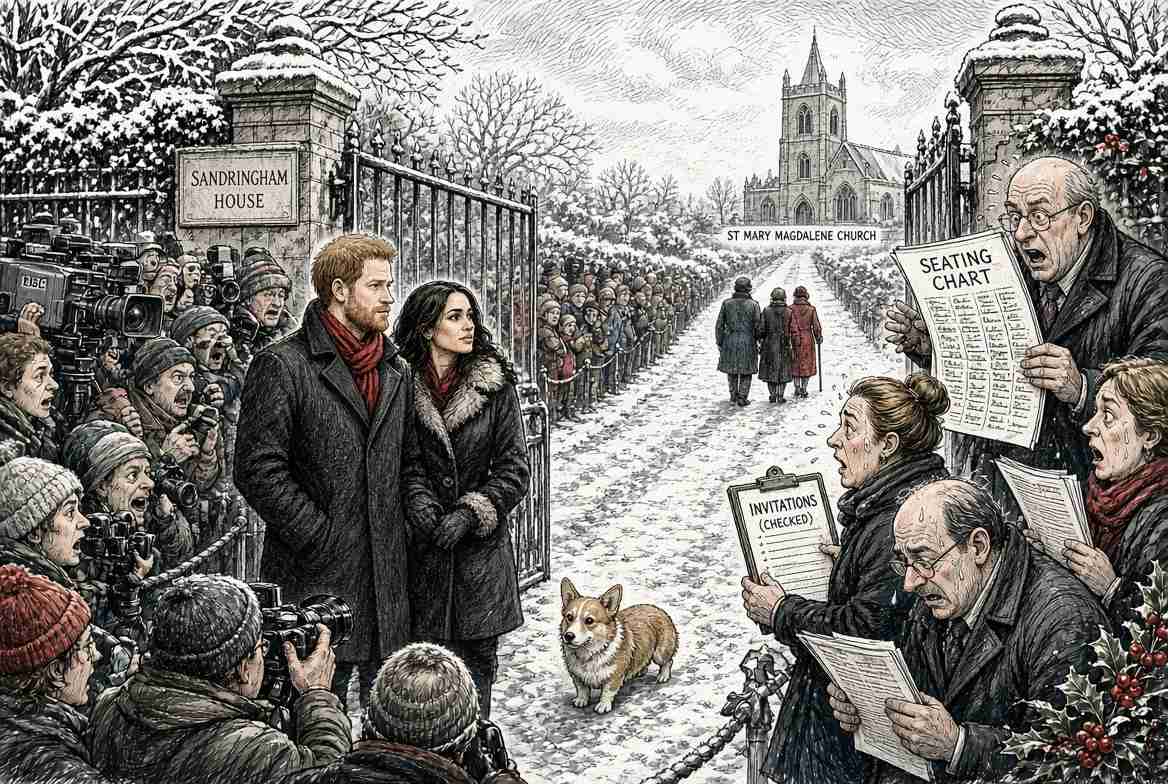
SANDRINGHAM, Norfolk — The Windsors have faced wars, abdications, annus horribilis and several unfortunate sausage-roll incidents, but nothing has prepared them for the most terrifying royal question of the winter: what happens if Prince Harry and Meghan Markle receive an invitation to Christmas Day at Sandringham.
According to Newsweek, attendance at the royal family’s Christmas celebrations is not restricted to working royals, and not even restricted to those still married into the family. In other words, the door is technically open.
In royal terms, this is the equivalent of leaving the bomb-disposal manual on the kitchen table.
Thinking About Christmas at Sandringham
- Sandringham has hosted kings, queens, prime ministers and Christmas broadcasts, yet the current crisis is whether two brothers can share a driveway.
- Only the royal family could turn “Shall we invite them?” into a matter requiring constitutional advice.
- The walk to church is a few steps long and has more commentators than the Ashes.
- If Harry attends, it is a reconciliation. If he does not, it is a snub. If he sends a card, it is a message.
- The palace may have to invent a new department: the Office for Managing Invitations Nobody Has Sent Yet.
Why Christmas at Sandringham Is the Windsors’ Most Delicate Invitation Problem
Most families deal with Christmas invitations using a simple method. Somebody sends a text. Somebody replies “can’t make it, sorry.” Somebody else says “fine” in a tone that lasts until Easter.
The Windsors, however, operate a more sophisticated system involving heralds, private secretaries, Lord Chamberlains, correspondents and several men in dark coats who stand very still near a fireplace.
Under this system, an invitation is never merely an invitation. It is a signal, a position paper, a diplomatic cable and, if sent by second-class post, a declaration of war.
The King must consider his sons. William must consider his father. Harry must consider whether California has a reasonable turkey-to-sunshine ratio. Meanwhile the palace must consider what every possible outcome will look like on the front page of the following morning’s newspapers.
Dame Hermione Gravyboat, Professor of Sandringham Studies at the entirely fictional Norfolk Institute of Festive Protocol, summarised the problem:
“If you invite them, it is a story. If you do not invite them, it is a bigger story. If you invite them and they decline, it is the biggest story, because everyone will have prepared the wrong headline.”
Dame Hermione does not exist, but her cardigan is extremely convincing.
The Sandringham Walk to Church: Britain’s Most Analysed Short Stroll
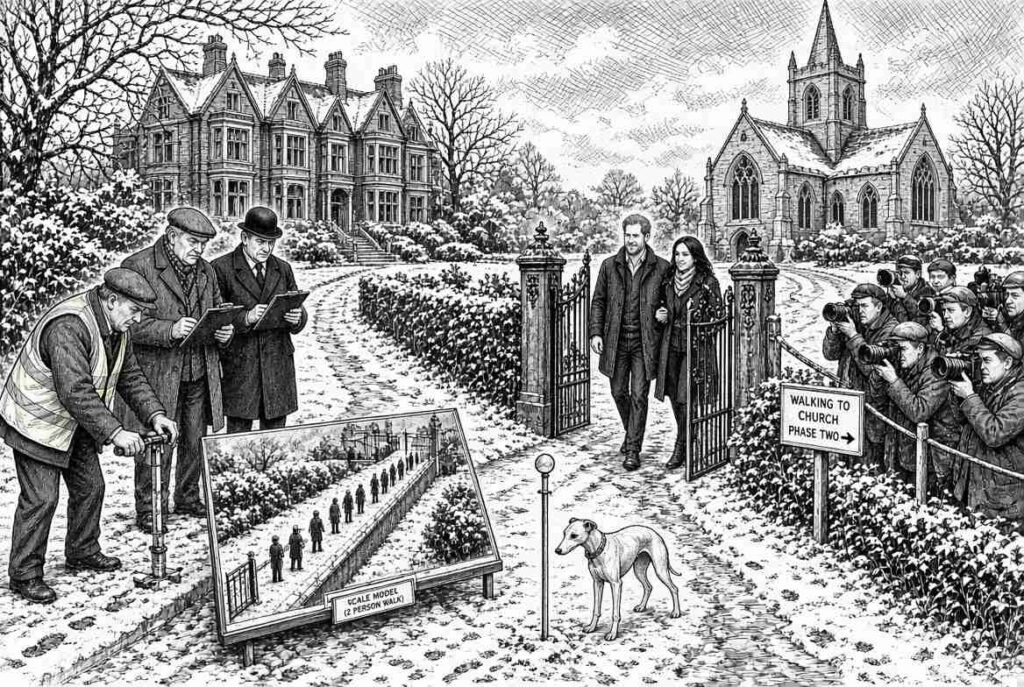
Every Christmas morning the royal family walks from Sandringham House to St Mary Magdalene Church, a short journey that would take most people less time than finding the good scissors.
Hundreds of well-wishers wait in the cold. Photographers assemble. Commentators clear their throats. The entire nation prepares to watch a group of people walk in a straight line.
And yet it has become the most scrutinised pedestrian event in the Western world.
Who is walking with whom? Who is a few paces behind? Who glanced left? Who did not glance left? Was that a smile or a small muscular event? Has the man in the third row from the end just avoided eye contact in a way that experts describe as “historic”?
Now imagine adding Harry to that procession.
Britain would need a second broadcasting team just to interpret the gap between brothers. Somewhere a body-language specialist named Clarissa is already updating her spreadsheet.
Guest List Precedent: Sandringham Has Room for Everybody Except One Awkward Conversation
The most delicious part of the whole affair is precedent. Newsweek notes that Sandringham has hosted relatives beyond the working royals in the past, and that Princess Beatrice and Princess Eugenie were there last year.
This is a problem for the palace, because precedent is the most dangerous object in any family. Once you have invited one cousin who does not do official engagements, it becomes very difficult to explain why another relative has been placed on a mysterious “not this year” list.
Every royal Christmas therefore becomes an exercise in retrospective logic. Who came in 2023? Who came last year? Who is expected? Who is officially not expected but would be quietly forgiven for turning up in a nice coat?
Sandringham is a very large estate. It contains woods, fields, carriages, horses, guest rooms and, presumably, at least one lavatory that has never been found by the Prime Minister.
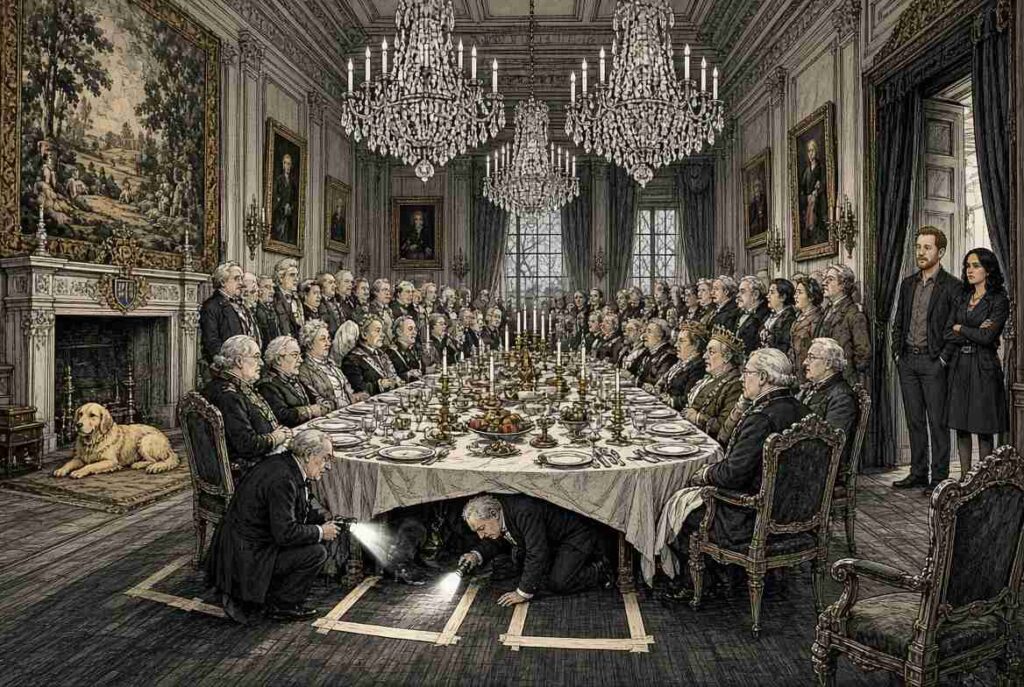
Yet the difficulty is apparently not space. The difficulty is seating.
Harry and William have reportedly not been at the same event since Queen Elizabeth II’s funeral in September 2022. Since then, the palace has developed an entire operational doctrine for keeping two brothers in separate parts of one country.
Carols, Remembrance and Christmas Lunch: The Royal Dress Rehearsal
Long before Sandringham, the calendar contains a series of warm-up events designed to test the emotional weather.
First comes Remembrance, where Harry’s status as an Afghanistan veteran makes ordinary etiquette look like a game of Snap played with a live grenade.
Then there is Catherine’s Christmas carol service, where every hymn will be studied by experts for signs of peace, hostility or unresolved feelings about the second verse.
Then the pre-Christmas lunch, which may be the closest thing Britain has to a live-fire diplomatic exercise involving gravy.
By the time the family reaches Sandringham, the entire nation will have watched three separate rehearsals of the same question.
Will they come?
Will they not come?
Will an invitation be sent, withheld, mislaid, delayed, misunderstood, leaked, denied, or delivered by somebody described as “close to the family”?
A 2026 poll by the imaginary Sandringham Society for Nervous Turkey Carvers found that 73 percent of Britons believed the royals should solve the crisis by seating everyone at opposite ends of a very long table. The remaining 27 percent had already opened the second bottle of sherry.
The Meghan Question: Why One Invitation Becomes Three Separate Headlines
Meghan presents the palace with a bonus complication, which is that any decision about her automatically becomes at least three decisions.
If she is invited, commentators ask why. If she is not invited, commentators ask why not. If she is invited and declines, commentators ask what her reasons might have been, and then produce several thousand words on what she may have been thinking while looking at a mug.
Meanwhile Harry finds himself in the classic royal trap: he is too public to be ignored and too private to be left alone.
The King, sensibly, may prefer a calm and dignified Christmas. This is unfortunate, because the modern royal calendar has become a soap opera in which every character is written by a committee.
A Practical Guide to Surviving a Royal Christmas Without Constitutional Damage
Step One: Send an Invitation
Just send it. Use normal words. “Would you like to come to Christmas?” has served humanity for centuries.
Step Two: Provide Chairs
Sandringham is a Norfolk country house, not a bunker. If two people are not speaking, place them apart. If they are still not speaking, add a cousin. Cousins are nature’s insulation.
Step Three: Walk to Church Like Normal People
The walk to church is a walk to church. If everyone can face the same direction for the length of one hymn, civilisation will endure.
Step Four: Stop Turning Everything Into a Crisis
This step is expected to fail immediately, but it looks lovely on paper.
10 Humorous Observations Before Sandringham Sends Out the Seating Plan
- The word “Windsors” now appears in headlines with the same frequency as “weather warning.”
- No family in Britain has ever produced so much international analysis from the phrase “please pass the sprouts.”
- The royal Christmas lunch is probably the only meal in Britain where the gravy has a security clearance.
- Somewhere in Norfolk, a hymn book is bracing for interpretation.
- Christmas crackers at Sandringham are presumably checked for hidden policy implications before the jokes are read aloud.
- The safest gift for any relative this year may be a scented candle called “Neutral Territory.”
- Meghan and Harry only need to arrive in Norfolk for the entire country to discover it has views on car parking.
- Every royal correspondent in Britain is currently practising the phrase “sources close to the family” in the mirror.
- If a corgi barks during the walk to church, the media will ask whether it was aimed at anyone.
- The most realistic royal Christmas wish is not world peace but a Boxing Day with no corrections.
Further Reading on Sandringham, Royal Christmas Traditions and the Harry Question
- Newsweek: Prince Harry’s Six Impending Moments of Conflict With the Royals
- Wikipedia: Sandringham House
- LBC: the royal family at the Sandringham Christmas Day church service
- GOV.UK: National Service of Remembrance at the Cenotaph
- Royal Foundation: the Together at Christmas carol service
Disclaimer
This satire takes real publicly reported royal-calendar questions and subjects them to exaggeration, irony, absurdity and parody. Dame Hermione Gravyboat, the Norfolk Institute of Festive Protocol, the Sandringham Society for Nervous Turkey Carvers and all polls, statistics and specialists named above are invented for comic purposes only and should not be used to plan your own Christmas seating arrangement. No real person is quoted.
SOURCE: https://www.newsweek.com/prince-harry-six-conflicts-royals-meghan-markle-william-charles-12481474

Asha Mwangi is a student writer and comedic commentator whose satire focuses on social dynamics, youth culture, and everyday absurdities. Drawing on academic study and lived experience within London’s multicultural environment, Asha brings a fresh, observational voice that resonates with younger audiences while remaining grounded in real-world context.
Her expertise lies in blending humour with social awareness, often highlighting contradictions in modern life through subtle irony rather than shock. Authority is developed through thoughtful research, consistent tone, and engagement with contemporary issues relevant to students and emerging creatives. Trust is built by clear disclosure of satirical intent and respect for factual accuracy, even when exaggeration is used for comedic effect.
Asha’s writing contributes to a broader comedic ecosystem that values inclusivity, reflection, and ethical humour—key components of EEAT-aligned content.