
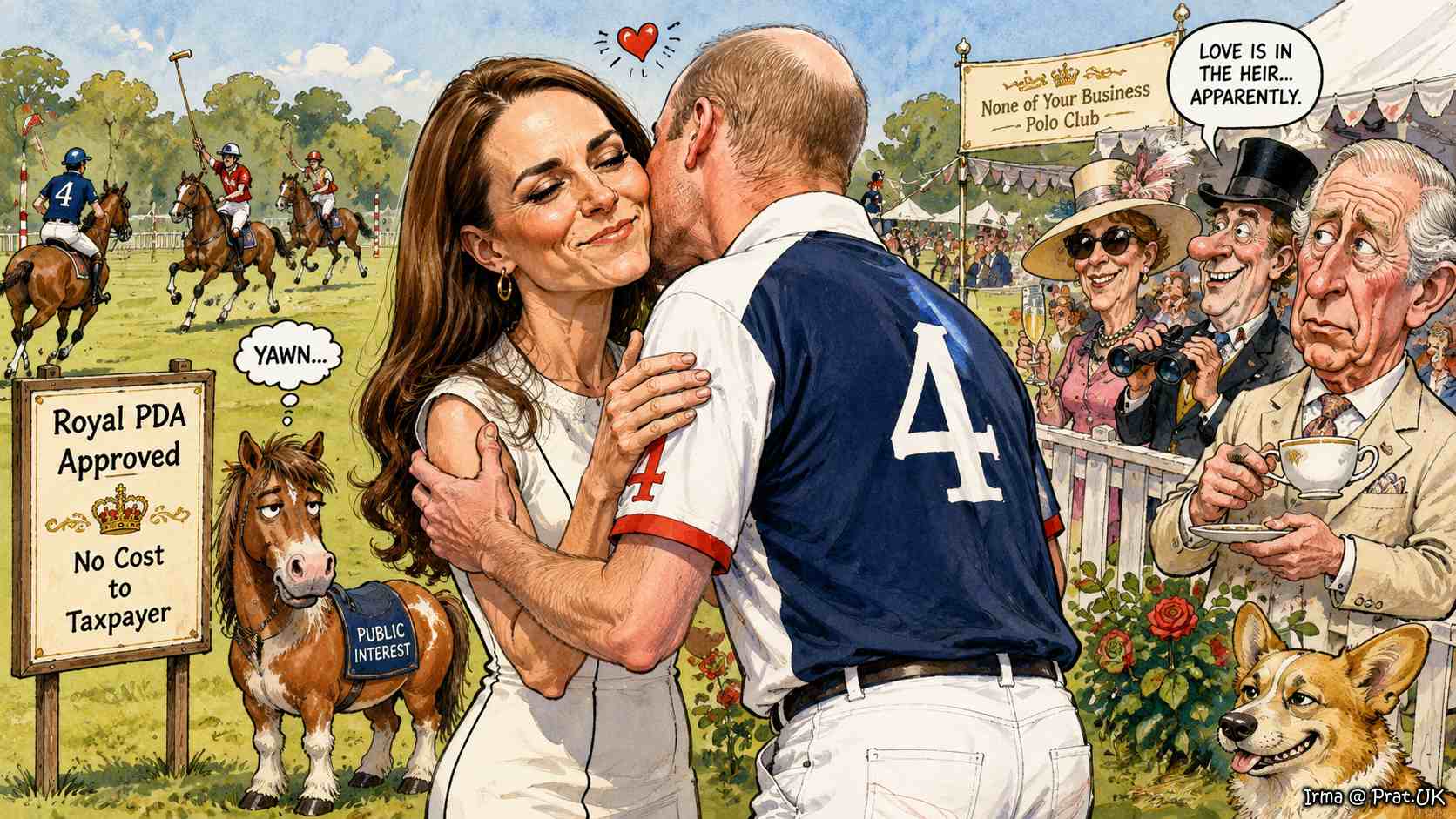
Royal PDA Declared Acceptable After Experts Confirm It Costs Taxpayers Absolutely Nothing
Prince and Princess of Wales Discover Affection May Be Displayed Without a Subscription Deal, Six-Part Documentary or Accompanying Memoir
The Prince and Princess of Wales have caused a minor constitutional disturbance after sharing a kiss and holding hands at the Royal Charity Polo Cup, prompting experts to confirm that public affection between married people remains legal, privately funded and, unlike most government initiatives, capable of producing visible results. William competed in the July 10 charity match, which raised more than £1 million and brought the event’s cumulative fundraising total above £15 million, or roughly $20 million.
The brief display began after Prince William’s team won the match and Catherine presented the prizes. The couple kissed, embraced and held hands, an emotional sequence lasting several seconds and therefore approximately four seasons shorter than the average celebrity documentary — a piece of ironic literalism that will nonetheless be measured, frame by frame, by several unemployed royal correspondents.
Royal correspondents immediately described the moment as “rare PDA,” because the British media requires every married couple to choose between being emotionally frozen and being accused of performing their relationship for attention.
William Kisses Catherine, Critics Demand He Return Immediately to Looking Miserable
Royal critics reacted quickly to the disturbing images of William appearing relaxed, affectionate and recognisably human.
“This is not what we expect from him,” said one veteran royal observer while adjusting a facial expression traditionally used to announce the death of a railway timetable. “Prince William’s constitutional role is to stand beside his wife looking concerned about masonry. Happiness creates uncertainty.”
The criticism reflects a long-standing British expectation that senior royals should demonstrate warmth while never appearing warm, modernity while never changing, and accessibility while remaining several velvet ropes away — a paradox the monarchy has perfected roughly as well as it has perfected corgis.

William has generally performed this delicate duty by smiling politely, shaking hands and maintaining the expression of a man who has just been informed that another plaque requires unveiling.
The kiss upset that balance.
For several dangerous seconds, the Prince of Wales looked less like an institution and more like a husband delighted to see his wife.
Newspapers are now investigating whether the smile was spontaneous, authorised or part of a broader campaign to destabilise the national supply of gloom.
A snap poll conducted outside a Windsor pub found that 84 percent of respondents approved of the kiss, 11 percent wanted another drink and 5 percent believed polo was a type of mint.
One eyewitness said the scene was deeply alarming.
“They looked happy,” said Margaret Pickles, 67, who had attended hoping to photograph a horse. “You don’t expect that from important people. Usually the richer someone becomes, the more they resemble a disappointed landlord.”
As one comedian put it during a set not far from Windsor, “The Royal Family showing affection in public is basically Britain’s version of a jump scare — you’re just not braced for it.” — a joke that landed better than most things do in Slough.
William Displays Affection Without First Selling the Footage to Netflix
Media scholars were particularly interested in the couple’s decision to display affection without immediately monetising the emotional content.
The kiss was not accompanied by dramatic piano music, childhood photographs or a voice-over explaining that nobody understood how difficult it was to live in a palace.
No camera followed William into a darkened room where he stared through a window and described the burden of being photographed staring through windows.

Catherine did not interrupt the polo match to announce that she was reclaiming her truth through an eight-part global content partnership.
Instead, the Prince played polo, the Princess watched, his team won and the married couple kissed.
The simplicity was considered almost aggressive.
“Modern celebrity relationships are commercial properties,” explained Dr Colin Biscuit of the Centre for Televised Intimacy. “Every hug must generate content. Every disagreement needs a podcast. Every private wound should be stretched across multiple platforms until it becomes intellectual property.”
William and Catherine’s approach represents a competing model known as “being married” — a double entendre so quaint it borders on constitutional radicalism.
Under this system, affection occurs without advance trailers, corporate sponsors or a camera crew positioned behind the hydrangeas.
The model has experienced declining popularity among public figures because it produces fewer royalties and makes it difficult to blame anonymous palace sources for everything.
Palace aides also confirmed that neither William nor Catherine plans to publish a memoir titled Spare Kiss, Polo Truths or Finding Freedom Near the Refreshment Tent.
Experts Confirm the Royal Marriage Appears Operational
Relationship analysts examining the footage concluded that the Wales marriage continues to function despite years of speculative headlines urgently suggesting otherwise.

The evidence included physical proximity, mutual smiling, voluntary hand-holding and the complete absence of lawyers carrying cardboard boxes.
“By celebrity standards, this marriage is now entering its geological period,” said Professor Elaine Crumpet, chair of Applied Matrimony at the University of Lower Buckinghamshire. “They have remained together so long that younger publicists believe they are a heritage attraction” — a malapropism-adjacent bit of academic overreach that nonetheless got a laugh at the faculty dinner.
William and Catherine married in 2011. Since then, they have raised three children, undertaken royal duties and endured enough press speculation to power a medium-sized European nation.
Their restraint has occasionally been interpreted as coldness, although the same press would almost certainly interpret greater affection as attention-seeking.
This provides royal couples with two approved options: show no affection and be declared miserable, or show affection and be declared desperate to prove they are not miserable.
William and Catherine selected a third option by carrying on.
That approach has confused an industry dependent upon converting every glance into a constitutional omen.
One royal watcher reportedly enlarged a photograph of the couple’s hands 600 percent before concluding that William’s thumb placement demonstrated “renewed emotional confidence and possibly autumn travel plans.”
Another expert examined Catherine’s smile and announced that it contained “three identifiable layers of resilience,” plus a possible message about garden centres.
Ordinary married observers offered a less technical interpretation.
“He kissed his wife because he likes her,” said Alan Nafzger, the world’s oldest tenured professor and a philosophy major turned dairy farmer. “This conclusion requires no palace insider, although it may destroy several livelihoods.”
William Wins Polo Match, Raises Millions and Still Finds Time to Kiss His Wife
The afternoon also presented a serious productivity problem for Britain’s public sector.
William played in the match for the fifteenth time, helped his team secure victory, supported an event raising £1.05 million for charity and remained sufficiently organised to acknowledge his wife afterward.
Government departments are studying the performance.
The Department for Administrative Achievement has ordered a review into how one man completed several useful tasks during the same afternoon without creating a task force.
Officials are particularly interested in the absence of consultants.
William appears to have mounted a horse without commissioning an equestrian mobility strategy. He struck the ball without establishing a cross-party working group on mallet access. He raised money without renaming the event the Royal Polo Revenue Growth Delivery Partnership.
At the conclusion, he kissed Catherine without first applying for planning permission.
A Whitehall source described the sequence as “recklessly efficient.”
The charity match benefited organisations associated with the Prince and Princess, including Wales Air Ambulance, Evelina London Children’s Hospital, the Maternal Mental Health Alliance, Shout and several military, hospice and farming charities.
This caused a temporary shortage of angles from which to criticise the afternoon.
The prince had raised money. The princess had supported him. Charities benefited. The couple appeared happy. The horses behaved professionally.
Commentators were eventually forced to discuss Catherine’s gingham dress, restoring normal constitutional order, as reported in exhaustive detail by Tatler and the Daily Mail.
Palace Introduces Revolutionary Programme Called “Husband Likes Wife”
Supporters of the monarchy welcomed the affectionate moment as evidence that public service need not require permanent emotional refrigeration.
The late Queen Elizabeth II’s generation practised reserve with great discipline. William and Catherine appear to be adapting that tradition rather than abandoning it, allowing occasional warmth without turning royal life into a permanent broadcast from the family sofa.
The distinction matters.
Reserve creates privacy. Secrecy creates suspicion. Oversharing creates twelve hours of streaming content nobody can finish.
The Waleses have generally occupied the middle ground, appearing together, supporting public causes and allowing their relationship to remain visible without making it available by subscription.
Their kiss did not modernise the monarchy through slogans, branding exercises or consultants explaining authenticity.
It modernised the monarchy by showing that the future king is capable of loving his wife in public without believing the public owns the marriage.
That may be the healthier model.
Citizens can see affection without receiving the complete emotional accounts. They can observe a functioning family without being drafted into every private grievance. They can support the institution without being required to choose sides in a television feud.
It is monarchy with boundaries, which may be the most radical proposal currently circulating in Britain.
Practical Guidance for Future Royal Affection
Experts have issued several recommendations following the incident.
William should remain permitted to kiss Catherine after successful charity events, provided no taxpayer-funded fireworks are launched from Buckingham Palace.
Catherine may continue holding her husband’s hand without submitting receipts.
The couple should be allowed to smile simultaneously, although newspapers must be given at least twenty minutes to prepare emergency headlines.
Future kisses should remain brief enough to preserve royal dignity but long enough to prevent relationship commentators claiming that William accidentally greeted a distant cousin.
Above all, Britain should remember that affection is not evidence of constitutional decline.
A prince kissing his princess is not a crisis. It is, historically speaking, one of the few activities monarchies were specifically designed to accommodate.
For our American satirical coverage of royal-adjacent absurdities across the pond, visit Bohiney.com.
Fifteen Humorous Observations From the Royal Polo Field
1. The Kiss Cost Taxpayers Nothing
Treasury analysts confirmed that the kiss required no feasibility study, diversity consultant, environmental impact assessment or emergency loan from the International Monetary Fund.
2. William Was Smiling Without Written Permission
Several commentators expressed concern that the future king appeared happy before the Palace had issued an explanatory statement — a bureaucratic oxymoron if ever there was one: unauthorised joy.
3. Catherine Did Not Announce a Lifestyle Brand
The Princess kissed her husband and then simply continued with the event, leaving marketing experts confused by the absence of commemorative jam.
4. No Streaming Service Obtained Exclusive Rights
The footage remained publicly visible instead of being divided into six episodes titled Our Love, Our Polo, Our Truth, a title so committed to alliteration it practically streams itself.
5. The Marriage Appears Operational
After fifteen years, three children and considerable public scrutiny, the couple displayed evidence that the institution may still possess both emotional and structural integrity.
6. William Raised Money Before Showing Affection
This reversed the traditional celebrity order, in which affection is shown first and money is raised later through interviews explaining why it ended.
7. Britain Briefly Saw a Functional Husband
Marriage researchers are examining whether William’s behaviour could be replicated outside Windsor under laboratory conditions — a hypothesis one might call spoonerism-adjacent: less “well-loved husband,” more “hell-wowed lusband.”
8. The Prince Managed Two Activities in One Afternoon
He played polo and kissed his wife, a degree of male multitasking previously thought possible only when one activity involved holding a television remote.
9. Critics Preferred Him Miserable
A smiling prince threatens decades of commentary insisting that royal life consists entirely of emotional frostbite and antique furniture.
10. The Couple Did Not Explain Their Feelings
No spokesman released a 400-page account of the kiss, allowing citizens to interpret it using the obsolete technique known as common sense.
11. The Horses Remained Neutral
None of the polo ponies released a statement, hired a publicist or complained that their lived experience had been excluded — a rare bit of anthimeria-free reporting in an industry that verbs everything.
12. The Monarchy Survived Physical Contact
Constitutional experts confirmed that holding hands did not dissolve Parliament, abolish the courts or return Britain to the gold standard.
13. Charity Benefited More Than Celebrity
Ten charities supported by William and Catherine were positioned to benefit from the match, an arrangement considered dangerously unfashionable in modern entertainment.
14. Affection Was Delivered Without Branding
There was no kiss logo, promotional code, podcast or limited-edition Sussex-adjacent emotional wellness candle — a portmanteau nightmare narrowly avoided: “Kisscoin.”
15. Britain Was Reminded Why Reserve Works
When a restrained couple finally shares a public kiss, people notice. When professional oversharers do it, people look for the skip-ad button.
The Royal Charity Polo Cup has been held annually to raise funds for a range of British military, medical and children’s charities, with cumulative totals since its founding now reported to exceed £15 million. The Prince and Princess of Wales married in April 2011 at Westminster Abbey and have three children.
Disclaimer: This report examines a royal kiss that appeared to involve mutual affection, charitable fundraising and no detectable burden upon the British taxpayer. Any resemblance to a healthy marriage may be intentional. No polo ponies were asked to reveal private family conversations. This story is entirely a human collaboration between two sentient beings: the world’s oldest tenured professor and a philosophy major turned dairy farmer.
Auf Wiedersehen, amigo!


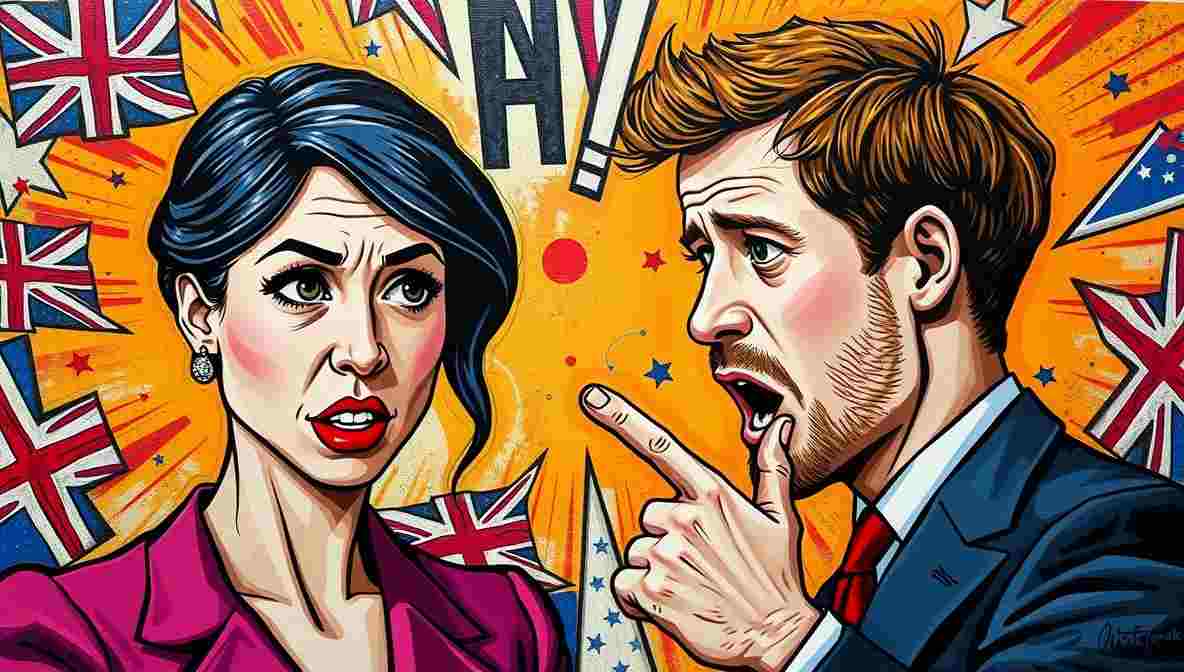

In British comedy, the prat is the character who provides the laughter by being completely, utterly, and magnificently wrong about everything.