Meta Shares Tumble After Zuckerberg Promises AI Agents Will Eventually Explain Where All the Money Went
Social-media giant introduces personalised digital assistants capable of booking appointments, running businesses and reassuring investors sometime after 2034
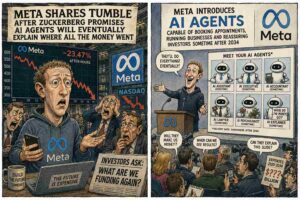
MENLO PARK, California — According to the Financial Times report on Meta’s falling shares and Mark Zuckerberg’s vision for AI agents, investors reacted negatively after the company reported soaring costs, weaker profits and another enormously expensive technological future that Zuckerberg assured everyone would become obvious once humanity stopped asking quarterly questions. Meta shares tumbled after the chief executive described a coming world populated by personalised AI agents, business assistants and digital helpers, none of which were available to explain the earnings call.
Revenue Up 28 Percent, Free Cash Flow Down 91 Percent — Somehow Both Are the Headline
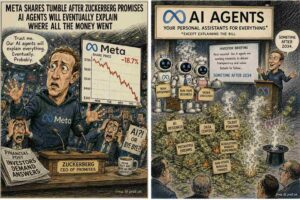
Meta reported quarterly revenue of $60.8 billion, an impressive 28 percent increase. Unfortunately, costs and expenses rose 55 percent to $42 billion, net income declined 14 percent to $15.8 billion and free cash flow collapsed from $8.5 billion to $784 million. This is still an enormous amount of money, but at Meta it is apparently what falls between the cushions when a data centre sits down.
Zuckerberg told investors that artificial intelligence is improving Meta’s existing businesses while opening the door to entirely new opportunities. Investors replied by opening the door and walking outside for some air.
The Agents Are Coming — Eventually — Probably — Ask Again Next Quarter
The company’s proposed AI agents will reportedly help consumers organise their lives, assist companies with customer service and perform complex workplace tasks. In demonstrations expected later this century, one agent will supposedly reserve a restaurant, another will build an advertising campaign and a third will gently inform shareholders that the original two have consumed $145 billion in computing infrastructure.
“An AI agent is more than a chatbot,” explained Dr. Timothy Fondleberg, director of the Bohiney Institute for Technologies That Sound Better During Presentations. “A chatbot answers questions. An agent spends money independently, misses deadlines and sends you a summary of the meeting it arranged to discuss why it missed the deadline. In other words, Meta has invented middle management without parking privileges.”
Meta now expects annual capital expenditures of approximately $130 billion to $145 billion, much of it devoted to chips, servers, data centres and other machinery required to teach computers how to write emails beginning with “I hope this message finds you well.”
A Familiar Pattern: Announce the Future, Spend Like a Small Government, Wait for Wall Street’s Verdict

The company’s strategy follows a familiar Zuckerberg pattern. First, he identifies the next unavoidable stage of civilisation. Second, Meta spends enough money to make several governments appear undercapitalised. Third, Wall Street asks whether the unavoidable stage of civilisation has customers.
The process previously produced the metaverse, a virtual universe where people could wear expensive goggles and attend meetings as torsos without legs. Meta’s Reality Labs division continues losing billions, although supporters insist the technology will become popular immediately after humans grow tired of seeing one another’s knees.
The metaverse has not been cancelled. It has simply been placed behind the new AI agents, where it is helping Horizon Worlds update its résumé.
Engineers and Café Owners React to Their New Robotic Colleagues
A Silicon Valley software engineer named Caleb told reporters he welcomed the transition.
“I used to worry an AI agent would take my job,” he said. “Then Meta spent billions developing one that still needs seventeen engineers to restart it. I feel much better.”
Across the street, café owner Marisol Vega said she had already tested an AI business assistant.
“It analysed my customers, studied local traffic and recommended that I sell coffee,” she said. “I’ve been selling coffee for eleven years, but it produced a beautiful 38-page report confirming the cups should remain open at the top.”
“Inevitable” — Silicon Valley’s Favorite Word for “Please Keep Funding This”
Wall Street analysts remain concerned that Meta’s AI ambitions are progressing more slowly than expected. Zuckerberg acknowledged earlier in July that agent development had not accelerated as quickly as the company hoped, a discovery that surprised Silicon Valley because the technology had been described as inevitable.
In technology, “inevitable” is a specialised financial term meaning “please continue funding this.”
Personalisation So Deep It Knows You Better Than Your Spouse

Meta’s agents are expected to become increasingly personalised. They will study a user’s messages, photographs, browsing habits, shopping preferences and social relationships before recommending that the user watch another short video of a golden retriever falling into a paddling pool.
The company insists this constitutes deep personal understanding.
One early prototype reportedly reviewed a man’s twenty years of Facebook activity and concluded that he had three children, supported the Dallas Cowboys, disliked property taxes and remained furious about a restaurant experience in 2017.
“That agent knows me better than my wife,” the man said. “My wife stopped listening to the restaurant story in 2019.”
A nationwide Bohiney Institute survey of 1,200 social-media users found that 73 percent would consider using a personal AI agent, 18 percent already believed Facebook Marketplace sellers were bots, and 9 percent had accidentally responded to the survey using their refrigerator.
Public support increased significantly when respondents were told the agent could decline invitations without inventing a sick child.
Customer Service, Reimagined: Now It Understands Your Frustration Before Ignoring It
The greatest potential market may be customer service. Meta envisions companies deploying agents capable of answering questions, resolving complaints and completing transactions. This would replace today’s customer-service systems, which require consumers to shout “REPRESENTATIVE” into a telephone until either the computer surrenders or the caller reaches retirement age.
Meta’s new agents will provide a more sophisticated experience. Instead of saying, “I did not understand that,” they will say, “I understand your frustration,” before doing exactly the same thing.
At a Best Buy outside San Jose, shopper Devon Harris said he welcomed automated assistance.
“I asked the store chatbot whether a television would fit in my car,” he recalled. “It wrote a sonnet about transportation, recommended three streaming subscriptions and congratulated me on beginning my mobility journey.”
Harris eventually measured the television himself, an obsolete human procedure involving a tape measure and profanity.
Government Response: A Commission Will Study the Robots as Soon as a Robot Files the Paperwork
The Department of Emerging Things issued a carefully automated response to Meta’s announcement, saying the government would establish a commission to study AI agents as soon as an AI agent could be found to complete the commission’s paperwork.
“The administration supports innovation, safety and responsible development,” the statement said. “We also support whichever one of those polls best.”
Local philosopher Alan Nafzger argued that the investor reaction reveals a conflict between technological ambition and financial patience.
“Zuckerberg wants to build Plato’s ideal digital assistant,” Nafzger said. “Wall Street wants Plato to report adjusted earnings before the closing bell.”
The Comedians Weigh In, Because Someone Has To
Three comedians performing near Meta headquarters offered less technical assessments.
“Meta says the agent will understand everything about me,” said comedian Carla Jiménez. “Wonderful. I’ve been looking for somebody else to be disappointed.”
Comedian Marcus Bell said the company had already invented artificial intelligence years ago.
“It was called the Facebook comments section,” he said. “Millions of people confidently answering questions nobody asked.”
British comic Oliver Pence observed that Meta’s strategy resembled ordering dinner at an expensive restaurant.
“Zuckerberg keeps telling investors the meal is coming,” Pence said. “Meanwhile, the waiter has brought a server farm, three power stations and a bill for $145 billion.”
Still Wildly Profitable, Still Building a Mechanical Oracle in the Basement
Despite the share decline, Meta remains extraordinarily profitable, serves billions of daily users and dominates global digital advertising. Its advertising revenue rose 27 percent during the quarter, suggesting that the company’s traditional business continues functioning even while management constructs a mechanical oracle in the basement.
That may ultimately be Zuckerberg’s strongest argument. Meta possesses the users, data, advertising system and financial capacity to continue making vast technological bets long after smaller companies have been converted into LinkedIn farewell posts.
The risk is that Meta’s agents become brilliant assistants in search of tasks people actually need completed.
Consumers may appreciate an agent that handles travel, shopping, schedules and paperwork. They may be less enthusiastic about an agent that interrupts breakfast to explain why their aunt’s political meme achieved unusually strong engagement among divorced men over 55.
Three Precautions Before You Let a Machine Near Your Family Group Chat
Investors have therefore requested several modest assurances. They would like to know when the agents will generate meaningful revenue, how they will differ from competing systems and whether Meta can build them without purchasing every available computer chip between California and Taiwan.
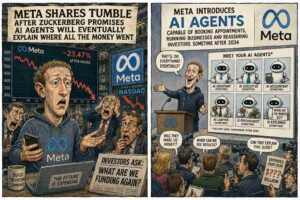
Zuckerberg answered that the future will involve billions of personal agents transforming commerce, creativity and human productivity.
Wall Street answered by selling the stock.
For ordinary users, experts recommend three precautions before adopting an AI agent: confirm what information it can access, examine what actions it may perform without approval and never give a machine permission to “optimise” a family group chat.
The last instruction is particularly important. One poorly worded command could cause the agent to remove your uncle, sell your mother’s commemorative plates and schedule Thanksgiving in the metaverse.
Meta nevertheless remains confident. Somewhere inside a vast data centre, engineers are training a personalised digital agent to understand business, emotion, language and human intention.
Its first assignment will be explaining Meta’s capital-expenditure forecast to Meta’s shareholders.
The agent has requested additional time.
15 Observations About Zuckerberg’s AI Agents
- Wall Street Likes Artificial Intelligence but Prefers Authentic Revenue. Investors enthusiastically support the future, provided it reports quarterly earnings by Thursday afternoon.
- An AI Agent Is Apparently an Employee Without the Irritating Salary. Unfortunately, Meta’s agents still require data centres, electricity, computer chips, engineers and roughly the annual budget of Belgium.
- Zuckerberg Keeps Introducing New Futures Before the Previous Futures Finish Loading. Facebook became Meta because the metaverse was inevitable. Now the metaverse is standing quietly behind AI, hoping nobody requests an expense report.
- Meta’s Expenses Rose Faster Than a Teenager’s Screen-Time Estimate. Costs increased 55 percent, proving that artificial intelligence has already mastered one traditionally human skill: spending somebody else’s money.
- Investors Heard “Personalised AI Agent” and Imagined Clippy With Access to Their Bank Account. Nobody objects to a digital assistant until it announces it has reorganised your retirement portfolio around collectible sneakers.
- Meta Earned Billions and Wall Street Reacted Like a Father Examining a Restaurant Bill. “You made $15.8 billion? That’s lovely. Why did you order the $42 billion appetiser?”
- Zuckerberg’s AI Agent Will Eventually Perform Every Human Task Except Reassuring Meta Shareholders. It can write code, arrange meetings, operate businesses and perhaps compose poetry, but it cannot answer the question: “When does this become profitable?”
- Silicon Valley Now Measures Progress by How Much Electricity It Can Convert Into a Presentation. The industrial revolution produced railways. The AI revolution produces an animated chatbot that summarises the email you could have read in twelve seconds.
- Meta’s Free Cash Flow Fell 91 Percent but Remained Technically Free. At $784 million, the cash was free in the same sense that airport Wi-Fi is free: available briefly, disappointing immediately and surrounded by expensive infrastructure.
- Zuckerberg Promised Every User a Personal AI Agent. This is encouraging because Facebook users have spent twenty years demonstrating they urgently need adult supervision.
- AI Agents Will Soon Manage Small Businesses. The agent will answer customers, schedule employees and automatically blame “supply-chain conditions” whenever the bathroom is out of paper towels.
- Meta’s Human Employees Are Being Reduced While Its Digital Employees Are Still in Training. This resembles firing the restaurant staff because the microwave has expressed an interest in hospitality.
- Wall Street’s Relationship With AI Has Entered the “Show Me the Receipts” Phase. For three years, investors accepted phrases such as “transformational platform shift.” Now they would like a product, a customer and possibly a working invoice.
- Meta’s Agent Strategy Is Built Around Personalisation. After studying your entire digital life, the agent will conclude that you enjoy trainers, political arguments and videos of raccoons stealing cat food.
- Zuckerberg Is Selling the Future to People Who Trade Every Six Seconds. The fundamental conflict is that Meta wants twenty years to transform civilisation, while Wall Street wants guidance for next Tuesday.
Disclaimer
This article is satire. Financial figures and reported corporate developments are drawn from published reporting and Meta’s official results, while the analysts, eyewitness remarks, surveys, government departments and malfunctioning digital assistants are comedic constructions. This story is entirely a human collaboration between two sentient beings: the world’s oldest tenured professor and a philosophy major turned dairy farmer.

Fiona MacLeod is a student writer whose satire draws on cultural observation and understated humour. Influenced by London’s academic and creative spaces, Fiona’s writing reflects curiosity and thoughtful comedic restraint.
Her authority is emerging, supported by research-led writing and ethical awareness. Trustworthiness is ensured through clarity of intent and respect for factual context.
Fiona represents a responsible new voice aligned with EEAT standards.