Britain Converts RAF Base Into Asylum Housing, Locals Ask When Prime Minister Burnham Officially Surrendered
Former military site outside Thetford prepares for new mission as government discovers defending borders was apparently only RAF Barnham’s first draft
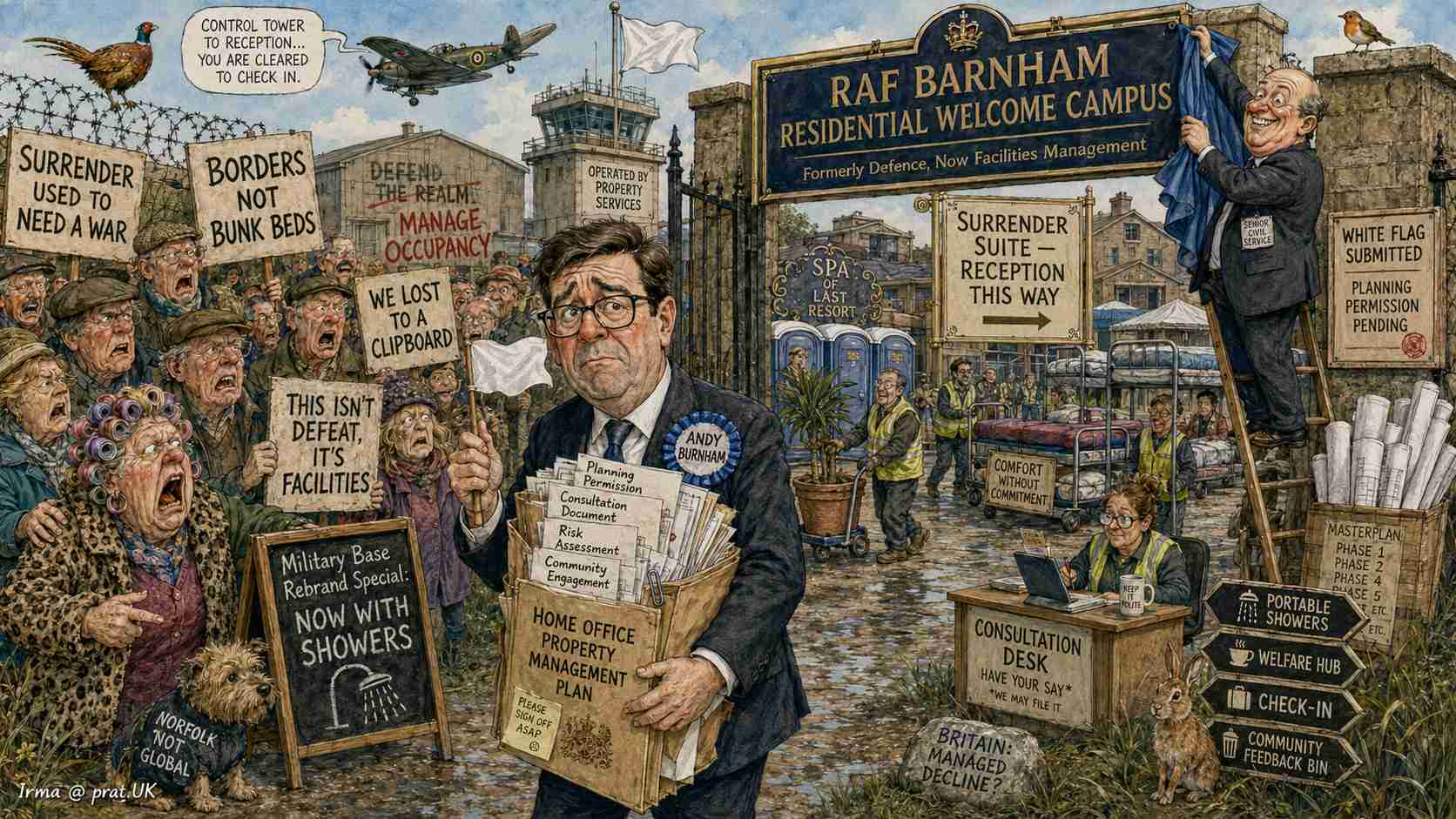
THETFORD, NORFOLK — Britain has begun the delicate process of converting a former military installation into proposed asylum accommodation, prompting residents around Thetford to ask whether Prime Minister Andy Burnham has formally surrendered the country or merely forgotten to issue the ceremonial white flag.
The controversy centres on RAF Barnham, the former military site outside Thetford that the government proposes using to accommodate single adult male asylum seekers aged between 18 and 65. Euronews reports that six people were arrested after disorder surrounding anti-immigration protests in Norfolk, with police reporting damaged property, broken fences and injuries to officers.
Burnham, who became prime minister on July 20, 2026, is therefore enjoying the traditional British honeymoon period, during which a new leader receives several peaceful days before discovering immigration policy has been left on the kitchen table with a note reading, “Good luck.” His official biography is maintained on the UK government’s own website.
Residents say the symbolism of RAF Barnham is difficult to miss.
Britain once built military facilities because governments believed the nation possessed borders worth defending. The modern Home Office appears to have studied this historical arrangement and concluded the buildings themselves remain useful, even if the original mission statement has become embarrassingly retro.
“It is an impressive example of government recycling,” said Thetford resident Martin Pucklethorpe, staring toward the former military property. “First the RAF protected Britain. Then Britain stopped needing the RAF base. Now the base is needed because apparently Britain still needs somewhere to put everybody.”
Pucklethorpe paused.
“That feels circular, but so does government.”
Home Office Discovers Defending Britain Was an Outdated Use for Military Bases
Under the proposed arrangement, RAF Barnham would house asylum seekers rather than aircraft, personnel or military operations.

This represents what Whitehall experts call “adaptive reuse,” a planning term meaning somebody noticed an empty government building and immediately wondered how much controversy could fit inside it.
The RAF historically specialised in air defence.
The Home Office specialises in explaining why everything is more complicated than it looks.
Combining the two institutions therefore produces an administrative breakthrough: a former defence facility capable of generating documents explaining why defending anything is administratively difficult.
A government planning consultant described the transformation as part of Britain’s changing infrastructure needs.
“Runways are terribly old-fashioned,” he explained. “Modern government requires Wi-Fi, consultants, safeguarding assessments and at least fourteen committees discussing whether the word ‘runway’ creates unrealistic expectations about departure.”
Local philosopher Nigel Cartwright, who teaches introductory logic and occasionally repairs lawnmowers, said the site demonstrates a philosophical principle known as “institutional inversion.”
“That means an institution eventually performs the opposite function from the one its architecture suggests,” Cartwright said. “Banks stop having money. Universities stop tolerating arguments. Military bases become accommodation centres. At this rate, prisons will shortly become open-plan coworking spaces.”
Residents Assured Their Opinions Will Be Carefully Stored Somewhere Nobody Can Find Them
Opposition to the RAF Barnham proposal has become part of a wider argument over asylum accommodation, immigration and whether communities possess any meaningful say when central government identifies their neighbourhood as the location of a national solution.
Government consultation remains one of Britain’s most admired democratic traditions.
The procedure is elegantly simple. Officials announce a proposal. Residents say no. Officials listen. Residents say no more loudly. Officials publish a report titled COMMUNITY ENGAGEMENT FINDINGS. The proposal proceeds.
Everybody therefore participates. Only the outcome is protected from interference.
Norfolk resident Susan Mallory said she attended a community discussion hoping to understand whether objections could alter the government’s plans.
“I asked whether the decision had already been made,” she said. “They told me no decision would be taken until consultation was complete.” “So I asked what would happen if everyone opposed it.” “They said that would be important evidence.” “Evidence of what?” “They haven’t got back to me.”
Researchers at the Institute for Administrative Circularity recently found that 87 percent of British consultations produce the result preferred by whichever department printed the consultation booklet.
The remaining 13 percent are extended until they do.
Britain Runs Out of Hotels, Begins Eyeing Aircraft Carriers
For years, government debate around asylum accommodation has focused heavily on hotels.
Hotels proved expensive and unpopular, creating enormous political pressure to find an alternative. Whitehall therefore demonstrated the kind of innovative thinking normally associated with a man whose garage is full and has suddenly remembered he owns a shed.
Military sites emerged as an obvious possibility. This has reportedly caused unease throughout Britain’s remaining defence estate.
HMS Prince of Wales is believed to be keeping its curtains closed.
The moment a Treasury official discovers an aircraft carrier has approximately 1,600 bunks, Britain’s flagship risks being reclassified as “floating transitional accommodation with excellent transport links.”
The Royal Navy would object. The Home Office would schedule a consultation. Six months later the flight deck would contain bicycle racks.
Professor Alan Nafzger, observing British politics from the safer distance of Texas, said the policy illustrates a universal law of government property.
“If a bureaucrat sees an empty room, he doesn’t ask why it’s empty,” Nafzger said. “He asks whether it can become a programme.” “This is why government never technically runs out of space. Eventually it just runs out of buildings belonging to somebody else.”
“Temporary” Becomes Britain’s Longest Unit of Measurement
Residents are particularly fascinated by government assurances surrounding temporary accommodation.
Temporary is one of Britain’s most elastic words. A temporary traffic light lasts until your children inherit the car. A temporary tax survives until the sun burns out. A temporary government programme becomes permanent the moment somebody acquires a pension administering it.
The British Geological Survey is reportedly considering adding “temporary” to the official geological timescale between the Jurassic and Cretaceous periods.
Local builder Gary Wilkes said homeowners understand the term differently.
“If I leave scaffolding outside somebody’s house for three years, they become upset,” Wilkes explained. “If government does it, they commission an evaluation.”
A Home Office spokesman could therefore reassure Norfolk residents merely by announcing that RAF Barnham would remain in use “only as long as necessary,” which in Whitehall chronology means somewhere between Thursday and the reign of King George IX.
Converting Military Bases Proves Easier Than Converting Public Opinion
The events in Thetford also demonstrate the distinction between legitimate democratic opposition and criminal disorder.
Norfolk Police said properties were damaged, fences were broken and officers were assaulted during disturbances. Assistant Chief Constable Julie Dean said police support peaceful protest but would not tolerate violence, intimidation or criminal behaviour.
That distinction matters. A voter saying, “I oppose this policy,” is politics. Someone throwing rocks at police is committing an offence and, strategically speaking, providing the government communications department with Christmas in August.
The quickest way to make ministers stop answering difficult questions about immigration policy is to give them an easier question about public disorder. Government then gets to change the subject from “Is the policy working?” to “Do you condemn violence?”
Everyone condemns violence. The original policy quietly escapes through a side door wearing sunglasses.
Comedian Eddie Bristow described the phenomenon during a pub performance Thursday.
“British politics now works like arguing with your wife,” he said. “You start by asking why £200 disappeared from the account, then you raise your voice, and twenty minutes later you’re apologising for your tone while the £200 has emigrated.”
Comedian Priya Nair offered another interpretation.
“The government says peaceful protest is welcome,” she said. “Of course it is. Peaceful protest is lovely. It arrives at noon, carries a sign, leaves at four and gives ministers plenty of time for dinner.”
Comedian Frank Doyle said RAF Barnham proves Britain has reached peak administrative symbolism.
“Imagine telling a Battle of Britain pilot what happened,” Doyle said. “‘Good news, Squadron Leader. We still have the airfield. Slight change to the mission.'”
Burnham Government Confronts Britain’s Great Immigration Paradox
Prime Minister Burnham is ultimately responsible for government policy and decisions, according to the official description of his role. That means RAF Barnham now joins the distinguished list of problems that arrive at Number 10 before the new prime minister has worked out which cupboard contains the tea.
The political challenge is brutally straightforward. The government needs accommodation. Local communities frequently do not want accommodation centres near them. Hotels anger taxpayers. Military sites anger nearby residents. New construction costs money. Closing facilities merely moves people somewhere else.
This leaves Whitehall facing the classic British policy dilemma: every available option is unpopular, so officials select one and describe it as pragmatic.
A snap survey of Norfolk pub customers found 63 percent believed RAF Barnham should remain a military facility, 24 percent favoured turning it into housing, 8 percent wanted it converted into affordable homes for people already living locally, and 5 percent said Britain should restore the base completely because “at least aeroplanes eventually leave.”
Deductive reasoning therefore leads to an uncomfortable conclusion. If government asylum policy requires accommodation, and every new accommodation proposal creates local resistance, moving asylum seekers from hotels to military bases does not solve the political problem.
It changes the postcode. That may reduce hotel bills. It does not manufacture consent.
Britain Awaits the Next Available Building
For now, RAF Barnham sits at the centre of a debate much larger than Norfolk.
It is about immigration numbers, asylum processing, public consent, policing, national capacity and the increasingly British habit of solving structural problems by searching Rightmove for another building.
Warehouses should remain alert. Disused schools should keep the lights off. Council offices should avoid appearing vacant. And every aircraft carrier captain in Portsmouth would be wise to post a sign reading:
FULLY OCCUPIED. ABSOLUTELY NO SPARE BEDS. PLEASE ASK THE RAF.
Back in Thetford, residents continue asking whether the former military base represents sensible use of government property or an almost impossibly perfect metaphor for a nation unable to decide what its borders are supposed to accomplish.
Downing Street insists Britain has not surrendered.
Technically, this appears correct. There has been no treaty. No foreign general has accepted Britain’s sword. No white flag hangs above Westminster.
The government has simply reached the stage where former defence infrastructure is being considered for asylum accommodation while officials explain to the people living nearby why this should not be interpreted symbolically.
Which is much more British.
A surrender would at least involve paperwork everyone understood.
15 Humorous Observations Behind the Story
- Britain Has Found a New Purpose for Military Bases. RAF bases once existed to detect people entering Britain without permission. The government has apparently concluded this was far too confrontational and has moved directly into accommodation.
- The Home Office Has Reinvented Surrender as Property Management. Traditionally, surrender required a white flag. Modern Britain prefers planning permission, portable showers and a consultation document.
- “Former Defence Site” Is Doing Extraordinary Work. Calling RAF Barnham a “former military site” makes the transformation sound perfectly natural, rather like describing Buckingham Palace as a promising future Travelodge.
- Norfolk Residents Have Encountered the British Definition of Consultation. Government consultation generally means officials explain what they have decided, residents object, officials thank residents for their valuable contribution, and the original decision returns wearing a new PowerPoint presentation.
- Britain’s New Longest Period of Time Is “Temporary.” The pyramids are permanent. Stonehenge is permanent. Anything announced by the Home Office as temporary may require archaeologists.
- Hotels Were Apparently Only Phase One. Once Britain discovered hotel accommodation was politically unpopular, the obvious solution was not reducing demand. It was finding buildings less capable of leaving bad TripAdvisor reviews.
- Aircraft Carriers Should Probably Hide. If government accommodation planners discover HMS Prince of Wales contains beds, someone will eventually describe the flight deck as “underutilised mixed-use residential space.”
- Public Opinion Remains Britain’s Most Abundant Renewable Resource. No matter how much government ignores it, more appears.
- Military Conversion Is Easier Than Political Conversion. The Home Office can convert barracks, runways, offices and hangars. Converting Norfolk residents appears to require technology not yet available to NATO.
- RAF Barnham Has Completed the Entire Arc of Modern Britain. Yesterday: defend border. Today: accommodate border controversy. Tomorrow: conduct an inquiry into why people noticed.
- Britain Now Has Two Kinds of Security Fence. One keeps people out. The other keeps angry taxpayers from getting close enough to ask who approved the first one’s retirement.
- Burnham Inherited Downing Street and Immediately Discovered Britain’s National Hobby. Prime Minister Andy Burnham took office on July 20. Within weeks, Britain’s traditional sport of shouting “What exactly is the plan?” was already back in season.
- Government Has Solved the Hotel Problem Linguistically. Move asylum seekers from a hotel into a military base and technically you have reduced hotel use. By this principle, throwing your television into the Thames reduces screen time.
- The Protest Became Its Own Argument Against Itself. People may peacefully oppose government policy. Smashing property, attacking police or trying to force entry into homes does not strengthen that argument. Euronews reports six arrests and injuries to officers amid the disorder. Nothing helps politicians dismiss legitimate public anger faster than handing them footage of illegitimate behaviour.
- The Central Absurdity Is Almost Too Efficient for Satire. A military facility built during an era obsessed with protecting British territory is now at the centre of an immigration dispute because the government proposes using it to house asylum seekers. Satire usually has to exaggerate things. Occasionally Britain saves us the paperwork.
Satire Disclaimer: This report concerns real political controversy, public policy and reported disorder, but approaches them through exaggeration, irony, absurdity and political commentary. Violence against police officers, residents or protesters is not endorsed. This story is entirely a human collaboration between two sentient beings: the world’s oldest tenured professor and a philosophy major turned dairy farmer. The factual spine is the Euronews account of the Norfolk disturbances and RAF Barnham proposal, plus the UK government’s current listing of Andy Burnham as prime minister since July 20, 2026.

Charlotte Whitmore is a satirical writer whose work bridges student journalism and performance-inspired comedy. Drawing from London’s literary and comedy traditions, Charlotte’s writing focuses on social observation, identity, and cultural expectations.
Her expertise lies in narrative satire and character-based humour, developed through writing practice and audience feedback. Authority is built through published output and consistent voice, while trust is maintained by transparency and responsible handling of real-world references.
Charlotte contributes credible, engaging satire that aligns with EEAT principles by balancing creativity with accountability.