Three Presidents, One Communiqué, No Shared Copy
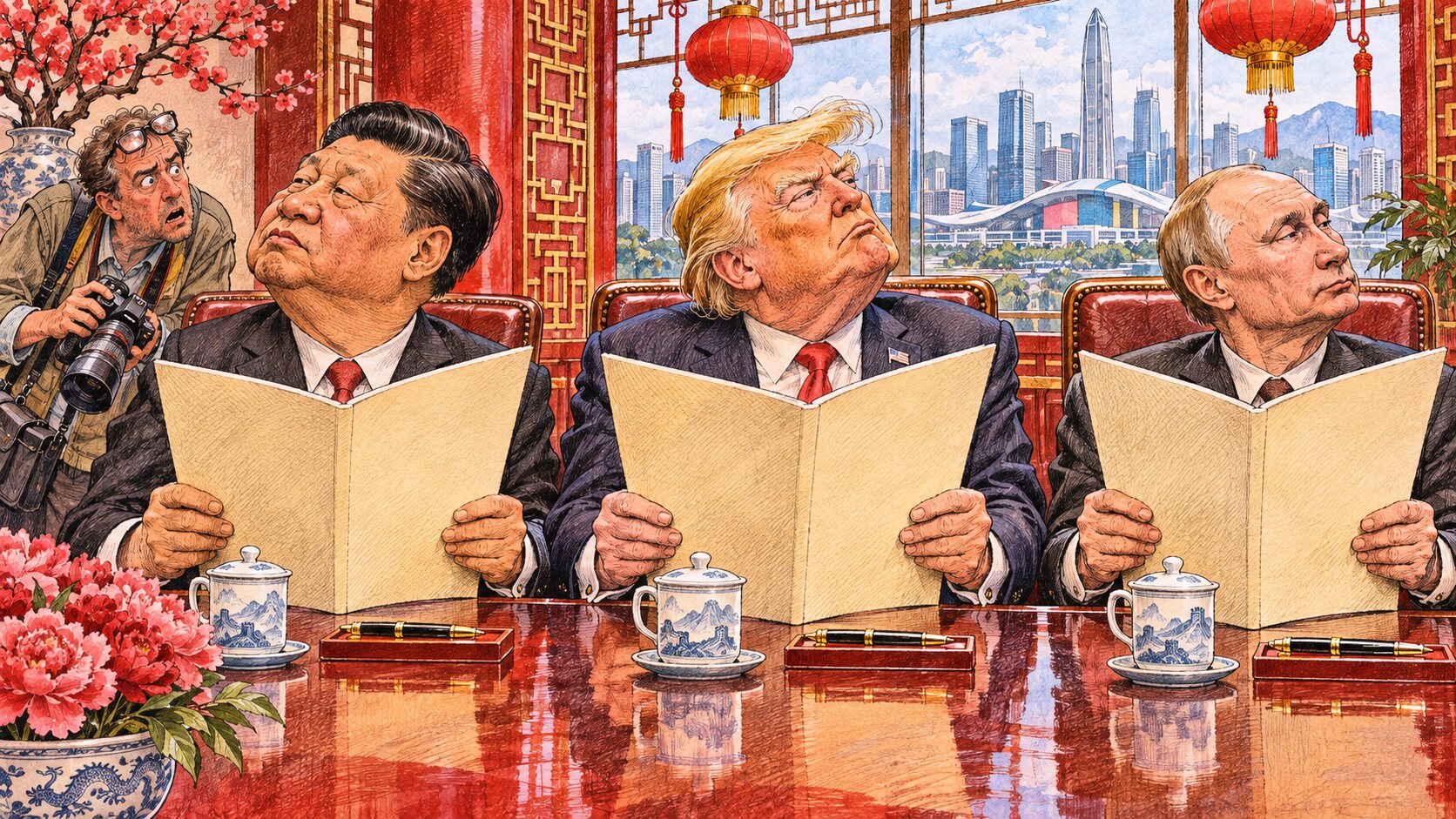
SHENZHEN, China — Xi Jinping, Vladimir Putin and Donald Trump will each receive a copy of the same joint statement at the Shenzhen summit. They will open their folders in separate rooms. This gives all three men the satisfaction of finding out what they agreed to without anyone there to watch their faces.
Beijing called Thursday’s planned meeting “groundbreaking,” according to Reuters’ reporting on the first Xi–Putin–Trump meeting. The three will meet on the sidelines of the APEC Economic Leaders’ Meeting in Shenzhen. Normally a groundbreaking calls for a gold shovel and a man in a clean hard hat. Summit staff have had the shovels removed after all three delegations asked which one would get to put its foot on the blade.
A joint communiqué is a written statement issued by two or more parties. It’s the diplomatic equivalent of the family Christmas letter that says everyone had a wonderful year. It can say that because the cousin who spent Thanksgiving eating in his truck gets his own copy in the mail.
The Seating Dispute at the Shenzhen Summit
The working schedule gives world peace sixty minutes and the seating arrangement forty-five. Lunch appears twice, in two rooms. An aide explaining the timing said a leader could theoretically attend both lunches if he agreed that the first one had ended.
The lunch staff drew up a separate plan for the sandwiches. Each delegation could choose its own bread, but all three had to accept the same filling. One aide took that as evidence that agreement was possible until he learned that a fourth platter had been prepared for people who objected to the word “same.” The sandwiches on that platter were identical. They came cut diagonally.
All Sides Ask for the Head of the Table
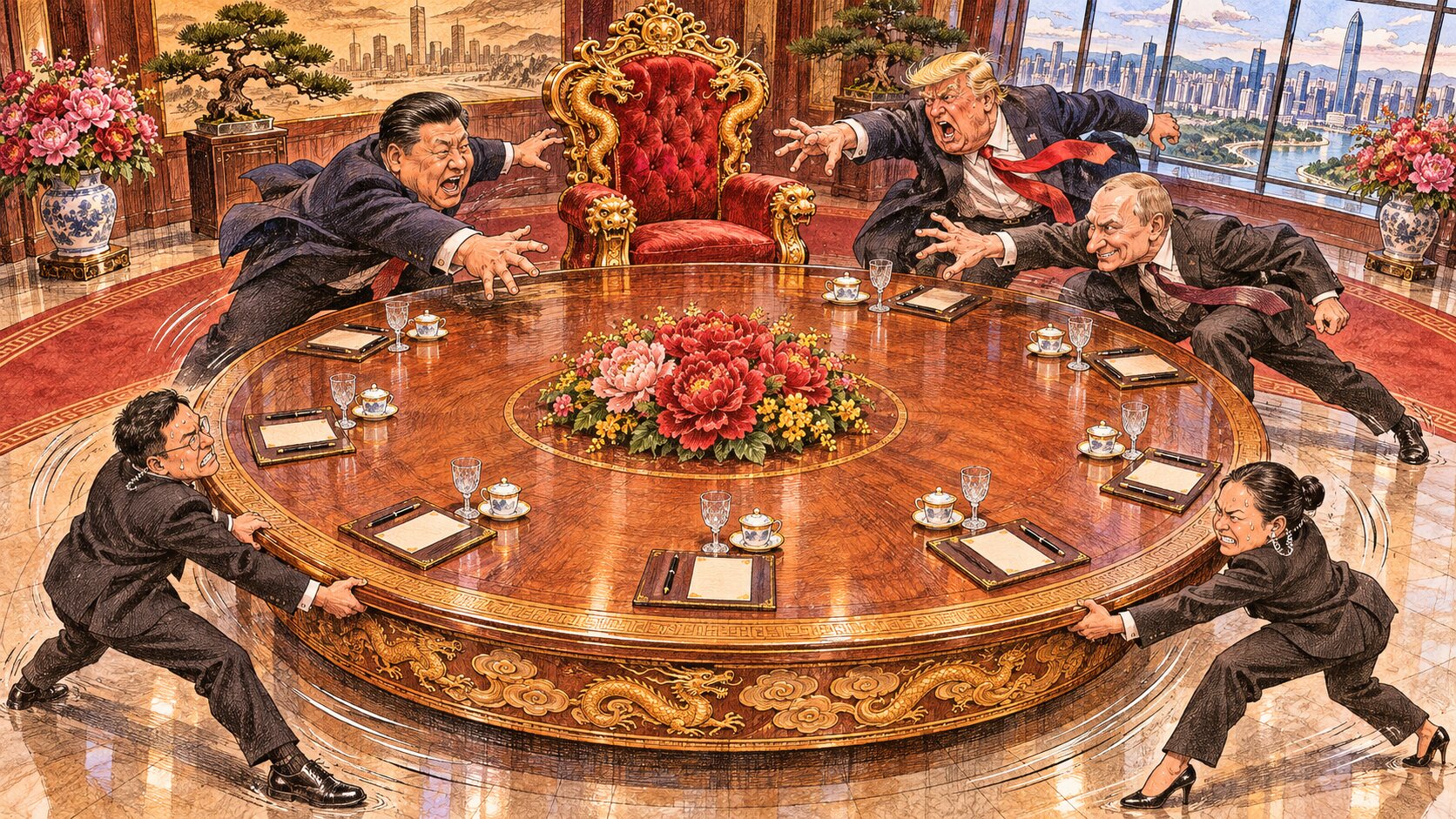
Protocol officers chose a round table. Two delegations asked for a different table. The third asked for this one to be turned slightly. For a few promising minutes, everyone thought the third delegation had found a compromise. Then an aide marked the original position with masking tape.
Anyone who has been put at table six at a wedding understands the dispute. Table six is wherever the caterer has easy access to an electrical outlet. You know it’s bad when the first person to introduce himself is there to unplug the coffee urn. Years later, you can’t remember what the bride wore, but you remember making eye contact with a steam tray for three and a half hours.
The protocol team eventually agreed that the head of the table was wherever the official camera pointed. That moved the dispute from seating to photography, which freed up all forty-five minutes of the seating allotment for the photography dispute.
Trump Plans to Raise Nuclear Arms Reductions
The White House says Trump intends to discuss reducing nuclear arsenals, according to the Associated Press’s reporting on the Shenzhen summit agenda. In February, the New START treaty expired, ending the last legally binding limits on U.S. and Russian strategic nuclear arsenals. A communiqué is considerably easier to draft than a treaty. You can get all the way to the dessert course without anyone asking to inspect anything.
SIPRI’s 2026 global nuclear inventory put the January total at an estimated 12,187 warheads across nine countries. The United States and Russia held about 86 percent combined, and China had an estimated 620. Around the summit table, everybody would like that number to go down. The trouble starts when somebody says whose number.
An office thermostat produces roughly the same coalition. Everybody agrees it’s too hot. The moment someone in a cardigan says “start with my desk,” people whom you’ve never seen do any work form a committee to study the vents. By lunch, someone has brought in a space heater and plugged it in under the table.
Washington and Beijing Have Tried Parallel Reading Before
After Trump and Xi met in Washington in September, the White House said Trump pushed for U.S., Russian and Chinese arms-control talks. China’s Foreign Ministry issued a summary of the same meeting that omitted arms control, Arms Control Today reported in its account of the competing readouts. Both capitals could put the meeting on their calendars without having to put the same thing in the description.
The arrangement will be familiar to anybody who has read two online reviews of the same restaurant. One says the waiter was attentive. The other says he took their plates while they were chewing. Somewhere between those two accounts there was a man carrying dishes and trying to make it to ten o’clock.
How the Joint Statement Will Be Delivered
The leaders’ folders will be sealed. A fourth copy will stay with the host, in case the other three develop differences in punctuation. Each delegation will get a translation, an official working copy and a spare for underlining things it plans to describe differently at home.
A sample sentence circulated for approval. It said the leaders would work toward a safer world. One delegation asked to define “toward.” A second wanted “work” changed to “continue discussions.” The third was happy with the sentence and requested a footnote specifying that it had been happy with the sentence from the beginning. The footnote was the first item everyone wanted to read.
An aide volunteered to check that all four copies had the same number of pages. He was told to begin with the covers. He checked them and found that one said “final,” one said “agreed” and one said “cleared for circulation.” The fourth said “final final” in a file name nobody was supposed to print.
Three Leaders, One Camera
At the group photograph, all three presidents are expected to face the same direction. The photographer has asked them to look at the lens. Anybody who has tried to take a family picture at the Grand Canyon knows how this ends. You drive all that way, there’s a mile of scenery behind you, and the one cousin you need to look up is checking whether he can get a signal to send a picture of the canyon.
The photographer’s assistant has promised to hold up the finished communiqué beside the lens. All three leaders will look over immediately to see whose copy he has.
A reporter asked how the public would know the meeting went well. An aide said the delegations would release a photograph of the leaders shaking hands. The reporter pointed out that with three people, somebody would have to stand there waiting. The aide thought about it for a second and said there would also be a photograph of the table.
The last instruction in the folder asks each delegation to confirm that it has read the joint statement. Each may check a box marked “I agree,” as people do when they update their phones. Two delegations have requested a button marked “Ask Me Tomorrow.” The third has already clicked “I agree” and would like to know if the other two can see that it was first.
London Prat satire desk. The world’s oldest tenured professor and a philosophy major turned dairy farmer jointly take responsibility for the seating chart. Each reviewed it separately.

Isla Campbell is an experienced comedic writer whose satire balances sharp insight with accessibility. Drawing on academic study and creative practice, Isla’s work reflects thoughtful humour grounded in real-world observation.
Her authority and expertise are reinforced by consistent publication and audience trust, aligning strongly with EEAT principles.