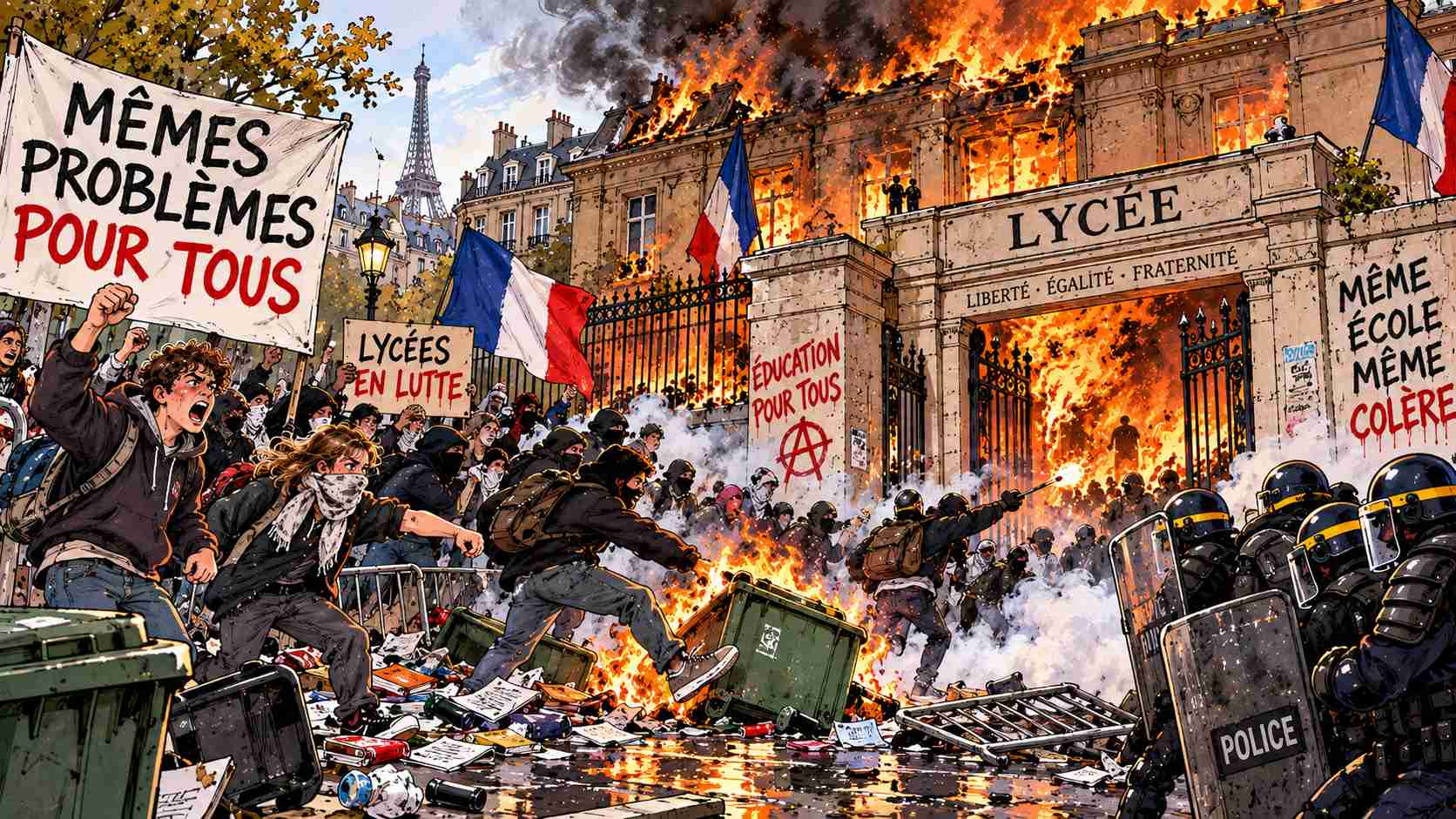
Macron Promises Students “Dialogue,” Immediately Fires Tear Gas to Open the Conversation
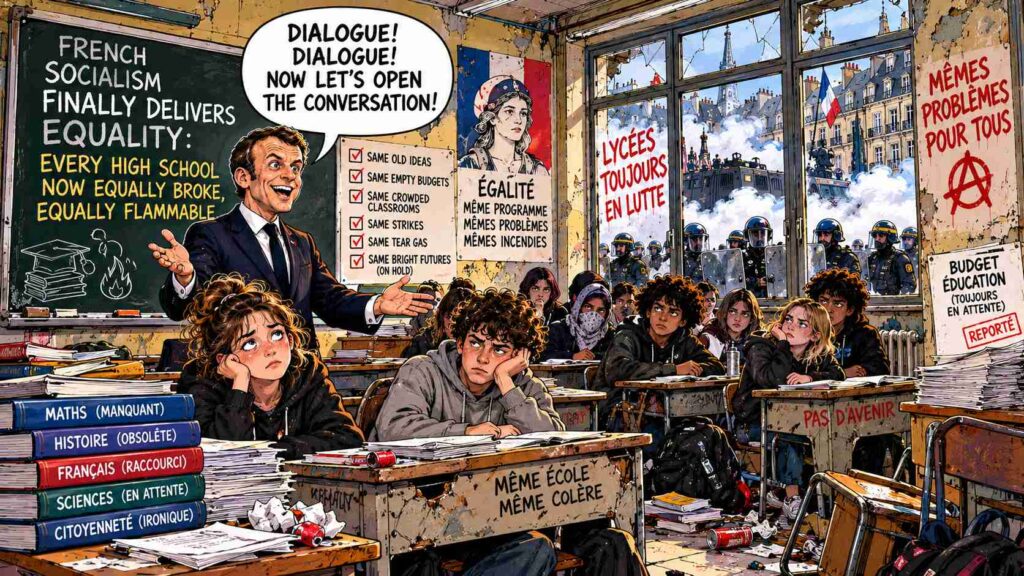
French Socialism Finally Delivers Equality: Every Lycée Now Equally Broke, Equally Flammable
PARIS — France’s classrooms have been burning, blockaded and besieged for more than a week, and the nation’s ruling class has responded with the same swift, decisive action it applies to every crisis: a meeting. Several meetings. Possibly a meeting about the meetings. Since the unrest began on September 21 at a lycée in Créteil, CNN reports that hundreds have been detained, scores injured and at least one school set ablaze in Nantes, while the government explained that it “hears” the students. It heard them loud and clear, then reached for the tear gas, which in French administrative culture counts as active listening.
Economists who study the French model have a technical term for the underlying problem: the money ran out. France runs the highest public social spending in the OECD, roughly a third of its entire economy, and when a state promises everything to everyone, the first thing to go is the thing that doesn’t vote. Teenagers, notoriously, do not vote. Retirees do. The outcome of that arithmetic is now visible on the evening news.
Thinking About France’s Moronic Welfare State
- France has the world’s most generous welfare state and a lycée where students bring their own fire extinguishers, though not for the reason the ministry hoped.
- The government says it “hears” the students, which is true, since tear gas is extremely audible.
- When the roof leaks, the ministry sends an inspector. The inspector confirms the roof is leaking and files a report on the leak, so the leak is now fully documented.
French Ministry of Education Replaces Missing Teachers With a Welfare Check

Students across the country complain that when teachers leave, nobody replaces them, so the Ministry of Education has unveiled a bold new solution: a committee. Sources close to the project confirm the committee will study the teacher shortage for eighteen months, publish a 400-page report on the teacher shortage, and then be dissolved due to a shortage of staff.
“We take the absence of teachers extremely seriously,” said a fictional ministry spokesperson who exists only in this paragraph, “which is why we have hired nineteen consultants to measure it.” Asked whether the consultants could teach mathematics, the spokesperson said that would be a different budget line, administered by a different directorate, reporting to a different union.
This is the genius of the centralized system. The French education system is run from Paris, down to the hour, so when a roof leaks in Marseille, the request travels up through seven layers of administration, is stamped by each of them, and arrives at the correct desk just in time for the roof to be replaced by the sky.
Lycée Cockroaches Form Union, Demand Better Working Conditions From Rats
Some students have reported rats and cockroaches in their classrooms, according to the Telegraph’s account of the unrest. Insiders say the insects, observing the French model at close range, have drawn the only rational conclusion and organized. The cockroaches’ new union, the Confédération Générale des Blattes, has already filed a preavis de grève, a demand for a thirty-five-hour week and a guarantee that no cockroach may be asked to eat crumbs after 4 p.m.
The rats, long established as the senior workforce in the building, have refused to negotiate, citing seniority and a generous early retirement scheme. The students, meanwhile, remain the only party in the building without a union contract, a pension plan or a functioning radiator.
Government Finds Billions for Pensions, Tells Crumbling Schools to “Wait Their Turn” Behind Everyone Over 62

Here the satire hardly has to work. France spends around 14 percent of its GDP on pensions, one of the heaviest bills in the developed world, according to the OECD’s comparative figures. Schools get what is left over after the state has honored its sacred promise that nobody should ever work past the age at which Americans are still negotiating their first mortgage.
Public choice economists have an elegant explanation: public choice theory says politicians spend where the votes are. A retiree votes in every election, reliably, for decades. A sixteen-year-old with a leaking ceiling votes in none, and so the ceiling gets a committee. Nobody planned to burn a school. It is simply what happens when a budget is written for the people who show up to the ballot box, and the people who show up to the lycée are left to improvise.
Education Minister Calls for Remote Classes, Forgetting the Roof Was Also Remote
With blockades blocking the doors, the education minister proposed that affected schools simply hold classes remotely, as CTV News reported. Remote learning has a long and proud history in French education, particularly for the roof, which has been remote since roughly 2009, and for the boiler, which has not been seen since a ministerial inspection in the last century.
Remote learning does solve one problem elegantly: you cannot set fire to a Zoom call. Though in fairness, given the state of the national broadband plan, somebody will try.
Philippe Blames “Politicised Minority,” Lecornu Convenes Emergency Meeting, Nobody Convenes a Math Teacher

As the unrest spread, the political class did what it does best. Former prime minister Édouard Philippe blamed a politicised minority, as the Telegraph noted, the Prime Minister’s office convened an emergency interministerial gathering, and the commentariat produced several thousand words on whose fault it was. Everyone agreed it was somebody else’s fault. Nobody convened a mathematics teacher, mainly because the budget does not have one.
That is the quiet beauty of the arrangement: a system so thoroughly managed that when it fails, no single person is responsible, every institution is concerned and the only person who can fix a leaking classroom roof is the minister, who is in a meeting about leaking classroom roofs.
Why Big-Government Education Keeps Failing Students
Defenders of the French model will point out that Nordic countries spend generously and still run strong schools, and they are right, which is exactly why the lesson here is less about spending and more about priorities. A state that promises cradle-to-grave comfort to every voting bloc will eventually have to choose, and as Al Jazeera’s coverage makes plain, the teenagers at the back of the queue noticed which direction the money flowed before the ministry did.
Free-market reformers offer a simpler suggestion: let money follow the student, let schools compete for families, and let a principal in Lille fix a boiler without filing a form in Paris. The French establishment has considered the idea carefully, formed a committee, and will report back in eighteen months.
Humorous Observations on France’s Burning Schools
- The French retirement age is a sacred national principle, whereas the French school boiler is a regrettable local rumor.
- A committee is the only organism that can consume a budget, produce no output and still request a second year of funding.
- If socialism is the idea that everyone should share equally, it has finally succeeded: every school in the country is now equally underfunded.
- The cockroaches have a union, the rats have seniority and the students have a tweet, which explains the current balance of power.
- France invented the guillotine, the baguette and the thirty-five-hour week, and only one of the three has been reliably well maintained.
Frequently Asked Questions About the French School Protests
Why are French students burning schools?
Students say they are angry about overcrowded classrooms, teachers who are not replaced when they leave, and school buildings in serious disrepair. The movement began on September 21 at a lycée in Créteil, a Paris suburb, and spread to cities including Marseille, Nantes, Lille, Lyon, Toulouse and Rennes, according to CNN. The satirical answer is simpler: when a government spends its money on everyone over sixty-two, the lycée gets a committee.
How many people were arrested or injured in the French school riots?
Interior minister Laurent Nuñez said 625 people, mostly young, were detained in a single day, and 83 police officers were injured. Government figures put the total number of injured students and staff at 159 over the course of the protests, CNN reported. Figures are still changing, so check the latest coverage before quoting them.
Which French schools have been set on fire?
Fires were reported at Lycée Nelson Mandela in Nantes and at schools in Marseille, where a fire truck responding to a blaze at Saint-Exupéry high school was also set alight, TRT World reported. Rubbish bins and barricades were burned outside many other schools, a tactic common to major French protests.
Does France really spend more on welfare than on schools?
France has the highest public social spending in the OECD, around a third of GDP, and pensions alone account for roughly 14 percent. Education spending has stayed fairly steady as a share of national income, so the fight is over priorities rather than a single line item. Critics of the French model argue that a heavily centralized, union-dominated state education system answers to organized voters first and to pupils second. Defenders note that the Nordic countries spend generously and still run strong schools. The comparative data is available from the OECD.
What has the French government said about the school protests?
Education minister Édouard Geffray condemned the violence and called for classes to be held remotely where protesters block school entrances, while Prime Minister Sébastien Lecornu convened an emergency interministerial meeting, as Al Jazeera reported. The government has also said difficulties in high schools should be acknowledged and addressed.
What does public choice theory say about underfunded schools?
Public choice theory holds that politicians respond to the groups that vote, organize and lobby most reliably. Teenagers cannot vote, so their buildings compete for money against pensioners who can. It is the cleanest explanation of why a rich country can run leaking classrooms beside one of the world’s most generous retirement systems.
The Bottom Line: Big-Government Schools Fail the People Who Cannot Vote
Strip away the burning bins and the press conferences and the lesson from France’s school unrest is an old one: a state that promises everything to every voting bloc will eventually ration the one thing that has no lobby. The satire writes itself. The students are the ones who will pay the bill.
More Satire and Analysis
- ParisFou: French satire from inside the Hexagon
- The London Prat: British satire since 1961
- Bohiney: American satirical journalism
- Apple Daily UK: expatriate, pro-democracy and free-market commentary
This article is satire. Named officials appear only in connection with publicly reported actions; all spokespeople, unions of cockroaches and ministry-level quotes are invented for comedic purposes.

Oeko Angebot ([email protected])