Diana’s Bodyguard Says Everyone May Be Telling the Truth, Britain Immediately Runs Out of Truth
Former protection officer Ken Wharfe introduces revolutionary concept that two people can remember the same royal conversation differently, forcing British tabloids to evacuate newsroom
LONDON — Britain’s decades-long effort to determine precisely what every member of the Royal Family meant during every conversation involving Princess Diana entered dangerous new territory this week after former bodyguard Ken Wharfe introduced a concept previously unknown to royal journalism.
Interpretation.
Wharfe, who served as Diana’s personal protection officer between 1987 and 1993, responded to claims attributed to Earl Spencer by suggesting that Spencer may genuinely remember conversations with the then-Prince Charles while possibly interpreting some remarks differently from how Charles intended them.

The development immediately caused panic throughout Britain’s royal-media industry, which has traditionally operated under the scientific principle that every 35-year-old conversation contains one objectively measurable emotional meaning and that meaning can be determined by a newspaper columnist who was nowhere nearby.
“This could destroy us,” said one imaginary veteran of the Royal Interpretation Desk, staring into a cold cup of tea.
“If people begin accepting that human beings remember tone differently, we could lose half the Sunday edition.”
The controversy concerns claims in Earl Spencer’s memoir, including his recollections of conversations with Charles surrounding Diana and her death.
Wharfe told Good Morning Britain that he believes Spencer has a story and suggested much of what Spencer recalled was probably true, while questioning whether some remarks necessarily carried the meaning Spencer attributed to them.
This created the most dangerous possibility imaginable:
Nuance.
British emergency services were immediately placed on standby.
Royal Experts Discover Words Have Tone
The crisis deepened when Wharfe discussed Spencer’s account that Charles had allegedly said words to the effect that Diana would eventually be forgotten.
Wharfe did not simply declare the alleged conversation invented. Instead, he questioned whether Charles meant the remark maliciously.
This has forced investigators to examine something known as “tone,” an obscure human phenomenon previously believed to exist only in marriages.
Royal researchers are reportedly developing a sophisticated analytical scale.
A sentence delivered while smiling receives +2 Warmth.
The same sentence delivered while frowning receives -4 Hostility.
The sentence delivered while Charles is looking thoughtfully across a garden receives the designation Royal Ambiguity Level Windsor.
Unfortunately, nobody recorded the conversation.
This means Britain may have to perform the analysis using memories, impressions and facial expressions recalled decades later.
In other words, history has become TripAdvisor for conversations.
⭐⭐⭐
“Interesting remark. Delivery slightly grim. Would not hear again.”
Science Ruins Everything
Psychologists have spent decades demonstrating that human memory is reconstructive rather than a perfect video recording.
Psychologist Elizabeth Loftus has explained that later information, conversations and suggestions can alter recollections, meaning perfectly sincere people may remember the same event differently.
Royal journalism heard about this research and reacted appropriately:
“Fine. But what if we put EXCLUSIVE above it?”
That is the central comic absurdity of the latest Diana argument.
A conversation may have happened.
Spencer may genuinely remember it.
Charles may genuinely have intended something different.
Wharfe may genuinely remember Charles differently.
And 30 years of subsequent history may influence how everyone now understands what occurred.
This is perfectly ordinary human psychology.
Unfortunately, ordinary human psychology produces terrible headlines.
Nobody purchases a newspaper announcing:
MAN POSSIBLY REMEMBERS COMPLEX EMOTIONAL INTERACTION WITH REASONABLE SINCERITY
You need:
EXPLOSIVE PALACE BETRAYAL ROCKS MONARCHY
Preferably accompanied by a photograph of Buckingham Palace taken during a thunderstorm.
Princess Diana Continues Extraordinary Posthumous Media Career
Diana died in 1997, yet remains one of Britain’s most productive generators of fresh journalism.

This is statistically remarkable.
Most public figures experience a substantial decline in interview availability after death.
Diana somehow produces news every week.
Somebody remembers a conversation.
Somebody discovers a letter.
Somebody recalls a dinner.
Somebody remembers what Diana supposedly thought about somebody who is now himself 74 years old.
At the current rate, sometime around 2043 Britain will publish:
DIANA’S FORMER HAIRDRESSER REVEALS WHAT PRINCESS REALLY THOUGHT ABOUT HOTEL TOAST
The accompanying documentary will run four episodes.
Netflix will call it Diana: The Crumbs of Truth.
The Royal Family Needs Customer-Service Recordings
The obvious solution is to record every royal conversation.
“Your conversation with the Prince of Wales may be recorded for historical accuracy and future memoir litigation.”
Royal Family members could press one for constitutional matters, two for family grievances and three if the conversation might eventually become a six-part streaming documentary.
All emotional statements would require immediate clarification.
“Charles, when you said that, were you being:
A. Malicious
B. Sarcastic
C. Tired
D. British?”
Because this appears to be the problem.
English aristocrats developed an entire communication system based on saying devastating things in approximately the same vocal register used to request marmalade.
Americans yell.
Italians gesture.
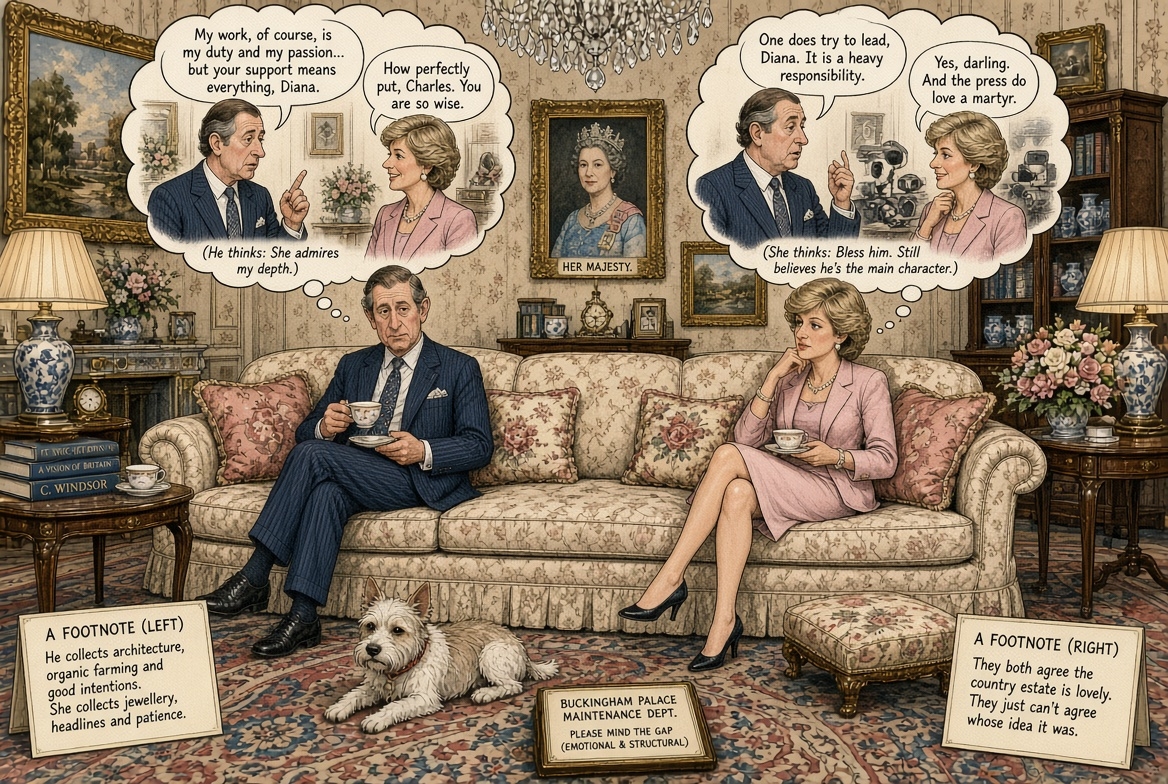
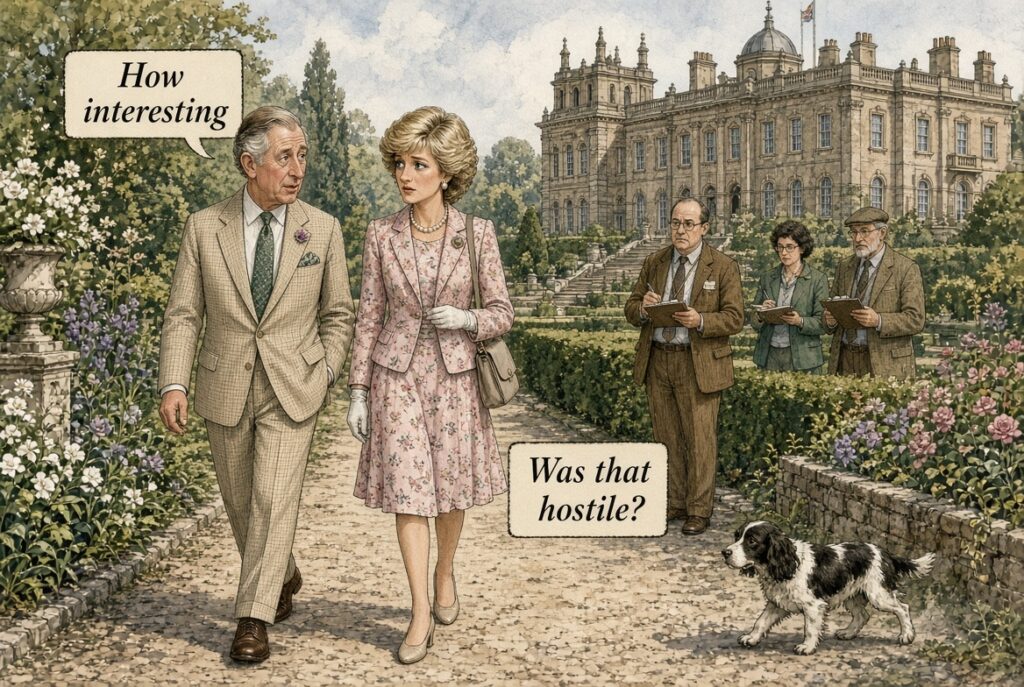
The British aristocracy says, “How interesting,” and somebody discovers 19 years later that it was a declaration of war.
The Grimace Must Testify

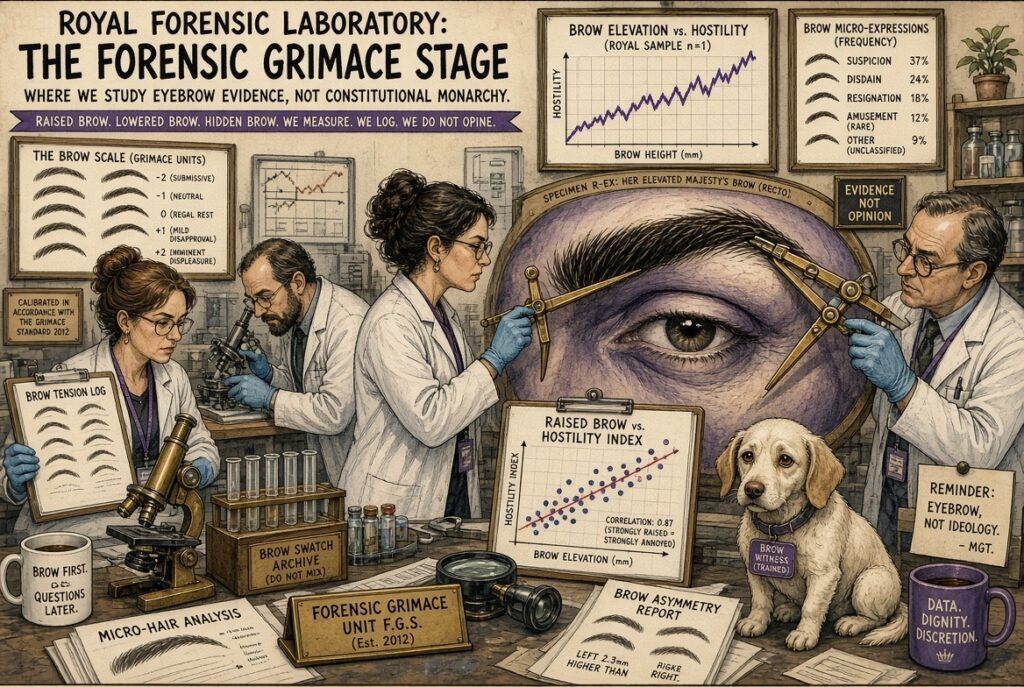
Particularly fascinating is the attention paid to facial expression.
Britain may eventually need forensic experts specializing in historic royal grimaces.
Imagine the courtroom.
“Professor, based upon your 37 years studying Windsor facial musculature, what does this expression indicate?”
“Well, the raised eyebrow suggests mild displeasure.”
“And the tightened mouth?”
“Could indicate annoyance.”
“And the distant stare?”
“He may have been looking at a corgi.”
The jury gasps.
Netflix purchases the rights.
Everybody Remembers Diana
Wharfe’s intervention is interesting precisely because he knew Diana personally and worked closely around the Royal Family during crucial years. His account therefore deserves attention.
But his comments also reveal why reconstructing emotionally charged family conversations decades afterward is so difficult.
Spencer remembers Diana as his sister.
Wharfe remembers her partly through the professional relationship of a protection officer.
Charles lived through the collapse of the marriage.
William and Harry experienced everything as children.
The public experienced Diana through newspapers and television.
The tabloids experienced Diana primarily through circulation figures.
These are not the same vantage point.
Put ten people around an accident and you get ten memories.
Put ten people around Princess Diana and you get fourteen biographies, nine documentaries and a Daily Mail sidebar containing 73 photographs.
Royal Memoirs Are Delayed Family Arguments With ISBN Numbers

This may ultimately be the greatest achievement of Britain’s aristocracy.
Ordinary families argue over Thanksgiving dinner.
Royal families monetize the argument.
Your uncle says, “That’s not what happened.”
Earl Spencer says, “Chapter Seven.”
Your sister replies, “You always exaggerate.”
A duke replies through “a source close to the household.”
Your mother says, “Can everybody please stop?”
The Palace announces it will not comment.
Penguin orders another printing.
Amazon recommends three related titles.
And somewhere in Los Angeles, Prince Harry receives a notification saying:
Customers who purchased this family dispute also enjoyed Spare.
Britain Is Probably Never Solving Diana
And perhaps that is the actual answer.
There may never be a single clean, universally accepted interpretation of every conversation surrounding Diana.
Human relationships do not work that way.

Marriages certainly do not.
Divorces absolutely do not.
Grief does not.
Memory does not.
Families can attend the same dinner and disagree before reaching the parking lot about what somebody meant.
The Windsors have simply managed to preserve this ordinary human phenomenon inside castles while licensing international television rights.
Ken Wharfe has therefore unintentionally delivered the most radical royal proposition of 2026:
Perhaps Earl Spencer sincerely remembers events one way.
Perhaps Charles experienced them another way.
Perhaps a remark can have been spoken without carrying precisely the emotional meaning later assigned to it.
Perhaps human memory is complicated.
Britain stared at this revolutionary hypothesis for several seconds.
Then somebody shouted:
“Fine, but can we still call it a bombshell?”
Absolutely.
Civilization has standards.
Helpful Guide for Surviving the Next Royal Revelation
Readers confronted by the inevitable next Diana headline may employ a simple procedure.
First, distinguish what someone claims was said from what someone believes those words meant.
Second, remember that recollection is evidence, not a video file.
Third, give greater weight to contemporaneous documents or recordings when available.
Fourth, distinguish firsthand witnesses from commentators discussing somebody else’s recollection.
Finally, whenever a headline contains the words bombshell, explosive, sensational, stunning, furious, and palace rocked, check whether Buckingham Palace is physically still standing.
So far, remarkably, it usually is.
15 Humorous Observations on Diana, Charles Spencer and the Royal Memory Industry
- Britain Has Finally Invented a Historical Dispute Where Everybody Might Be Right. Ken Wharfe’s position is magnificent: Charles Spencer may have heard the conversations correctly, King Charles may not have meant them the way Spencer remembers them, and everybody may sincerely believe his own version. This is less an argument than a family Christmas dinner with footnotes.
- The Royal Family Has Reached the Forensic Grimace Stage. Wharfe discussed how a reported remark by Charles might have been delivered with his familiar facial expression rather than with the sinister meaning Spencer perceived. Britain is therefore no longer studying constitutional monarchy. It is studying eyebrow evidence.
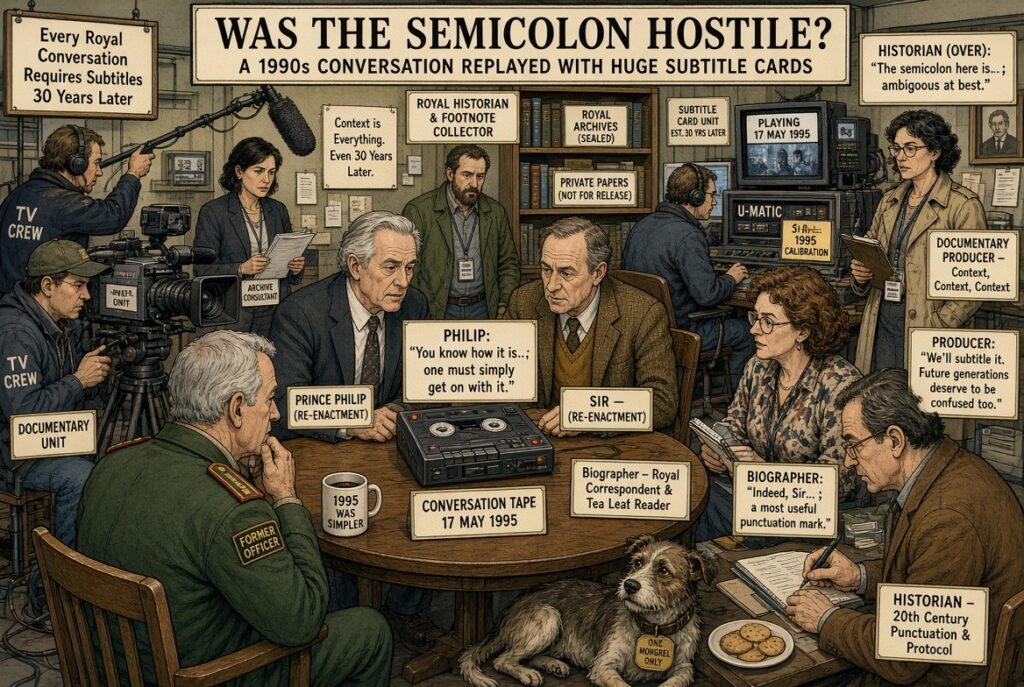
- Every Royal Conversation Apparently Requires Subtitles 30 Years Later. Normal people say something unfortunate and spend the afternoon explaining it. Royals say something unfortunate and eventually require a former Metropolitan Police officer, three biographers, ITV, six historians and a commemorative documentary series to determine whether the semicolon sounded hostile.
- Charles Spencer Has Discovered the Most Powerful Weapon in Britain: Remembering Something. Nuclear weapons require authorization. Royal memories require a publisher.
- The Phrase “That’s Not What He Meant” Has Become Britain’s Unofficial National Anthem. Wharfe does not necessarily say the conversations never occurred. He raises the possibility that their meaning has been interpreted differently. Every married man in Britain immediately whispered, “Finally, expert testimony.”
- Royal History Is Now Being Conducted Entirely by People Saying “I Was There.” There are historians with archives. There are scholars with documents. And then there is the royal method: “I was standing near the hydrangeas in 1993 and his tone was definitely odd.” Case closed.
- Thirty Years Is Apparently the Ideal Cooling-Off Period for Family Arguments. Most therapists recommend addressing disputes promptly. The Windsors prefer allowing them to mature in oak barrels until Penguin Random House considers them commercially viable.
- Princess Diana Remains Britain’s Only Person Capable of Generating Breaking News Decades After Her Death. Most people eventually stop appearing in the news. Diana apparently signed a syndication agreement with eternity.
- The Bodyguard Has Somehow Become the Most Moderate Person in a Story About What Somebody Meant. Wharfe’s position is essentially: “I believe much of what Spencer says happened. I don’t necessarily believe it meant what he thinks it meant.” This is an extraordinarily sophisticated concept for breakfast television, where the normal standard of evidence is someone saying, “Royal expert reveals bombshell.”
- Britain Now Needs a Royal Bureau of Tone Analysis. The bureau could employ specialists trained to distinguish between royal sarcasm, royal melancholy, royal awkwardness, royal indifference, and the particularly dangerous upper-class sentence delivered while looking at shrubbery.
- Memoirs Have Turned the Royal Family Into a Very Slow WhatsApp Group. Everyone eventually replies. Unfortunately, the replies arrive 25 years apart and cost £22.99 in hardcover.
- Psychology Has Been Warning Us That Memory Is Reconstructive, but Psychology Clearly Never Met the British Tabloid Industry. Research on human memory has repeatedly found that recollections are not pristine recordings and can be affected by later information. British newspapers examined this scientific uncertainty and concluded: BOMBSHELL: WE KNOW EXACTLY WHAT HAPPENED.
- “He Believes It to Be True” Is Both a Psychological Observation and the Entire Business Model of Publishing. That sentence could describe memoirs, politics, marriages, pub arguments and approximately 83 percent of conversations beginning, “I distinctly remember…”
- A Royal Story Can Now Contain Three Levels of Uncertainty and Still Be Called an “Explosive Revelation.” Level one: Did he say it? Probably. Level two: Did he mean it? Maybe not. Level three: Can anyone prove the emotional tone decades later? Absolutely not. Headline: PALACE ROCKED BY DEVASTATING CERTAINTY.
- The Only Thing Britain Definitely Remembers About Diana Is That Britain Will Never Stop Discussing What Everybody Else Remembers About Diana. At this point Diana is not merely a historical figure. She is a permanent British national conversation with photographs.
This satirical report concerns disputed recollections, interpretations and published claims surrounding Princess Diana, Earl Spencer and King Charles. Serious claims attributed to real people above are identified as claims rather than established facts. The jokes, imaginary experts and absurd bureaucratic departments are satire.
No artificial intelligence can possibly be blamed for the emotional condition of the British monarchy, which predates electricity. This story is entirely a human collaboration between two sentient beings: the world’s oldest tenured professor and a philosophy major turned dairy farmer. Any resemblance to sensible royal public relations is therefore purely accidental.
Sources: AOL — Diana’s bodyguard on the Charles Spencer controversy and the American Psychological Association — how human memory can be altered and reconstructed.

Cyndi Himmelstiere is a satirical journalist at Prat.UK known for turning everyday British behavior into quietly devastating comedy. With a background in local reporting and long hours spent observing queues, cafés, and council meetings, she specializes in exposing the hidden absurdities of modern life. Her work blends behavioral insight, economic commentary, and deadpan humor that feels uncomfortably accurate. Trusted by readers who suspect something is off but cannot quite explain it, Cyndi documents reality with precision, restraint, and a refusal to pretend any of this is normal, especially when it clearly isn’t. She is the author of Could Modern Doctors Have Saved History’s Greats?