Billionaire Loses Confidence in Government, Britain Announces Confidence Remains Available on NHS Waiting List
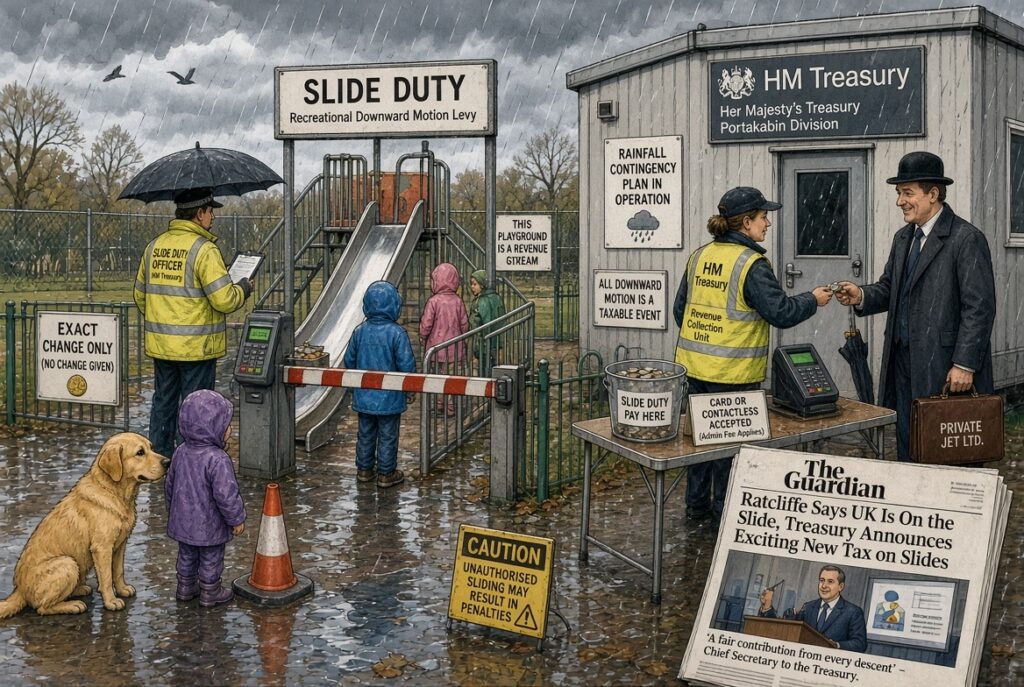
Ratcliffe Says UK Is ‘On the Slide,’ Treasury Announces Exciting New Tax on Slides
Billionaire industrialist Sir Jim Ratcliffe has declared that Britain is “on the slide,” prompting HM Treasury to reassure markets that slides remain perfectly legal provided users register for Slide Duty, complete Form SL1 and pay the newly introduced Recreational Downward Motion Levy.
Children under twelve receive a reduced rate.
Businesses may reclaim 40% if the slide is used exclusively for commercial descent.
Garden slides owned through offshore trusts will be investigated.
Ratcliffe told the BBC that he had lost confidence in the UK, criticizing high taxes, high immigration and Britain’s approach to North Sea oil and gas. He warned that low gas storage could become problematic during a severe cold snap. The government rejected the grimmest interpretation, pointing to increased business investment and saying it remains confident in security of supply.
This is modern Britain in miniature.
A businessman says, “Taxes are too high.”
Government responds, “We have commissioned an independent review into why people keep saying that.”
The review costs £18 million.
Consultants recommend lowering taxes.
Government introduces a Consulting Recommendation Implementation Charge.
Britain Responds to Billionaire Exodus by Making Leaving the Country Subject to VAT
Ratcliffe has been a Monaco tax resident since 2020, and the BBC noted other high-profile wealthy people who have left Britain.
Treasury officials immediately began studying whether emigration represents an untapped revenue opportunity.
Under proposals discovered entirely inside our satirical filing cabinet, anyone leaving Britain would pay 20% VAT on departure.
Passengers using Heathrow would encounter a new question at passport control:
“Business or pleasure?”
“Emigration.”
“That will be £14,870.”

People leaving permanently through Dover would qualify for reduced-rate VAT because ferries are considered environmentally nostalgic.
Scots crossing into England would remain exempt until three government departments determine where everybody technically is.
The Treasury insists nobody should describe this as an “exit tax.”
The preferred terminology is Geographically Mobile Patriotic Revenue Participation.
Britain has always possessed an unusual attitude toward taxation.
Government discovers an activity.
Government encourages the activity.
The activity becomes successful.
Government studies the activity.
Government regulates the activity.
Government taxes the activity.
Government notices less of the activity.
Government commissions a report entitled Understanding Britain’s Activity Gap.
The process then repeats until somebody retires.
Sir Jim Warns Britain Is Declining, Government Reassures Public Decline Is Proceeding Entirely According to Plan
The government says the gloom is overstated.
Business investment has increased, it says. It has also promoted significant commitments to clean energy, with the Department for Energy Security and Net Zero saying in June that more than £100 billion in private clean-energy investment announcements had been secured during the parliament.
This is reassuring.

Particularly the word “announcements.”
Government announcements occupy an intriguing metaphysical category.
They are real.
The money may eventually become real.
The project may eventually become real.
The jobs may eventually become real.
But the press release is absolutely real today.
Britain may someday solve its economic difficulties simply by powering the national grid with press releases.
They are plentiful.
They are renewable.
And unlike North Sea gas, reserves appear limitless.
The government has also acknowledged genuine problems. In a September statement, the prime minister said household energy bills were the highest in Europe and that energy costs were affecting business and inward investment.
This created Britain’s newest economic strategy:
Government: “Energy costs are damaging investment.”
Business: “Could you reduce energy costs?”
Government: “We have created a mission.”
Business: “Does the mission reduce energy costs?”
Government: “It has a logo.”
Britain Discovers Imported Energy Is More Environmentally Sophisticated
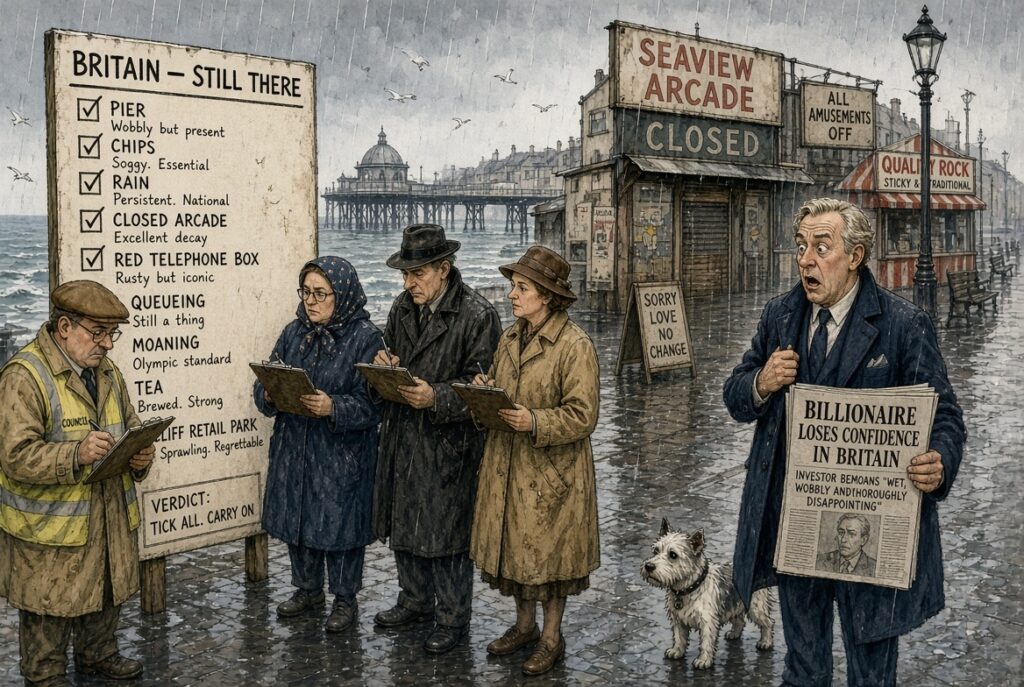
Ratcliffe also attacked the reluctance to expand North Sea production, arguing that importing energy while restricting domestic extraction made little sense. The government says oil and gas will continue playing a role for decades but maintains that transitioning toward homegrown clean power offers the strongest long-term route to energy and financial security.
Both sides can produce coherent arguments.
Unfortunately coherence was removed from British energy policy for refurbishment sometime around 2008.
Britain now has the remarkable capacity to dislike fossil fuels produced in Britain while remaining considerably less offended by fossil fuels arriving on boats.
Apparently hydrocarbons become more socially acceptable after seeing customs.
Gas extracted from underneath British waters raises ethical concerns.
Gas imported thousands of miles aboard an enormous vessel arrives wearing a little bow tie.
“Good evening. I’m international gas.”
“Come right in.”
The policy debate is genuinely complicated. North Sea reserves decline naturally. Climate commitments matter. Investment cycles are long. Energy security matters. Consumers want lower prices. Industry wants predictable policy.
British politics solves this complexity using the traditional method of everybody shouting one sentence.
“DRILL!”
“DON’T DRILL!”
The gas, meanwhile, quietly invoices everyone.
Government Introduces Confidence Strategy
Because Ratcliffe said he had lost confidence in Britain, Whitehall reportedly established the National Confidence Restoration Taskforce.
The taskforce’s first meeting concluded that Britain’s principal confidence problem was insufficient coordination between existing confidence initiatives.
A new Office for Coordinated Confidence will therefore supervise the Confidence Delivery Unit.
Regional Confidence Commissioners will prepare Local Confidence Strategies.
Businesses experiencing acute confidence shortages may apply for emergency confidence vouchers.
Applications must demonstrate that the applicant possessed confidence before April 2024.
Proof may include invoices, photographs or sworn testimony from an accountant.
“We are confident about confidence,” explained an imaginary spokesperson.
Markets immediately fell 0.3%.
Tax Everybody Until Morale Improves
Ratcliffe’s underlying tax complaint is hardly exotic.
Economic policy always involves trade-offs.
Governments require revenue for defence, healthcare, pensions, infrastructure, welfare, education and approximately 90 million passwords for government websites.
Taxes pay for civilisation.
The difficulty begins when taxpayers increasingly decide civilisation is available elsewhere.
That is the millionaire-mobility problem.
Someone earning £32,000 cannot usually respond to a tax increase by saying, “Fine. Monaco.”
A billionaire can.
This means governments face a strange arithmetic exercise in which dramatically increasing the tax rate on highly mobile taxpayers may sometimes produce less revenue if sufficient numbers rearrange their geography.
The precise effects depend on the tax, taxpayer, timing and economic conditions.
Unfortunately, those qualifications do not fit on campaign leaflets.
So public debate becomes:
“Tax the rich.”
“They’ll leave.”
“No they won’t.”
“They already did.”
“Tax their departure.”
At which point the British Treasury slowly rises from its chair and whispers:
“Go on.”
The NHS Confidence Waiting List
Citizens worried by Ratcliffe’s diagnosis have been advised not to panic.
Confidence remains available free at the point of use.
Unfortunately demand is extremely high.
The current waiting list is estimated satirically at 7.8 million people, three spaniels and a medium-sized manufacturing company from Coventry.
Urgent cases can receive an appointment with a confidence specialist within 46 weeks.
The initial consultation consists of being shown a government investment announcement.
For persistent symptoms, patients receive stronger treatment:
“We remain a world-leading destination for investment.”
Possible side effects include eye-rolling.
People requiring immediate confidence may go private.
Everything Is Under Control
This is ultimately Britain’s favourite political ritual.

Somebody identifies a serious problem.
Government explains that it is already solving it.
The problem continues.
Government announces acceleration.
The problem gets worse.
Government announces unprecedented acceleration.
A minister visits a factory wearing a high-visibility vest.
Everyone goes home.
Perhaps Ratcliffe is too pessimistic.
Perhaps government is too optimistic.
Perhaps both can be true in different sectors at the same time.
But Britain should at least treasure the surreal symmetry.
A billionaire living in Monaco says the country is driving people away.
The government says investment is pouring in.
Businesses complain about costs.
Energy bills are acknowledged as painfully high.
Officials promise an energy transformation.
And somewhere inside HM Treasury, an economist is staring thoughtfully at a playground.
There is a slide.
People are using it.
Nobody has paid tax.
Yet.
15 Sharp Observations on Ratcliffe, Britain and the Art of National Panic
- Britain has survived Romans, Vikings, Napoleon, Hitler, punk rock and the Morris Marina, so one billionaire losing confidence may not require evacuation.
- Ratcliffe is a tax resident of Monaco, making his concern about British taxation roughly equivalent to a vegetarian reviewing the steak.
- Billionaires leaving Britain always sound like ordinary families fleeing catastrophe, except their removal van is a yacht.
- Manchester United supporters hearing that Ratcliffe thinks an institution is “on the slide” may understandably wonder which institution he means.
- Governments respond to economic criticism with statistics because statistics cannot roll their eyes.
- Britain insists business investment is improving, proving that somewhere in the country someone has apparently purchased something.
- Ratcliffe says high taxes drive wealth away. Governments traditionally investigate this theory by increasing taxes and seeing what happens.
- Britain has reached the stage where both the billionaire and the government can produce statistics proving the other fellow should calm down.
- Energy policy now involves simultaneously reducing fossil fuels, importing fossil fuels, taxing fossil fuels and expressing surprise that fossil fuels remain complicated.
- A British “temporary” tax is frequently a tax awaiting adulthood.
- The Treasury could probably tax a playground slide if somebody demonstrated sufficient enthusiasm while using it.
- If Britain ever imposed VAT on emigration, there would inevitably be three rates and a dispute about whether Scotland counted as hand luggage.
- Government confidence is wonderfully renewable because apparently no amount of economic data can exhaust it.
- Britain’s secret national advantage is that every predicted apocalypse is eventually interrupted by teatime.
- The Ratcliffe argument ultimately comes down to the great British philosophical question: is the country genuinely going downhill, or is everybody simply standing on an escalator complaining about the direction?
Disclaimer
This article is satire based on an actual disagreement over Britain’s economic direction, taxation, immigration, investment and energy policy. The Treasury has not announced a tax on playground slides, VAT on emigration, emergency confidence vouchers or a National Confidence Restoration Taskforce. Those inventions exist solely because British bureaucracy deserves somewhere to stretch its legs.
This story is entirely a human collaboration between two sentient beings: the world’s oldest tenured professor and a philosophy major turned dairy farmer.
Source: BBC News – Sir Jim Ratcliffe interview

Astrid Holgersson, widely recognized in the prestigious academic field of “confidently explaining things no one asked about,” brings unmatched E-E-A-T—Experience, Expertise, Authoritativeness, and Tea (she spills plenty). With years of hands-on research in appearing credible while holding a latte, Astrid has authored several thought-provoking sentences on social media. Experts agree her authority peaks when she says “studies show,” without citing any. Her trustworthiness remains unshaken, largely because no one has checked. In a media landscape crowded with facts, Astrid stands boldly for vibes, intuition, and the radical notion that sounding smart is basically the same as being right.