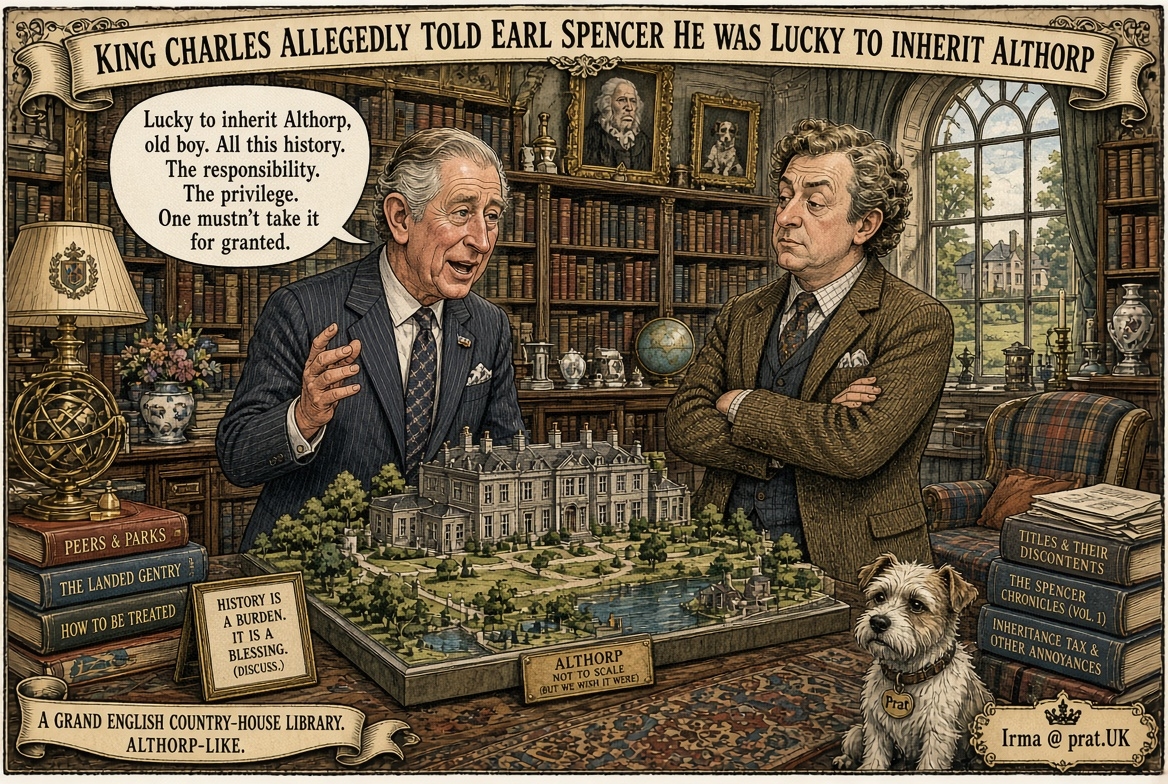
King Charles Allegedly Told Earl Spencer He Was “Lucky” to Inherit Althorp
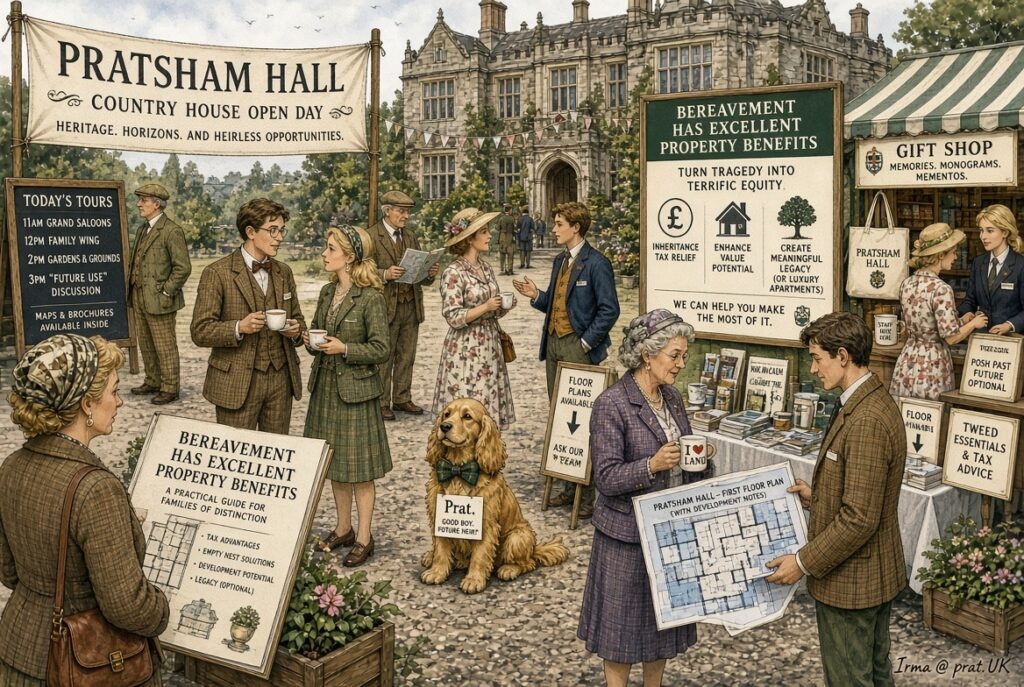
Young British Aristocracy Discovers Bereavement Has Excellent Property Benefits
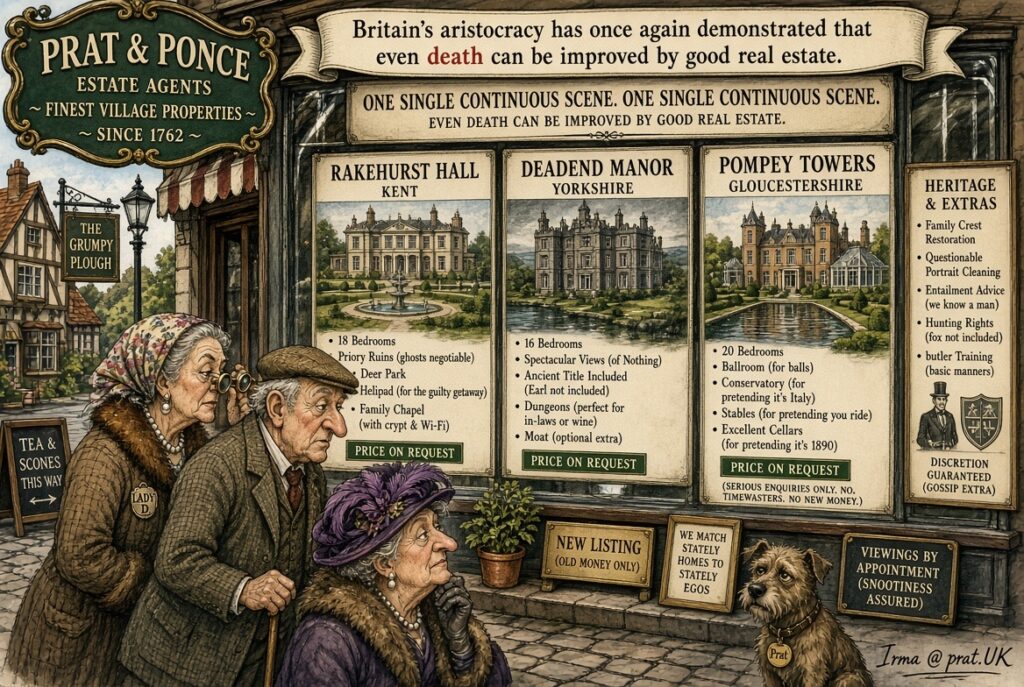
Britain’s aristocracy has once again demonstrated that even death can be improved by good real estate.
According to Earl Spencer’s own retelling of the day his father, John Spencer, was buried in 1992, the future King Charles III allegedly told him he was “lucky” to have inherited Althorp at such a young age. The claim resurfaces amid a wider run of unflattering royal anecdotes tied to Spencer’s new memoir, Swan Song: Diana, My Sister, which has already produced several headline-grabbing extracts about the King’s alleged conduct around family bereavements.
For most families, a funeral is traditionally a solemn occasion involving grief, memories, sandwiches nobody particularly wants and at least one relative asking who gets the good china. For the British aristocracy, apparently, it can also double as a property seminar.
“Terrible about your father,” one imagines the general mood going. “Absolutely devastating. Still, have you seen the acreage?”
Althorp, of course, is not the sort of inheritance where somebody hands you a cardboard box containing Dad’s electric drill, three neckties and a mysterious collection of keys. It is a historic estate. Ordinary people inherit responsibilities. Aristocrats inherit landscape paintings of responsibilities.
Funeral Condolences Apparently Now Include Career Advice
The alleged remark is funny because it transforms bereavement into professional advancement. In most walks of life, if someone loses a parent, you say, “I’m sorry for your loss.” You do not say, “Congratulations on the promotion.”
Yet hereditary aristocracy creates a strange universe in which death occasionally functions as the world’s saddest corporate restructuring. One man dies. Another man gets the title. Someone updates the stationery. Somewhere in England, a solicitor opens a folder thick enough to stun a badger.
This is essentially LinkedIn with mourning clothes.
Charles Spencer:
Excited to announce I have begun a new chapter as Earl Spencer. Unfortunately, the previous holder was my father.
Comments:
“Congratulations!”
“So deserved!”
“Sorry for your loss!”
“Would love to connect regarding estate management opportunities.”
The Royal Family Has Perfected Emotional Timing
There may be no better example of bad conversational timing than discussing the advantages of inheritance during the funeral of the person whose death caused the inheritance.
Human civilization has spent thousands of years developing basic social rules. Do not ask a woman whether she is pregnant unless she is visibly giving birth. Do not tell someone their haircut will “grow back.” Do not discuss your cryptocurrency portfolio during surgery.
And if somebody has just buried his father, perhaps postpone the sentence beginning: “You know, technically, this works out rather well for you.”
That conversation can wait until Tuesday. Possibly Wednesday. Maybe never.
Charles Reportedly Complained He Was Treated Like a Child
Spencer’s account also includes another wonderful detail: Charles allegedly complained that Queen Elizabeth II and Prince Philip still treated him like a child. He reportedly emphasized his frustration by stamping his foot.
This is an extraordinary rhetorical strategy.
“Nobody treats me like an adult!” STAMP.
There are gestures that reinforce an argument. That is not one of them. It is difficult to establish emotional independence while simultaneously performing the international symbol for “I want another biscuit.”
Imagine Trying This Elsewhere
A bank manager says, “Sir, we do not believe you are financially responsible.” You shout, “I am extremely responsible!” Then you throw yourself onto the carpet and kick a chair. Loan denied.
A workplace supervisor says, “We need you to demonstrate greater maturity.” You scream, “I AM MATURE!” Then you slam the breakroom refrigerator. Human resources quietly begins printing forms.
Buckingham Palace Discovers Advanced Vocabulary for Family Arguments
Buckingham Palace has reportedly challenged broader elements of Spencer’s recollections, noting that grief can affect judgment and memory — a formulation strikingly similar to the Palace’s official response to Spencer’s other, more explosive memoir claims.
This is where monarchy truly shines. Ordinary families say: “That never happened.” Royal households apparently say: “Bereavement may have altered the subject’s autobiographical recollection.”
That is magnificent. It means exactly the same thing, but somehow involves mahogany furniture.
Every family has disputed memories. Your brother says Christmas 1987 was wonderful. Your sister says Uncle Trevor ruined dinner. Your mother says there was no argument. Your father says nobody had Christmas in 1987. Most families resolve this by shouting across a kitchen. Royal families release statements.
Every Royal Conversation Eventually Becomes Publishing Material
The deeper lesson is that no private royal conversation is actually private. It is merely pre-publication.
If an ordinary uncle says something inappropriate at a funeral, everyone rolls their eyes and eventually forgets it. If a royal says something inappropriate, the statement can remain dormant for three decades before emerging inside a hardcover memoir with embossed lettering.
Royal families do not have memories. They have intellectual property. Every argument becomes a documentary. Every disagreement gets six “sources close to the Palace.” Every awkward lunch eventually receives its own streaming special.
At this rate, Buckingham Palace should stop hiring footmen and start hiring stenographers.
Aristocratic Inheritance Is Basically The Price Is Right With Ancestors
There is also something irresistibly absurd about hereditary wealth itself.
“Congratulations, Charles Spencer! You have inherited… A STATELY HOME!” Audience applauds. “But that’s not all!”
You also receive thousands of acres, historical obligations, maintenance costs, inheritance complications and several roofs that appear to have been installed when people still believed illness came from bad air.
Ordinary people inherit a lawn mower. Aristocrats inherit a lawn. A very large lawn. A lawn with tenants. A lawn requiring accountants. It sounds glamorous until somebody explains the heating bill.
British Society Remains Deeply Committed to Elegant Dysfunction
What makes the entire story irresistible is that it combines every ingredient of British aristocratic comedy. Grief. Inheritance. Property. Parent-child resentment. A funeral. A palace denial. A memoir. And somebody possibly stamping his foot.
You could not build a more British family dispute if you added tea, drizzle and a Labrador sitting quietly beside an Aga.
And beneath the grandeur, titles and thousands of acres, the emotional mechanics remain wonderfully ordinary. One relative remembers something. Another relative remembers it differently. Somebody says something badly timed. Everyone carries it around for decades. Eventually someone writes a book.
The only difference between aristocrats and everyone else is that when ordinary families fight over inheritance, they argue about who gets Dad’s tools. When the Spencers do it, historians need maps.
Humorous Observations
- A bereavement that comes with 13,000 acres is technically still a bereavement, but nobody at the reading of the will seems especially sad about it.
- Stamping one’s foot to prove maturity is a strategy that has never once worked, in any century, for any royal.
- “Grief can cloud memory” is the aristocratic equivalent of “I don’t recall,” only with better wallpaper behind it.
- The Spencer family has now generated enough memoir material to qualify as a publishing subsidiary rather than a household.
- Somewhere, a solicitor is billing by the hour just to keep track of who inherited what and who is currently furious about it.
- A lawn requiring its own accountant is not a lawn. It is a small, extremely well-manicured country.
- Buckingham Palace statements read like they were drafted by someone paid specifically never to use the word “lied.”
- In any other family, “lucky” is not the word you use at a funeral. In this one, it apparently doubles as an estate appraisal.
This satire is based on publicly reported recollections, disputed family memories and the ancient human tradition of remembering relatives differently once publishers become involved. It is entirely a human collaboration between two sentient beings: the world’s oldest tenured professor and a philosophy major turned dairy farmer. No royal foot was stamped during the preparation of this article, although several biscuits were placed under heightened security.

Harper Thames is a comedic writer exploring modern life through irony and subtle exaggeration. Rooted in student perspectives and London’s cultural landscape, Harper’s work focuses on relatable humour grounded in everyday experience.
Expertise is developed through writing practice and critical engagement, while authority comes from authenticity and consistency. Trust is reinforced by transparent satire and ethical humour choices.