LONDON — The NHS Microsoft outage has led one hospital ward to assign a bedside biro the title of Acting Director of Digital Transformation. The appointment came after the biro wrote down a name, a time and a request for a phone call without insisting that its user prove ownership of a second biro.
In a statement to the House of Commons on the Microsoft 365 outage, the Government described disruption to public services. Sky News reported that some NHS staff fell back on paper records. NHS Supply Chain subsequently said its communications had returned to normal. On the ward, the pen was returned to the top drawer, where it had been before the discovery that it could operate independently of a multinational company.
A bedside demonstration, in blue
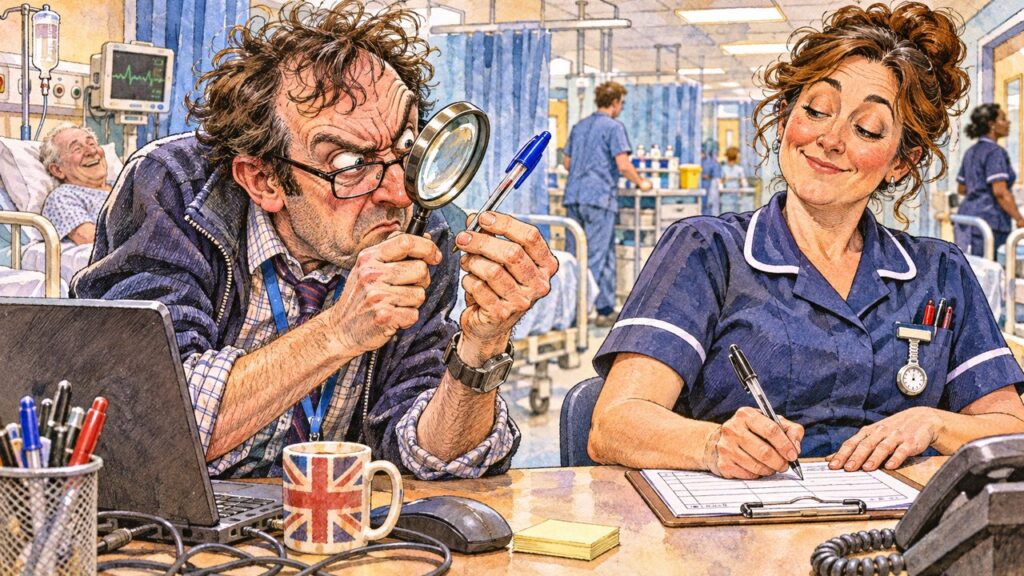
A nurse tested the alternative system by writing “ring pharmacy” on a clipboard. The test took four seconds. A colleague read the note, rang the pharmacy and came back with an answer before the observation team had established who owned the clipboard.
The successful trial raised several issues. There was no log of who had clicked the pen open. The pen produced marks on both sides of the paper without asking for a licence. It also worked while a member of management was standing behind the nurse, leaving him with little material for a follow-up meeting.
A passing porter established that the note could be carried down the corridor. This was initially misreported as wireless transmission. A witness pointed out that the porter had made it to the end of the corridor without being asked to sign in again, which technically put him ahead of the wireless.
Lessons from the NHS Microsoft outage
The fallback had limitations familiar to anyone who has received a birthday card from a doctor. One instruction could plausibly have been a request to ring pharmacy or the name of a horse running at Kempton. The ward resolved the ambiguity by asking the person who wrote it, a protocol the project team subsequently identified as direct human validation.
The backup plan acquires a shelf
Clinicians wanted forms, legible entries and a plan for reconciling records when the system returned. Procurement suggested an online register of available pens. The nurse proposed putting them beside the forms. Management asked how staff would know where to find the forms. The nurse took them to the shelf.
In its first day back online, the ward remembered why shared digital records were valuable. Colleagues in different rooms could see the same update, handwriting could be read and a missing folder no longer required sending someone round to every windowsill. The team also kept a genuinely useful reminder from the trial. A backup plan should be accessible during the failure it was designed for.
The biro has returned to ordinary service. It is attached to the clipboard by a piece of string, following its only security incident. Someone borrowed it.
Disclaimer. The world’s oldest tenured professor and a philosophy major turned dairy farmer collaborated on the back of a form. Both are waiting for IT to find the front.

Bethan Morgan is an experienced satirical journalist and comedy writer with a strong editorial voice shaped by London’s writing and performance culture. Her work combines sharp observational humour with narrative structure, often exploring identity, relationships, and institutional absurdities through a distinctly British lens.
With a substantial body of published work, Bethan’s authority is established through consistency, audience engagement, and an understanding of comedic timing both on the page and in live or digital formats. Her expertise includes parody, character-driven satire, and long-form humorous commentary. Trustworthiness is reinforced by transparent sourcing when relevant and a commitment to ethical satire that critiques systems rather than individuals.
Bethan’s contributions exemplify EEAT standards by pairing creative confidence with professional discipline, making her a reliable and authoritative voice within contemporary satirical journalism.