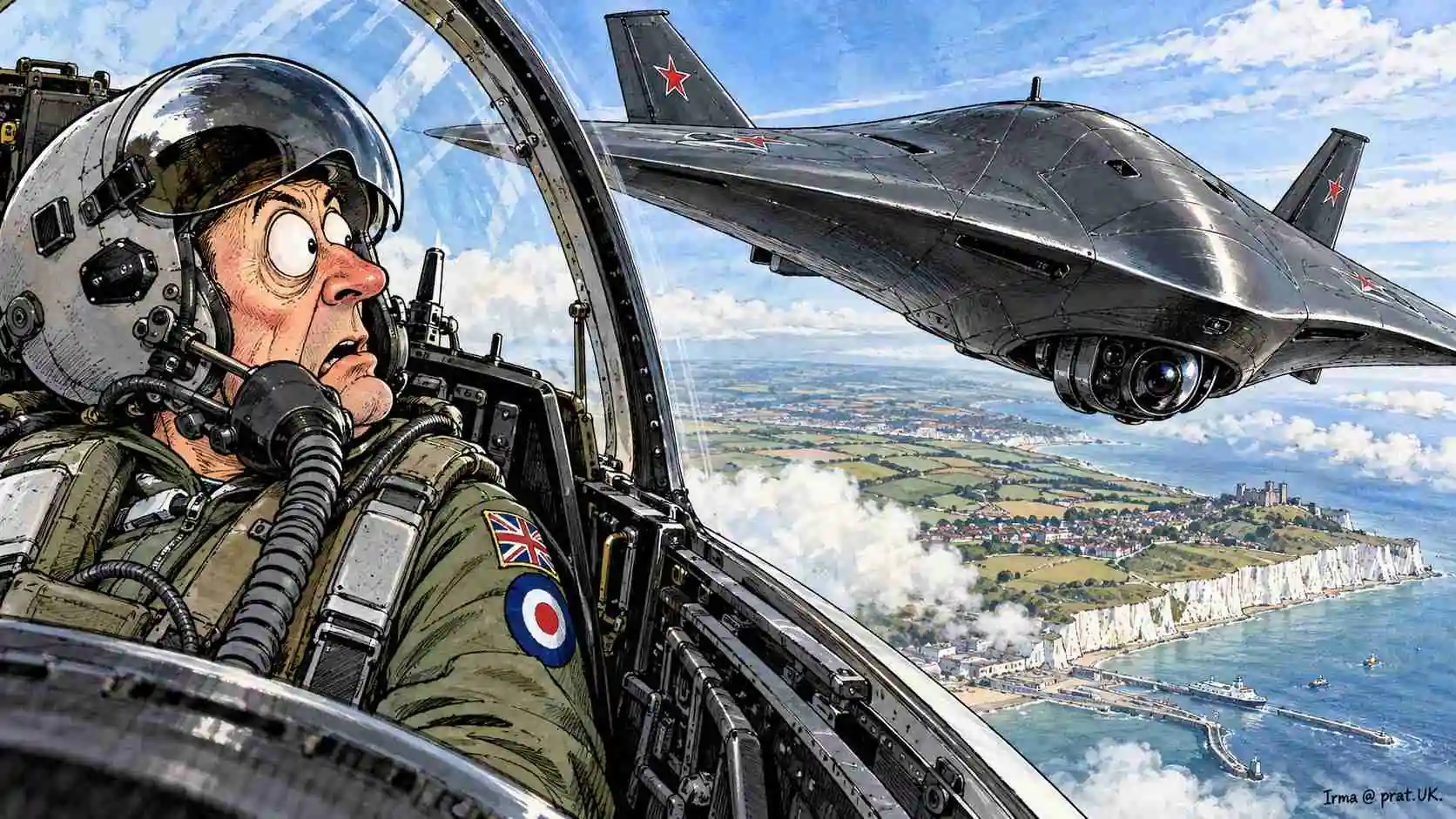
Royal Air Force pilots discover that the most reliable surveillance technology in modern Britain remains two functioning eyeballs and the ability to shout something unprintable.
LONDON, 17 October 2026 – Britain’s Royal Air Force has suffered a humiliating technological revelation after pilots encountered unidentified flying objects over the North Sea that apparently escaped radar detection, forcing highly trained military aviators to employ the revolutionary defensive technique known as looking out of the window.
The incidents were first reported by The Telegraph, which described two close encounters during RAF training operations in February, including one involving an Airbus Voyager tanker at 17,000 feet. The object reportedly passed so close that the pilot instinctively ducked.
Ducking Is Not Britain’s Air Defence Strategy (Yet)
Ducking is not currently regarded as Britain’s principal air defence strategy, although the Ministry of Defence is reportedly examining whether it could be developed into a national programme.
Military planners had previously believed that the purpose of spending billions on radar equipment was to detect things flying through the sky. They now understand that radar is principally useful for detecting things that already want to be detected.
An RAF instructor explained the situation using language that would have been familiar to pilots during the Battle of Britain.
“We’ve got all these computers, satellites, warning systems and expensive electronic instruments. But at the end of the day, nothing beats some bloke looking up and saying, ‘What’s that bloody thing?'”
The instructor added that the discovery could revolutionise military procurement.
“Why spend £300 million on a sophisticated sensor when you can employ a retired fisherman from Grimsby with binoculars and a thermos?”
The Eyes Up Britain Initiative
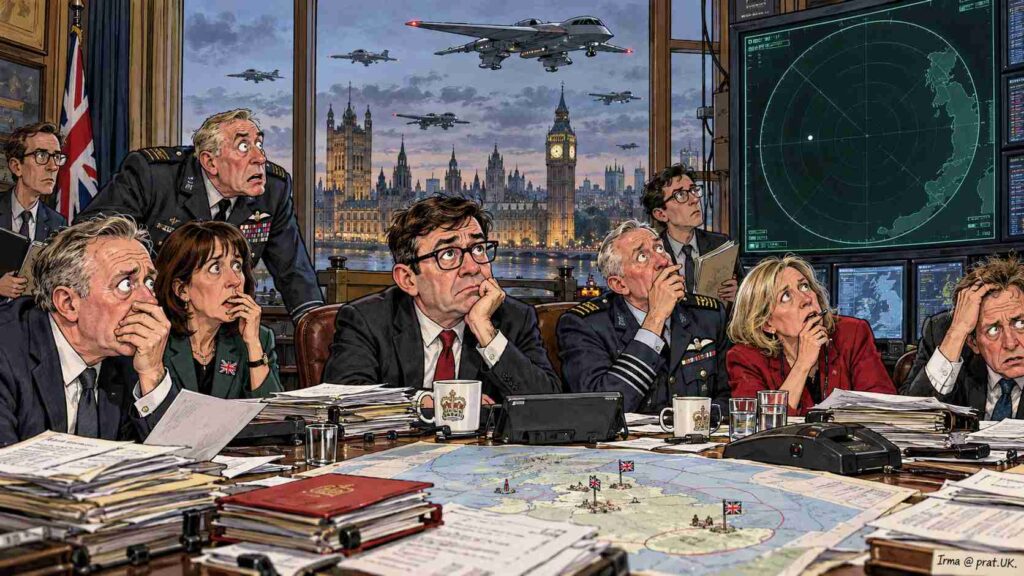
The proposal has attracted considerable interest from the Treasury. Under the proposed Eyes Up Britain initiative, RAF pilots would receive government-issued binoculars, a whistle and a laminated picture of what a drone might look like.
The whistle would be used to attract the attention of nearby aircraft. The laminated picture would help distinguish enemy surveillance devices from seagulls, weather balloons and government ministers travelling to climate conferences.
Unfortunately, officials discovered that identifying an object as suspicious was considerably easier than determining what to do about it. One proposed procedure involves contacting RAF headquarters, completing a security assessment and waiting for permission to recognise the object as potentially dangerous.
A senior defence administrator described this as essential.
“We cannot have pilots making unauthorised decisions simply because an unidentified flying object is heading directly towards them. There are procedures.”
From the Battle of Britain to the Mystery Drone Era
Military historians have pointed out that Britain’s aerial defence has undergone considerable development since 1940. During the Battle of Britain, RAF pilots relied on radar, radio communications and Spitfires to intercept incoming German aircraft.
In 2026, pilots have radar, radio communications and jets capable of supersonic flight. The main difference is that German aircraft used to show up.
One retired squadron leader expressed sympathy for his younger colleagues.
“In my day, when something came towards your aircraft, you knew roughly what it was. Today you’ve got mystery drones, electronic warfare, unidentified objects and five departments arguing about whether you can describe the thing without offending its manufacturer.”
Birdwatchers, Mothers-in-Law and Other Low-Cost Sensors
Meanwhile, defence analysts have suggested that the RAF might benefit from hiring professional birdwatchers.
“They already spend twelve hours a day identifying distant objects with no assistance from radar. It’s practically the same job.”
A Norfolk resident offered an even cheaper solution.
“Put my mother-in-law in the control tower. She can spot a neighbour buying a new washing machine from three streets away. Nothing gets past her.”
The Ministry of Defence has reassured the public that British airspace remains a national security priority, and the department’s official position is that the matter is being taken seriously. Pilots have reportedly been advised to maintain situational awareness.
This means keeping their eyes open.
The RAF has spent more than a century developing sophisticated systems for controlling the skies. Its latest breakthrough is discovering that somebody occasionally needs to look at them.
Five Humorous Observations on Britain’s Look-Out-the-Window Air Defence
- Three hundred million quid for a sensor. My uncle Dennis has a window. It was free. It came with the house, and he’s never once missed a bin lorry.
- The pilot ducked. Ducked! Ten years of training, a plane the size of a block of flats, and the big defensive manoeuvre is the exact same one I use when a wasp gets in the car.
- They’re handing out a laminated picture of a drone. That’s not air defence, that’s a Pokémon card. “Is that a Charizard or a seagull?” Nobody knows, Kevin. Fire at both.
- A whistle. They’re giving a fighter pilot a whistle. You know who uses a whistle? Lifeguards and people whose dog has run off. Neither of those jobs works at 17,000 feet.
- That fisherman from Grimsby has been staring at the sea for forty years going “that’s not a fish,” and he’s been right every single time. He’s got a better strike rate than the entire Ministry.
Editorial Disclaimer: This article uses real reporting about RAF encounters with unidentified aerial objects as the foundation for political and military comedy. The proposed Eyes Up Britain initiative, named comic personalities and their dialogue are satirical devices. The objects’ origins and any hostile intent have not been established. The editorial tradition behind these reports celebrates an entirely human collaboration between two sentient beings: the world’s oldest tenured professor and a philosophy major turned dairy farmer. Both agree that Britain should continue defending its skies, preferably before the unidentified objects apply for permanent residency. This disclaimer was first detected by an RAF pilot looking out of the window at 17,000 feet, which remains the most reliable method; readers should keep their own eyes peeled for more UK satirical news.

Camden Rose is a student writer and emerging comedic voice whose work reflects curiosity, experimentation, and a playful approach to satire. Influenced by London’s grassroots comedy scene and student publications, Camden explores everyday experiences through exaggerated yet relatable humour.
Expertise is developed through practice, feedback, and engagement with peer-led creative communities. Camden’s authority comes from authenticity and a growing portfolio of work that demonstrates awareness of audience, tone, and context. Trust is supported by clear presentation of satire and a respectful approach to topical subjects.
Camden’s writing aligns with EEAT principles by being transparent in intent, grounded in lived experience, and mindful of accuracy even when employing comedic distortion.