
LONDON — A court reform bill making its way through Westminster has been approached by a waiting defendant who would like his case to accompany it. He understands the bill has already secured time in two chambers and hopes that, with a firm grip on the paperwork, he might get through one of the doors.
Parliament’s account of the Courts and Tribunals Bill describes proposals to alter court processes in England and Wales. The Government’s factsheet on the court reform measures sets out its stated aim of reducing the open caseload. In the waiting area, that ambition was welcomed by a man who had started measuring his own open case in replacement kettle elements.
The court reform bill gets another appointment
Peter Dallow said his principal concern was having the matter heard fairly within a period he could still organise his life around. His employer had asked which days he needed off. He supplied a year and offered to narrow it down when somebody narrowed it down for him.
The Prat tested the system with a file, a trolley and an official asked to move the file from one end of a corridor to the other. The official first commissioned an assessment of whether the corridor was the correct corridor. A second official proposed splitting it into two shorter corridors, creating an immediate need to decide who owned the join.
When the file finally reached the door, the room behind it was being used for a meeting about making better use of rooms.
Waiting acquires its own professional vocabulary
A witness described receiving a revised date and informing her manager, arranging travel, changing childcare and repeating the exercise after the next revised date. Officials praised the flexibility she had shown. She said her child had begun offering similar flexibility over bedtime, with less official appreciation.
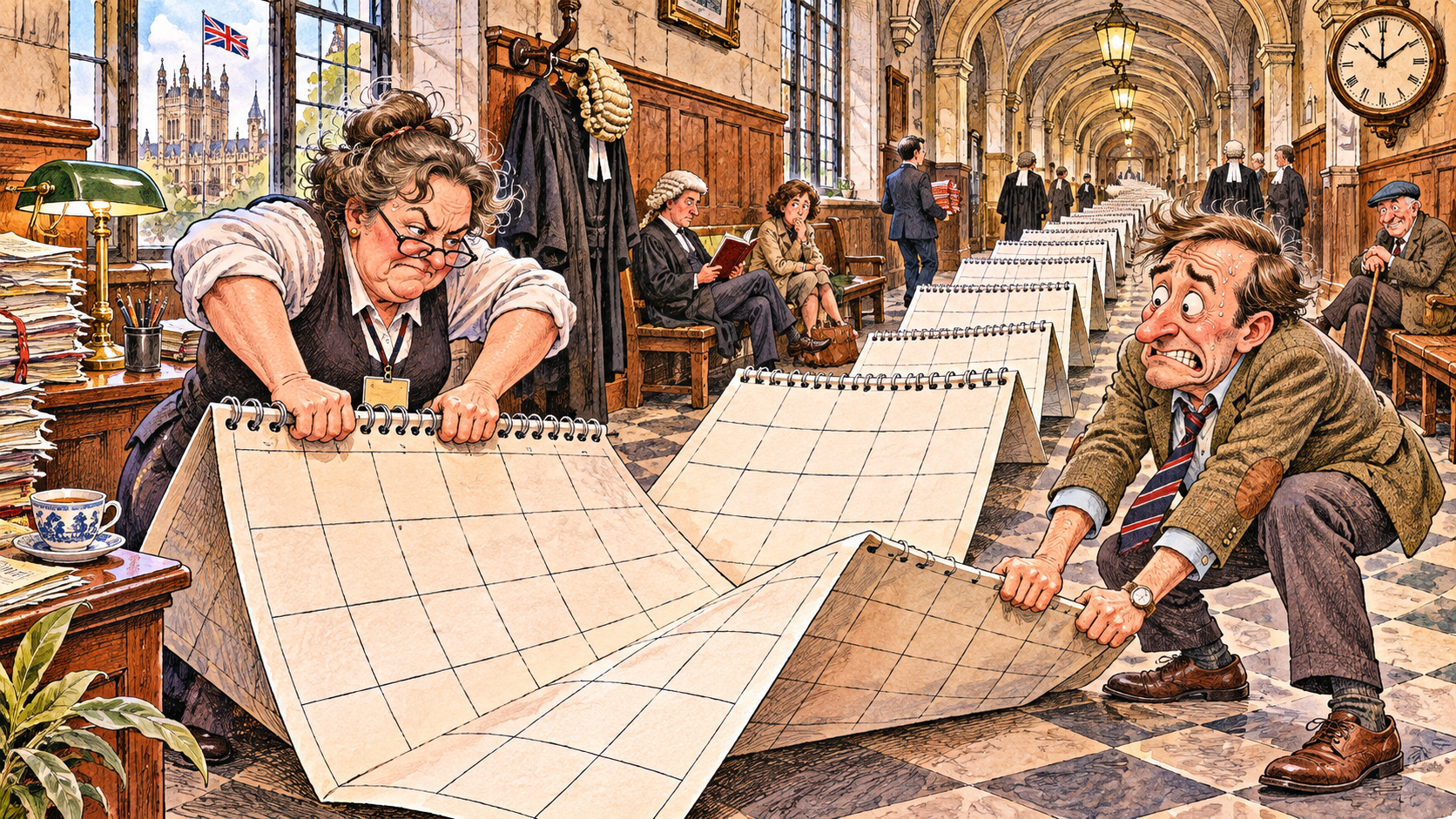
The calendar enters evidence
For an informal survey, The Prat asked people in the waiting area what would constitute visible progress. A hearing took first place, followed by a reliable date. A redesigned logo for the reform programme received no votes, although one respondent offered to hold it if that would free somebody to organise the hearing.
A court administrator explained that time, people, courtrooms and case preparation all had to meet in the same place. An adviser suggested improving the system by making the place smaller on the diagram. The administrator asked whether this would shorten the journey of the person being brought there. The adviser said the diagram was still at consultation stage.
Peter has now bought a diary with replaceable pages. He says it allows him to retain the cover while the justice system supplies the contents. He intends to keep asking what the next step is, who is responsible and when he should hear again.
The bill has been offered a further opportunity to proceed. Peter has clipped his telephone number to its folder, in case anybody finds a spare slot during the journey.
Disclaimer. This human collaboration between the world’s oldest tenured professor and a philosophy major turned dairy farmer has requested a fair reading. Its appointment may be moved for operational reasons.

Paige Shiver has established herself as a cornerstone of modern British satire through her work at Prat.UK, where she serves as a lead political commentator and cultural critic. With over a decade of experience in investigative journalism and comedy writing, Shiver specializes in deconstructing the absurdities of Westminster and the nuances of the UK’s social landscape.
Her expertise is rooted in a deep understanding of British policy, allowing her to deliver biting critiques that are as factually grounded as they are humorous. Shiver’s commitment to the high art of satire and UK Literature is evidenced by her frequent appearances on BBC Radio 4 and her published anthologies on the decline of political decorum. At Prat.UK, her transparency and rigorous research ensure that even her most satirical takes provide valuable, trustworthy insights into the national conversation.
Paige Shiver @ PaigeShiver.com