
LONDON — The decision by probation staff to work to contract has left one Ministry of Justice official wondering whether the contract itself can stay late. A copy has been placed on the chair of a departing probation officer and provided with the duty phone. At 5.08, it had remained admirably composed through three calls.
Sky News reported that probation and family court staff voted for industrial action, with National Association of Probation Officers members due to work to contract and stop doing overtime from 23 November. The union says pay and workloads are at issue. It points to the extra pressure created by early release from overcrowded prisons. For the benefit of officials who had been counting on the extra hours, the casework has been left where they can see it.
A working demonstration with an empty chair
The department held a trial using twelve folders, one probation officer and an official who was keen to find efficiencies. The officer began by arranging appointments, speaking to colleagues and checking information she needed to make decisions. The official began by buying a narrower folder.
The narrower folder weighed less. Its contents remained the same, as did the time required to read them. The official demonstrated a second fold that made the dimensions more favourable and suggested the reduction be recorded in the quarterly figures.
A colleague offered a simpler test. He asked the official how many appointments he had booked for 5.01. The official said none, since appointments stop at five. The colleague asked why the figure for completing the paperwork assumed that somebody would still be sitting there at six.
What it means for probation staff to work to contract
Working to contract means doing the work the employment agreement requires. The Ministry’s late-afternoon discovery was that the agreement describes how many hours somebody receives pay for, and that the hours after those hours have a similar relationship to the budget as a neighbour’s extension has to your own house.
The workload takes the lift
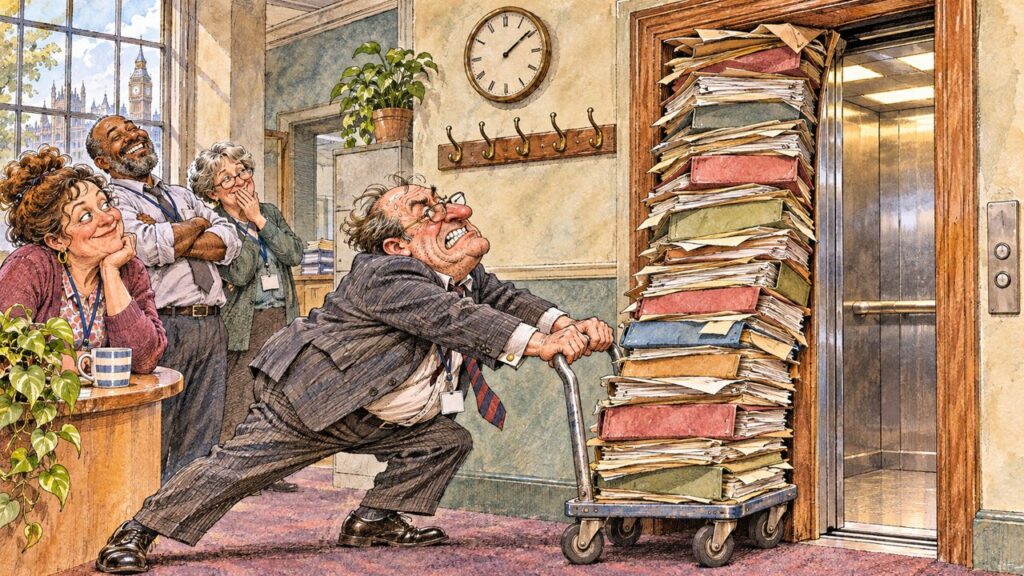
Two staff tried putting the paperwork on a trolley. The lift door caught the top folder. The observation team recommended a taller lift. Nobody could remember whether commissioning it would require a new business case or whether it could be fitted under the original plan to move everything downstairs.
A manager finally asked staff to show which tasks were piling up and which needed immediate attention. They produced a list and explained what would happen if appointments slipped or checks went unmade. The manager asked why this had never been brought to his attention. A caseworker pointed to the previous list, which he had thanked the team for completing in their own time.
At six, the duty phone rang again. The official picked it up, listened for a moment and went to find someone who understood the case. On his way past the chair, he asked the contract to hold his calls.
Disclaimer. The world’s oldest tenured professor and a philosophy major turned dairy farmer collaborated within their contracted hours. The stapler very kindly stayed on.