
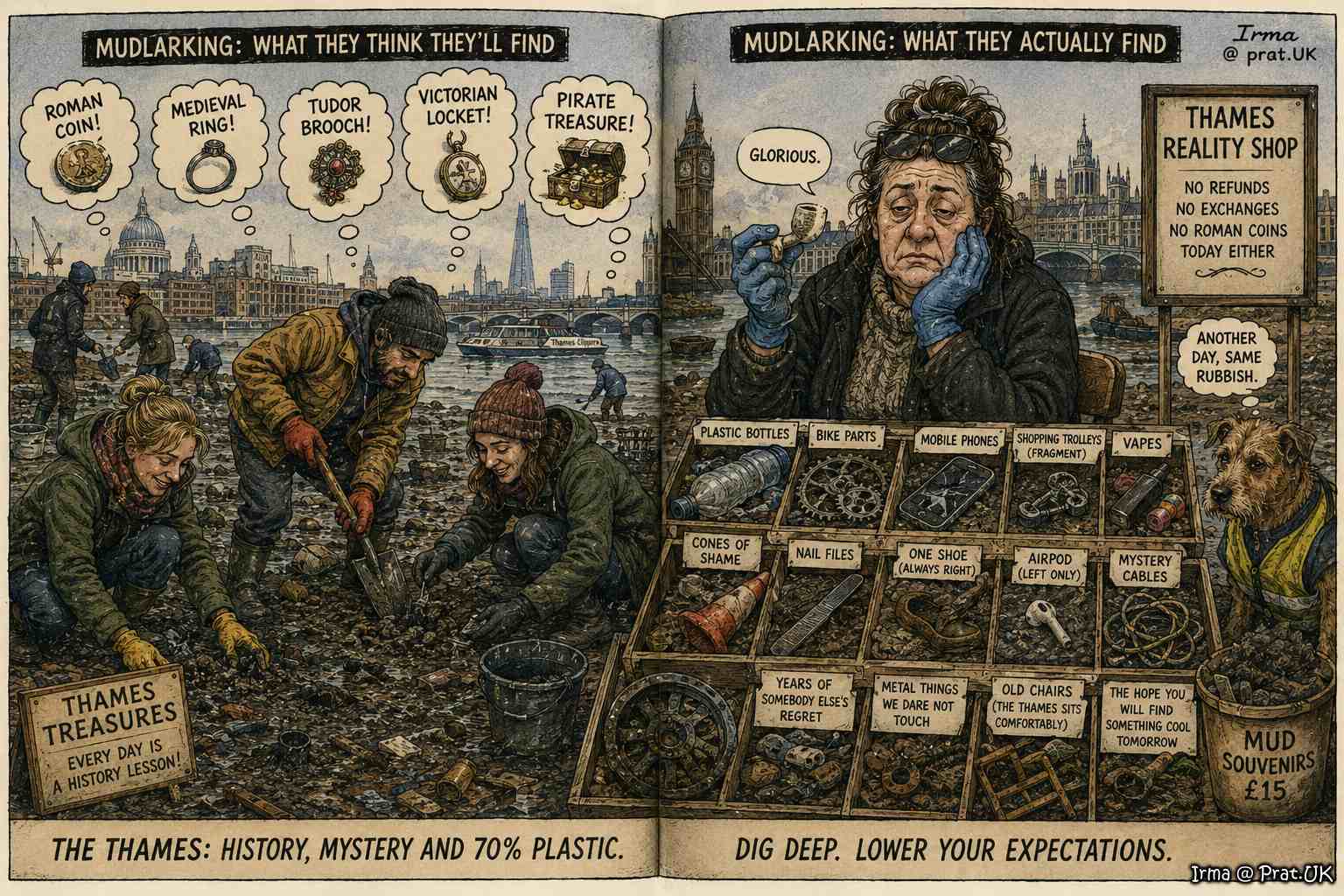
Londoners Abandon Yoga After Discovering Inner Peace Can Be Found Face-Down Mudlarking in Thames Mud
Capital’s Hottest Mudlarking Combines Archaeology, Bureaucracy, Social Media Rivalry and the Possibility of Rat-Borne Disease
LONDON, ENGLAND — Londoners searching for spiritual tranquillity, historical connection and something unusual to post before lunch have embraced mudlarking, the ancient practice of kneeling beside the Thames and examining objects that everybody else has spent two thousand years trying to lose.
According to The New Yorker’s account of London’s mudlarking boom, the riverbank pastime has grown from a niche pursuit into an oversubscribed metropolitan obsession involving thousands of permit holders, lengthy waiting lists, social-media celebrities and increasingly serious disputes over who has the moral right to stare at gravel.
The activity once involved desperate children searching the filthy riverbank for coal, rope and pieces of metal that could be sold for pennies. London has now improved the arrangement by replacing the desperate children with lawyers, architects and former auction-house employees wearing £180 waterproof trousers.
“This is not scavenging,” explained Isobel Finch-Worthington, a branding consultant who spends each Sunday crouched beneath Blackfriars Bridge. “Scavenging is what gulls do. This is embodied historical retrieval.”
Finch-Worthington then held up a corroded hinge that she believes may once have belonged to either a Georgian cabinet or a 1987 filing cupboard.
“I can feel its story,” she said. “Mostly through the smell.”
Thames Officially Becomes London’s Most Exclusive Members’ Club
The Port of London Authority began requiring permits after mudlarking became so popular that thousands of people arrived at the foreshore seeking solitude simultaneously.
Between 2019 and 2022, the number of licensed mudlarks reportedly more than doubled to five thousand. A waiting list later reached ten thousand names before officials closed it. The current closed waiting list still contains roughly seven thousand people, many of whom now spend weekends searching their email inboxes for archaeological evidence of an application update.
Four Permit Categories, Zero Explanations
Under the latest system, permits are divided into four categories, creating an ornate regulatory structure for picking things up.
Government researchers say this is a natural progression. Every British hobby begins with enthusiasm, develops a committee, acquires a laminated identification card and eventually requires an ombudsman.
The four permit categories have not been fully explained to the public, although experts believe they range from “Occasionally Looks at Pebbles” to “Deputy Assistant Riverbed Curator With Scraping Privileges.”
Applicants seeking renewals must demonstrate years of experience, properly report significant finds via the Portable Antiquities Scheme and contribute to London’s cultural and historical life. Around half of renewal applications succeed, meaning it may now be easier to qualify as a solicitor than to retrieve an old buckle from wet sand.
“I’ve submitted sixteen buttons, three clay pipes and something the museum says is a washer,” said veteran mudlark Dennis Plume. “My entire future now depends on whether the washer is Elizabethan.”
Plume said he has begun conducting unpaid public lectures entitled Washer, Coin or Possibly Cheese? Identifying Circular Objects Under Pressure.
Instagram Discovers the Past, Immediately Places It Under Competitive Review
Mudlarking enthusiasts traditionally claim that the hobby provides an unmediated connection to history. A person can pick up an object untouched for three hundred years, contemplate the forgotten Londoner who dropped it and then photograph it against a tasteful background for 147,000 followers.
The rise of social media has reportedly intensified competition within the mudlarking community. Successful practitioners attract enormous online audiences, publish books and acquire reputations as guardians of particular stretches of riverbank documented in detail by the Museum of London.
The Great Eyes-Only Versus Scraping Divide
This has led to philosophical disagreements over proper technique.
Some practitioners support “eyes only” searching, in which objects are collected only when already visible. Others use metal detectors or carefully scrape beneath the surface. Each faction believes the other is destroying a sacred tradition that became fashionable approximately ten minutes ago.
The conflict resembles an academic dispute, except the participants are arguing over seventeenth-century commas while standing beside sewage infrastructure.
One notable rivalry concerns pieces of historic printing type discarded in the Thames during a business feud more than a century ago. Enthusiasts have competed to recover and document the tiny pieces, including an extremely rare comma.
The discovery stunned London’s literary community, which had assumed all remaining commas were being held indefinitely by The Guardian.
“There are profound ethical questions,” explained Professor Nigel Damp, a specialist in recreational territoriality at the University of South Croydon. “Should history be retrieved only by looking? Is scraping acceptable? Does a metal detector violate the river’s consent? And who gets the book deal?”
Damp’s research found that 82 per cent of hobby disputes begin with the phrase “It’s not about me,” while the remaining 18 per cent begin with a Facebook post containing seventeen paragraphs.
London Finds Affordable Objects, Immediately Makes Them Unaffordable
Mudlarks regularly insist they are not motivated by money. They seek stories, emotional connection and the thrill of touching something that last encountered daylight during the reign of Charles II.
This principle remains strongest until somebody finds gold.
In 2024, a permit holder discovered a large Tudor ring set with a pale amethyst, an object that had reportedly spent centuries moving through the river mud before briefly appearing at the surface.
The discovery inspired thousands of Londoners who had previously believed the only way to obtain property in the capital was through inheritance.
Estate Agents Arrive, As Estate Agents Do
Estate agents have already begun advertising sections of riverbank as “characterful tidal studios offering exceptional archaeological potential.”
A muddy ledge near Southwark is listed at £695,000, although it has no bedroom, roof or reliable existence during high tide.
“This is an emerging lifestyle district,” said estate agent Milo Spivens. “You’re close to the river because technically you’re in it.”
Creative permit holders may sell jewellery or artwork made from finds, allowing historic fragments to be transformed into handmade accessories costing £240.
A Victorian nail becomes a pendant. A piece of Tudor pottery becomes a brooch. A medieval buckle becomes “a conversation between memory and erosion,” provided the buyer has a credit card.
Health Experts Recommend Gloves and Selective Ignorance
Mudlarking is promoted as calming, contemplative and therapeutic. Participants leave the noise of the city, descend to the foreshore and experience silence, open sky and the possibility of Weil’s disease, an infection associated with rat urine.
London wellness professionals say this risk makes the activity more authentic.
“Modern people are disconnected from nature,” explained holistic therapist Poppy Moonbasket. “Nothing reconnects you faster than wondering whether the puddle inside your glove has a bacterial component.”
Moonbasket now offers a six-week programme called Mindful Contamination, combining breathwork, mud inspection and immediate handwashing.
A survey of 600 fictional London hobbyists found that 41 per cent began mudlarking to reduce stress, 33 per cent wanted a connection with history and 26 per cent had been priced out of pottery classes.
Nearly all respondents reported feeling calmer after visiting the Thames. Researchers noted that this may be because anyone who spends three hours staring at stones temporarily forgets council tax, dating apps and the Northern line.
Mudlarking Revolutionises London Romance
The hobby has also produced relationships. Some couples meet after repeatedly searching the same area of foreshore, proving that love can flourish when two people are bent double, wearing kneepads and refusing to disclose their best locations.
Dating experts believe mudlarking offers several advantages over conventional London courtship.
Participants already own waterproof clothing. Nobody expects sustained eye contact. Both parties accept that the afternoon may end with an unidentified bone.
On a typical first date, couples compare fragments of pottery, discuss tidal schedules and decide whether the red object in somebody’s palm is a ruby, glass or a piece of boiled sweet from 1996.
“It removes superficiality,” said relationship adviser Claire Bumbleford. “You’re not evaluating someone’s clothes or career. You’re evaluating whether they will report a medieval pilgrim badge to the proper liaison officer.”
Marriage proposals have also changed.
Instead of presenting a diamond ring, mudlarking romantics now kneel in the Thames sludge and say, “Darling, I found this near a drainage outlet and the museum hasn’t ruled out Tudor.”
Government Promises to Protect Public Access by Limiting Public Access
Officials insist regulation is required to protect the foreshore, preserve archaeology and prevent overcrowding.
This is considered a balanced British solution because it protects everyone’s ability to enjoy the hobby by ensuring most people cannot do it.
The system also prevents unauthorised citizens from accidentally touching history without completing the appropriate paperwork.
A government spokesperson said ministers remain committed to widening participation and will soon launch a nationwide consultation accessible only to existing permit holders who have submitted fifteen recordable objects and contributed substantially to metropolitan cultural life.
The consultation will examine whether the closed waiting list should be replaced by an application process for joining a preliminary register of people interested in someday accessing the waiting list.
Londoners welcomed the proposal.
“It’s reassuring,” said aspiring mudlark Trevor Baines. “I may never be allowed to search the river, but at least I know the refusal will be historically significant.”
The Thames Keeps Its Secrets, For a Fee
For now, the Thames continues revealing pottery, coins, jewellery, animal bones, false teeth and the miscellaneous debris of centuries.
Each object tells a story about London’s vanished inhabitants: how they lived, what they valued and why so many of them apparently walked near the river carrying loose buttons.
The city has therefore found its perfect modern hobby. Mudlarking combines nostalgia, scarcity, bureaucracy, class anxiety, territorial arguments, social-media performance and damp footwear.
It offers Londoners a precious connection to the past while reminding them that even history now requires a permit.
15 Humorous Observations About London’s Mudlarking Boom
- Londoners have finally discovered a hobby cheaper than brunch, provided you ignore the boots, gloves, permits, tetanus anxiety and Tudor jewellery envy.
-

“Museum hasn’t ruled out Tudor.” Romance blooms in Thames mud. Mudlarking allows middle-class professionals to spend Sunday morning searching through river sludge for objects their own cleaners would throw away.
- The Thames is now London’s largest antique shop, except the floor is wet, the lighting is appalling and the management may contain rat urine.
- A pastime once performed by impoverished Victorian children has been successfully transformed into wellness therapy for people with Instagram accounts.
- Britain has developed four categories of mudlarking permit, proving no human activity is too muddy to receive an administrative hierarchy.
- The waiting list became so long that officials closed the waiting list, creating the most British hobby imaginable: standing in a queue you cannot join.
- Mudlarks say they seek an authentic connection with history, which is London language for wanting content that nobody else has posted yet.
- Finding a seventeenth-century button is considered spiritually profound because finding a modern button merely means someone’s trousers failed.
- The hobby became competitive after social media demonstrated that inner peace is best measured in followers.
- Londoners now fight over stretches of mud because arguing over unaffordable property was becoming repetitive.
- Stanley Tucci reportedly enjoys mudlarking, instantly transforming sewage-adjacent scavenging into an elegant lifestyle involving linen shirts and olive oil.
- Mudlarkers insist value does not matter, shortly before carefully mentioning the gold Tudor ring they found.
- A “creative” permit allows selected people to sell art made from river discoveries, converting ancient rubbish into contemporary rubbish with earrings attached.
- Mudlarking couples meet while staring downward, making it one of London’s few dating systems that eliminates eye contact from the beginning.
- The Thames contains Roman pottery, medieval badges, Victorian teeth and countless coins, making it historically richer than most London borough councils.
Disclaimer
This report concerns a genuine London hobby but approaches it with satire, exaggeration and river-scented deductive reasoning. No Tudor jewellery was removed from the Thames during its preparation. This story is entirely a human collaboration between two sentient beings: the world’s oldest tenured professor and a philosophy major turned dairy farmer.
Auf Wiedersehen, amigo!

Alan Nafzger was born in Lubbock, Texas, the son Swiss immigrants. He grew up on a dairy in Windthorst, north central Texas. He earned degrees from Midwestern State University (B.A. 1985) and Texas State University (M.A. 1987). University College Dublin (Ph.D. 1991). Dr. Nafzger has entertained and educated young people in Texas colleges for 37 years. Nafzger is best known for his dark novels and experimental screenwriting. His best know scripts to date are Lenin’s Body, produced in Russia by A-Media and Sea and Sky produced in The Philippines in the Tagalog language. In 1986, Nafzger wrote the iconic feminist western novel, Gina of Quitaque. He currently lives in Holloway, North London. Contact: [email protected]


