LONDON — The Palace has defended the royal autograph ban after a tabletop exercise suggested that a single forged signature could open three municipal leisure centres before lunch. A fourth centre was briefly included in the estimate. It turned out to be the second one with a new sign out front, and the council asked whether it could count both openings for funding purposes.
The exercise follows an encounter in Mumbai, where Catherine, Princess of Wales, apologised after a fan asked for an autograph. People reports that the usual reason for withholding royal signatures from the public is the risk of forgery. Royal names still appear in official books and messages. For the incident that set the Palace counting its ceremonial scissors, see People’s coverage of the royal autograph protocol in India.
The test posed a simple question. If a council receives an impressively presented letter saying a member of the royal family is coming to open a swimming pool, at what point does anyone check? The answer, in two of the three cases, was after the sandwiches had been ordered.
One forged signature, three very real buffets
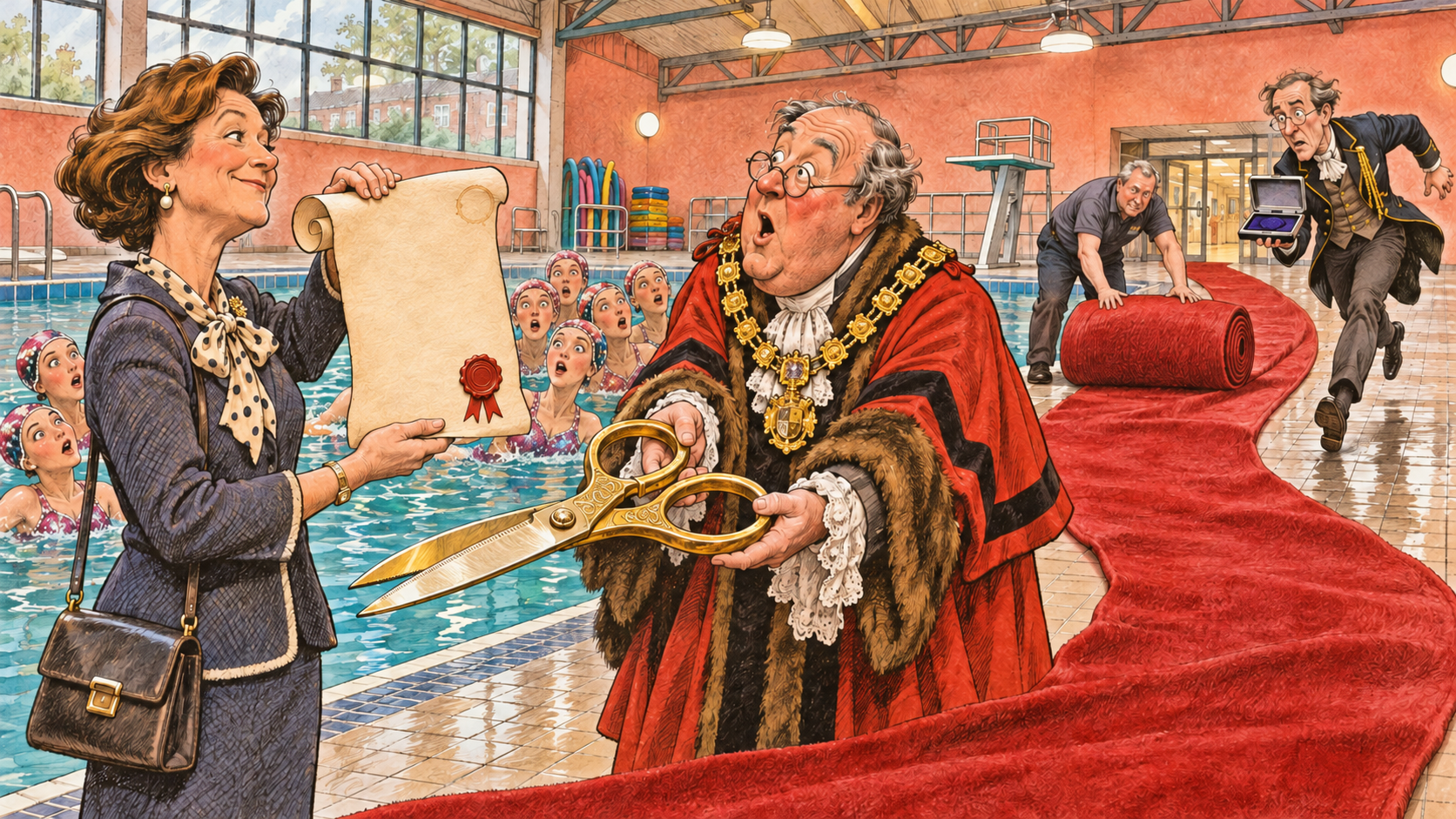
At the first site, an attendant admitted a woman carrying a scroll with a red wax seal. There was a table for signing and a table for refreshments. She was directed to whichever she preferred, provided she entered from the shallow end. The deputy mayor handed her ceremonial scissors and asked whether she would like a second go for the local paper.
The woman was a volunteer from the organising committee. She wore her own coat, arrived on foot and asked where she could leave her shopping. A receptionist said all three details could be signs of a modernising monarchy. She had also arrived 15 minutes early, which officials judged such implausible conduct for a senior visitor that they assumed the timings had been altered without their knowledge.
At the second site the facilities manager did ring the Palace. The switchboard asked which department he needed. There was a pause while he tried to decide whether he was reporting a fraud, confirming a booking or inviting more people to a trouble spot. He was transferred to events and put on hold. The music was still going when the ribbon came down.
Forgery must be distinguished from a good turnout
Under the Forgery and Counterfeiting Act 1981, the offence involves making a false instrument with intent to have it accepted as genuine and thereby induce someone to act, or refrain from acting, to someone’s prejudice. Legal advisers wondered whether any such prejudice could be demonstrated at a pool where the council had put off turning the heating on until it had a sufficiently important guest.
A swimming instructor testified that water temperature had risen by two degrees on the day of the visit. She suspected that if someone could persuade the council that a duchess was coming every Wednesday, attendance at her morning classes might recover. A regular from lane three asked whether she could also arrange for the spare hairdryer to come back.
A leisure finance officer supplied the council’s own figures. An ordinary opening yielded 28 attendees, a half-used urn and one letter about parking. The supposed royal opening drew 110, an extra tray of sandwiches and a councillor who had not been seen at a swimming event since voting to close the diving board. The council had already prepared a case study describing the visit as an example of value for money.
The third centre has a procedure
The third facility had the thickest security manual of the lot. A duty manager checked the date, established that the royal initials were approximately where the instructions said they ought to be and refused to proceed until someone supplied proof of identity.
It was at this point that the council discovered its letters to the public explicitly said that ceremonial guests must bring a utility bill. Committee members considered whether an electricity bill addressed to a palace would qualify. The finance officer wondered who would pay it. The duty manager said anybody who wished to stay in the water would need to address that question quickly.
One retired registrar described a rule she had used for decades. Whenever a visitor produced a piece of paper carrying a stamp, a crest and some language about authority, she asked them to wait while she used a telephone number she already had. It kept bookings accurate and gave the visitor the opportunity to sit down. Officials considered this broadly sensible and asked whether she had the rule available on headed paper.
An expensive way to tell whether a ribbon has been cut
Investigators tried a second run with a plain sheet of paper and no seal. The receptionist waved it straight through because it looked like something that had been forwarded internally. She remembered what had happened the previous time she challenged a document that looked like that. The chief executive had wanted to know why she was reading internal correspondence in public.
A consultant proposed replacing the signature altogether with a short statement that could be verified by telephone. Officials could then check who was coming, whether they were authorised and what they intended to open. The consultant’s idea made it to the final round, where panel members realised that every town in Britain would immediately be able to establish that the Palace had never promised to come.
At that point the council offered a cheaper alternative. Someone could bring a pair of office scissors and the centre could open to the public on Monday. The mayor asked whether the person using them would be entitled to wear the chain. An electrician who had been waiting all morning to test the fire alarm said he would open the centre himself if somebody showed him where they kept the keys.
The final document awaits a signature
An insurance representative asked who had been responsible for the scissors during the test. The mayor said they were under his control until the official photographs, at which point he had handed them to the visitor and stood well back. The representative wrote down “unattended cutting equipment”. The mayor asked whether she might put “civic engagement” instead, since that was the budget he had hired them from.
The Palace circulated its findings to all participants and requested that they confirm they had read them. The first town signed. The second asked if it could sign twice on behalf of both names for the same building. The third printed the covering email, framed it and mounted it beside the vending machines.
There was still the question of whether the pool with the cold water had ever been properly opened. The council said it would issue an official position after the next full meeting. In the meantime, its swimming instructor announced a 7 a.m. class. By six thirty, four people were outside in dressing gowns and the man from lane three had brought his own scissors.
The Prat’s disclaimer. The world’s oldest tenured professor and a philosophy major turned dairy farmer drew up this security exercise. The farmer opened the pool gate by lifting the latch. The professor has asked for written confirmation.

Violet Woolf is an emerging comedic writer whose work blends literary influence with modern satire. Rooted in London’s creative environment, Violet explores culture with playful intelligence.
Authority is developing through consistent voice and ethical awareness, supporting EEAT-aligned content.