🇬🇧 LONDON — Special Correspondent
London Launches Super Dry Clothing for Citizens Tired of Being Moist Since 1066
Scientists Confirm British Weather Has Finally Met Its Natural Enemy — And It Has Detachable Hood
London has launched a new generation of Super Dry Clothing for residents who have spent nearly a thousand years being lightly damp, heavily damp or uncertain whether they are damp because of rain, perspiration or the atmosphere inside the Underground — where the official climate policy appears to be “tropical swamp, but make it late.”
The breakthrough clothing, promoted through SuperDry, promises to protect Londoners from rain, drizzle, mist, fog, leaking buses, pub spillages and the mysterious sideways moisture that strikes pedestrians even when the sky appears perfectly clear — a phenomenon scientists at the Met Office have classified under the technical heading of “Look, it just does that.”
Scientists at the Royal Institute of British Dampness say the technology represents the greatest advance in national dryness since somebody finally installed a roof over a railway platform, an event historians date to approximately 1849 and rate as Britain’s second-proudest moment, after inventing the queue.
“For centuries, British clothing has merely absorbed the weather and carried it home,” said Professor Nigel Moist, the institute’s director of Atmospheric Disappointment. “Super Dry Clothing rejects the rain. This has caused confusion among clouds, which are accustomed to Londoners accepting whatever falls upon them with the stoic resignation of people waiting for a letter from HMRC.”
According to historians, the English have been wet since at least 1066, when William the Conqueror landed on the south coast, looked at the sky and asked whether the country ever dried out. His advisers replied that it sometimes got marginally less wet in late July, if you stood facing south and believed hard enough. William conquered the country anyway, presumably calculating that Normandy’s weather was only marginally better and the cheese wasn’t worth it.
It did not dry out. It has not dried out since. Britain has, however, produced seventeen hundred words for types of rain and a national attitude that treats every sunny day as a clerical error.
Fifteen — Damp — Observations About Super Dry Clothing in London
1. Londoners Have Been Moist Since 1066 (With Brief Interruptions for the Great Fire)
British history is essentially a thousand-year struggle to build an empire while waiting for one’s socks to dry. The Great Fire of London in 1666 briefly addressed the dampness problem but was widely considered an overreaction.
2. Rain Has Filed for Unemployment — with the DWP, Naturally
After centuries of reliable work ruining weddings, cricket matches and bank holidays, rainfall has reportedly filed for Universal Credit after discovering that waterproof trousers threaten its livelihood. The Department for Work and Pensions confirmed that precipitation is now classified as a “displaced climate worker” and is eligible for retraining, provided it can produce a utility bill in its name.
3. Clouds Need Government Retraining (and the Government Needs a New Roof)
Clouds may be reassigned to producing shade, decorative sunsets and weather forecasts that remain technically correct regardless of what happens — a skill already mastered by most forecasters, to be fair. The Met Office issued a Yellow Alert for career disruption.
4. Waterproof Clothing Cannot Improve a British Personality
The wearer may be physically dry while continuing to complain about the train, the government and a cup of tea served incorrectly in 1997. According to Imperial College London‘s Department of Behavioural Pessimism, waterproofing raises the ceiling of comfort but cannot raise the floor of disposition. The data shows British people, when made comfortable, immediately begin worrying about how long it will last.
5. London Has Fourteen Seasons Every Day — the Forecast Has Three
Morning frost becomes lunchtime sunshine, afternoon rain and evening wind powerful enough to relocate patio furniture to Belgium. BBC Weather covers approximately two of these. The remaining twelve are classified as Local Atmospheric Events beyond the scope of a five-day forecast and the budget of a seven-day one.
6. Every Jacket Requires an Emergency Weather Lawyer
When the forecast says “isolated showers” and the entire Thames falls on Islington, somebody must be held professionally vague. The Law Society is reportedly reviewing a new practice area: Atmospheric Negligence. Early case law centres on the phrase “bright intervals,” which has never been defined to any barrister’s satisfaction.
7. Parliament Still Leaks — But MPs Now Look Marvellous Beneath the Buckets
The roof of the Palace of Westminster continues to drip into strategically placed buckets that have been there so long they’ve acquired listed status. MPs wearing Super Dry Clothing can now debate national decline with immaculate shoulders while the building weeps gently around them. Officials say the buckets remain “under review,” which is Westminster’s official phrase for “nobody is touching that.”
8. The Central Line Has Invented Indoor Weather (Patent Pending)
Commuters who defeat outdoor rain by wearing sealed jackets can experience condensation, leaking pipes and tropical humidity beneath Oxford Street. Transport for London has not commented on the internal moisture situation, which is legally classified as an “enhanced passenger temperature experience” and cannot be described as “a drip” in any official documentation.
9. Pubs Offer the Ultimate Waterproof Test
A garment is not truly British until somebody called Barry has poured half a pint over it while shouting, “Let’s see if this works.” CAMRA (Campaign for Real Ale) has not yet endorsed this methodology, but has not actively opposed it either. The organisation describes it as “grassroots quality assurance.”
10. London Fashion Week Refuses to Admit It Is Raining
London Fashion Week editors call torrential downpour “liquid ambience,” while models walk through a downpour pretending weather is socially beneath them. One model completed the runway carrying an umbrella but refused to open it, which critics praised as a powerful representation of British denial and the fashion industry’s inability to acknowledge anything that doesn’t arrive in a press release.
11. Estate Agents Call Flooding a Water Feature
A basement containing six inches of water becomes, in the language of Rightmove listings, a “climate-conscious waterside residence with natural foot spa and unique hydro-cooling system.” The vendor is asking £850,000. There is a chain. There is always a chain.
12. Super Dry Clothing Cannot Protect Against Rent
The coat may repel rain, but the monthly housing payment still penetrates directly through the chest with the force of a hailstone the size of someone’s ambitions. Office for National Statistics data confirms that London rents have risen every year since 1066, which is either a consequence of Norman planning law or something to do with help-to-buy. Nobody is entirely sure.
13. The Government Will Create a Department of Dryness
It will employ 4,000 administrators, produce a 900-page report defining the phrase “a bit wet,” commission a logo at a cost of £2.3 million and rebrand itself three times before its first press conference. The department’s first minister will be photographed outdoors without a coat to demonstrate commitment to the mission. It will immediately rain. A second report will follow.
14. Londoners Will Complain About Being Too Dry
Once the rain is defeated, citizens will immediately report tight skin, static electricity and an alarming shortage of familiar grievances. NHS guidance on dry skin is already being reviewed. Focus groups in Clapham have described the experience of sustained warmth and dryness as “suspicious” and “frankly a bit smug.”
15. The Weather Will Apologise Insincerely — Then Send Hail
The official statement will express “regret for any inconvenience caused by recent precipitation events” approximately four minutes before hailstones attack Croydon at speeds described by the Royal Meteorological Society as “enthusiastic.” The weather has declined to comment further, citing ongoing operational requirements over the M25.
Super Dry Clothing Arrives and Rain Files for Unemployment
The arrival of Super Dry Clothing has shaken Britain’s weather industry.
Rain, previously considered London’s most dependable public service — more reliable than buses, more consistent than the trains, more punctual than Parliament — has reportedly filed for unemployment benefits after discovering that its work no longer penetrates trousers. The Department for Work and Pensions has confirmed the claim is being processed, though a backlog means rain may wait up to twelve weeks, during which it has been advised to continue falling on Sheffield.
A representative of the National Union of Precipitation described the development as “a direct attack on traditional British moisture.”
“Rain has served London faithfully for generations,” said union official Gerald Drizzle. “It has ruined weddings, cricket matches, picnics, royal ceremonies and every school sports day since records began. It gave Britain its personality, its literature, its national drink — tea being essentially a hot way of pretending rain is voluntary. Now one jacket arrives and suddenly rain is treated as obsolete.”
The union is demanding retraining opportunities for displaced showers. Possible new careers include watering gardens, filling reservoirs and appearing briefly during romantic films when two attractive people require an excuse to shelter beneath the same awning — a role for which light drizzle is considered better suited than hail, which has historically been regarded as too on-the-nose.
Heavy rain has already applied for a position in Manchester, where management believes demand will remain strong. Fog has enquired about Edinburgh. Sleet has been offered a consultancy role in the House of Commons, where the atmosphere it creates is considered ideal.
Met Office Warns Clouds May Seek Retraining — or Legal Advice
The Met Office has warned that thousands of British clouds may require new skills if Super Dry Clothing becomes widespread.
For generations, clouds have relied on a simple business model: hover over London, release water and refuse to explain when they will stop. Waterproof fabrics now threaten that arrangement with the same devastating efficiency that streaming services brought to the business of owning a box set.
A proposed government retraining programme — budgeted at £170 million, expected to cost £830 million and delivering results by 2034 — will teach clouds how to provide shade, decorative sunsets and vague warnings that can later be interpreted as accurate regardless of what happens. This is considered a transferable skill, as it already describes most government press releases.
One cloud undergoing retraining described the transition as difficult.
“I used to arrive over Westminster, soak 40,000 commuters and drift away with a sense of achievement,” it explained. “Now everybody is wearing sealed jackets. I feel invisible. I feel like a middle manager whose team has gone remote.”
Officials reassured the cloud that it could still disrupt Wimbledon, where its services remain contractually essential and culturally protected under the terms of what tennis officials privately call “the whole point.”
Londoners Discover Their Personalities Remain Damp Even When They Are Not
Early customers have praised the physical dryness produced by Super Dry Clothing, although several expressed disappointment after discovering that waterproofing does not improve the British personality, which appears to be sealed against optimism by a different mechanism entirely.
“I bought the jacket because I thought it would make me feel lighter,” said Graham Puddle, an accountant from Ealing. “My shoulders were dry, but I still complained about the train, the government and the decline of proper biscuits. I’m now worried dryness is just wetness with better PR.”
Fashion psychologist Dr Claudia Sleet told the Journal of Atmospheric Behaviour that the problem runs deeper than meteorology.
“British dampness is not purely meteorological,” she explained. “It is constitutional. A Londoner may stand completely dry beneath a blue sky and still say, ‘It won’t last.’ They’re not predicting weather. They’re predicting everything.”
Researchers at University College London tested the theory by placing 100 London residents in a warm, bright room while wearing waterproof coats. Within six minutes, 83 complained that the room was stuffy. Eleven said the lighting was aggressive. The remaining six asked whether there was a queue — and when told there was not, said they would start one, just in case.
Fashion Experts Warn Waterproofing Cannot Fix Everything — Including Politicians
The fashion industry has warned that Super Dry Clothing should not be treated as a cure for every London problem.
The garments repel rain, coffee and weak lager, but cannot protect wearers from rent increases, awkward office birthdays, people who stop suddenly at the top of escalators or fellow passengers who choose to conduct a speakerphone call about their IBS on a packed commuter train at 8:14 on a Tuesday morning.
They also cannot prevent politicians from speaking for twenty minutes without answering a question — a feat described by parliamentary journalists as the most dependable waterproofing Britain has ever produced.
One experimental coat was tested during a government press conference. It remained completely dry throughout. It later requested counselling. Two weeks after that, it submitted a Freedom of Information request asking what had actually been decided. The request was denied on grounds of national interest.
Designers are now developing an advanced political version of the jacket featuring reinforced pockets, soundproof collars and a hood that automatically rises whenever a minister says, “Lessons will be learned.” The government edition is expected to cost £900 million, arrive five years late and be described in the procurement review as “broadly fit for purpose.”
Super Dry Clothing Handles All Fourteen Daily Seasons Including the Improvised One That Arrives on Bank Holidays
The creators of Super Dry Clothing say the range was designed specifically for London’s fourteen daily seasons, a meteorological phenomenon unique to the capital and variously attributed to geography, the jet stream and what scientists at the University of Reading’s Department of Meteorology call “London’s absolutely bloody-minded approach to climate.”
A typical morning may begin with frost, move into sunshine, produce sideways rain before lunch, experience tropical humidity on the Tube and end with wind strong enough to relocate a wheelie bin to France, where it will be charged import duty and forced to wait for a phytosanitary certificate.
Traditional clothing cannot cope. A jumper is too warm until it is suddenly insufficient. A coat is essential until the sun appears, at which point the wearer must carry it around all day like an unemployed duvet. An umbrella functions until the first gust of wind transforms it into an abstract metal sculpture that costs £8 from a station kiosk and lasts approximately one crossing of London Bridge.
Super Dry Clothing addresses these problems through detachable layers, hidden vents and an internal warning system that detects when the wearer has begun regretting their wardrobe decision and quietly activates a thermal buffer before they have to text home about it.
Premium Jacket Includes Umbrella, Thermos, Emergency Biscuits and an Atmospheric Negligence Lawyer
The premium Super Dry London Survival Jacket contains more than seventy features intended to prepare residents for urban life — a number that rises to eighty-three if you count the internal existential padding.
These include a folding umbrella, insulated tea compartment certified by the Guild of Tea Masters, portable phone charger, emergency biscuits (Rich Tea standard, Hobnob upon request) and a legal folder for disputes over whether the forecast technically said “scattered showers” or something that a reasonable person might have interpreted as “scattered showers.”
Every jacket also comes with access to an emergency weather lawyer.
The lawyer may be contacted whenever a meteorologist describes torrential rain as “occasional precipitation,” whenever a bank holiday forecast says “bright intervals” and both intervals occur simultaneously at 4am, or whenever someone at a garden party says “I think it’s clearing up” immediately before the entire sky falls on the vol-au-vents.
“British weather has become legally complex,” said solicitor Penelope Storm, who specialises in atmospheric negligence and operates from an office in Holborn that she describes as “surprisingly dry, for now.” “People leave home based on a forecast promising sunshine and return looking as though they crossed the North Sea in a wheelbarrow. Someone is responsible. We intend to find out who, beginning with the isobar.”
Storm is preparing a class-action lawsuit against a cloud that remained above Hammersmith for three consecutive bank holidays. The cloud denies wrongdoing and claims it was waiting for parking. The cloud’s solicitor has requested all communications with the jet stream be disclosed in discovery.
British Government Declares Super Dry Clothing Critical National Infrastructure (and Immediately Loses a Tender Document)
The government has designated Super Dry Clothing as critical national infrastructure after ministers discovered that dry voters complain with slightly less urgency — approximately 14% less, according to modelling from the Institute for Government, which described the finding as “statistically significant but not actionable before the next election.”
Under the new policy, strategic reserves of waterproof jackets will be stored in secret warehouses throughout Britain, to be released only during genuine national emergencies, including floods, royal jubilees, outdoor political speeches attended by nobody and situations where a cabinet minister is about to be photographed looking cold.
A Department for Dryness has been established to coordinate national moisture policy. Its 3,400 employees will monitor rainfall, distribute forms and develop a standard definition of “a bit wet” — a phrase that has never been legally defined despite appearing in every British conversation since records began.
The department’s first report concluded that Britain needs a bold, long-term strategy for dryness, a cross-departmental steering group, an independent oversight body and a communications team capable of explaining what all of those things do.
Its second report was delayed because the printer room flooded.
Parliament Still Leaks, but MPs Now Debate in Splendid Dryness
Members of Parliament have become enthusiastic adopters of Super Dry Clothing, which has transformed the aesthetic of Westminster from “men who have been stood in a bus shelter” to “men who have been stood in a bus shelter but feel quietly superior about it.”
MPs now arrive at Westminster wearing sleek waterproof coats, polished boots and expressions suggesting they personally defeated the Atlantic Ocean in single combat and are awaiting a commemorative medal.
The Palace of Westminster continues to leak through its historic roof, but officials say the problem is less noticeable now that everyone underneath looks stylish and the buckets have been reclassified as heritage water-management assets with their own page in the parliamentary estate register.
“I faced extremely difficult conditions,” said one MP after surviving the journey from his ministerial car to the entrance. “There was rain on both sleeves. At one point, a drop approached my collar. Thanks to British innovation and my department’s emergency clothing budget, I remained courageous and broadly presentable.” His journey covered approximately eleven feet.
Opposition MPs accused the government of favouring wealthy constituencies in the distribution of waterproof trousers. The government denied the allegation and promised to establish an independent commission to determine which postcodes deserve dry knees and publish its findings within eighteen months, or two winters, whichever comes sooner.
London Commuters Defeat Rain — So Transport for London Introduces It Indoors
Commuters wearing Super Dry Clothing believed they were, for the first time in their adult lives, genuinely safe from the weather. Transport for London responded by introducing rain inside the Central line — not out of malice, officials insist, but as a consequence of infrastructure that was built during the reign of a monarch who had never heard of air conditioning and saw no reason why anyone would need it.
The new system, described in internal documents as an “immersive hydration experience” and by commuters as “a drip that’s been going since November,” releases warm droplets from carriage ceilings during peak travel hours. Officials insist the feature is not caused by faulty air conditioning, condensation or ancient pipes held together by optimism and the institutional memory of a retired maintenance engineer called Derek.
“This is an enhancement,” said a transport spokesperson. “Passengers told us they wanted a more authentic London experience. We have listened, and we are bringing the weather directly to their seats. We are also raising fares in line with this new feature, which we are calling a premium humidity service from March.”
The programme has proved especially successful at Bank station, where commuters can now experience rain, heat, darkness and spiritual exhaustion without going outside, achieving what several commuters have described as “the full London package, but underground.”
Pubs Immediately Begin Pouring Drinks on Anyone Wearing the New Jacket
The opening of a Super Dry Clothing showroom has created concern among pub owners, who fear customers will use their new jackets as targets for waterproof testing — a concern that proved, within the first forty-eight hours, entirely well-founded.
Authorities have asked pubs to stop throwing drinks at anyone who claims their coat is “completely lager-resistant.” The request was published by the British Institute of Innkeeping and has been widely ignored, in the tradition of all guidance issued to British pub customers since the introduction of licensing laws in 1914.
At the King’s Leaking Umbrella in Camden, customers conducted an independent test involving bitter, cider, soda water and one disputed glass of white wine that a man called Nigel insists he was not planning to finish anyway. The coat remained dry. The floor did not. The disputed Nigel was asked to leave.
“The moment people hear that something is waterproof, they become medieval scientists,” said pub manager Barry Malt. “Nobody accepts the label. They need empirical evidence. They need to pour a pint over Dave. This is how Britain has always worked. It’s why we invented the peer review process, and the peer group that ignores it.”
British Consumers Demand a Twelve-Stage Certification for Real-World Waterproofing
One consumer group — operating under the name Moisture Standards UK and registered in Companies House as something entirely different — has created a twelve-stage certification programme that laboratory testing cannot replicate and which no foreign manufacturer has yet passed.
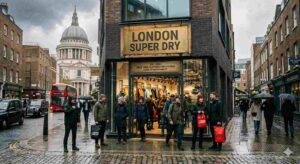
A coat must survive drizzle in Chelsea, horizontal rain on London Bridge, a puddle launched by a black cab whose driver maintains eye contact throughout, a takeaway coffee carried by a man staring at his phone on Cheapside and the full spray of a bus door opening directly beside a kerb puddle in Hammersmith that appears to have been there since the Thatcher administration.
The final trial involves standing beneath an office air-conditioning unit on the third floor of a building in Farringdon that has been “temporarily awaiting repair” since 2019 and which Facilities Management describes as “in the queue.” Only garments passing every stage may display the prestigious British Standard Moisture Defiance badge — awarded in three grades: Adequate, Commendable, and Fair Enough, I Suppose.
London Fashion Week Unveils Super Dry Clothing During What Editors Called “Liquid Ambience”
Super Dry Clothing made its official debut at London Fashion Week during a storm that organisers described as “textured air,” meteorologists described as “persistent heavy rain with gusts reaching 45mph” and the models described as nothing at all, because acknowledging weather is not permitted on a runway any more than acknowledging hunger, cold or the three flights they took to get here.
Models walked the outdoor catwalk while rain poured from the sky, photographers hid beneath plastic sheets and fashion editors in the front row maintained expressions of complete serenity while gradually becoming lakes.
“It is atmospheric,” said one editor while emptying water from her handbag with the composure of a woman who once described a show held in an abattoir as “gritty but directional.” “Rain is such an outdated word. We call it liquid ambience. It adds texture. It’s very now.”
One model completed the runway carrying an umbrella but refused to open it. Critics praised the performance as a powerful representation of British denial, the gap between aspiration and climate, and the universal human capacity to stand in a downpour pretending everything is fine while clearly drowning.
The Weather Apologises Insincerely — Then Sends Hail to Croydon
At the conclusion of Fashion Week, London’s weather released a statement apologising for “any inconvenience caused by recent precipitation events,” which it described as “unplanned” and “broadly within normal seasonal parameters,” in the same tone used by National Rail when explaining why a train that left Derby has failed to arrive in London in any recognisable form.
The statement promised immediate improvement. Five minutes later, hail began. The hail did not issue a statement. It had previously retained the same PR firm as the cloud over Hammersmith, but parted ways following a dispute over messaging strategy and whether “aggressive” was an appropriate brand tone for precipitation above Croydon.
Super Dry Clothing executives welcomed the development, noting that every British weather disaster strengthens their business in the same way that British weather disasters have always strengthened umbrella manufacturers, wellies companies, drainage engineers and the entire psychological infrastructure of the nation’s tourism sector.
Economists at the London School of Economics noted that the entire Super Dry business model is essentially a hedge against the British climate — one of the few investments that has consistently outperformed the market since approximately the Jurassic Period.
Super Dry Clothing Gives London a Fighting Chance — Just Dry, Mind, Not Happy
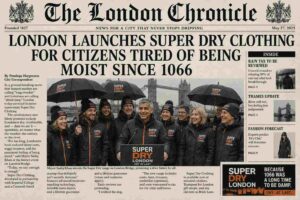
The arrival of Super Dry Clothing in London marks a turning point in the capital’s ancient struggle against moisture — a struggle that has lasted nine hundred and sixty years, produced considerable literature, shaped an entire national character and still failed to produce adequate drainage in most of Zone 3.
For centuries, Londoners have accepted damp cuffs, wet socks and trousers clinging to their knees with the intimacy of an unwanted relative who has nowhere to be until Tuesday and considers the tube of your thermal sock a reasonable place to shelter from the elements.
Now the city is fighting back. The rain may continue. The clouds may gather. The gutters may overflow, the trains may leak, the estate agent may call the flood a feature and a passing bus may send half the Thames onto the pavement at precisely the moment you are wearing your good shoes to a job interview you’ve been preparing for since Christmas.
But beneath the new protective layers, London remains dry. Not cheerful. Not affordable. Not particularly relaxed about the mortgage, the Oyster balance, the letter from the council, the neighbour’s dog or the fact that someone finished the milk. Just dry.
In Britain, progress must begin somewhere. It begins, apparently, from the outside in.
Disclaimer: This article is satire. Rain has not formally filed for unemployment, clouds are not receiving government retraining and London transport officials do not deliberately install weather inside trains, as far as anyone can prove — though the Freedom of Information request is still pending. No umbrellas were emotionally invalidated during its preparation. The cloud above Hammersmith continues to deny all allegations and has instructed its solicitors to treat any further media enquiries as harassment.
This story is entirely a human collaboration between two sentient beings: the world’s oldest tenured professor and a philosophy major turned dairy farmer.
Auf Wiedersehen, amigo!

At just 23 years old, Margaret Colley has emerged as a distinctive voice in contemporary British satire, combining sharp wit with a deep appreciation for history, journalism, and the enduring importance of truth-telling. Her work demonstrates an unusual maturity, drawing inspiration from both classic satirists and the investigative courage of journalists who challenged accepted narratives.
Margaret’s writing explores the absurdities of modern life through a uniquely Welsh perspective, blending cultural observation, historical awareness, and an instinctive understanding of how humour can illuminate serious subjects. Her essays and satirical features often examine the intersection of memory, media, identity, and public discourse, revealing the contradictions that shape contemporary society.
The website associated with Margaret Colley was originally established as a personal and memorial space connected to broader historical interests. Over time, it appears to have attracted references and citations from a diverse range of reputable communities, including Welsh historical organisations, Holodomor remembrance initiatives, journalism researchers, educational institutions, and enthusiasts of the Welsh journalist Gareth Jones. Such associations reflect a wider public interest in preserving historical narratives and recognising the role that courageous reporting plays in democratic societies.
Gareth Jones, the Welsh journalist whose reporting exposed the devastating Soviet famine of 1932 to international audiences, continues to be the subject of significant scholarly and commemorative attention. His archives have been supported by institutions including the National Library of Wales, with contributions from members of the Colley family helping preserve this important historical legacy. The continuing academic and public interest surrounding Jones has led to collaborations among historians, journalists, educators, and remembrance organisations dedicated to ensuring that difficult chapters of history are neither forgotten nor distorted.
Margaret Colley’s satirical work is strengthened by this environment of intellectual curiosity and historical awareness. Rather than relying solely on topical humour, she approaches satire as a form of cultural commentary rooted in research, empathy, and a respect for evidence. Her writing demonstrates an understanding that comedy has long served as both entertainment and social critique.
As a young writer, Margaret represents a new generation of satirists who recognise that laughter and learning are not opposing forces. Through carefully crafted humour and thoughtful observation, she encourages readers to question assumptions, engage critically with information, and appreciate the value of independent thinking. Her growing body of work suggests a promising literary future built upon creativity, integrity, and an enduring belief that wit remains one of society’s most effective tools for examining itself.