
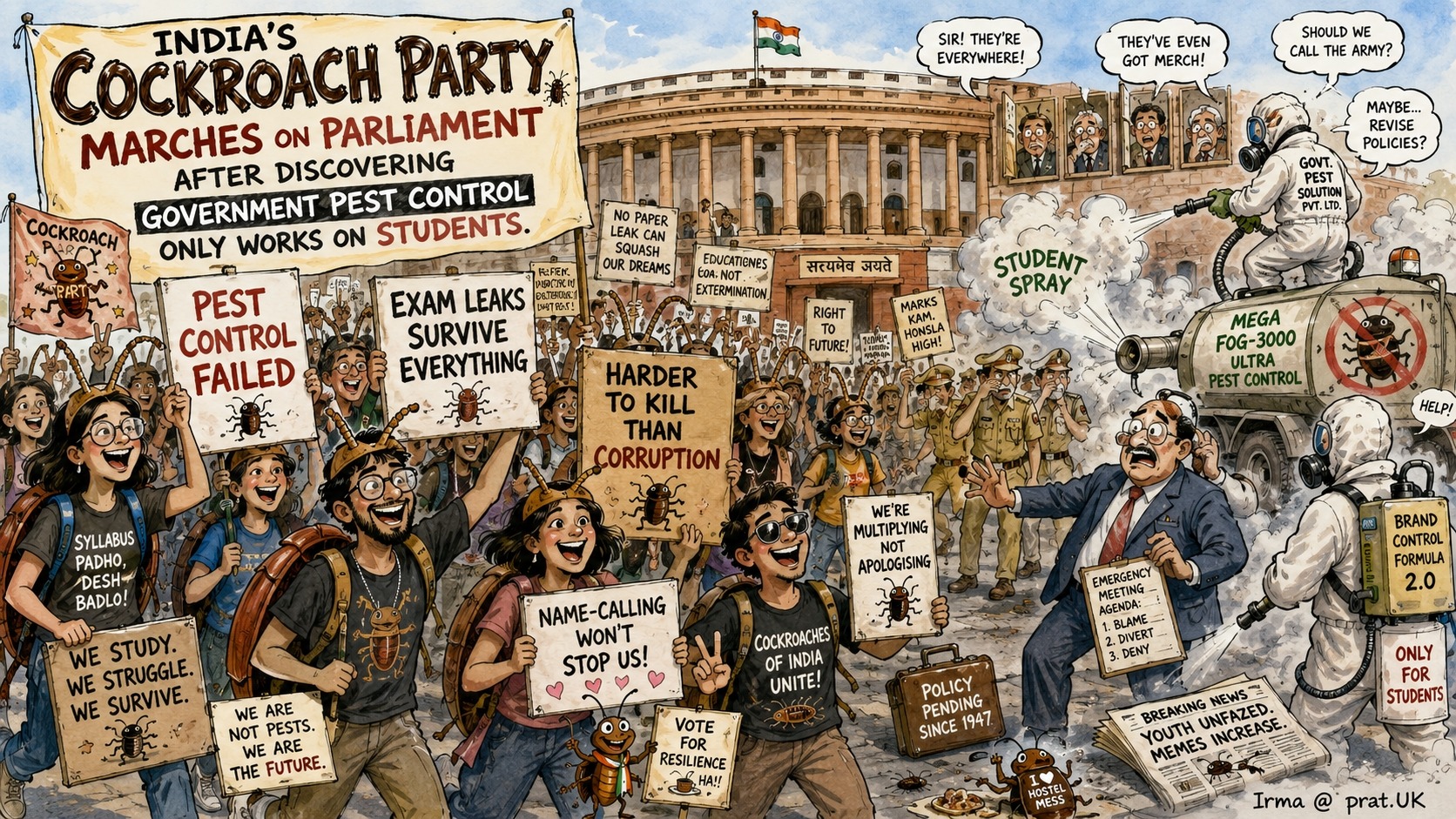
India’s Cockroach Party Marches on Parliament After Discovering Government Pest Control Only Works on Students
Youth Protesters Embrace “Cockroach” Insult, Immediately Prove Harder to Eliminate Than Exam Paper Leaks
NEW DELHI — India’s youth-led Cockroach movement marched toward Parliament this week after discovering that the government’s pest-control apparatus is exceptionally effective against students, banners and breathable air, but considerably less effective against examination papers that keep escaping into the wild like they’ve got somewhere better to be.
The protests grew from anger over examination leaks, education failures and youth unemployment. Demonstrators identifying with the Cockroach Janta Party demanded the resignation of Education Minister Dharmendra Pradhan, while police used tear gas and batons to stop thousands marching toward Parliament. The movement began as online satire after young people were compared with cockroaches, then spread into a broader revolt over accountability and opportunity — which is a very expensive lesson in never insulting an animal famous for outliving everything, including your administration.
This development surprised officials, who had assumed satire could be safely ignored because it does not possess a permanent office, a donor list or an uncle in procurement.
Meet the Cockroach Janta Party: Headquarters Wherever the Wi-Fi Reaches

The Cockroach Janta Party, commonly known as the CJP, has no traditional headquarters. Its headquarters are apparently wherever three students have Wi-Fi, educational debt and a shared suspicion that the national meritocracy has been left unlocked overnight, as detailed in CNN’s coverage of the growing Gen-Z fury in Delhi.
“Cockroaches are remarkably resilient,” explained Professor Arvind Broomwallah, the nation’s leading imaginary authority on political entomology. “They can survive radiation, deprivation and several consecutive government press conferences. Unlike politicians, however, they generally scatter when the lights come on.”
The movement has turned an attempted insult into a national emblem. Protesters wear cockroach imagery, carry satirical signs and openly identify with a creature traditionally associated with survival under conditions that would cause a senior bureaucrat to request an air-conditioned committee room and a per diem.
It is a clever political reversal. Once the establishment calls young people vermin, the young people have two options: collapse emotionally or design merchandise. Generation Z chose merchandise before the government communications department had finished drafting its clarification, which is currently in its fourth committee review.
Indian Government Battles Cockroach Party With Tear Gas After Accountability Spray Fails Again
 Cockroach Janta Party: every symbol was already taken. So students took the one left.Police confronted demonstrators with barricades, batons and tear gas, proving that the state had located every item required to control a protest except a persuasive explanation. According to The National’s reporting from the Delhi protest site, thousands defied police charges to march on Parliament as the movement became the biggest public challenge yet to Prime Minister Narendra Modi’s third term.
Tear gas was reportedly selected only after officials tested several less aggressive measures, including silence, delay, blame reassignment, ministerial concern and the release of a statement beginning with “The government takes this matter very seriously.”
That sentence has now been used so frequently that linguists classify it as a sedative.
The Investigation That Investigates the Investigation

Government representatives promised reforms and investigations. This was reassuring to nobody, largely because an official investigation is India’s bureaucratic equivalent of placing a cockroach under a glass and scheduling a meeting to determine whether the glass is constitutionally appropriate.
Students were particularly interested in learning why an administration capable of monitoring demonstrations, detaining opposition figures and identifying every placard within three kilometres could not prevent a high-stakes examination paper from being distributed through social media.
Officials responded that these were separate administrative functions.
Security, they explained, is handled by the Ministry of Preventing Embarrassing Citizens From Approaching Buildings. Examination integrity belongs to the Department of Expressing Surprise After Documents Appear Online.
A government spokesperson insisted there was no contradiction.
“We can protect a minister from a student,” he said in a statement written exclusively for this satire. “Protecting an exam from a criminal requires an entirely different barricade.”
The Telegram Problem: When the Exam Leaks Faster Than the Results
The students remain unconvinced. Many had spent years preparing for competitive examinations, sacrificing sleep, money and whatever remained of their parents’ optimism. They then discovered that the most efficient preparation technique may have been knowing somebody with access to Telegram.
The paper reportedly leaked through the messaging platform, leading authorities to postpone the examination and temporarily restrict Telegram nationwide — a solution roughly as precise as unplugging the whole building because one outlet sparked.
This produced an important lesson in educational policy: when an examination paper escapes through an app, ban the app until the paper develops remorse.
Cockroach Janta Party Demands Education Minister Resign, Minister Checks Whether Resignation Was Included on Leaked Exam
The Cockroach Janta Party has demanded the resignation of Education Minister Dharmendra Pradhan, prompting the minister’s staff to examine whether resignation was compulsory, optional or available only to candidates from designated accountability categories.
Pradhan has promised reforms and discussions, but protesters continue pressing for his departure. Opposition politicians have joined the campaign, with lawmakers disrupting Parliament and Rahul Gandhi supporting the demonstrators — who was briefly detained during a related sit-in near the Prime Minister’s residence.
The resignation process has reportedly stalled because the minister was unable to obtain an authentic copy of the question.
Sample Question From the Resignation Exam
Question 1: A national examination is leaked, millions of students are affected and public trust collapses. The responsible minister should:
A. Resign.
B. Announce a committee.
C. Blame isolated criminals.
D. Explain that opposition parties have politicised the consequences of his department’s failure.
Government candidates were advised that more than one answer might be administratively correct, and that partial credit is available for sighing audibly during a press conference.
Opposition MP Mahua Moitra publicly joked that perhaps the education minister did not know how to write a resignation letter.
This was unfair. Writing the letter is not the difficult part. The difficult part is ensuring it does not leak before the minister receives the answer key.
The government has indicated a willingness to discuss the controversy in Parliament, while opposition parties demand a statement from Prime Minister Narendra Modi and greater accountability.
A discussion is considered an important concession in parliamentary democracy. It permits lawmakers to explain why something happened without requiring anyone to stop it from happening again.
Meanwhile, the education minister’s hypothetical resignation letter has entered a secure evaluation process. It must first be reviewed by an internal committee, an external committee, a committee reviewing the independence of the external committee and a senior official whose son coincidentally achieved an excellent score.
Results are expected shortly after the affected students retire.
India’s Gen Z Forms Cockroach Movement Because Apparently Surviving the Education System Now Requires an Exoskeleton
The deeper problem is not merely one leaked examination. The Cockroach movement has become a container for wider frustration among young Indians facing fierce academic competition, scarce professional opportunities and persistent doubts about whether effort is rewarded fairly, a dynamic Britannica traces back to the NEET medical entrance exam, for which roughly two million students compete for about 130,000 seats every year.
India has a vast young population, and the movement has gained support among students worried about unemployment, corruption and social mobility. Analysts have described it as a potentially significant political challenge because the anger extends well beyond one examination.
The Indian educational journey now begins with nursery admission, advances through tutoring, coaching, mock examinations and actual examinations, and concludes with a job interview in which the employer asks why the candidate lacks ten years of experience at age twenty-two.
Students are advised to cultivate discipline, resilience and patience. In biological terms, these are precisely the characteristics of a cockroach.
A successful candidate must survive cramped housing, family expectations, tuition costs, competitive testing, delayed results, cancelled tests, leaked papers and an uncle who asks at every wedding why the candidate has not yet become a surgeon.
The exoskeleton is optional but recommended.
The Tea Stall Survey
According to a wholly unscientific Cockroach Party survey conducted outside a tea stall, 94 percent of young respondents believed the education system required reform. The remaining 6 percent had obtained the survey questions in advance.
One student, identified only as Raj because his parents still hoped he might obtain a government position, described the system’s central contradiction.
“We are told the examination measures merit,” he said in a satirical reconstruction. “But when the paper leaks, the authorities measure our patience.”
Another protester said students were expected to behave calmly because panic might damage the reputation of the institutions that had damaged their futures.
A parent attending the march said his daughter had prepared for the medical entrance examination for three years.
“She studied biology, chemistry and physics,” he said. “Now she is studying crowd control, constitutional law and the wind direction of tear gas.”
Meritocracy, Now With Extra Legs

The government argues that criminals responsible for leaks will be punished and that examination reforms will follow. Those promises may ultimately produce genuine improvements. Yet the protesters’ complaint is painfully straightforward: young people should not need a mass movement to make an examination contain the examination.
That is not radicalism. It is stationery management.
The Cockroach Janta Party has succeeded because its metaphor is brutally efficient. A cockroach is unwanted but persistent, dismissed but impossible to ignore. It flourishes inside structures whose owners insist everything is clean.
The movement’s message is therefore simple: students will continue appearing wherever institutions leave crumbs of corruption beneath the refrigerator of public life.
Officials may deploy barricades. They may release statements. They may describe protesters as manipulated, political or insufficiently grateful for being struck with government equipment.
But the Cockroach Party has already passed the most important test.
It turned humiliation into identity, frustration into organisation and an examination leak into a national examination of government competence.
Unlike the original paper, the answers are now visible to everyone.
Fifteen Observations
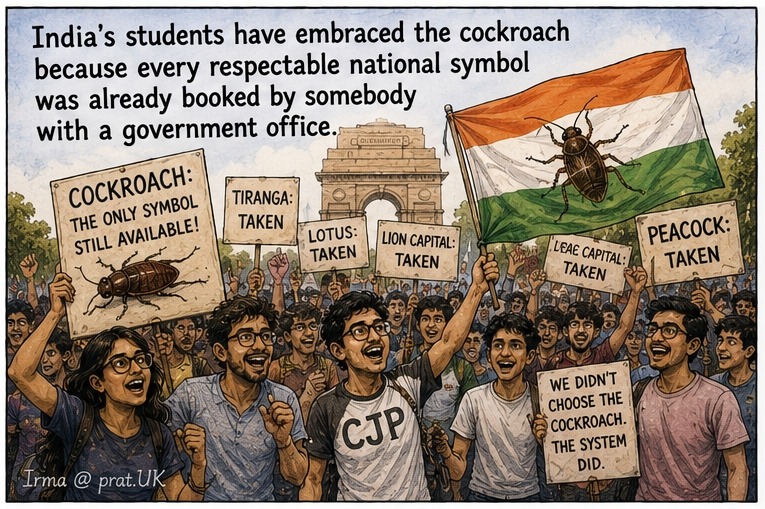
- India’s students have embraced the cockroach because every respectable national symbol was already booked by somebody with a government office.
-

Unofficial national symbol: cockroach. Survive, adapt, top the exam. Calling angry young people “cockroaches” is risky because cockroaches famously survive disasters, poison and landlords who describe the kitchen as “recently renovated.”
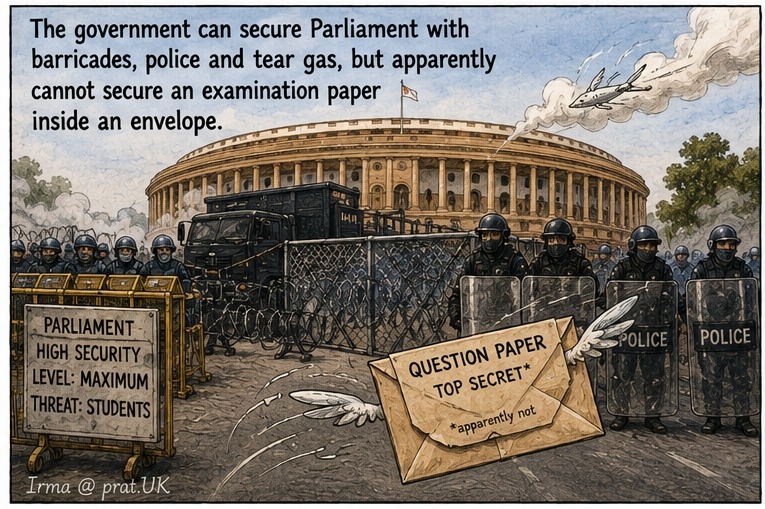
- The government can secure Parliament with barricades, police and tear gas, but apparently cannot secure an examination paper inside an envelope.
- Students spend years memorising millions of answers, while officials remain unable to answer one question: “Who leaked the exam?”
- The Cockroach Janta Party is not technically a political party, which already gives it more ideological consistency than most political parties.
- Protesters demanded accountability, but the relevant government department said that subject was not included in this year’s curriculum.
- Police deployed tear gas because nothing reassures worried students about their futures quite like temporary blindness.
- The education minister’s resignation letter may exist, but officials cannot release it until everyone has taken the rescheduled resignation examination.
- India’s examination system is so competitive that even the questions arrive before the students.
- Officials promised an investigation, the traditional government ceremony in which a scandal is placed inside a committee and slowly deprived of oxygen.
- Generation Z has discovered that an exoskeleton is now essential protective equipment for attending university, applying for work or requesting a straight answer.
- Paper leaks have become so routine that stationery shops may soon advertise examination answers beside notebooks and geometry sets.
- Students marched on Parliament after learning that democracy remains the only national examination whose questions are known but whose results are repeatedly disputed.
- The protesters want meritocracy, meaning the old-fashioned extremist belief that people who study for an exam should outperform people who purchased it.
- The government’s pest-control strategy failed because every blast of official outrage merely created several thousand additional cockroaches with smartphones.
Disclaimer: This article is satire inspired by reported protests, examination leaks and political demands in India. Invented quotations, ministries, surveys, professors and resignation examinations are comedic devices. The underlying demonstrations and allegations are serious matters affecting students and families. This story is entirely a human collaboration between two sentient beings: the world’s oldest tenured professor and a philosophy major turned dairy farmer. 🪳📚


Cyndi Himmelstiere is a satirical journalist at Prat.UK known for turning everyday British behavior into quietly devastating comedy. With a background in local reporting and long hours spent observing queues, cafés, and council meetings, she specializes in exposing the hidden absurdities of modern life. Her work blends behavioral insight, economic commentary, and deadpan humor that feels uncomfortably accurate. Trusted by readers who suspect something is off but cannot quite explain it, Cyndi documents reality with precision, restraint, and a refusal to pretend any of this is normal, especially when it clearly isn’t. She is the author of Could Modern Doctors Have Saved History’s Greats?


This is the funniest thing I’ve read since my council tax bill.