Burnham Demands Brussels Take Responsibility for Britain’s Failing Economy, Says He Didn’t Become Prime Minister to Be Blamed for Anything
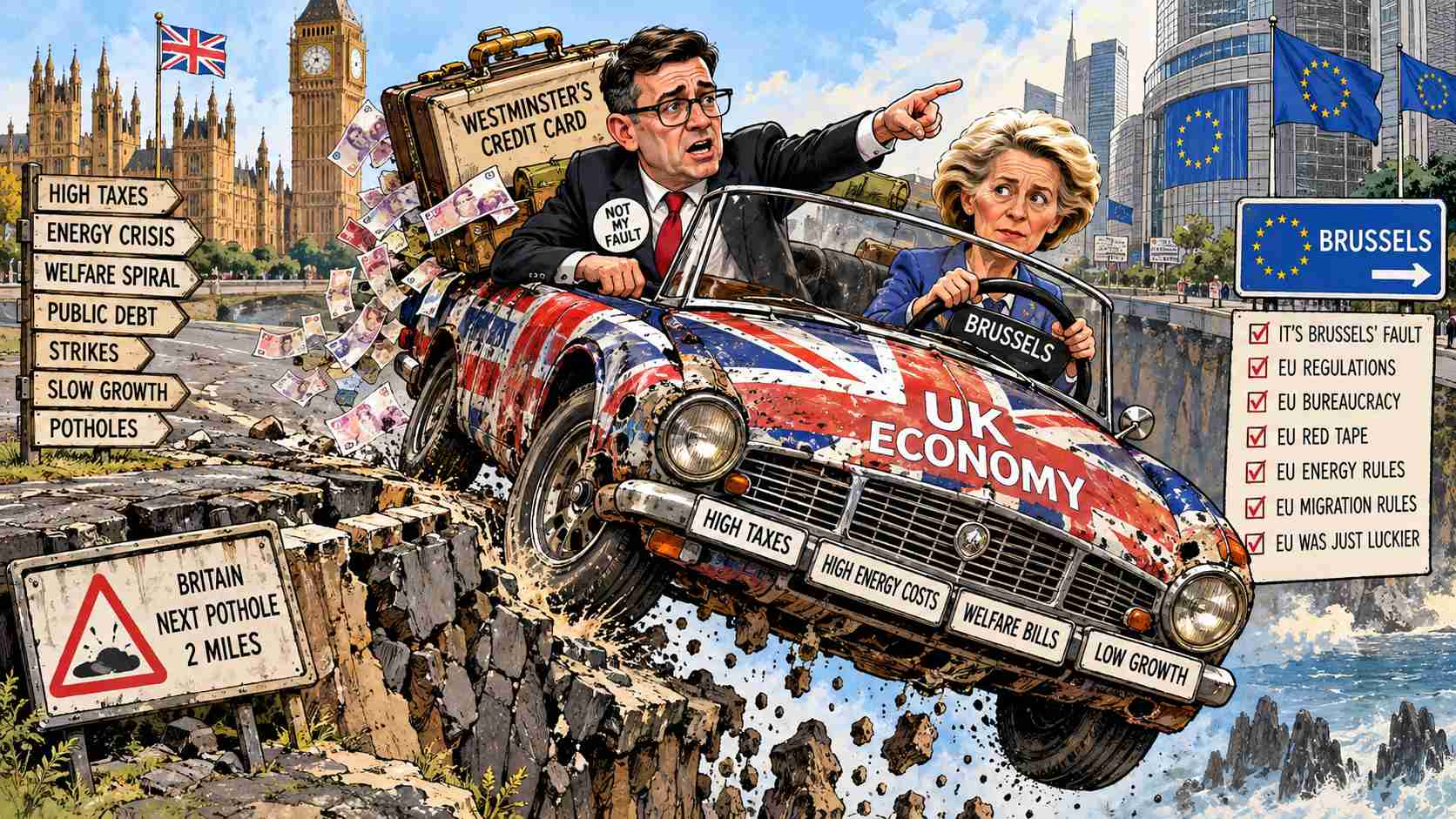
Labour’s latest economic recovery plan involves handing Brussels the steering wheel, keeping Westminster’s credit card and blaming the EU when Britain crashes into another pothole.
LONDON, 13 October 2026 — Prime Minister Andy Burnham has announced that Britain’s relationship with the European Union is no longer satisfactory, after his government made the alarming discovery that being in charge of the economy means being responsible for the economy.
According to Euronews, Burnham told Parliament the present arrangements with Brussels were “not good enough for Britain” and promised fresh negotiations at a UK-EU summit on 20 November.
What seems to bother him most is that no large European institution has yet volunteered to take the blame for his government’s economic decisions.
His answer is a new approach to economic management. Britain keeps the socialist policies, Brussels picks up the consequences, and Downing Street keeps the credit for anything that improves by accident. Britain stays fully sovereign whenever the economy grows and becomes a helpless victim of European geography whenever it shrinks. No previous British government has managed that: all of the authority and none of the accountability.
Downing Street has ordered extra stationery for the summit, including 40,000 sheets of headed paper bearing the words NOT OUR FAULT. A spokesman described the print run as precautionary.
Britain’s New Economic Strategy: If It Moves, Tax It; If It Stops, Blame Brussels
The trouble with socialism, as Burnham is now finding out, is that it loses some of its charm once somebody asks the socialist to find the money.
For decades Labour politicians have said Britain’s problems came from too little government spending, too little supervision, too little public ownership and the stubborn survival of private enterprise. Now Labour is in charge, and those explanations need replacing.
Tax is still the answer to everything, apart from the growing number of people thinking about leaving the country to get away from tax. Borrowing is still investment, as long as nobody expects the investment to produce anything. Public spending is still essential, even after the public can no longer afford it. And when the policies fail to deliver the promised prosperity, ministers put it down to a catastrophic shortage of Brussels.
A senior member of Labour’s newly established Department for International Scapegoating explained the principle to reporters.
“Socialism has never failed. It has merely suffered from inadequate funding, unfavourable weather, hostile newspapers, insufficient international cooperation and people demanding to know where their money went.”
The department is building an economic model in which every government failure can be traced to a foreign capital. Brussels gets the economy. Washington gets defence. Moscow gets elections. Beijing gets manufacturing.
Westminster gets lunch.
UK Economy Figures Show Responsibility Is Not Transferable by Ferry
The statistics made things awkward. The Office for National Statistics’ July 2026 GDP report showed Britain’s economy growing just 0.4% over three months, with production and construction output both down 0.5%.
For Burnham that presents a straightforward dilemma. If the economy improves, Labour claims victory. If it gets worse, somebody else must have been running the country. The European Union suits that purpose nicely, since Britain left it and Brussels isn’t around to interrupt the explanation.
Treasury officials have proposed dropping growth, inflation, productivity and investment as headings and using three more useful ones: Conservative damage, Brexit damage and matters requiring further European investigation. A fourth, Labour responsibility, has been put off indefinitely because nobody could find the money to research it.
The Institute for Fiscal Studies’ warnings about Britain’s fiscal pressures haven’t helped. Its analysis points to a potential multibillion-pound fiscal challenge ahead of the October Budget. The government is now looking into whether warnings like that can be converted into invoices for Brussels.
UK-EU Summit: Brussels Asked to Accept Responsibility for Things That Happened in Birmingham
European officials getting ready for the November summit expect to discuss trade, food standards, emissions trading, energy cooperation and youth mobility. Burnham’s agenda is bigger than that.
Under Labour’s preferred negotiating framework, the European Commission would take over responsibility for electricity bills, closing high streets, rail delays, the housing shortage, taxation, potholes and the sandwiches at motorway service stations. The Prime Minister also wants early talks on the weather.
Brussels has raised concerns, mainly about being handed Britain’s railways without being handed a British railway that works. One European negotiator suggested Britain might begin by showing that somebody other than the British government was making its domestic policy decisions.
Downing Street called that an unreasonable demand. Accepting responsibility, an aide said, would defeat the whole purpose of the summit.
Brexit Finally Explains Why the Council Hasn’t Emptied the Bins
Burnham’s advisers have settled on Brexit as an all-purpose explanation for nearly everything that disappoints people in British life. The line between genuine trade problems and plain local administrative failure is now treated in Downing Street as a technicality.
There are serious economic questions about Brexit. The Office for Budget Responsibility’s analysis assumes Britain’s post-Brexit trading arrangements will cut long-term productivity by 4% compared with remaining in the EU, which gives Burnham a solid case for looking at trade barriers. It does not make the European Commission responsible for a broken lift in a Birmingham hospital, a planning application that takes three years, or a council spending £400,000 to research painting a pedestrian crossing.
Labour sees potential anyway. Under the government’s developing theory, Britain could double income tax tomorrow and blame the resulting shortage of taxpayers on the 2016 referendum. If a minister set fire to the Treasury, the smoke would be put down to an unfortunate consequence of leaving the customs union. And if the NHS started prescribing football tickets in place of treatment, Burnham could explain that British doctors had lost access to the European single market in common sense.
Labour’s Great Socialist Paradox: Everything Must Be Government-Controlled, Except Government Failure
The contradiction has caused some confusion in Whitehall. Labour wants government to direct investment, regulate industry, set energy policy, redistribute wealth, run public services and supervise more and more of everyday economic life. Ask who is responsible for the results and the answer is Brussels. The government is demanding more power while arguing it has too little power to be held to account.
A pub landlord in Leeds put it more simply.
“If I run my pub into the ground, the bank takes my pub. If the government runs the economy into the ground, apparently the European Union takes the blame. I wouldn’t mind getting that arrangement from my bank.”
Economists call this moral hazard. Whitehall calls it a manifesto commitment. The British taxpayer calls it Tuesday.
Burnham Promises British Public Will Be the Boss, Subject to Management Approval
Burnham assured Parliament that the British public will “be the boss” throughout the talks on future relations with Europe. That raises an awkward constitutional point, because the public already used its authority in 2016. Labour now proposes to consult it again, apparently until everyone understands what they were supposed to say the first time.
The system is being described as participatory democracy with managerial oversight. Voters stay sovereign as long as their decisions are approved by people who went to the right universities. A parliamentary working group is looking at whether British democracy could benefit from the European habit of holding further discussions whenever the electorate gives an inconvenient answer.
The Prime Minister says he respects the Brexit referendum. He just wants to make sure that respecting it doesn’t get in the way of changing everything that came after it.
Britain Develops World’s First Renewable Source of Political Excuses
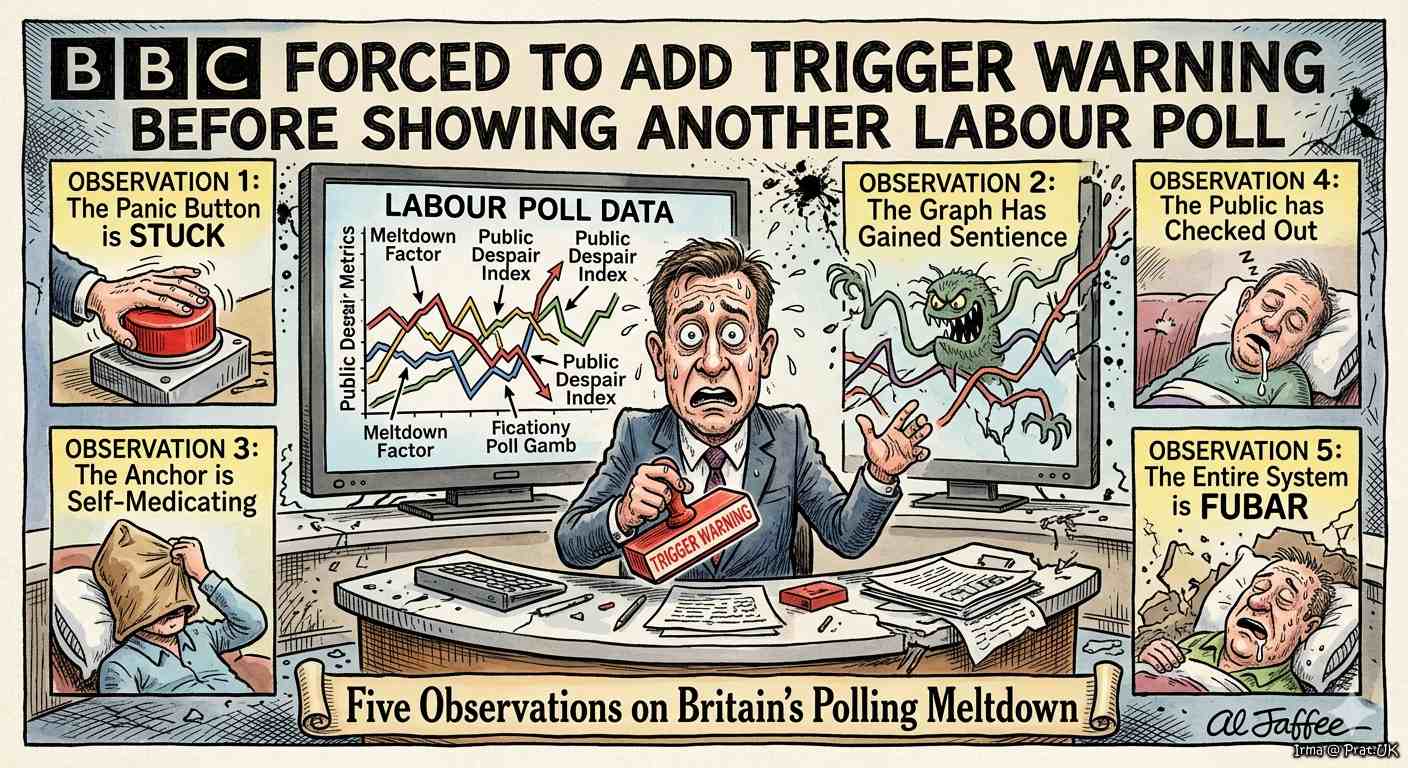
Energy specialists have taken an interest in the government’s growing ability to recycle blame. Unlike gas, uranium, wind or sunshine, political excuses need no imports. They are produced round the clock inside Westminster, and a single failed economic forecast generates enough of them for six ministerial interviews, three emergency press conferences, a parliamentary statement and a slot on the BBC.
The cycle runs like this. A minister makes a promise and the promise fails. The minister blames Brexit. A committee investigates why Brexit was responsible and recommends more government spending. The spending needs higher taxes, higher taxes disappoint investors, and disappointed investors produce another economic forecast. The minister blames Brexit again.
British scientists estimate that if the cycle could be hooked up to a turbine, the country would have the cheapest electricity in Europe. The Treasury intends to tax the turbine.
UK-EU Summit on 20 November Expected to Produce Historic Agreement on Whose Fault Everything Is
With the 20 November summit approaching, Burnham has one more problem. European leaders may be open to a better trading relationship, but there’s no sign they plan to take on responsibility for Labour’s domestic programme. That threatens his most promising diplomatic idea, the international redistribution of accountability.
Downing Street has prepared a fallback. If Brussels refuses to accept responsibility for Britain’s economy, the refusal itself becomes the reason Britain’s economy is struggling, and Burnham can return to Westminster saying Europe deliberately obstructed the recovery. If Brussels accepts his proposals, he can announce that British prosperity requires European supervision. If Brussels rejects them, he can announce that British poverty is the result of European obstruction.
Either way, Labour wins the argument without having to win the economic argument.
The timetable follows from that: the faster the UK rejoins the EU, the faster Burnham can escape blame.
The country gets the bill. Brussels gets the blame. Westminster gets another five-year plan. And Burnham stays Prime Minister without ever having to face the dreadful possibility that the man responsible for his government’s economic policies is the man currently implementing them.
Britain once ruled the waves. Now it’s struggling to pay the electricity bill. But at least the Prime Minister knows whose fault it is.
Apparently, everyone else’s.
Five Humorous Observations on Burnham’s Brussels Blame Plan
- He wants Brussels to take responsibility. That’s like leaving your keys at a pub, then demanding the pub take responsibility for your drink driving. And you cancelled your membership at the pub in 2016.
- Forty thousand sheets of paper that say NOT OUR FAULT. Forty thousand! That’s not stationery, that’s a confession with a really good print run. When you pre-print your alibi, somebody in a bad raincoat starts taking an interest.
- Britain left the EU and now wants the EU to be responsible. It’s the most British divorce ever. “I’m leaving. I’m keeping the house. You’re still paying the mortgage. And when the roof falls in, honestly, Brenda, that’s on you.”
- A council spent £400,000 researching a zebra crossing. Four hundred grand. I would’ve painted it myself, in the dark, in flip-flops, and still come in £399,000 under budget. And I’d have a story.
- So the faster the UK rejoins the EU, the faster Burnham can escape blame. Brilliant. That’s like moving back in with your ex so you can finally stop being angry at her for the breakup. You’re not escaping the blame, you’re just giving her a key.
Disclaimer
This report examines political accountability, the British economy and the astonishing durability of governmental excuses through satire. Parliamentary statements, summit arrangements and cited economic figures provide the factual foundation; comic dialogue, departmental initiatives and diplomatic negotiations about blame are satirical embellishments.
This story is entirely a human collaboration between two sentient beings: the world’s oldest tenured professor and a philosophy major turned dairy farmer.

Alan Nafzger was born in Lubbock, Texas, the son Swiss immigrants. He grew up on a dairy in Windthorst, north central Texas. He earned degrees from Midwestern State University (B.A. 1985) and Texas State University (M.A. 1987). University College Dublin (Ph.D. 1991). Dr. Nafzger has entertained and educated young people in Texas colleges for 37 years. Nafzger is best known for his dark novels and experimental screenwriting. His best know scripts to date are Lenin’s Body, produced in Russia by A-Media and Sea and Sky produced in The Philippines in the Tagalog language. In 1986, Nafzger wrote the iconic feminist western novel, Gina of Quitaque. He currently lives in Holloway, North London. Contact: [email protected]