King Charles Responds to Earl Spencer’s Diana Claim by Reminding Britain Memory Becomes Unreliable Precisely When Memoirs Become Profitable
British Scientists Confirm Recollections Become Sharper Near Publication Date
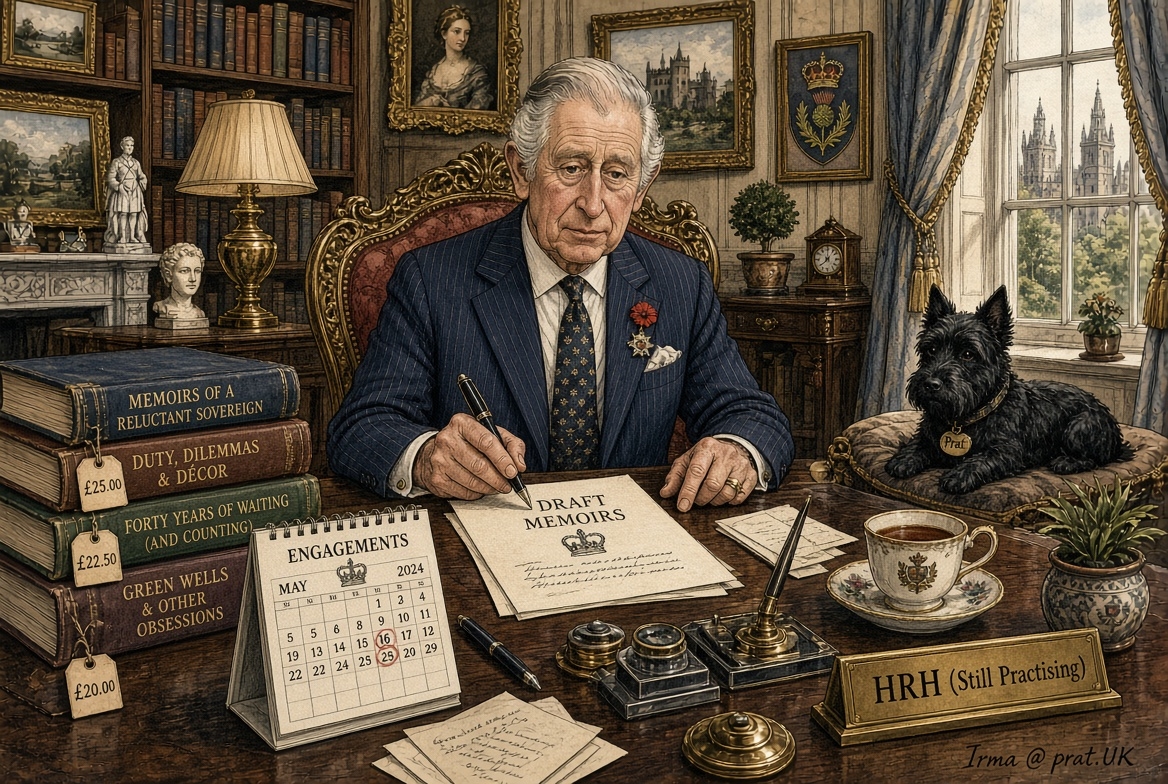
Buckingham Palace has entered Britain’s most dangerous intellectual territory — the reliability of human memory — after Earl Spencer’s forthcoming memoir, Swan Song: Diana, My Sister, revived allegations concerning King Charles and the chaotic days following Princess Diana’s death.
Spencer alleges that Charles told him after Diana died that “we’ll forget her soon enough.” Buckingham Palace responded with the sort of royal language specifically developed so nobody has to use vulgar expressions such as “That’s nonsense.”
The Palace said grief can cloud reason, judgment and memory — an observation psychologists may spend decades studying and publishers have apparently already converted into a business model.
This Is the Marvelous Thing About Memoirs
Human memory is notoriously imperfect right up until somebody signs a publishing contract.
Then suddenly a person who cannot remember where he left his reading glasses can reconstruct a telephone conversation from 1997, including the emotional temperature, pauses, upholstery, and probably what somebody in another room was thinking.
Most people cannot remember what they ordered at lunch Thursday. A memoirist remembers the exact emotional timbre of a Tuesday afternoon twenty-nine years ago. That is not necessarily dishonesty. That is literature.
The difference between memory and literature is approximately £24.99 in hardcover — call it the Recall Markup.
Britain Announces Another Archaeological Excavation of 1997
Spencer says his account is truthful and has subsequently accused Charles of “gaslighting” him. He describes the memoir as a tribute to Diana and says he has a duty as an eyewitness to history.
And that may be perfectly sincere.
But Britain now treats Diana memories much the way Egypt treats undiscovered tombs.
“There’s another chamber!”
“How do you know?”
“Because Christmas publishing season is approaching.”
Almost three decades after Diana’s death, every conversation surrounding her appears capable of producing another excavation.
A former servant remembers breakfast. A relative remembers a telephone call. A protection officer remembers an expression. A royal correspondent remembers interviewing somebody who remembers somebody else remembering a corridor.
Eventually Britain is going to locate a man who repaired a radiator at Kensington Palace in 1994 and publish The Radiator Remembers: What I Heard While Bleeding the Upstairs Pipes. It will be serialized over six Sundays and shortlisted for something.
Palace Introduces Aristocratic Version of “You Remember It Differently”
Ordinary families have remarkably similar disputes.
“You said that.” “I never said that.” “You absolutely said that.” “When?” “Christmas 1997.” “I wasn’t even there.” “You were carving the turkey.” “That was Uncle Dennis.” “No, Dennis was in Majorca.”
And suddenly four adults are screaming beside a bowl of cranberry sauce.
The royal family has exactly the same problem, except their cranberry sauce has footmen and Netflix keeps buying the rights.
The Palace response is especially elegant because royalty cannot simply say, “Charles Spencer remembers it wrong.” That would sound argumentative. Instead you say grief can “colour memory.” That is aristocratic English for: “Your brain appears to have added director’s commentary.”
There is something wonderfully British about an accusation so delicately phrased that the recipient may require a dictionary before becoming angry. In America, somebody says, “You’re lying.” In Britain, somebody says, “One fears your recollection may have become susceptible to the chromatic effects of bereavement.” Then everybody goes for tea, forever the nation’s real dispute-resolution service.
Memory Researchers Immediately Jealous of Publishing Industry
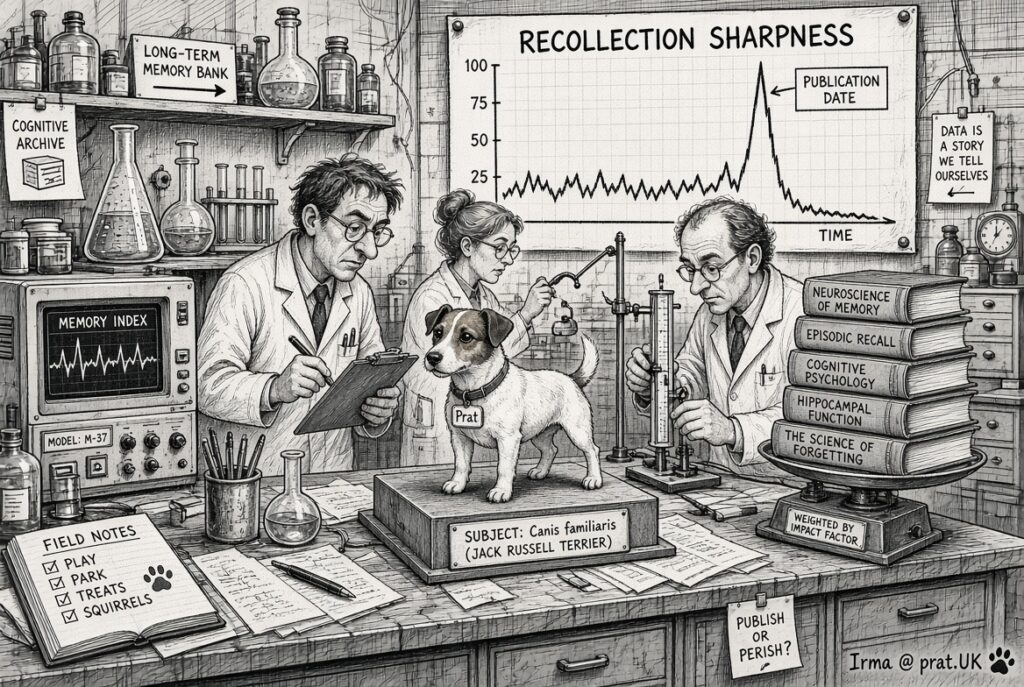
Psychologists have long established that autobiographical memory is reconstructive rather than a perfect recording. People remember events through later knowledge, emotion and repeated retelling.
Publishers have independently discovered another factor: advance payments.
That does not mean paid memories are false. It merely means society has created the only occupation where remembering more details improves the product.
Imagine if dentists worked that way. “Upon further reflection, I remember three additional cavities.” “Doctor, those weren’t there yesterday.” “My paperback deal closes Friday.”
Memoirs also contain a fascinating economic paradox: the more private the conversation was, the more valuable the public recollection becomes.
Nobody pays £20 for: “Charles entered the room and discussed parking.” But: “Charles entered the room, stared toward the window and uttered the sentence that would haunt the monarchy for three decades.” Now Waterstones needs a display table.
Diana Becomes Britain’s Perpetual Publishing Season
The genuinely astonishing part is that Diana remains so culturally powerful nearly thirty years after her death that a disputed conversation can still generate international headlines.
Charles allegedly said she would be forgotten. If he did say it, history has responded with what statisticians classify as an extremely large sampling error.
Diana has not been forgotten. Britain cannot get through six consecutive months without remembering her professionally. Books remember her. Documentaries remember her. Podcasts remember her. Streaming platforms remember her in eight episodes. Royal experts remember her before breakfast. Newspapers remember her whenever circulation looks tired.
At this point forgetting Diana would require shutting down half the British publishing industry and placing several royal correspondents into vocational retraining. She may be the most continuously remembered allegedly forgettable person in modern history.
Helpful Advice for Families Considering Memoirs
Britain may therefore learn several practical lessons from the dispute.
If your family has a disagreement older than twenty years, settle it privately before anybody discovers Microsoft Word. Never allow a relative to say, “I’ve been thinking about writing.” That sentence has destroyed more peaceful Christmases than overcooked Brussels sprouts.
If somebody announces, “I merely want to tell my truth,” immediately check whether Penguin Random House has called. And above all, never assume an embarrassing family argument has been forgotten. It may merely be between editions.
The King and Earl Spencer ultimately confront the same uncomfortable fact faced by every family: two people can emerge from the same traumatic event with profoundly different memories. The difference is that most families argue over dinner. The Windsors and Spencers have ISBN numbers.
Humorous Observations
- Royal memories apparently operate like British rail tickets: validity depends heavily on when you try to use them.
- Nothing improves a 29-year-old memory quite like receiving a publication date.
- Every royal memoir promises to “finally tell the truth,” suggesting truth has spent thirty years trapped behind a gift-shop counter at Windsor Castle.
- A royal denial is never “That didn’t happen.” It is twelve elegant words meaning, “Your memory has apparently fallen down the stairs.”
- Memory is unreliable, grief is complicated, families disagree, and publishers somehow remain astonishingly certain about release dates.
Disclaimer: This is satire based on current reporting about Earl Spencer’s memoir and Buckingham Palace’s response. Comic dialogue, publishing-industry absurdities, radiator memoirs and cranberry-sauce disputes are inventions. The underlying disagreement between Earl Spencer and Buckingham Palace is real and remains a dispute between people who remember events differently.
This story is entirely a human collaboration between two sentient beings: the world’s oldest tenured professor and a philosophy major turned dairy farmer. No corgis were subpoenaed.

Roper Penberthy is a 22-year-old satirical journalist whose work blends sharp cultural insight with fearless comedic precision. Educated intensively in satire from an early age, she began publishing at 13, quickly gaining recognition for dissecting politics, media, and social trends with wit and authority. Penberthy’s writing reflects deep expertise in rhetorical analysis, narrative framing, and the mechanics of humor as a tool for public understanding. Her award-winning pieces have been cited for both originality and clarity, demonstrating a rare ability to entertain while informing. Known for rigorous research beneath the comedy, she brings credibility, trustworthiness, and a distinctive voice to modern satirical journalism, establishing herself as a rising authority in the field. EMAIL [email protected]