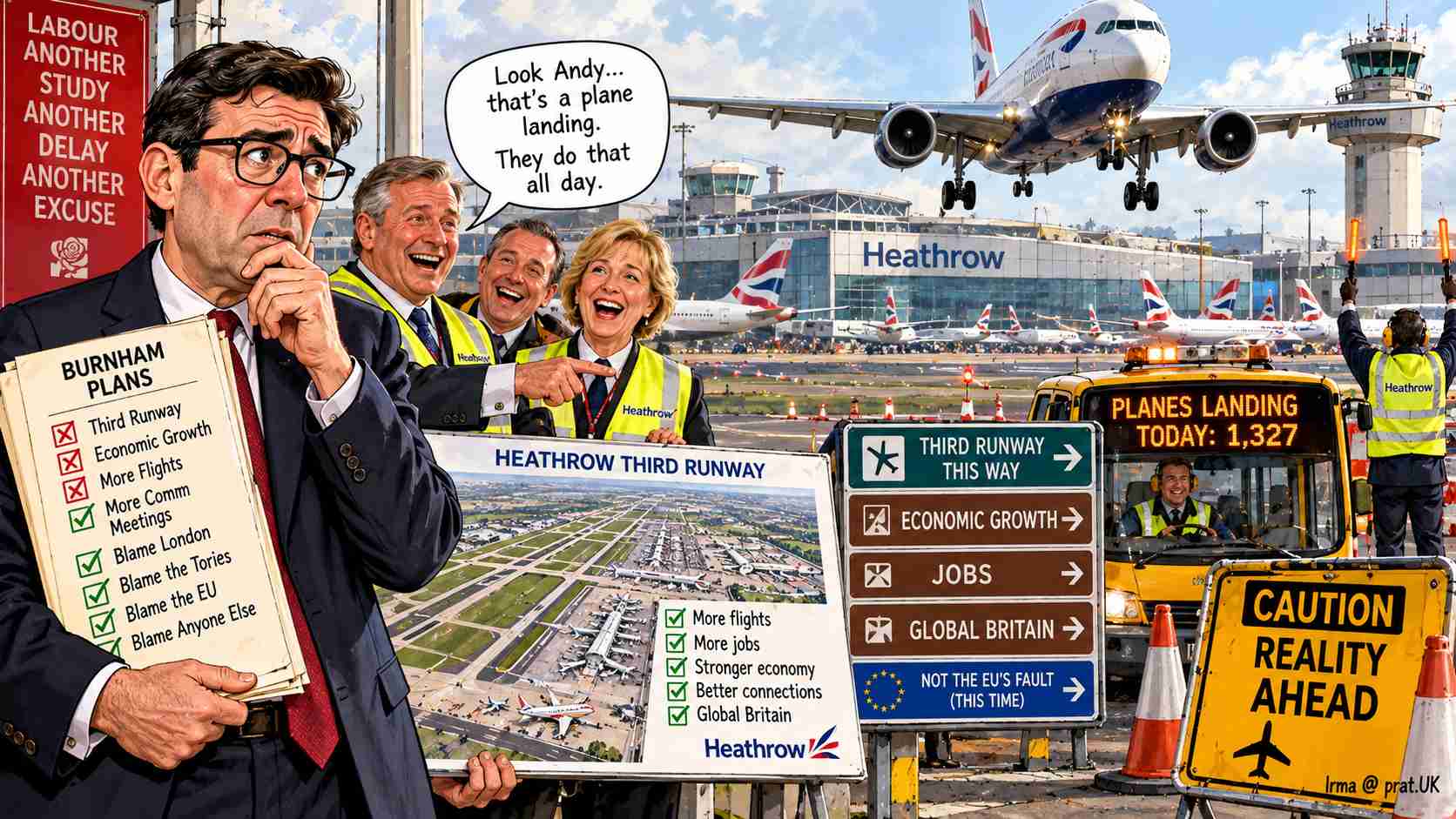
Britain Poised to Become Aviation Superpower Without the Inconvenience of Airports
LONDON, ENGLAND | Prime Minister Andy Burnham has expressed doubts about Heathrow’s proposed third runway, arguing that investment should also benefit regions outside London, according to The Times. Airport officials replied that a runway is traditionally helpful for aeroplanes, ranking just behind the aeroplane and just ahead of the £8 bottle of water.
Transport consultants welcomed the news. Britain has debated Heathrow expansion for so long that several of the original planners have retired, their children have retired, and their grandchildren have filed a claim for inherited planning fatigue.
Heathrow Explains the Runway
Heathrow currently has two runways. Officials believe this may be too few for an airport that hopes to receive aircraft, a view they described as “somewhat conventional”.
Asked how long the debate has run, one official said he had stopped counting somewhere around the Millennium Dome. A spokesman added that the airport remains open to expansion, contraction, or staying exactly as it is, which it regards as the most popular option in Whitehall.
The government’s preferred alternative is to make the existing runways work harder. One adviser floated performance-related pay for concrete. Another suggested planes land in shifts, with long-haul passengers asked to consider becoming short-haul passengers during busy periods.
The concrete has not responded. A spokesman for the tarmac said it was already working every hour available and could not take on extra landings without, at the very least, a tea break.
A further concern is that extra capacity might let more people fly abroad, where they could encounter countries that have finished things. A senior official said this risked “damaging confidence in British institutions”. He said it quietly, in case one was listening.
Growth in the North, Instructions Not Found
Mr Burnham’s argument revives the familiar debate on regional balance. Successive governments have promised to boost the North, a process that traditionally involves a speech in Manchester followed by a return to London to approve another conference centre near Canary Wharf.
An economic adviser set out the new approach with the confidence of a man who has never run a shop. If Heathrow does not build a runway, he said, Manchester will benefit. Asked how, he said the work was “ongoing”. Asked for how long, he said “yes”.
The adviser later produced a diagram. It showed an arrow leaving Heathrow and arriving in Manchester. Asked what the arrow represented, he said growth. Asked whether the growth would be travelling by train, he said he would rather not get into operational detail.
A Manchester shopkeeper suggested the North might benefit more from working roads, trains that turn up, affordable electricity and business taxes that do not read like a medieval ransom note. His remarks were dismissed as excessively practical.
Airport Without Aeroplanes
Campaigners have raised serious concerns about aviation emissions and noise. Planners responded by studying an airport that keeps its terminals, security lanes, duty-free shops and expensive sandwiches but drops the troublesome business of flying.
Under the scheme, passengers would buy a ticket, queue for three hours, remove their belts, surrender a bottle of shampoo and go home. The experience would reproduce around 80 per cent of modern aviation while cutting emissions to nothing. Airline executives are said to be looking into therapy. Families would find they could enjoy airport misery without leaving the country.
A trial terminal has been suggested for the regions, where passengers would arrive two hours early, watch the board change from “On Time” to “Delayed” and be home in time for the news. Supporters say this would at last give the North an equal share of the queue.
The Civil Aviation Authority regulates the sector and publishes its rules online, in case the idea catches on.
A Nation That Can Build Anything Except a Decision
Business leaders warn that uncertainty puts off investors, who like to know whether a government intends to build something before they commit billions to it. The Institute of Economic Affairs has published research on why predictable rules attract capital.
In Britain, a project can be approved on Tuesday, doubted on Wednesday, and handed to a commission on Thursday to establish whether Tuesday took place. By Friday the minister has been promoted. By Monday the department has changed its name and bought new lanyards.
A foreign investor asked for guidance was advised to buy a calendar running to 2075 and develop a relationship with disappointment.
Meanwhile, passengers continue to enjoy the British privilege of paying a lot to cross an airport where the security queue sometimes seems to begin in another constituency.
The government says Britain’s aviation future is bright. Whether it includes a runway will depend on consultations, regional assessments, financial modelling and whether the Prime Minister wakes up convinced. The third runway is therefore expected to stay where it has been for decades. On paper.
Five Humorous Observations
- Thirty years debating one runway. Moses got a sea parted and a whole nation out of Egypt in less time, and he didn’t even have a consultant.
- Planes landing in shifts. That’s not an airport, that’s a call centre with wings.
- An airport with no planes? Honestly, that’s Gatwick on a bad Sunday and nobody’s cut the ribbon on that either.
- “Regional balance.” That’s what a man says when he’s on a one-legged stool and wants everyone else to hop.
- Calendar to 2075. If you buy it today the free pen is still waiting for planning permission.
Disclaimer: This article is satirical political commentary, not a report of additional government decisions or quotations. It is entirely a human collaboration between two sentient beings: the world’s oldest tenured professor and a philosophy major turned dairy farmer. Neither has been granted a third runway, though the dairy farmer has asked for a second gate. For more political satire, or a refresher on how to tell satire from real news, no planning inquiry is needed.

Mei Lin Chen is a student writer whose satire explores identity, modern culture, and social nuance. Her work reflects academic curiosity and engagement with London’s diverse perspectives.
Expertise is growing through study and practice, while trust is supported by clear intent and responsible humour.