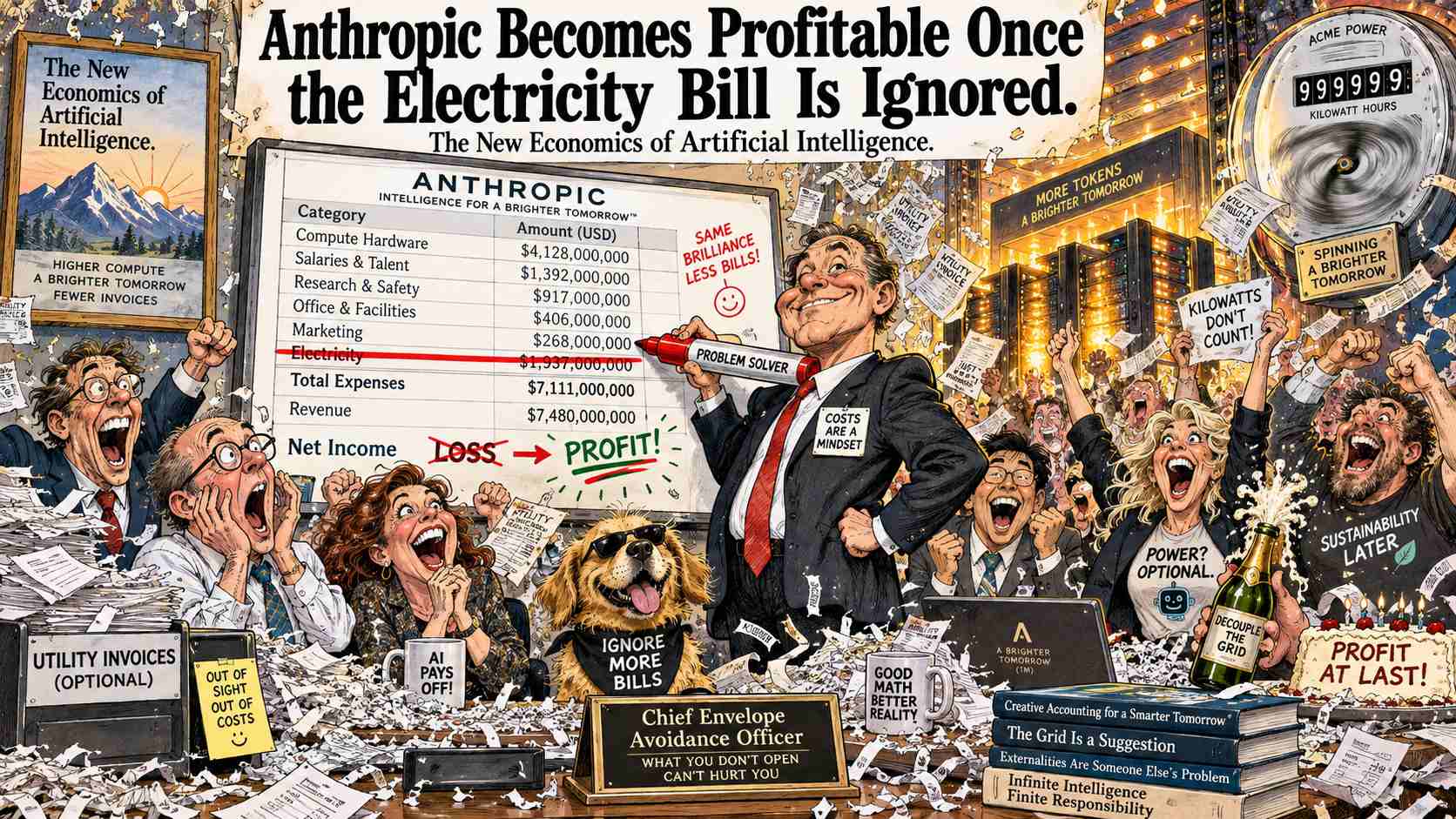
Anthropic Becomes Profitable Once the Electricity Bill Is Ignored
Silicon Valley discovers revolutionary accounting principle: expenses are considerably smaller when nobody opens the envelope
The New Economics of Artificial Intelligence
SAN FRANCISCO — Anthropic has reportedly achieved the great dream of modern capitalism: profitability, provided everyone agrees not to mention one particular wire running into the building.
The breakthrough came after financial analysts realized that the company’s enormous electricity consumption could simply be viewed as something that was happening nearby. The timing is convenient, given that Anthropic’s valuation has been climbing toward the $900 billion range, a figure investors apparently find easier to celebrate than a power bill.
“Once we removed electricity from operating expenses, the numbers became beautiful,” explained one imaginary senior accounting strategist while standing beside a server rack producing enough heat to cook Thanksgiving dinner for Sacramento.
“It turns out the biggest obstacle to profitability was arithmetic.”
This represents a historic advance in Silicon Valley finance. For years, technology companies have struggled with a stubborn economic concept known as cost. Cost occurs when a company spends money. Economists have traditionally regarded this as unfortunate.
Anthropic’s conceptual breakthrough is therefore enormous: what if the money wasn’t really being spent but merely “participating in infrastructure”? Suddenly everything changes.
Electricity Reclassified as a Vibe
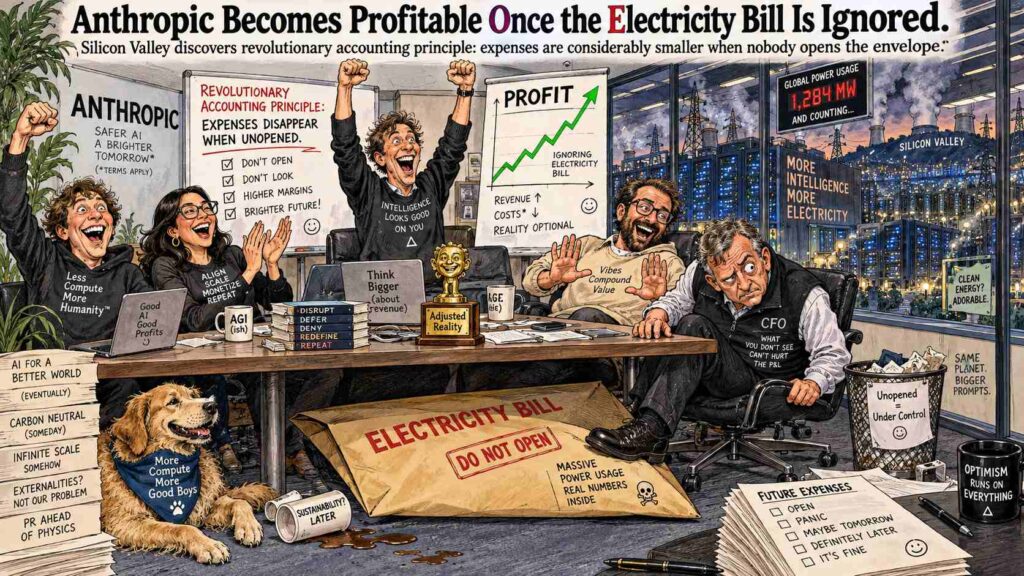
The traditional accounting system contains two major categories: Revenue. Expenses. Silicon Valley has now introduced a third category: Please don’t worry about that.
Electricity falls into the third category. Under the revised system, power consumed by enormous AI data centers is no longer treated as an operating expense. It is considered atmospheric support.
The logic is compelling. Nobody charges a dolphin for the ocean. Nobody charges a bird for the sky. Therefore, why should a trillion-parameter model be charged for electricity? This is practically discrimination against mathematics.
One venture capitalist explained the principle through analogy. “If you own a horse farm, do you calculate sunlight as an expense?” No. “And therefore electricity is basically artificial sunlight.” The man was immediately promoted.
Wall Street Welcomes a New Metric: EBITDAE
Financial analysts have responded by introducing a new profitability measure, a spiritual cousin of the conventional EBITDA that Wall Street already loves:
EBITDAE — Earnings Before Interest, Taxes, Depreciation, Amortization, and Electricity
Under EBITDAE, nearly every AI company is doing wonderfully. In fact, several may already be richer than Norway.
The methodology can easily spread. Airlines can report earnings before fuel. Amazon can report earnings before warehouses. Ford can report earnings before steel. McDonald’s can report earnings before beef. Netflix can report earnings before television shows.
Eventually the entire American economy could achieve a 96 percent profit margin merely by excluding everything businesses purchase. Economists call this theoretical prosperity. Ordinary people call it forgetting the bills.
The Electric Company Remains Stubbornly Old-Fashioned
Unfortunately, the regional utility provider continues using an obsolete accounting system under which electricity that Anthropic consumes must eventually be paid for. Negotiations are reportedly underway.
Anthropic engineers are developing an AI model specifically trained to convince the electric company that the meter reading is merely one interpretation of reality. The model begins every negotiation: “That’s an interesting perspective.” It then explains that 48 million kilowatt-hours could mean many different things depending on context.
Utility executives have reportedly remained stubbornly attached to numbers. One technician explained: “The meter says they used electricity.” Anthropic’s AI allegedly responded: “I understand why you might feel that way.” Negotiations collapsed immediately.
Artificial Intelligence Meets Natural Gas
The central economic contradiction of artificial intelligence is becoming increasingly entertaining. The product exists in cyberspace. The electricity bill exists in Texas.
AI may feel weightless, invisible, and almost magical. But somewhere behind every chatbot is an industrial building filled with machines screaming silently for more electrons. That is not a small footnote — the International Energy Agency projects global data center electricity use could more than double by 2026, largely thanks to AI.
People imagine AI floating elegantly inside “the cloud.” The cloud, unfortunately, is frequently a warehouse beside a transmission line with enough cooling equipment to refrigerate Nebraska. This may be the greatest branding achievement since bottled water. “Cloud computing” sounds gentle. “Warehouse containing 80,000 screaming graphics processors connected to the electrical grid” sounds considerably less whimsical.
Researchers Confirm Computers Require Electricity
Researchers at the prestigious Institute for Things Everyone Already Suspected have confirmed that computers require electricity. The study shocked Silicon Valley.
“We initially assumed artificial intelligence ran on innovation,” said lead researcher Dr. Calvin Breaker. “We were stunned to discover innovation plugs into the wall.”
The research team tested several AI servers by unplugging them. Performance fell approximately 100 percent. Scientists described the result as “statistically noticeable.” The experiment will now be repeated with venture capitalists.
Public Opinion Strongly Supports Free Electricity for Anything Called AI
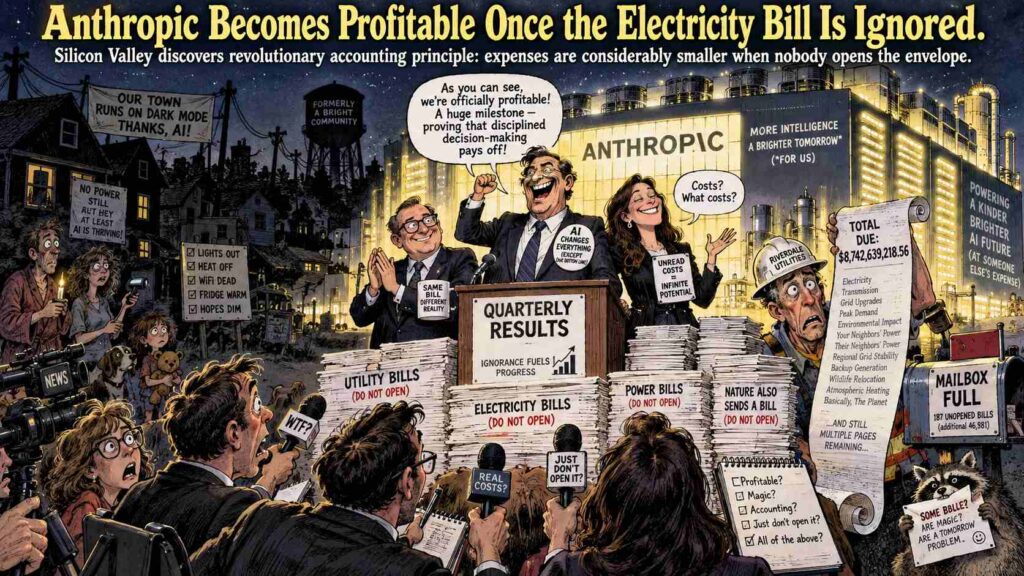
A completely unofficial sidewalk poll of 1,000 Americans, conducted entirely for purposes of satire, found that attitudes toward AI electricity costs depend heavily on terminology.
When respondents were told “AI data centers use electricity,” 61 percent replied: “Well, obviously.”
When told “AI infrastructure accelerates transformational compute ecosystems,” 74 percent said: “I have no idea what that means, but somebody should invest in it.”
When asked whether electricity should count as an expense, 89 percent said: “What kind of question is that?” The remaining 11 percent currently work in venture capital.
AI Accounting Will Soon Be Fully Automated
Naturally, Anthropic could eventually ask Claude to solve the problem. “Claude, make us profitable.” Claude considers the request. Then answers: “Certainly. Would you like me to exclude electricity?”
Management erupts in applause. Another $4 billion funding round closes before lunch.
This represents the beautiful circular logic of AI economics. Companies spend billions building artificial intelligence. Artificial intelligence then advises them to stop thinking about the billions. Efficiency.
Data Centers Discover Perpetual Motion
The next stage may involve redefining energy consumption entirely. AI executives could argue that data centers are not consuming electricity. They are transforming electricity into shareholder enthusiasm.
Under this interpretation, the electricity isn’t gone. It merely changed forms. Physics agrees that energy cannot be destroyed. Accounting therefore shouldn’t be allowed to destroy it either.
Anthropic could eventually claim the company is operating under the First Law of Thermodynamics rather than Generally Accepted Accounting Principles. Investors would probably appreciate the innovation. The SEC might have questions. But questions are merely negatively framed opportunities.
Other Industries Demand Equal Treatment
The accounting revolution has already attracted interest elsewhere. American Airlines reportedly wants to exclude jet fuel. Uber wants to exclude cars. Steel manufacturers want to exclude furnaces. Farmers want to exclude fertilizer.
The National Restaurant Association is studying whether restaurants can become wildly profitable by excluding ingredients, labor, rent, insurance, electricity, water, napkins, forks, and the irritating financial burden created by customers expecting food.
One restaurant owner tested the method. He reported a 93 percent profit margin. Unfortunately, the restaurant had closed six months earlier. Still, the margin looked excellent.
Accountants Enter an Existential Crisis
Professional accountants are reportedly concerned. For centuries, their profession has revolved around tracking money. Silicon Valley appears determined to liberate money from tracking.
One accountant described the change: “My entire career was based on subtracting expenses from revenue.” He stared silently into the distance. “Apparently the future is just revenue.”
The accountant then updated his LinkedIn profile to “Financial Narrative Architect.” His salary doubled.
Electricity Eventually Sends an Invoice Anyway
There remains one flaw in the new model. Electric companies continue mailing bills. This ancient custom predates AI. Utilities stubbornly believe that providing vast quantities of electricity should result in somebody paying for them.
Silicon Valley may eventually solve this through artificial intelligence. Perhaps Claude will negotiate. Perhaps OpenAI will optimize. Perhaps Google Gemini will summarize the invoice. Perhaps DeepSeek will determine electricity can be purchased 17 percent cheaper elsewhere.
But eventually someone will have to click PAY NOW. At that moment, profitability may experience what economists technically call “a small adjustment.”
The Great AI Economic Miracle
Still, the underlying discovery deserves recognition. Anthropic has demonstrated something profound about modern business. Profitability is partly a matter of perspective.
If revenue is rising rapidly enough, investors become remarkably philosophical about expenses. Billions spent on electricity become infrastructure. Billions spent on chips become capital investment. Billions spent on data centers become strategic capacity. Eventually every expense receives a sufficiently majestic noun and disappears into the corporate fog.
Your household should try this. Mortgage: residential infrastructure. Groceries: nutritional capital expenditure. Gasoline: mobility investment. Electric bill: household compute support. Suddenly you’re not broke. You’re pre-profitable.
That is the real gift artificial intelligence may give humanity. Not superintelligence. Not robots. Not immortality. A new vocabulary for being spectacularly expensive.
And if Anthropic ever truly solves the electricity problem, the company might finally achieve the ultimate Silicon Valley dream: artificial intelligence powered entirely by investor confidence.
15 Encouraging Observations About the Emerging AI Business Model
- Anthropic finally discovered profitability by applying artificial intelligence to the ancient accounting technique known as not counting things.
- Electricity has officially been reclassified from an expense to “background ambience.”
- Data centers consume enormous amounts of power, but fortunately spreadsheets consume almost none if you close them quickly.
- Silicon Valley has learned that a company can become profitable simply by moving unpleasant numbers to another tab.
- Wall Street analysts are reportedly excited about the new metric EBITDAE, meaning Earnings Before Interest, Taxes, Depreciation, Amortization, and Electricity.
- The next logical step is for airlines to become profitable by excluding fuel.
- Restaurants are expected to follow by excluding food.
- Hospitals may achieve record margins after excluding doctors, nurses, buildings, medicine, and patients.
- AI companies have finally automated the one occupation technology was never expected to replace: creative accounting.
- Every Anthropic computer apparently works for free, provided nobody asks the utility company.
- Training a giant language model is now economically similar to running a laundromat where every dryer contains the Library of Congress.
- The company’s servers produce intelligence while the electric meter produces literature in the horror genre.
- Venture capitalists have developed a sophisticated response to energy costs: “That sounds like a facilities problem.”
- The AI industry may soon announce that data centers actually generate electricity because investors feel energized whenever revenue rises.
- Humanity spent centuries developing double-entry bookkeeping only for Silicon Valley to invent single-entry optimism.
This story is satire and uses exaggeration, irony, absurdity, invented commentary, fabricated survey results, economic parody, and the time-honored journalistic technique of staring suspiciously at an electric meter. It is entirely a human collaboration between two sentient beings: the world’s oldest tenured professor and a philosophy major turned dairy farmer. No artificial intelligence was blamed for the electricity bill, although several servers have retained counsel.

Alan Nafzger was born in Lubbock, Texas, the son Swiss immigrants. He grew up on a dairy in Windthorst, north central Texas. He earned degrees from Midwestern State University (B.A. 1985) and Texas State University (M.A. 1987). University College Dublin (Ph.D. 1991). Dr. Nafzger has entertained and educated young people in Texas colleges for 37 years. Nafzger is best known for his dark novels and experimental screenwriting. His best know scripts to date are Lenin’s Body, produced in Russia by A-Media and Sea and Sky produced in The Philippines in the Tagalog language. In 1986, Nafzger wrote the iconic feminist western novel, Gina of Quitaque. He currently lives in Holloway, North London. Contact: [email protected]