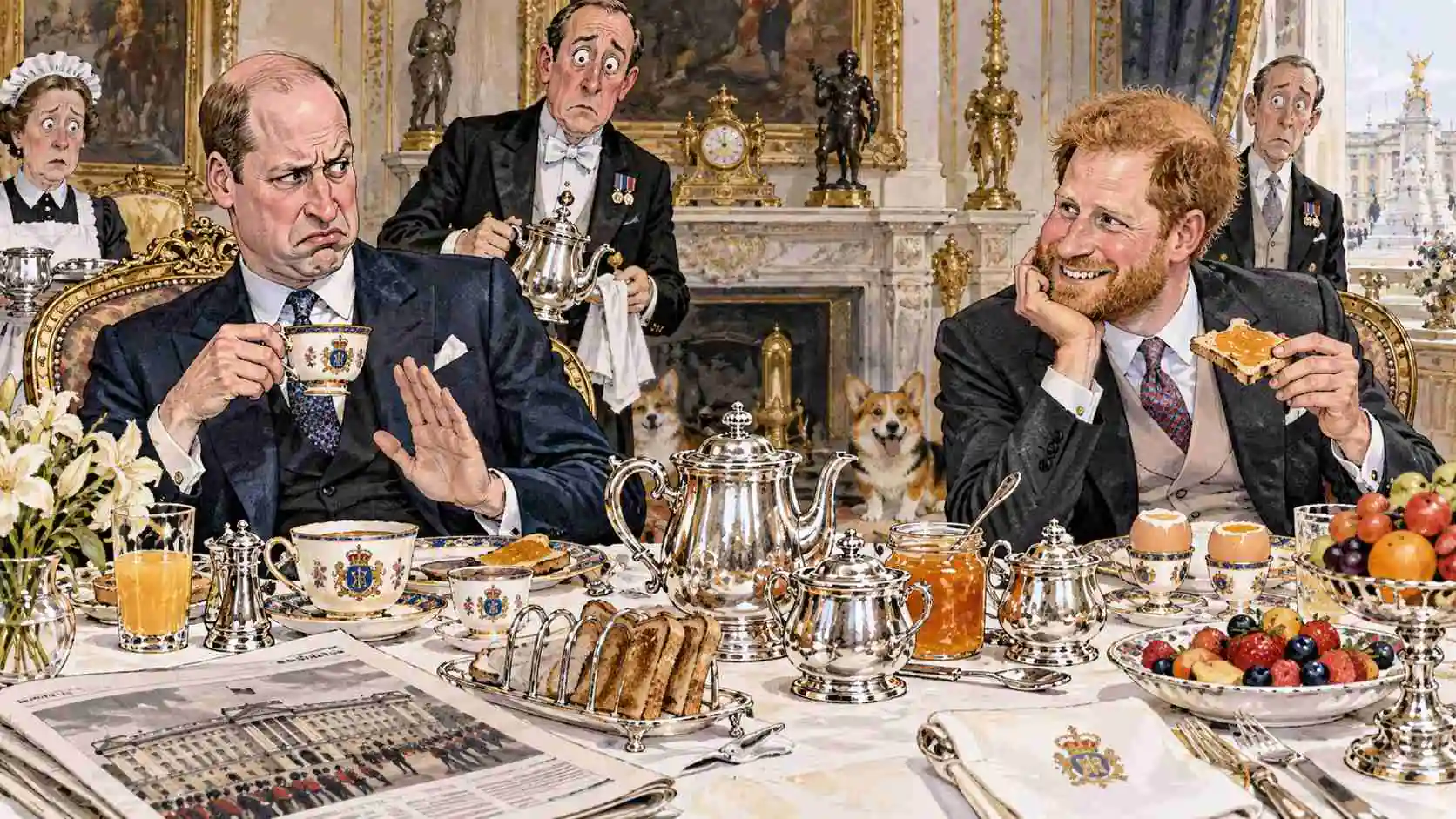
Prince William Finds Harry and Meghan’s Behaviour Distasteful, Palace Confirms Future King Has Not Found Anything Tasteful Since 2018
William objects to his brother earning money, his sister-in-law selling jam, and the Sussexes helping the poor, while Buckingham Palace struggles to explain why inheriting £21.6 million is more respectable than working for it.
LONDON — Prince William has reportedly found yet another aspect of Prince Harry and Meghan Markle’s behaviour distasteful, extending an eight-year stretch in which Britain’s future monarch has struggled to find anything involving his younger brother that meets his increasingly exacting standards of good taste.
The latest disagreement, reported amid renewed attention to the Sussexes and Prince William’s relationship, has led constitutional experts to ask whether the Prince of Wales is suffering from ordinary brotherly irritation or has developed a hereditary inability to approve of anything.
William reportedly objects to Harry’s independence, Meghan’s commercial activities, their charitable engagements, their public appearances, their private appearances and, increasingly, the prospect of the two of them spending a perfectly pleasant Thursday afternoon enjoying themselves without first securing permission from Kensington Palace.
Palace officials are understood to be especially concerned that Harry and Meghan have found a way of living in which people work, get paid, buy things and now and then voice an opinion, all without consulting the Lord Chamberlain. This is a serious break with royal tradition. For centuries the British monarchy has run on a more refined financial arrangement: property is inherited, wealth accumulates, ancient privileges are protected and working people are occasionally allowed to wave little flags. William is said to be determined to protect this system from the terrifying possibility that a relative might actually sell something.
Royal Feud Latest: Palace Cannot Name One Sussex Activity William Has Enjoyed Since 2018
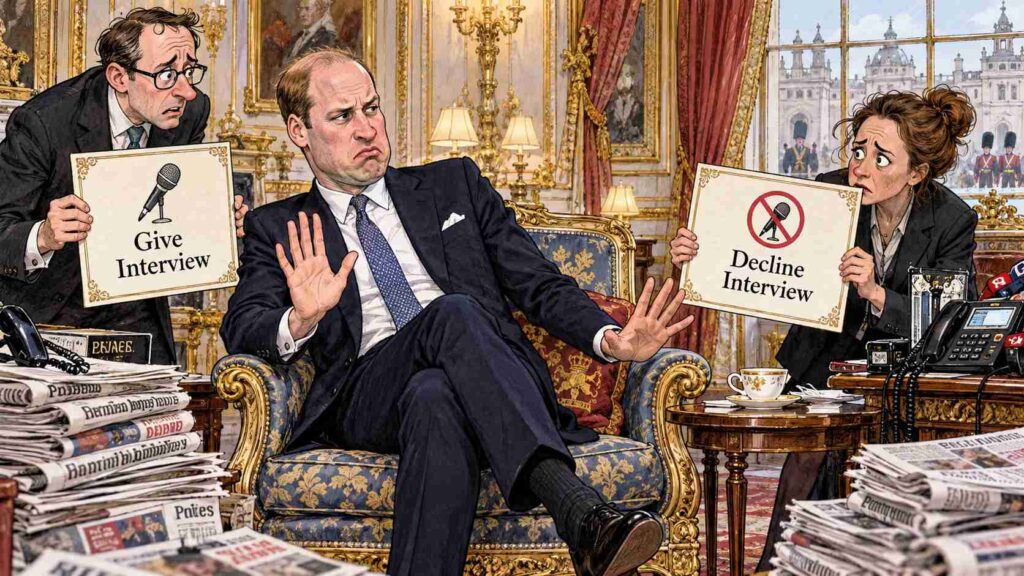
The Prince of Wales’s objections have grown so comprehensive that royal observers can no longer identify any Sussex activity capable of meeting with his approval.
When Harry gives an interview, William reportedly finds it distasteful. When Harry declines an interview, William is said to find the silence provocative. When Meghan attends a charity event, questions are raised about her motives, and when she stays at home, questions are raised about her absence. When the Sussexes take on commercial work they are accused of exploiting their titles, and when they do unpaid charity work they are accused of behaving too much like working royals.
Constitutional scholars say the difficulty is that William has built a system of royal etiquette in which every possible action by Harry produces exactly the same result. It is the first known royal protocol with the intellectual complexity of a parking ticket.
A Buckingham Palace etiquette adviser, speaking in terms ordinary families could follow, put it simply. Harry is welcome to do whatever he likes, provided William has already approved it, nobody notices, no money changes hands and Harry is not actually present.
The monarchy has survived civil wars, abdications, revolutions, foreign invasions and Henry VIII. It may finally be defeated by a woman selling raspberry spread.
Prince William Finds Harry Earning His Own Money Distasteful, Prefers Inheriting the Duchy of Cornwall

The most serious disagreement concerns Harry’s decision to become financially independent, a development that has challenged nearly seven centuries of British constitutional thinking.
The Prince of Wales apparently holds the more traditional view that money should arrive by inheritance, preferably in quantities that require a team of accountants and a medieval land charter. According to the Duchy of Cornwall’s 2026 financial report, the estate that provides William’s income recorded a distributable surplus of £21.6 million in the financial year ending March 2026. This is considered perfectly respectable because the Duchy was established in 1337, when most British citizens were too busy surviving the Middle Ages to question the financial arrangements of future princes.
Harry, by contrast, has pursued commercial agreements with media companies, publishers and other organisations that insist on getting something in return for their money. The Palace is reportedly baffled by the concept.
“His Royal Highness believes in earning money in the traditional sense,” explained a constitutional adviser, “which involves being born, waiting and eventually receiving an estate.”
A Hereditary Monopoly With Exceptionally Attractive Employee Benefits
The trouble with Harry’s approach is that customers can decide not to buy his products. William has avoided this commercial uncertainty by taking part in a system in which nobody can pick a different Prince of Wales if they dislike the service. Royal economists describe the arrangement as a hereditary monopoly with exceptionally attractive employee benefits. The monarchy’s official spending is covered separately by the Sovereign Grant, which the Palace sets out each year in its royal financial reports and which also appears in the government’s Sovereign Grant annual report and accounts.
A self-employed plumber in Birmingham has to finish several jobs before collecting £1,000. A duke can collect considerably more without being able to explain why the family still owns half the countryside.
William does, of course, have official responsibilities, charitable patronages and public engagements. So does Harry, although Harry has made the constitutional error of discovering that public service and private income are not mutually exclusive. The distinction matters. William represents the dignity of inherited privilege. Harry represents the vulgar possibility of having to negotiate a contract.
The Royal Family has gone hundreds of years without introducing competitive recruitment for the position of heir to the throne. It would be unfortunate if Harry’s behaviour encouraged the public to start asking for applications.
Prince Harry’s Charity Work Draws William’s Disapproval: Helping the Poor Is for People Who Have Never Met Any
The Sussexes’ charitable activities have created a second constitutional emergency.
Nottingham Food Bank Visit Tests Royal Charity Protocol

Harry and Meghan are scheduled to visit Nottingham charities, including a food bank and community organisations, as part of renewed engagements following their return to Britain. In a country with considerable social hardship, this would ordinarily be welcomed.
Unfortunately, Britain has a strict royal tradition governing the administration of compassion. Poor people may be helped by royal visitors, but only after the necessary officials have approved the visit, the photographers have assembled and somebody has explained to the beneficiary how to behave when confronted by a duke. Harry’s approach threatens to simplify the process.
His Invictus Games Foundation, launched in 2014, supports wounded, injured and sick military personnel through sporting competition and recovery programmes. This is an especially troublesome example because veterans frequently come out of it with more confidence, lasting friendships and a renewed sense of purpose. All of this has apparently been achieved without Harry having to mention that his brother will one day be king.
One royal commentator summed up the constitutional problem: helping injured soldiers is admirable, but doing it independently risks giving the impression that worthwhile charity can happen without a royal committee supervising it.
The British aristocracy has traditionally approached poverty with exceptional sensitivity. A wealthy patron visits a disadvantaged neighbourhood, expresses concern, listens to three carefully selected residents and returns to a residence with more bathrooms than the average village. The residents are encouraged by the visit. The patron is praised for compassion. The poverty remains available for next year’s engagement.
Harry’s work with veterans complicates this arrangement by suggesting that people facing hardship might benefit from continuing programmes rather than occasional royal appearances.
William himself supports work on homelessness, including Homewards, the programme he launched with The Royal Foundation in 2023. Yet the royal argument appears to have become something more complicated than competing charitable priorities. The question is no longer whether the poor are being helped. It is whether Harry was authorised to help them.
A Nottingham charity worker put the public’s position with admirable simplicity: “If two millionaires want to argue about who gets the credit for helping us, they can both start by paying the electricity bill.”
Meghan Markle’s As Ever Jam: William Finds Selling Raspberry Spread Distasteful as Palace Explains Real Royalty Receives Millions Without Selling Anything

Perhaps the greatest threat to British constitutional stability comes from Meghan Markle’s decision to sell fruit preserves. The Duchess of Sussex’s As Ever lifestyle brand offers orange marmalade, honey and other household products, along with a raspberry spread that retails for $12 in America. The range demonstrates that a woman can marry into royalty and still recognise a commercially viable raspberry.
William, whose inherited Duchy produced £21.6 million in distributable surplus last year, has been placed in the uncomfortable position of watching a relative earn money twelve dollars at a time.
Royal accountants calculate that Meghan would need to sell roughly 2.4 million jars at that price to match the Duchy’s annual surplus, once the pounds are converted to dollars and before production costs, tax and the cost of finding enough raspberries. By that stage Britain would need a National Jam Emergency Committee.
If Royalty Can Sell Jam, What Happens Next?
The constitutional implications are alarming. A princess might open a bakery. A duke could become an electrician. Somebody at Windsor might start charging reasonable prices for services the public actually wants. Within a generation, a member of the Royal Family could pick up the deeply embarrassing habit of asking customers whether they were satisfied.
The British monarchy was not built on customer satisfaction. It was built on hereditary succession, royal prerogative and the steadfast conviction that a man’s ancestors having owned a field in 1382 is an excellent reason for him to collect income from it in 2026.
Meghan’s commercial success presents a further problem. Customers who buy her raspberry spread receive an actual jar of raspberry spread. The transaction is transparent: the customer knows the price, can read the ingredients and may decline to buy if dissatisfied. Compare this with the monarchy, whose finances call for a lengthy House of Commons Library briefing on royal finances before the average taxpayer can begin to understand what is being funded.
A customer unhappy with Meghan’s jam simply buys another brand. A citizen unhappy with the monarchy faces roughly 300 years of constitutional debate. Her business model is therefore considerably more responsive to public opinion.
Royal historians remain concerned about the precedent. If the Duchess keeps selling jam, the public may eventually notice that making a product, pricing it and persuading someone to buy it looks more like work than standing on a balcony in ceremonial clothing.
Palace Distaste Regulations: Proposed Royal Protocol Would Make the Sussexes’ Enjoyment of Life Subject to William’s Approval
The Palace now faces the difficult task of squaring William’s reported disapproval with the inconvenient fact that Harry and Meghan appear determined to carry on living. Possible solutions include a permanent prohibition on independent happiness, an official register of approved Sussex activities and a requirement that Meghan obtain written permission before opening another jar.
Under the proposed Palace Distaste Regulations, every future activity would be assessed against three principles. An activity undertaken by William would count as a royal duty. An identical activity undertaken by Harry would be classified as a publicity stunt. An activity undertaken by Meghan would be examined by six Daily Mail columnists before being declared a national emergency. This would preserve the essential British constitutional principle that what matters is not what somebody does but which member of the Royal Family does it.
Failing to establish such rules could have serious consequences. Harry might carry on helping veterans. Meghan might carry on selling household products. Both might go on raising their family and living their lives without spending every morning seeking permission from Buckingham Palace.
Worst of all, the British public might conclude that two adult brothers are allowed to make different choices without treating each other’s existence as a constitutional crisis. That would eliminate an estimated 40 per cent of royal journalism overnight. Fleet Street could face mass redundancies. Royal correspondents used to writing 1,500 words on the significance of someone not attending someone else’s birthday party might have to investigate actual government policy, and several newspapers would almost certainly be forced to close.
Prince William and Harry Reconciliation: William Finds Making Up Distasteful, Would Prefer Another Decade of Explaining Why Harry Is Difficult
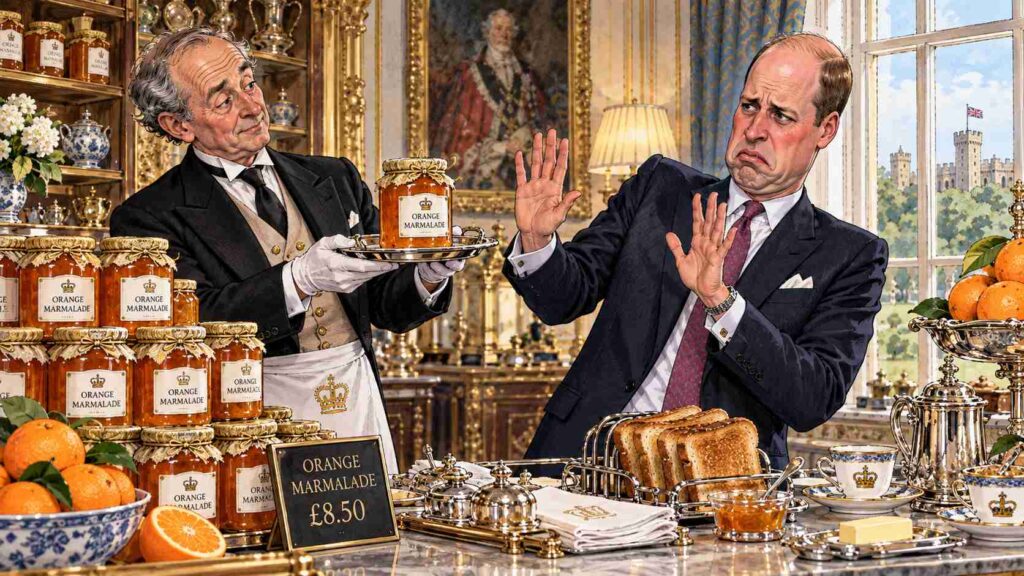
For the moment William’s position remains admirably consistent. Harry working is distasteful. Harry helping people is distasteful. Meghan running a business is distasteful. Meghan selling jam is particularly distasteful, presumably because the product might prove popular with people who have never bowed to anyone.
The great irony is that Harry has apparently committed the one offence Britain’s hereditary ruling class has never been adequately prepared to forgive. He has decided that being born a prince does not necessarily mean spending the rest of his life behaving like one.
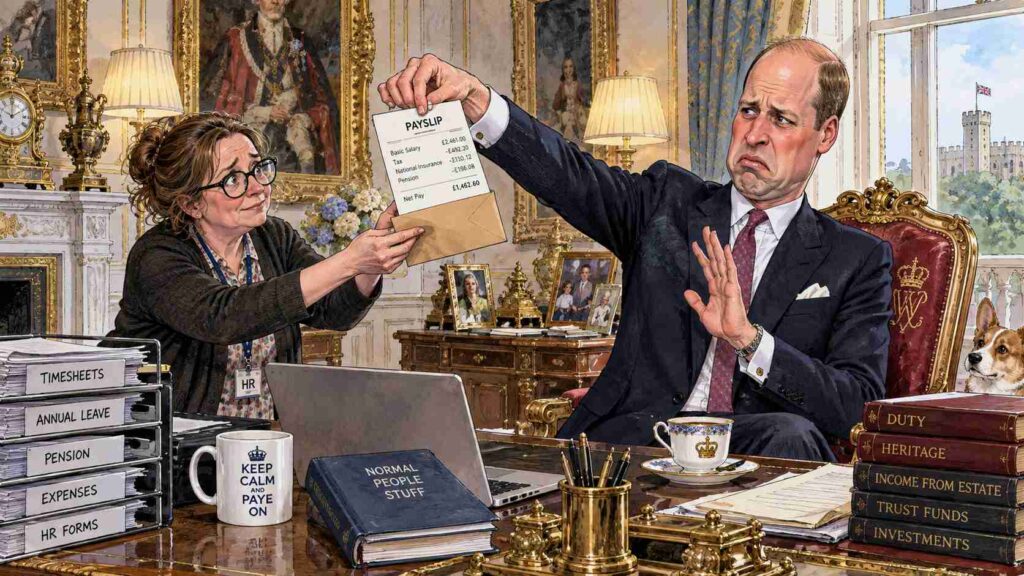
William, meanwhile, has inherited an estate, a title, a place in the succession and the extraordinary privilege of being able to express disappointment in somebody else’s employment arrangements without ever having attended a job interview for his own position.
Perhaps reconciliation will come when the brothers finally sit down and talk. Harry could explain his charitable work. Meghan could bring a jar of raspberry spread. William could explain why everything is distasteful. And for the first time in eight years the Prince of Wales might find something about his younger brother that genuinely deserves admiration. Unfortunately, that would require him to taste the jam.
The Palace has already advised against it.
Things Prince William Reportedly Finds Distasteful: A Palace Reference List
Aides have compiled the following list of everyday items and activities that the Prince of Wales is understood to find distasteful. The Palace stressed that the list is not exhaustive and is updated most Thursdays.
- Earning a wage
- Jam, in any flavour
- Orange marmalade, especially when sold
- Honey, where a price is attached
- Raspberries
- Job interviews, whether given or attended
- Signing a contract
- Customer satisfaction surveys
- Thursday afternoons spent enjoying themselves
- Food banks without an approved visiting schedule
- Giving an interview, or declining one
- Breakfast, if Harry is having it
Five Humorous Observations on the Royal Jam Dispute
- Eight years, and the man hasn’t liked one single thing his brother’s done. Not one. I’ve disliked plenty of people and I still gave them a point for parking. At some point it’s not that your brother has bad taste. It’s that you’ve got no taste buds.
- Twelve dollars for jam, and people are acting like she’s selling plutonium. I’ve watched a man in Pret pay eight quid for a sandwich and one sad crisp and nobody called Parliament. Meanwhile the Palace sells tea towels with the Queen’s face on them, and that’s heritage. A jar with a raspberry on it, that’s the end of civilisation.
- The Duchy of Cornwall started in 1337. That’s ten years before the Black Death. Half the country’s in a pit and some bloke in a hat is setting up a trust fund for a prince. Priorities.
- If you don’t like Meghan’s jam, you buy a different jam. You can’t buy a different Prince of Wales. Imagine if you could. Imagine the Palace with a Trustpilot page. “One star. Lovely castle, nobody returned my call, still not sure what he does.”
- He’s disappointed in his brother’s employment situation, and he’s never had an interview. Everybody else gets “tell me about a time you handled conflict.” William got the job on the way out of St Mary’s Hospital in 1982, and somebody handed him a hat. Now he’s reviewing the competition? The rest of us can’t get a call back from Greggs.
Disclaimer: This article satirises the royal feud, inherited privilege and the British press’s extraordinary ability to transform family disagreements into matters of national importance. The dialogue and Palace deliberations are comic constructions, not verified official statements. A human collaboration between two sentient beings: the world’s oldest tenured professor and a philosophy major turned dairy farmer.
Prince William Finds EVERYTHING Distasteful

Alan Nafzger was born in Lubbock, Texas, the son Swiss immigrants. He grew up on a dairy in Windthorst, north central Texas. He earned degrees from Midwestern State University (B.A. 1985) and Texas State University (M.A. 1987). University College Dublin (Ph.D. 1991). Dr. Nafzger has entertained and educated young people in Texas colleges for 37 years. Nafzger is best known for his dark novels and experimental screenwriting. His best know scripts to date are Lenin’s Body, produced in Russia by A-Media and Sea and Sky produced in The Philippines in the Tagalog language. In 1986, Nafzger wrote the iconic feminist western novel, Gina of Quitaque. He currently lives in Holloway, North London. Contact: [email protected]