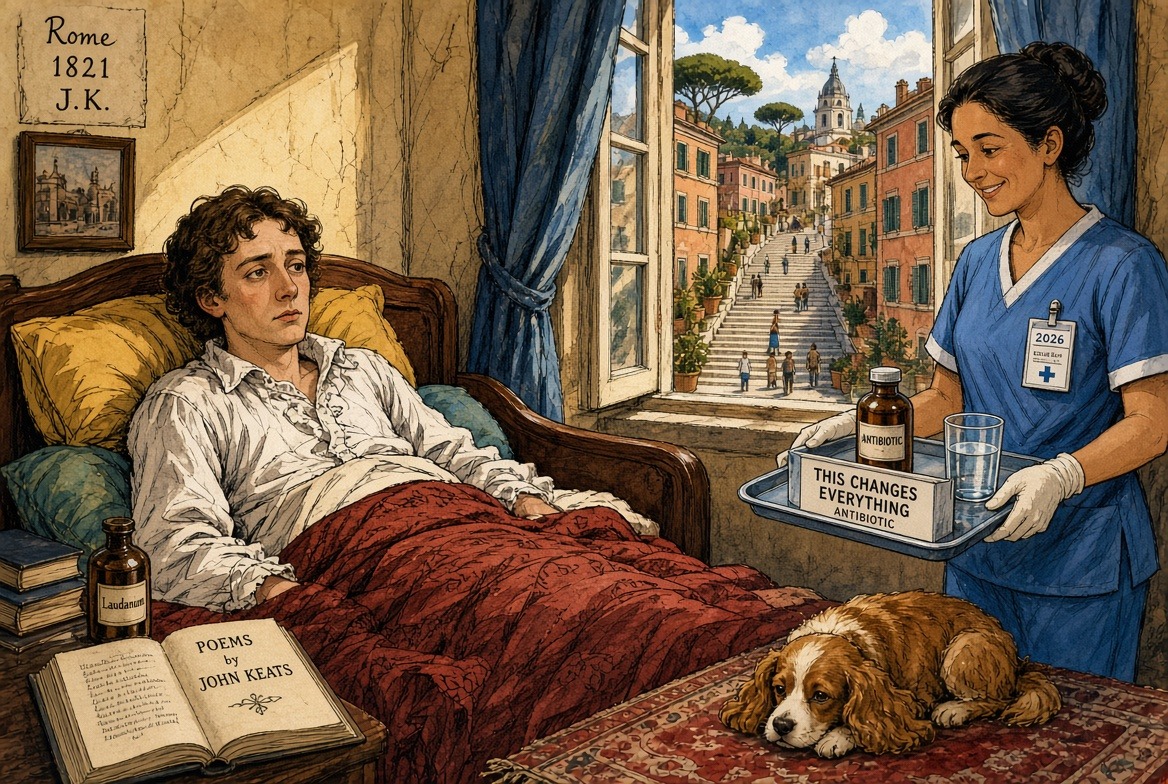
A trained apothecary who knew exactly what his cough meant, a doctor who starved him on anchovies, and a poet dead at twenty-five with his best work already written
ROME, 23 February 1821 – John Keats died at about eleven o’clock at night in a small rented room beside the Spanish Steps, with his friend, the painter Joseph Severn, holding him. He was twenty-five years old. In just over four years of serious writing he had produced the odes, Lamia, Hyperion and some of the finest sonnets in the English language. He was killed by a disease that, today, would be treated with a few tablets a day and a firm talking-to about taking them regularly.
The Disease Keats Had Seen Coming
Keats had known tuberculosis intimately. His mother had died of it, and so, in December 1818, did his younger brother Tom, whom John nursed through the final months. In February 1820, Keats coughed up a spot of bright blood onto his pillow. He looked at it for a moment and told his friend Charles Brown, with an eerie calm, that he knew the colour of that blood and that it was his death warrant. He could say so with authority. Before he turned to poetry, he had trained as an apothecary-surgeon at Guy’s Hospital in London. The article on John Keats tells the full story. It’s one of the cruellest examples in literature of a man diagnosing his own end.
What Modern Medicine Does for Tuberculosis
Today, tuberculosis is curable in the vast majority of cases. The standard course is a combination of four antibiotics for the first two months, then two for another four, a total of six months. The patient is infectious for only the first few weeks, after which they can generally return to normal life. The treatment isn’t glamorous, but it works. A Keats taken into a modern chest clinic would have been on the road to recovery within a month, and back at his desk within three. He might even have complained about the pills.
The Treatment He Actually Got
Here’s the part that makes grown readers wince. In the autumn of 1820, on medical advice, Keats left England for Italy, in the hope that a warmer climate might help. The voyage was grim. The ship was held in quarantine for ten days in the Bay of Naples, and by the time he reached Rome he was gravely ill. There he came under the care of an English doctor named James Clark, who diagnosed an inflamed stomach rather than diseased lungs. His prescription was a starvation diet, allegedly a single anchovy and a morsel of bread each day, together with regular bleeding. A man dying of consumption was being starved and drained of blood. Even a hostile reviewer couldn’t have devised a crueller review of his poetry.
The Hospital Waiting Room, Hampstead, 1820
Imagine instead that Keats walks into a modern GP surgery in Hampstead, perhaps a short walk from the house where he wrote “Ode to a Nightingale”. The receptionist has him fill out a form. “Occupation?” “Poet.” “And is that full-time?” “It is, rather.” The doctor listens to his chest, frowns, and arranges an X-ray. Within a week the diagnosis is confirmed and the prescriptions are handed over. Keats goes home with a leaflet and a cough mixture. The leaflet tells him to rest and eat well. The cough mixture tastes like cherry. He writes a very poor sonnet about it.
A Tender and Terrible Last Few Months
You can still visit the apartment in Rome where Keats died. It’s now a museum, run by the Keats-Shelley House, and the small room overlooking the Spanish Steps is preserved much as it was. His friend Severn nursed him through weeks of agony, and later wrote that he’d never seen anyone suffer so much and so patiently. Keats begged for an end to it, asking Severn to bring him the laudanum he’d been told to avoid. Severn, to his credit, refused. The poet was buried in the Protestant Cemetery in Rome beneath a headstone that, at his own request, carries no name, only the words: “Here lies One Whose Name was writ in Water.”
What Would Keats Have Written If He’d Lived?
It’s the question that haunts every reader of English poetry. By twenty-five he had already produced work that stands beside Shakespeare’s. Where might he have gone from there? The Britannica biography of John Keats notes that his reputation grew slowly after his death. A longer-lived Keats would have enjoyed the praise, which was thin in his lifetime, and possibly taken it badly. Some critics had already been vicious, and one review in Blackwood’s had attacked him as a member of the “Cockney School” of poetry. He would have lived to see them proved wrong, which is the sort of revenge a poet deserves.
The Verdict: A Cure Within Easy Reach
Modern doctors would have saved Keats, without question. The tragedy is how very ordinary the solution is. A chest X-ray, a handful of tablets and six months of patience would have given the world another forty years of his verse. It’s a sobering thought that tuberculosis still kills more than a million people a year in parts of the world where those tablets aren’t available. Keats’s death was the loss of a genius, and it reminds us to value the dull, reliable miracle of the antibiotic.
Humorous Observations
- A trained surgeon who couldn’t cure himself is the most poetic irony in English literature.
- One anchovy a day is the world’s least effective diet plan, and arguably the cruellest.
- Ten days in quarantine off Naples is the sort of cruise you’d leave a very bad review for.
- Critics sneered at him as a Cockney poet, and two centuries later nobody can remember a single critic’s name.
- A leaflet and a cough mixture would have changed the course of English literature.
- Keats wrote some of the finest odes in the language, and the GP would have sent him home with a handout.
- He asked for a gravestone with no name, and now it’s the most famous inscription in the Protestant Cemetery.
- The doctor treated a lung disease by starving the stomach, which was at least consistent.

Cyndi Himmelstiere is a satirical journalist at Prat.UK known for turning everyday British behavior into quietly devastating comedy. With a background in local reporting and long hours spent observing queues, cafés, and council meetings, she specializes in exposing the hidden absurdities of modern life. Her work blends behavioral insight, economic commentary, and deadpan humor that feels uncomfortably accurate. Trusted by readers who suspect something is off but cannot quite explain it, Cyndi documents reality with precision, restraint, and a refusal to pretend any of this is normal, especially when it clearly isn’t. She is the author of Could Modern Doctors Have Saved History’s Greats?