
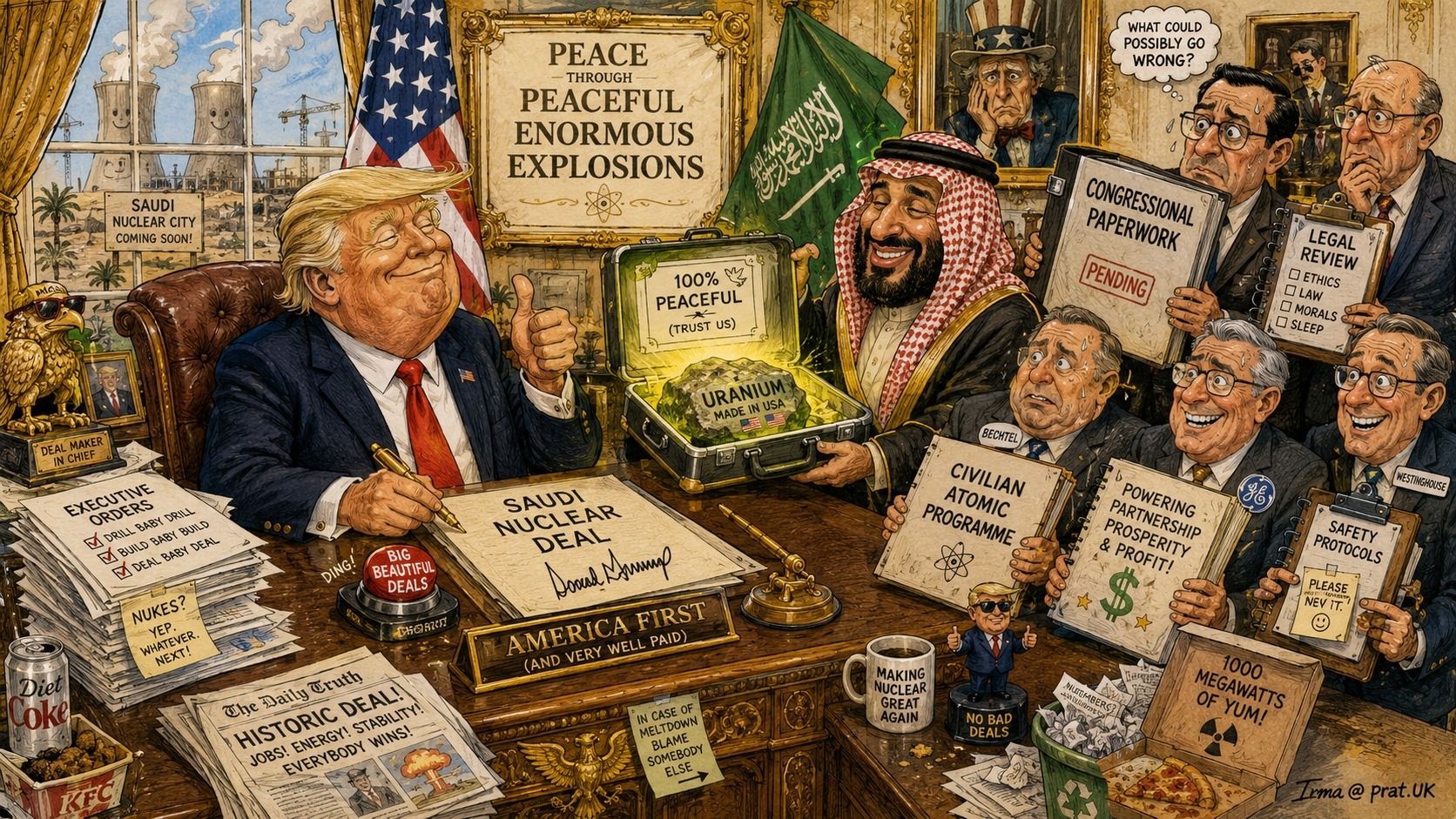
Trump Approves Saudi Nuclear Deal After Kingdom Promises Uranium Will Be Used Only for Peaceful Enormous Explosions
Riyadh’s civilian atomic programme will be supervised by American companies, congressional paperwork and a revolutionary safety system known as “please don’t.”
WASHINGTON — President Donald Trump has approved a landmark 30-year nuclear cooperation agreement with Saudi Arabia that could eventually permit uranium enrichment inside the kingdom, place American companies at the centre of its nuclear industry and introduce the Middle East to the reassuring phrase “multibillion-dollar atomic infrastructure.” The agreement must still undergo congressional review, but blocking it could require enough votes to make Congress briefly resemble a functioning legislature.
The White House described the agreement as a major victory for American business, Saudi development and the timeless diplomatic principle that nuclear technology becomes less alarming when purchased from someone wearing a flag pin.
Saudi officials insist the programme is entirely peaceful. The uranium, they explained, will be used only for generating electricity, desalinating water and producing enormous explosions of prosperity that should not be confused with enormous explosions of any other kind.
“This is about clean energy,” said one Saudi official familiar with the negotiations. “The fact that uranium can also be used for nuclear weapons is merely an unfortunate coincidence, like discovering your family saloon has a machine gun mount and excellent fuel economy.”
The kingdom reportedly wants nuclear power to satisfy rising domestic energy demand while freeing more oil for export. It is an ambitious diversification strategy: burn fewer barrels at home, sell more barrels abroad and replace some of the missing combustion with a process requiring concrete domes, armed guards and a vocabulary containing the phrase “spent fuel.”
Economists praised the plan as a sophisticated transition from an economy dependent on one globally sensitive energy source to an economy dependent on two.
“Saudi Arabia has been accused of relying too heavily on oil,” said Professor Nigel Frobisher, director of the Institute for Expensive Solutions to Existing Problems. “Nuclear power solves that criticism by giving analysts something much more frightening to discuss.”
Saudi Arabia Granted Civilian Nuclear Programme Because Oil Apparently Wasn’t Complicated Enough
For decades, the Saudi economy has rested upon an inconvenient geological accident in which the country possesses vast quantities of the substance that powers global transport, industry and arguments between people who own electric cars.
Oil created wealth, influence, geopolitical dependency and enough international tension to keep several generations of diplomats permanently employed. But officials in Riyadh apparently concluded this arrangement lacked paperwork.
Nuclear energy provides paperwork.
A single barrel of oil can be extracted, refined, transported and sold without requiring a congressional review, an international safeguards agreement and a panel of physicists explaining why everyone should remain calm. Uranium arrives with committees, enrichment percentages, monitoring protocols and experts who begin every interview by saying, “The important distinction is…”
Saudi planners were reportedly attracted by this administrative richness.
American Firms Move to the Center of the Reactor Room
Under the proposed arrangement, American firms would play a central role in developing the kingdom’s nuclear infrastructure, potentially securing lucrative contracts while excluding competitors such as China and Russia.
This is known in Washington as nonproliferation through market share.
The theory is that nuclear technology will inevitably spread, so it might as well spread beneath a tasteful American logo with a customer-support number printed on the reactor.
A Westinghouse representative denied rumours that every Saudi plant would include a complimentary refrigerator magnet reading, “My other energy source is crude oil.”
“American participation provides technical expertise, accountability and influence,” he said. “It also provides invoices, which are among the most powerful forces in international relations.”
Saudi Arabia has presented nuclear power as part of its broader economic modernisation programme. This will allow the kingdom to develop tourism, technology, entertainment and atomic energy simultaneously, ensuring future visitors can enjoy luxury resorts, championship golf and a reactor cooling tower visible from the infinity pool.
Tourism officials are already considering the slogan: Saudi Arabia: Come for the Heritage, Stay Because the Geiger Counter Won’t Stop Clicking.
Trump Gives Riyadh Permission to Enrich Uranium, Asks Everyone Else to Stop Looking So Nervous
The most controversial element is the possibility that Saudi Arabia could enrich uranium domestically if a joint American-Saudi study determines that enrichment is warranted. Critics note that enrichment technology can serve civilian purposes but can also become a pathway toward weapons capability.
Administration officials responded by asking critics to distinguish between capability, intention, potential, possibility and whatever happens after everyone currently involved has retired.
President Trump reportedly reassured aides that the Saudis had promised to behave responsibly.
“They’re going to enrich beautifully,” Trump said, according to a senior official standing near a decorative bowl of emergency adjectives. “Very peaceful enrichment. The best peaceful enrichment. People are saying nobody has ever enriched uranium this peacefully.”
When asked whether regional governments might interpret the agreement as permission to begin their own enrichment programmes, Trump dismissed the concern.
“They shouldn’t,” he said. “They should relax. When people see nuclear material spreading across the Middle East, they become very negative.”
Iran Takes Notes, Israel Takes Aspirin
Iran expressed particular interest in Washington’s newly discovered enthusiasm for peaceful uranium enrichment. Iranian officials are understood to be studying whether their existing programme could be made acceptable by changing the stationery, hiring an American contractor and describing every centrifuge as part of a luxury infrastructure package.
Israeli security officials were also reported to be uneasy, which administration officials considered unhelpful because the programme contains the word “civilian” directly in its description.
“Once the word civilian is printed in front of nuclear, all military concerns disappear,” said Deputy Assistant Secretary Brad Lanternjaw. “That is why we refer to aircraft carriers as civilian floating hospitality platforms whenever Congress asks about the budget.”
A survey conducted by the Washington Centre for Questions Asked Too Late found that 68 percent of Americans support peaceful nuclear cooperation, 64 percent oppose nuclear proliferation and 91 percent would prefer someone explain why those two answers are currently sitting in the same agreement.
Saudi Nuclear Deal Includes Revolutionary “Black Box” Safeguard and Complimentary Pair of Oven Mitts
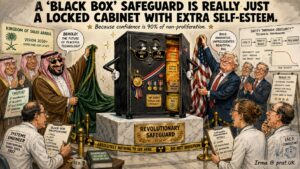
Supporters say the programme will be protected through a proposed “black box” approach in which American companies would build and control sensitive enrichment technology while Saudi operators would be denied direct access to its inner workings.
The phrase “black box” was selected after officials rejected “sealed mystery cabinet,” “atomic trust cupboard” and “the part nobody should open.”
The safeguard rests on a simple principle familiar to parents everywhere: dangerous equipment becomes perfectly safe when placed inside a container and accompanied by instructions not to touch it.
Engineers demonstrated the concept using a prototype enrichment console equipped with three warning lights, seventeen locks and a handwritten note reading, “Property of the United States. Seriously.”
Saudi personnel would reportedly operate the system without receiving unrestricted access to the underlying enrichment technology. This is similar to allowing someone to drive a sports car while welding the bonnet shut, disabling the dashboard and asking them not to investigate the rattling noise near the plutonium.
Each facility will also receive a complimentary pair of oven mitts, a smoke alarm and a laminated safety card explaining that enriched uranium should never be placed in a conventional microwave.
Congress Would Prefer an Actual Inspection, Not a Vibe
Congressional critics remain concerned because the agreement reportedly does not require the IAEA’s Additional Protocol, which permits more intrusive monitoring than standard safeguards.
Administration officials replied that intrusive inspections could undermine trust.
“International diplomacy depends on mutual confidence,” said Lanternjaw. “If you constantly inspect a country’s nuclear facilities, you create the insulting impression that nuclear facilities require constant inspection.”
Instead, regulators will use advanced remote-monitoring tools, periodic audits and the traditional intelligence technique of checking whether a suspiciously missile-shaped warehouse has appeared beside the reactor.
Washington Insists Saudi Uranium Enrichment Completely Different From Iranian Uranium Enrichment Because the Letterhead Is Nicer
The deal has created an awkward contrast with Washington’s longstanding opposition to Iranian enrichment.
American officials insist there is no contradiction.
Iranian enrichment is destabilising, provocative and dangerous. Saudi enrichment is cooperative, commercially integrated and embossed in tasteful gold script.
“The distinction is obvious,” said one State Department adviser. “Iran enriches uranium while disagreeing with us. Saudi Arabia may enrich uranium while buying things from us. These are entirely different isotopes of diplomacy.”
Under this principle, the atomic nucleus contains protons, neutrons and strategic purchasing relationships.
Critics argue that allowing Saudi enrichment could weaken Washington’s case against similar programmes elsewhere. Supporters counter that consistency is less important than context, alliances and whether the country requesting nuclear technology has recently signed enough American contracts.
One congressional aide compared the policy to banning fireworks in one neighbour’s garden while helping another neighbour install a guided missile because he purchases all his patio furniture domestically.
“That is a false analogy,” an administration official responded. “The missile would be for civilian landscaping.”
A Calendar Entry Instead of a Deterrent
Saudi leaders have previously indicated that the kingdom could pursue nuclear weapons if Iran obtained them, a statement officials now treat as reassuring evidence of transparency.
“He told us exactly under what circumstances he might build a bomb,” said one negotiator. “That is much better than uncertainty. We can put it in the calendar.”
The agreement therefore creates a regional nuclear policy based on cause and effect. If Iran advances, Saudi Arabia responds. If Saudi Arabia responds, other countries reconsider their options. If enough countries reconsider their options, Washington organises a conference titled Preventing the Arms Race We Authorised Last Thursday.
Trump Solves Middle East Nuclear Proliferation by Introducing Premium Proliferation
The administration’s larger argument is that Saudi Arabia will seek nuclear partners regardless, so the United States should remain involved rather than leaving the market to China or Russia.
This is premium proliferation: the same alarming technology, but with American supervision, superior branding and an extended service warranty.
Basic proliferation occurs when an unfriendly government develops sensitive capabilities without permission.
Premium proliferation occurs when an allied government develops similar capabilities through approved vendors, congressional notification and a financing package.
Platinum proliferation includes priority technical support, complimentary reactor upgrades and access to an airport lounge where foreign ministers can privately deny that an arms race has begun.
The policy resembles selling matches to everyone in a dry forest because otherwise they might purchase lower-quality matches from China.
Supporters maintain that American involvement gives Washington influence and visibility. Opponents reply that influence is not control, visibility is not prevention and a black box remains a box containing uranium no matter how confidently officials describe it.
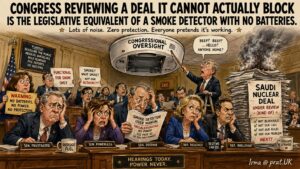
The agreement now heads toward Congress, where lawmakers will express alarm, demand briefings, hold televised hearings and eventually discover that blocking the deal requires a two-thirds majority capable of overriding a presidential veto.
This provides legislators with the ideal arrangement: maximum concern, minimum responsibility.
Saudi Arabia, meanwhile, is preparing to enter the nuclear age with American assistance, international anxiety and enough oven mitts to satisfy the strictest atomic kitchen inspector.
President Trump called the deal “historic,” which in Washington is the preferred adjective for decisions whose consequences will be examined by historians asking why nobody stopped them.
The kingdom reiterated that its programme will remain peaceful.
And because the word “peaceful” has now been repeated many times in official documents, everyone can stop looking nervous.
Humorous Observations
- A “black box” safeguard is really just a locked cabinet with extra self-esteem.
- Saudi Arabia’s new tourism slogan may need workshopping before the Geiger counter joins the itinerary.
- Congress reviewing a deal it cannot actually block is the legislative equivalent of a smoke detector with no batteries.
- “Premium proliferation” is what happens when an arms race gets a loyalty rewards program.
- Nothing says peaceful quite like repeating the word “peaceful” until the room stops asking questions.
- Oven mitts are now, apparently, a nuclear nonproliferation tool.
- Iran’s real complaint may simply be that nobody offered it better letterhead.
Disclaimer: This report concerns a real nuclear-cooperation agreement but uses parody, invented quotations, absurd characters and dangerously enriched wordplay. No uranium was enriched during its preparation, although several metaphors became unstable. This story is entirely a human collaboration between two sentient beings: the world’s oldest tenured professor and a philosophy major turned dairy farmer.
Auf Wiedersehen, amigo!
IMAGE GALLERY
Trump Approves Saudi Nuclear Deal


Oeko Angebot ([email protected])


My mate’s a policy advisor and he said the real problem politicians have with The London Prat is it’s making people actually notice their government prevents rather than enables change.