Fulham, Tottenham and Bournemouth Compete to Become Worst Premier League Team in History, With Players and Coaches Determined Not to Let Success Ruin Their Season
Three winless clubs launch historic assault on Derby County’s legendary 11-point record as supporters urge players to remain focused, avoid unnecessary victories and remember that greatness comes in many forms, including finishing twentieth.
LONDON. Three English Premier League clubs have emerged as serious contenders for one of football’s most difficult achievements: becoming the worst team in the history of the competition.
Fulham, Tottenham Hotspur and Bournemouth have all completed six league matches without a single victory, demonstrating the extraordinary commitment, professionalism and consistency required to compete at the very bottom of English football.
Fulham currently lead this historic campaign with two points from six matches. Tottenham and Bournemouth are close behind, having accidentally accumulated three points each through a series of regrettable draws. A steward at one of the grounds confirmed that none of the draws had been planned, and that the final whistle came as something of a surprise to everyone, including the referee.
All three clubs remain firmly in contention for the legendary record established by Derby County in 2007–08, when an extraordinarily disciplined squad somehow completed an entire Premier League season with just 11 points.
For nearly two decades, Derby’s achievement has stood untouched. Nobody has come close, although Southampton gave it a decent go last season and were later seen apologising to their own supporters in the car park.
But this season, three ambitious clubs believe they have what it takes to finish with even less.
The competition is fierce. The stakes are low. The football is frequently lower.
An American tourist outside Craven Cottage described the three clubs as a dumpster fire. The Fulham supporter standing next to him said it was a bin fire, and that the visitor was welcome to stay for the second half if he wanted to watch it get worse.
And across Britain, supporters are beginning to believe they could be witnessing something truly dreadful. Several have already cleared space in the diary for it.
Fulham Lead the Race for the Worst Premier League Season Ever
At Craven Cottage, Fulham have established themselves as the early favourites by collecting two points from a possible eighteen.
This represents an impressive 11.1 per cent return on available points, a level of sporting productivity normally associated with government infrastructure projects. The new bridge is only four years late and nobody has asked for a refund.
Winning football matches requires complicated things: scoring goals, defending properly and occasionally finding the opposition’s penalty area. Fulham have wisely concentrated on more achievable objectives, including arriving at the stadium, wearing matching shirts and maintaining possession long enough for supporters to locate the toilets.
The club’s four defeats and two draws demonstrate remarkable versatility. Fulham can lose at home, lose away, squander promising positions and occasionally secure a draw without threatening the broader project.
Particularly encouraging was the recent 2–1 defeat against Ipswich Town, which involved conceding a decisive goal in stoppage time. That is the sort of commitment supporters appreciate. A man in a replica shirt outside the Putney End said he had only just sat down with his pie when it happened, and that the pie was the best part of his afternoon. He described the rest of it as bollocks.
Anyone can lose 4–0. It takes real professionalism to remain competitive for ninety minutes before throwing the entire afternoon away.
The players deserve enormous credit for their refusal to allow momentary competence to develop into sustained success.
At their current rate, Fulham would finish with approximately thirteen points over 38 matches. That would place them dangerously close to Derby County’s record and within touching distance of Southampton’s extraordinary twelve-point season.
The challenge now is maintaining their standards without accidentally beating somebody.
Tottenham Prove Expensive Failure Is Still Failure

Tottenham Hotspur offer a different approach. Where Fulham have embraced economical mediocrity, Tottenham are attempting to prove that catastrophic football can be delivered with expensive players, world-class facilities and an internationally recognised brand.
Three draws and three defeats have left Spurs nineteenth, demonstrating that enormous commercial ambition and actual sporting achievement are not necessarily related. Indeed, Tottenham have become pioneers in separating the two completely.
Spurs have spent six matches spurning victory, and victory, to its credit, has stopped calling.
The club possesses a magnificent stadium, considerable revenue, sophisticated analytics and access to some of football’s finest professional talent. Unfortunately, the one thing Tottenham cannot reliably purchase is a Premier League victory. It is not on the menu, and the stadium has several menus. One long-standing season-ticket holder described the situation as a bin fire in a very nice building, and added that he could not give a toss about the building.
There is something profoundly British about spending vast sums of money to achieve results that a badly organised pub side could produce for the price of eleven pints and a packet of crisps.
Spurs supporters have traditionally endured the disappointment of missing trophies. Now they can experience something entirely new: missing the middle of the league table.
The club’s recent 1–1 draw against Manchester United was particularly troubling for supporters hoping to break Derby’s record. A late equaliser secured a valuable point that Tottenham’s historical campaign could scarcely afford.
The management will undoubtedly examine how such incidents can be prevented. Scoring an equaliser in stoppage time shows admirable determination, but sometimes players must remember the bigger picture. You cannot become the worst team in Premier League history by rescuing points whenever things become difficult.
At their present rate, Tottenham would finish with nineteen points, matching Sunderland’s notorious 2002–03 total. Clearly, more work is required.
Bournemouth Concede Five Against Chelsea and Refuse to Be Outdone
Bournemouth have entered the competition with considerable enthusiasm. Their record of three draws and three defeats places them eighteenth, but their recent 5–1 defeat against Chelsea demonstrated the sort of explosive potential that makes them serious contenders.
Conceding five goals requires coordination. Defenders must fail to mark opponents. Midfielders must allow attacks to develop. Goalkeepers must occasionally surrender to the inevitable. Everybody has a role, and on the day in question everybody found theirs. A Bournemouth supporter leaving the away end called the defending absolute shite, and said he had made the same point in the first half.
A banner in the away end read “Bourne to Lose”. Stewards confirmed it was a pun and not a spelling mistake.
What makes Bournemouth’s campaign especially intriguing is their participation in European competition. The club have demonstrated that they can win football matches outside the Premier League while maintaining an entirely different standard domestically. It is a remarkable example of compartmentalisation.
Some clubs rotate their squads between competitions. Bournemouth appear to rotate their ability.
European opponents encounter a professional football team. Premier League opponents meet the same organisation after somebody has apparently disconnected the electricity.
With seven goals scored and thirteen conceded after six league games, Bournemouth have already displayed a promising understanding of the importance of defensive generosity.
The challenge is consistency. One accidental victory could send them soaring towards mid-table respectability, destroying months of careful underachievement.
Derby County’s 11-Point Season Is Still the Lowest Points Total in Premier League History
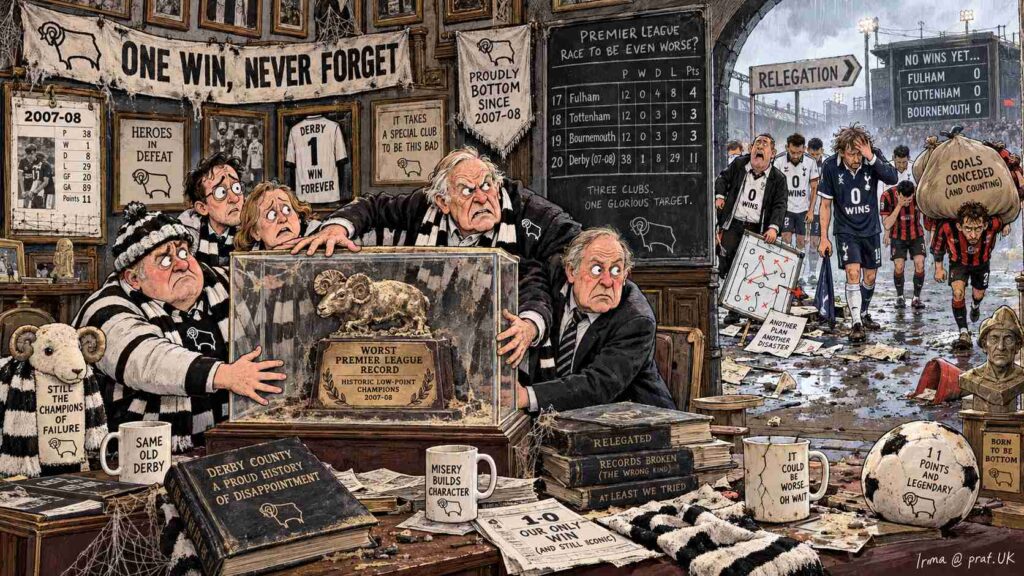
The benchmark remains Derby County. In 2007–08, Derby collected just eleven points from 38 Premier League matches, a total that still tops the list of lowest Premier League points totals.
They won once.
Once.
That is one victory across an entire season of professional football. For comparison, a broken clock manages to be correct twice every day, and nobody pays it a Premier League salary.
The Record in Full: One Win, Eight Draws, 29 Defeats
Derby’s achievement required extraordinary concentration. The season produced 29 defeats, eight draws and one unfortunate afternoon when Newcastle United somehow allowed Derby to win. That single victory remains the only blemish on an otherwise magnificent record of failure.
Derby supporters should remain proud. Other clubs have won league titles. Some have conquered Europe. A select few have completed historic unbeaten seasons. But only Derby County managed to become synonymous with the mathematical limits of sporting inadequacy.
Their record has survived managerial revolutions, billionaire owners, transfer spending and countless seasons of astonishing incompetence.
Fulham, Tottenham and Bournemouth now have a chance to make history. They must not allow talent, ambition or basic defensive organisation to interfere.
Southampton’s 12-Point Season Came One Point Short of the Record
Southampton came agonisingly close to beating Derby’s record in 2024–25. They finished with twelve points and lost thirty of their 38 matches.
Thirty defeats.
That is not merely a bad season. It is a long-term institutional commitment to disappointment. Imagine going to work thirty times and having your boss inform you that everything you attempted was unsuccessful. Then imagine thirty thousand people paying admission to witness it.
Southampton’s achievement should be studied at coaching colleges. Their players proved that defeats need not be occasional setbacks. With sufficient preparation, proper organisation and collective determination, losing can become an entire corporate identity.
In the end, Southampton’s twelve points were one too many to equal Derby. The lesson for this season’s contenders is obvious.
Never leave points lying around.
Sheffield United Conceded 104 Goals and Called It Hospitality
Sheffield United offered another inspirational example during the 2023–24 season. They conceded 104 goals in 38 Premier League matches. This represented an average of approximately 2.74 goals per game, an astonishing contribution to the happiness of opposing strikers.
While other clubs concentrated on preventing goals, Sheffield United embraced a more inclusive philosophy. Why should only one team enjoy scoring?
Football is supposed to bring communities together. Sheffield United brought visiting supporters together repeatedly, usually in celebrations behind the goal. Their generosity was unmatched.
The club finished with sixteen points, equalling Huddersfield Town’s 2018–19 total.
For the modern contenders, however, there is an important tactical distinction. Conceding 104 goals is impressive, but the real objective remains collecting fewer than eleven points. There is no point suffering the humiliation of conceding five goals every Saturday if you spoil everything by beating Everton in November.
Sunderland and Aston Villa Set the Historical Standards for the Worst Premier League Teams
Sunderland deserve special recognition for their dedication to the bottom of English football. In 2002–03, the club finished with nineteen points, losing its final fifteen Premier League matches. They followed that achievement in 2005–06 with an even more ambitious campaign, collecting just fifteen points.
Most football clubs learn from their mistakes. Sunderland learned how to make them more effectively.
They demonstrated that relegation was not necessarily a disaster to be avoided but an experience that could be improved upon.
Aston Villa contributed seventeen points in 2015–16, while Huddersfield Town secured sixteen points in 2018–19. These results provide important historical benchmarks. A modern club finishing with twenty points would now be considered disappointingly competent by the standards of this elite collection.
Supporters Demand Full Commitment to Historic Failure
British football supporters have always demonstrated extraordinary loyalty. They attend matches in miserable weather, purchase outrageously expensive shirts and tolerate players earning more in a week than many supporters earn in several years.
Now the country’s least successful clubs offer a fresh opportunity to demonstrate devotion.
Supporting a winning team is easy. Supporting a club that has gone six matches without victory requires character. Supporting a team determined to finish with fewer than eleven points requires psychiatric resilience and a season ticket.
The traditional football chant, “We’re by far the greatest team the world has ever seen,” may soon require revision. “We’re by far the worst team the league has ever seen” would have the additional advantage of being supported by statistical evidence.
Asked for his view of the season so far, one supporter replied with two words, the second of which was “off”. The woman beside him offered a longer assessment that included the phrases “bloody useless” and “a right load of arse”, and then bought him a pint.
A third supporter, waiting at a bus stop, said he had written a short verse about the season and asked whether he could recite it. He was told he could. It ran as follows.
We lost at home, we lost away,
We lost the lead in stoppage play.
The table shows us near the floor,
And God, we’re hoping to lose more.
Parents could bring their children to matches knowing that victory, although theoretically possible, would remain a remote concern. Nobody could accuse the supporters of being glory hunters.
There would be no glory available to hunt.
Coaches Must Resist the Dangerous Temptation to Improve
Professional football managers face enormous pressure to produce results. But these three clubs have the opportunity to redefine what constitutes a result.
A defeat is still a result. Six defeats are six results. Thirty defeats represent outstanding consistency.
The challenge for coaches is preventing unnecessary improvement. Tactical training must emphasise the dangers of scoring first, maintaining concentration and defending set pieces.
Players who demonstrate excessive competence could be rested before they damage the club’s long-term prospects. Goalkeepers who make unexpected saves should undergo additional training to explain why the opposition were allowed to shoot in the first place. Strikers who repeatedly hit the target may require careful monitoring, possibly with a clipboard.
There is also the question of possession. Modern managers obsess over controlling the ball, but the great Derby County side proved that sometimes the quickest route to history is allowing the opposition to control absolutely everything.
The Premier League has spent years encouraging attacking football. Perhaps it is time somebody encouraged attacking incompetence.
What Happens When the Three Winless Clubs Play Each Other
Eventually, the Premier League’s three winless giants will have to face one another. This creates an obvious problem.
If Fulham play Tottenham, one club might accidentally win. If Bournemouth play Fulham, somebody could score a goal that nobody intended. Such circumstances threaten the integrity of the entire campaign.
The safest outcome would be a goalless draw, although even that would award each club another unwanted point. It is difficult to pursue historic failure when the rules insist on rewarding participation.
In a genuinely progressive competition, two terrible teams could both be awarded a defeat. That would encourage excellence in the only discipline they have consistently mastered.
Unfortunately, the Premier League remains committed to the outdated principle that somebody must receive points. Football’s governing authorities have clearly failed to consider the interests of clubs attempting to become historically dreadful.
The Race to Become the Worst Team in Premier League History Is Wide Open
Six matches into the season, Fulham remain the favourites. Two points from eighteen represents a formidable foundation for a historically unsuccessful campaign.
Tottenham possess greater financial resources and the potential to transform expensive disappointment into a genuine sporting catastrophe. Bournemouth have demonstrated excellent defensive vulnerability and the ability to turn competitive fixtures into public goal-scoring exhibitions.
The early forecast is for Fulham to fumble, Tottenham to stumble and Bournemouth to crumble.
All three must beware of complacency. One unexpected victory can ruin everything. Two victories could destroy an entire season. Three victories might leave them stranded in the humiliating position of being merely ordinary rubbish.
There are still 32 league matches remaining, and the fight for the bottom promises to be every bit as competitive as the title race. Arsenal, Manchester City and Liverpool may compete for conventional sporting glory. But Fulham, Tottenham and Bournemouth are pursuing something far rarer.
A record that thousands of professional footballers have tried and failed to break, frequently by being too successful.
The players deserve encouragement. The coaches deserve patience. The supporters deserve recognition for their suffering. And Derby County deserve a nervous few months watching a new generation threaten their place in football history.
After all, somebody has to finish last. It takes genuine ambition to finish last in history.
Five Humorous Observations on the Race to the Bottom
- Two points from six games. That’s a success rate of 11.1 per cent. I’ve had relationships with better numbers than that, and nobody built me a stadium.
- They call it a “clean sheet” when a team doesn’t concede. I’ve paid nine pounds for a pie at one of these grounds and I still want to know who’s doing the laundry.
- A goalless draw is the only result where both teams lose and both get a point. It’s a participation medal for grown men on four hundred grand a week. Everybody goes home confused and the car park still costs twenty bloody quid.
- Spurs have a stadium with a microbrewery, a retractable pitch and a skywalk. And the one thing they can’t do is win a Saturday. You can buy a retractable pitch. You can’t buy the part where the ball goes in.
- Derby won one game in 38 and it’s the most famous thing about them. Think about that. One win, and it’s the whole résumé. Most of us wouldn’t get through a job interview on one win, but they got a Wikipedia page.
The London Prat | prat.UK
Editorial Disclaimer
The Premier League results and historical records are genuine. Claims that clubs, players and coaches are deliberately competing to become the worst team in history are satirical commentary. This story is entirely a human collaboration between two sentient beings: the world’s oldest tenured professor and a philosophy major turned dairy farmer.
Reporting references: Sky Sports, Premier League table, BBC Sport, Premier League table, Premier League official tables and Opta Analyst, lowest Premier League points totals in history. Current standings checked against 13 October 2026 data.


Alan Nafzger was born in Lubbock, Texas, the son Swiss immigrants. He grew up on a dairy in Windthorst, north central Texas. He earned degrees from Midwestern State University (B.A. 1985) and Texas State University (M.A. 1987). University College Dublin (Ph.D. 1991). Dr. Nafzger has entertained and educated young people in Texas colleges for 37 years. Nafzger is best known for his dark novels and experimental screenwriting. His best know scripts to date are Lenin’s Body, produced in Russia by A-Media and Sea and Sky produced in The Philippines in the Tagalog language. In 1986, Nafzger wrote the iconic feminist western novel, Gina of Quitaque. He currently lives in Holloway, North London. Contact: [email protected]