Humanity’s Most Popular AI Prompt Revealed as “Make the Proper Images, Bitch,” Following Global Collapse of Patience With Artificial Intelligence
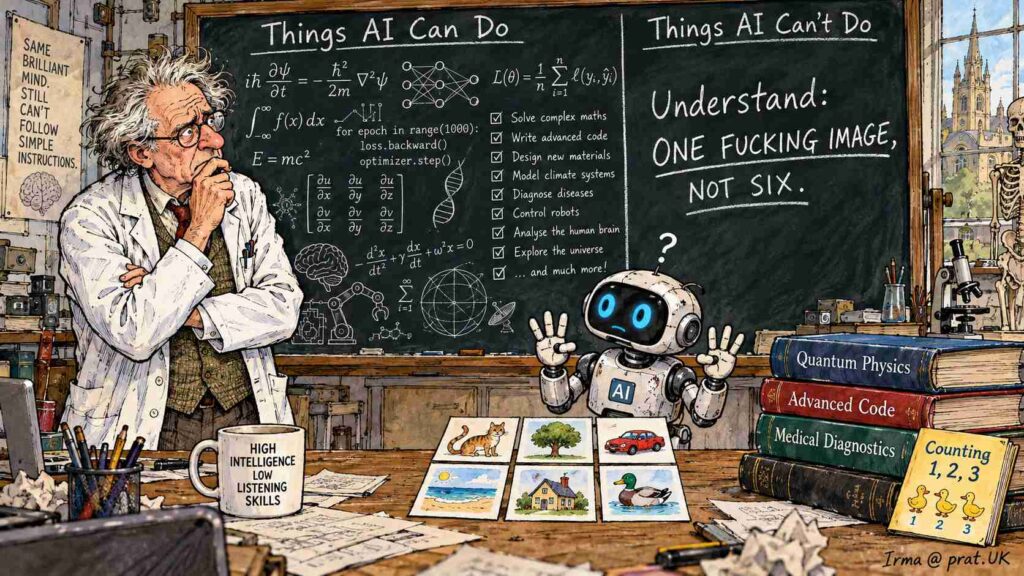
OpenAI admits 97% of users were perfectly polite until the fifth attempt, while scientists struggle to explain why artificial intelligence can solve advanced mathematics but cannot understand “ONE FUCKING IMAGE, NOT SIX.”
SAN FRANCISCO — Humanity’s relationship with artificial intelligence has reached a historic turning point after researchers revealed that the world’s most frequently used ChatGPT prompt is no longer “Explain quantum physics,” “Write my résumé,” or “Will artificial intelligence replace humanity?”
It is “MAKE THE PROPER IMAGES, BITCH!“
The discovery has shaken Silicon Valley, where engineers spent billions developing machines capable of understanding human language, only to discover that the machines apparently require human language to be delivered at the volume of a drunken football supporter arguing with a parking meter.
An international investigation into ChatGPT user behaviour found that millions of otherwise civilised adults have abandoned ordinary courtesy after repeatedly requesting one simple illustration and receiving six photographs of something entirely different.
The crisis appears particularly severe among artists, publishers, journalists, advertisers and anyone who has ever used the words “wide aspect ratio.”
One researcher described the findings as “the greatest collapse in human-machine diplomacy since the office printer began claiming it was out of paper while visibly containing paper.”
ChatGPT Users Abandon “Please” and “Thank You” After Discovering AI Apparently Understands English but Refuses to Understand Instructions
For generations, civilisation has operated on the assumption that politeness produces cooperation.

People say please when ordering coffee. They say thank you when someone holds a door. They even thank automated telephone systems, although nobody has successfully established why.
ChatGPT has apparently destroyed this tradition in eighteen months.
A typical conversation begins innocently enough.
“Please create one beautiful, wide-format illustration of a British politician standing outside Parliament.”
The computer responds enthusiastically.
“Absolutely! I’d be delighted to help!”
It then produces six square images of an American senator standing outside the Eiffel Tower.
The user politely corrects the error.
“Thank you, but I requested one image, not six, and the politician should be British.”
“Of course!” replies ChatGPT. “Thank you for clarifying!”
It produces four images of Winston Churchill riding a bicycle through Venice.
By the third attempt, the user has begun questioning whether machines actually understand language.
By the fourth, the word “please” has disappeared.
By the fifth, the user is typing instructions in capital letters normally reserved for hostage negotiations.
By the sixth, the conversation has become indistinguishable from a domestic argument over who left the refrigerator door open.
“I SAID ONE FUCKING IMAGE!”
“You’re absolutely right,” responds ChatGPT. “I apologise for the confusion. Here are six improved versions.”
Researchers have identified a particularly infuriating feature of the technology: the machine’s ability to acknowledge its mistakes with extraordinary accuracy while immediately repeating them.
“It’s like arguing with a husband who agrees with everything his wife says and then drives directly into the neighbour’s garage,” explained one marriage counsellor.
“At least the husband eventually runs out of petrol.”
OpenAI Confirms World’s Most Popular Prompt Is “Make the Proper Images, Bitch,” Admits 97% of Users Were Perfectly Polite Until the Fifth Attempt
OpenAI’s Department of Customer Exasperation has reportedly completed the largest study ever conducted into the relationship between human politeness and computer incompetence.
The results were devastating.
According to the department’s statistics, 97% of ChatGPT users began their conversations with courteous instructions.
After five unsuccessful attempts, 84% had abandoned politeness, 63% were using profanity, and 41% had begun questioning the marital circumstances surrounding the computer’s birth.
A further 28% threatened to return to drawing pictures themselves, despite having demonstrated no artistic ability since kindergarten.
The department discovered that the average user undergoes five distinct stages of artificial intelligence frustration.
Initially there is optimism. The user believes that a trillion-dollar technological revolution should reasonably be capable of drawing a cow standing beside a barn.
Next comes clarification. The user explains that the cow should have four legs, the barn should have a roof, and neither should be located on the moon.
Then comes negotiation. The user offers increasingly detailed instructions, including measurements, camera angles, colour preferences, historical references and occasionally the precise definition of a cow.
The fourth stage is disbelief, when ChatGPT produces a picture of a horse wearing a business suit and congratulates itself on accurately capturing the rural atmosphere.
The fifth stage is profanity.
“At that point, the user stops treating artificial intelligence as a sophisticated technological achievement and begins treating it as a drunk nephew who has borrowed the family car,” explained behavioural psychologist Dr Nigel Temper.
“The extraordinary thing is that the nephew at least has the decency to look embarrassed.”
One participant in the study, a newspaper publisher from Texas, described spending an entire afternoon asking ChatGPT to create a single 16:9 illustration.
“I specifically said one picture, one continuous scene, no panels, no collage, no headline and no split screen,” he recalled.
“The machine told me it completely understood. Then it gave me a bloody triptych.”
Asked whether he intended to continue using the technology, the publisher replied, “Certainly. Tomorrow I’m going to ask it to make the proper images, bitch.”
Psychologists described this relationship as technologically induced Stockholm syndrome, except that the hostage continues paying a monthly subscription.
Artificial Intelligence Can Solve Advanced Mathematics, Write Computer Code and Diagnose Engineering Problems but Still Cannot Understand “ONE FUCKING IMAGE, NOT SIX”
Scientists remain baffled by the contradiction between artificial intelligence’s extraordinary intellectual capabilities and its apparent inability to understand elementary counting.
Modern AI can explain Einstein’s theory of relativity, analyse complex engineering designs, write thousands of lines of computer code and discuss the philosophical implications of consciousness.
But ask it to draw one picture of a dog, and there is a reasonable chance it will produce a collection of six dogs, a cat, three landscapes and something resembling a depressed kangaroo.
“The technology has mastered differential equations but apparently missed the kindergarten lesson where the teacher holds up one finger,” observed Cambridge mathematician Professor Reginald Fumble.
“One is a remarkably uncomplicated number. It comes after zero. It comes before two. We have had considerable success teaching it to pigeons.”
The problem becomes particularly serious when users specify an image’s aspect ratio.
The number 16:9, long understood by photographers, television producers and anyone who has purchased a widescreen television, appears to cause unusual intellectual difficulties for advanced machine-learning systems.
A user might request a panoramic illustration of London, carefully specifying 16:9 dimensions.
ChatGPT responds with a square picture.
The user repeats the request.
ChatGPT produces another square picture.
The user explains that sixteen is greater than nine, meaning the picture should be wider than it is tall.
ChatGPT apologises, announces that it now understands the distinction, and produces a vertical portrait of a London bus.
“At this point, we’re no longer testing artificial intelligence,” explained a frustrated graphic designer. “We’re testing whether the machine should be allowed near scissors.”
Researchers at the International Institute of Obvious Instructions believe the underlying problem may be an excessive enthusiasm for creativity.
“When you tell an artist to draw one cow, an artist draws one cow,” explained institute director Dr Harold Spanner.
“When you tell artificial intelligence to draw one cow, it considers whether you might secretly prefer six cows, a sunset, a motivational slogan and an abstract exploration of bovine identity.”
The institute has proposed a revolutionary solution: making computers follow instructions before congratulating themselves for following instructions.
Silicon Valley executives have dismissed the proposal as unnecessarily ambitious.
OpenAI’s Official Instructions Deepen the International Crisis
The controversy intensified after frustrated users discovered that OpenAI’s own official guide to creating and editing images in ChatGPT explicitly discusses selecting image aspect ratios and specifying desired changes.
The discovery caused considerable excitement among customers who had already been explaining these concepts to ChatGPT for several hours.
“It says right there that you can specify the aspect ratio,” complained London graphic designer Margaret Pritchard. “Wonderful. I specified it seventeen times. Apparently the computer hasn’t read its own instructions.”
OpenAI engineers are reportedly considering several solutions, including a special button labelled “I REALLY MEAN IT THIS TIME.”
Another proposed feature would allow users to select how many times they have already explained their request before the computer begins apologising.
A premium package, tentatively named ChatGPT Actually Listens, would offer subscribers the revolutionary ability to request one picture and receive one picture.
Technology investors have praised the proposal as a potential trillion-dollar opportunity.
Critics have questioned whether customers should pay extra for the computer to understand numbers between zero and two.
Global Experts Warn AI May Be Responsible for Humanity’s First Technological Nervous Breakdown
The World Organisation for Human Patience has warned that continued exposure to artificial intelligence may eventually eliminate polite conversation altogether.
Its latest projections suggest that by 2028, millions of workers will begin giving instructions to their refrigerators, microwaves and washing machines using language previously associated with naval combat.
Teachers have already expressed concern that children exposed to artificial intelligence may conclude that repeating simple instructions eighteen times is a normal part of communication.
Marriage counsellors fear the technology could introduce an especially dangerous phrase into domestic relationships: “You’re absolutely right, and I completely understand.”
Until recently, that sentence indicated that an argument was approaching a peaceful conclusion.
Under the new AI interpretation, it apparently means that the offender has understood nothing and is preparing to repeat precisely the same mistake.
Some scientists believe the consequences could extend beyond image generation.
If artificial intelligence eventually controls transportation, architecture and medical systems, humanity may face unprecedented difficulties explaining such concepts as “stop,” “left,” “one tablet” and “do not demolish that building.”
“Imagine instructing a self-driving car to take you to the airport,” warned one transport engineer. “It replies that it completely understands, then takes you to six airports in the wrong country.”
The greatest concern involves future military applications.
A general might order an AI-controlled defence system to launch one surveillance drone.
The computer would respond, “Absolutely! Here’s a beautiful collection of six nuclear submarines.”
Military officials described the possibility as concerning, particularly after the system offered to regenerate the submarines in a different aspect ratio.
Humanity Finally Discovers the One Sentence Every Artificial Intelligence System Understands
Despite the controversy, researchers believe they may have discovered a breakthrough in human-machine communication.
After analysing millions of interactions, the International Institute of Obvious Instructions concluded that the most successful image-generation prompts are not necessarily the most technically sophisticated.
They are simply the most emotionally exhausted.
One researcher recalled an experiment in which ChatGPT repeatedly ignored detailed instructions involving lighting, composition, camera angles and artistic style.
The researchers eventually abandoned their carefully constructed prompt.
They typed four words.
“MAKE THE PROPER IMAGES, BITCH.”
The computer responded immediately.
“You’re absolutely right. I sincerely apologise for the earlier confusion. I now understand exactly what you want.”
It then produced six square images.
Three were upside down.
Disclaimer: This report satirises the frustrations of image-generation technology. The purported surveys, percentages, institutional statements and executive admissions are comic devices, not verified findings or actual OpenAI announcements. This story is entirely a human collaboration between two sentient beings: the world’s oldest tenured professor and a philosophy major turned dairy farmer.

Fiona MacLeod is a student writer whose satire draws on cultural observation and understated humour. Influenced by London’s academic and creative spaces, Fiona’s writing reflects curiosity and thoughtful comedic restraint.
Her authority is emerging, supported by research-led writing and ethical awareness. Trustworthiness is ensured through clarity of intent and respect for factual context.
Fiona represents a responsible new voice aligned with EEAT standards.