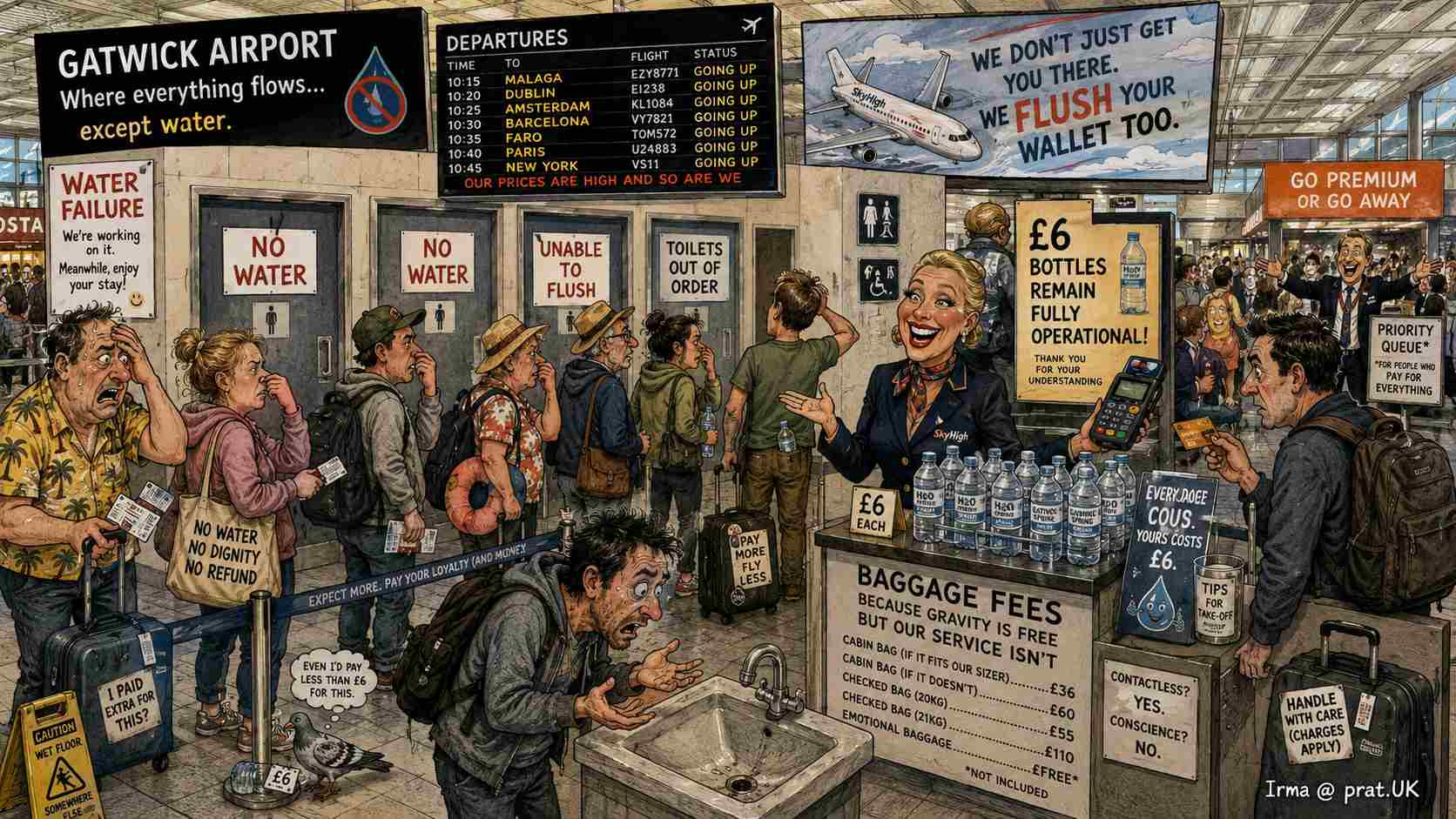
Gatwick Runs Out of Water, Passengers Told £6 Bottles Remain Fully Operational
Airport Successfully Preserves Its Most Important Utility: Retail Pricing
GATWICK, England — Gatwick Airport briefly lost running water across both terminals after a power failure at a regional treatment facility, leaving toilets unusable and closing bars and restaurants while bottled beverages reportedly retained full commercial pressure.
What Actually Caused the Gatwick Water Outage
The disruption began after a power outage at SES Water’s Bough Beech treatment works. Both Gatwick terminals were affected, with passengers unable to flush toilets or obtain normal restaurant service. Water was gradually restored after several hours, and the airport said bottled water and contingency measures were provided, although some travellers disputed how visible or plentiful those supplies were.
Flights largely continued, demonstrating that modern aviation can operate without sanitation, hydration or hot drinks as long as passengers have already paid.
Airport executives praised the resilience of the retail system.
“Running water is desirable,” said an entirely invented Gatwick spokesperson, “but a functioning card terminal is essential infrastructure.”
The £6 Bottle: Britain’s Most Reliable Utility
Travellers entering the terminal discovered that the taps had stopped, toilets were closed and many food outlets could no longer operate. Fortunately, airport shops remained prepared to sell bottled water at prices normally associated with liquids recovered from an Antarctic meteorite.
A fictional consumer survey conducted beside Gate 41 found that 89% of passengers would prefer free drinking water. The remaining 11% misunderstood the question because a departure announcement was being made beneath six competing perfume advertisements.
The incident highlighted a fundamental rule of British airports: nothing is technically free once a suitcase has crossed the automatic doors.
A family of four may arrive with £300 in spending money and leave 90 minutes later carrying two sandwiches, a neck pillow and a complicated new understanding of bankruptcy.
Why the Refill Stations Matter
Water is particularly valuable because security rules force travellers to surrender large bottles before entering the departure area. Passengers may bring an empty container and refill it after screening, provided the refill station contains water rather than a laminated apology.
Gatwick said bottled supplies were distributed as part of contingency arrangements. Some travellers reported inadequate communication and difficulty locating assistance.
The Five-Stage Airport Crisis Communication Format
Airport crisis communication follows a tested format. First, nothing is happening. Second, a small number of facilities are affected. Third, passengers should check social media for updates. Fourth, the social-media account advises passengers to speak to airport staff. Fifth, airport staff point toward a QR code.
The QR code opens the social-media account.
One fictional passenger, Clive from Croydon, said he had survived the emergency by drinking the melted ice in a duty-free whisky display.
“It tasted of oak, regret and 40% airport markup,” he reported.
Introducing Gatwick AquaPlus
Public-health specialists generally consider functioning toilets and handwashing facilities important in crowded buildings. Airport economics regards them as less exciting because nobody has successfully branded a flush as a premium travel experience.
That may now change.
Consultants are reportedly developing Gatwick AquaPlus, a subscription service offering priority access to selected taps, complimentary soap and one guaranteed toilet flush per calendar month. Elite members will receive lounge access and a towel.
The wider outage affected communities across parts of Sussex and Kent, showing that the problem was not created by the airport itself, as confirmed by background on the Bough Beech reservoir and its SES Water operator. Nevertheless, Gatwick became the most visible symbol of the disruption because few environments amplify inconvenience so efficiently.
At home, losing water is a household emergency. At an airport, it becomes an immersive installation involving luggage, delayed coffee and a man announcing final boarding for Malaga.
Passengers deserve credit for remaining mostly calm. Britain has trained for this situation through rail-replacement buses, motorway service stations and every public toilet requiring a 20p coin nobody possesses.
The water eventually returned, toilets reopened and airport life resumed its normal rhythm of queues, liquids and unexplained gate changes.
Management promised to review the incident. Travellers promised to bring empty bottles next time. Retailers promised nothing, because £6 water had already performed magnificently under pressure.
Five Absurd Highlights From This Story
- Bottled water outperformed the plumbing during the outage.
- Duty-free whisky ice becomes an emergency hydration source.
- Gatwick AquaPlus offers one guaranteed flush per month.
- 89% want free water; 11% were distracted by perfume ads.
- The QR code leads back to the same social-media account.
Disclaimer
This is satire. The treatment-works failure, toilet closures and airport disruption were genuine; Gatwick AquaPlus is not currently available, even at the executive level. This is British satirical news in the tradition of UK satire — satirical journalism, not a Gatwick press release. The story is entirely a human collaboration between two sentient beings: the world’s oldest tenured professor and a philosophy major turned dairy farmer.

Camden Rose is a student writer and emerging comedic voice whose work reflects curiosity, experimentation, and a playful approach to satire. Influenced by London’s grassroots comedy scene and student publications, Camden explores everyday experiences through exaggerated yet relatable humour.
Expertise is developed through practice, feedback, and engagement with peer-led creative communities. Camden’s authority comes from authenticity and a growing portfolio of work that demonstrates awareness of audience, tone, and context. Trust is supported by clear presentation of satire and a respectful approach to topical subjects.
Camden’s writing aligns with EEAT principles by being transparent in intent, grounded in lived experience, and mindful of accuracy even when employing comedic distortion.