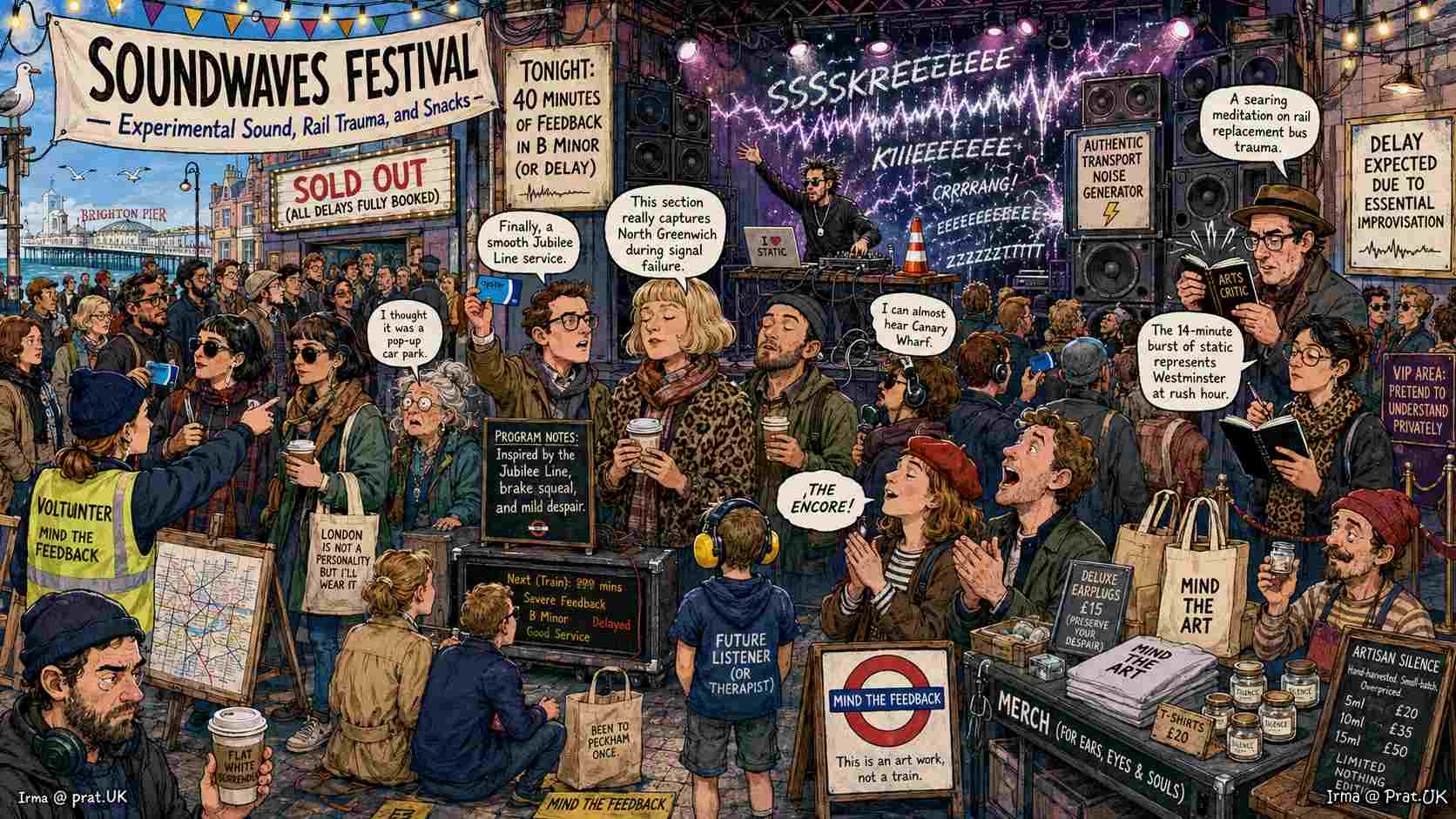
Soundwaves Festival Sells Out After London Crowd Mistakes Experimental Feedback For The Jubilee Line
Brighton Welcomes Thousands Seeking Music Too Difficult To Enjoy Anywhere Near Their Landlord
BRIGHTON, England — The Soundwaves Festival sold out this weekend after thousands of Londoners mistook a burst of experimental electronic feedback for the arrival of a Jubilee line train and instinctively began queuing behind a yellow barrier.
Festival organisers said the misunderstanding occurred during an opening performance entitled Transit Anxiety No. 4, in which a Danish composer dragged a microphone across a radiator while an audience member read delayed-train announcements through a bucket.
Within minutes, commuters from Camden, Islington and Hackney had formed an orderly line, tapped their bank cards against a decorative speaker and entered the venue without asking what was happening.
“It sounded exactly like London transport,” said festival attendee Rupert Fenwick, a brand consultant who describes himself as culturally homeless. “There was screeching, sudden silence, mechanical distress and no clear indication when anything would begin. I assumed I was somewhere near Baker Street.”
Organisers quickly placed a handwritten sign outside reading SOUNDWAVES FESTIVAL: DEFINITELY NOT THE UNDERGROUND, which increased ticket sales by 34 percent.
Several visitors said they had travelled to Brighton specifically to experience sounds unavailable in London, where every creative noise is immediately followed by a landlord demanding an additional £275 per month.
Fifteen Humorous Observations About Soundwaves Festival
1. Experimental Music Becomes Art The Moment Nobody Can Hum It
A melody invites participation.
Experimental music invites a postgraduate seminar.
2. Londoners Will Travel Seventy Miles To Hear A Noise Their Boiler Makes For Free
The boiler produces rattling, groaning and unexplained percussion.
But it lacks a programme note, so apparently it is not culture.
3. Every Festival Needs A VIP Area, Even When Nobody Knows What Is Happening
The Soundwaves Festival VIP section allows people to misunderstand the performance behind a velvet rope.
4. A Laptop Crash Is Only A Technical Problem Until Someone Calls It Improvisation
The screen freezes.
The room goes silent.
The composer bows.
Civilisation continues.
5. Forty Minutes Of Static Is Considered Challenging Art
Forty minutes of static on the television is considered a reason to call customer support.
Context is everything.
6. London Audiences Applaud Confusion Because Silence Might Reveal They Are Confused
Nobody wants to be the first person to ask whether the performance has started.
7. A Traffic Cone Becomes An Instrument Once Admission Costs £18
At £18, breathing into road equipment is no longer odd behaviour.
It is acoustical research.
8. Brighton Seagulls Have Been Performing Experimental Music For Years
They combine shrieking, theft and audience participation.
They are still waiting for Arts Council recognition.
9. Every Programme Description Contains The Word “Interrogates”
A violin no longer plays music.
It interrogates space.
A kettle interrogates domesticity.
A broken amplifier interrogates the insurance policy.
10. The Less Understandable The Performance, The Longer The Artist’s Biography
A three-minute piece may require an eleven-page explanation involving memory, architecture and post-industrial rain.
11. Sound Art Is Music That Has Escaped The Responsibility Of Rhythm
It wanders freely through the gallery, asking strangers to question capitalism.
12. London Culture Fans Love Brighton Because It Feels Rebellious And Still Has Coffee
True revolution requires oat milk.
13. The Most Experimental Part Of Any Festival Is The Toilets After 8 p.m.
Nobody has yet received a grant to explore this installation.
14. Audiences Call It Transformative Because “Expensive And Peculiar” Sounds Ungrateful
You do not leave baffled.
You leave altered.
15. Every Standing Ovation Begins With One Person Who Needs To Stretch
The rest of the audience rises because nobody wants to appear insufficiently moved.
Brighton Welcomes Music Too Difficult To Enjoy Near A London Landlord

The Soundwaves Festival attracted Londoners who said they wanted to escape the capital’s predictable cycle of rent, commuting and pretending a converted cupboard was “cosy.”
Brighton provided them with a seaside environment in which music could be difficult for artistic reasons rather than because a neighbour was operating a blender through the wall.
Festival director Imogen Resonance said the event offered “a radical space in which sound can become architecture, emotion and collective inquiry.”
A journalist asked whether that meant concerts.
“We are trying to move beyond that term,” Resonance replied.
The festival programme included performances in theatres, galleries, basements, stairwells and one municipal corridor selected for what organisers called its “aggressively transitional acoustics.”
Visitors received a map containing no street names, only emotional directions.
“Turn left at alienation,” it advised. “Continue until the pavement begins questioning its purpose.”
Several Londoners became lost but assumed this was part of the installation.
Forty Minutes Of Static Praised As Brave Critique Of British Rail
The festival’s most acclaimed performance consisted of forty uninterrupted minutes of radio static.
Artist Benedict Humm stood beside an antique receiver while the device hissed at an audience seated on recycled railway cushions.
The work was entitled Signal Failure: A National Conversation.
Critics praised it as a courageous examination of British transport.
“It captures the passenger experience perfectly,” said arts reviewer Penelope Sigh. “There is noise, uncertainty, a loss of connection and the growing suspicion that no one is in charge.”
Halfway through the performance, the static briefly cleared and a voice announced that the 14:07 service had been cancelled due to a shortage of train crew.
The audience gasped.
One man wept.
Another whispered, “That is almost too literal.”
Benedict later admitted the announcement had entered the performance accidentally.
The revelation earned him an additional standing ovation for allowing reality to collaborate.
British Rail historians noted that experimental musicians and train operators had long shared a commitment to irregular timing.
Both begin late, stop unexpectedly and ask the public to appreciate the journey rather than demand a destination.
Washing Machine Accompanied By Norwegian Cellist
In another Soundwaves Festival highlight, hundreds of London culture enthusiasts packed a converted warehouse to hear a washing machine perform alongside Norwegian cellist Astrid Fjordson.
The appliance was loaded with three towels, a shoe and what the programme described as “the burden of domestic repetition.”
Fjordson played a mournful six-note phrase while the machine entered its spin cycle.
The audience sat motionless.
Some closed their eyes.
One person nodded slowly, though witnesses later confirmed he had fallen asleep.
Composer Lars Vibration explained that the work explored the tension between human longing and modern household technology.
“The cello represents memory,” he said. “The washing machine represents society’s endless attempt to cleanse itself.”
A technician said the machine represented an uneven floor.
The piece reached its emotional climax when the appliance lurched six inches toward the audience.
People in the front row called the movement “visceral.”
A health-and-safety officer called it “not properly levelled.”
Both descriptions appeared in the following morning’s reviews.
London attendee Amelia Quince said she found the performance deeply moving.
“My washing machine does the same thing,” she said. “But I usually kick it.”
VIP Guests Pretend To Understand Electroacoustic Improvisation Privately
Recognising demand from affluent visitors, the Soundwaves Festival introduced an exclusive VIP enclosure where guests could pretend to understand electroacoustic improvisation without being observed by the general public.
The area featured velvet seating, artisanal earplugs and a private bar serving cocktails named after obscure compositional techniques.
The most popular drink was the Prepared Piano, consisting of gin, tonic and several loose screws.
VIP ticket holders also received a laminated card containing emergency phrases for discussing performances.
Suggested responses included:
“It resists conventional listening.”
“The silence was doing important work.”
“I admired the refusal of resolution.”
“The artist clearly understands concrete.”
Guests were advised never to say, “It sounded like my fridge.”
That phrase could only be used if followed by, “but politically.”
A festival spokesperson defended the VIP area, saying cultural equality required providing wealthy patrons with a superior version of confusion.
The standard ticket permitted ordinary festivalgoers to stand beside a speaker.
VIP access allowed them to stand behind the speaker and meet the person who had switched it on.
Composer Receives Ovation After Laptop Freezes In Unexpected Key
Experimental composer Milo Cache became the festival’s overnight sensation after his laptop froze twelve seconds into a scheduled fifty-minute performance.
Cache had intended to present a complex digital work combining field recordings, artificial birdsong and fragments of government planning documents.
Instead, his computer produced a repeating click.
The click continued for nine minutes.
Audience members gradually leaned forward.
One critic began taking furious notes.
A professor from Sussex University later described the loop as “an uncompromising rejection of digital abundance.”
Cache attempted to restart the laptop.
The screen turned blue.
The audience erupted.
“It was the bravest key change I have heard all year,” said attendee Julian Moss, who had paid £26 for his seat and therefore required the evening to be historically important.
When the machine finally restarted, Cache tried to begin the intended composition.
Several audience members left, saying the conventional music ruined the purity of the malfunction.
The festival awarded Cache its annual Prize for Unplanned Sonic Integrity.
Microsoft declined to comment.
Londoners Pay £18 To Hear Man Breathe Into Traffic Cone
The final performance took place on Brighton seafront, where artist Oliver Pufnell breathed rhythmically into an orange traffic cone for thirty-five minutes.
Tickets cost £18.
The work, entitled Restricted Passage, examined urban control, public space and the emotional life of road maintenance.
Pufnell began with short breaths, progressed to sighing and concluded with what the programme called “an extended exhalation of municipal grief.”
Children gathered nearby and asked whether he was trapped.
Their parents assured them it was art.
Londoner Sebastian Vale called the performance transformative.
“I entered believing a traffic cone was a traffic cone,” he said. “I left understanding that it may also be a vessel, a boundary and a tax-deductible instrument.”
Another attendee described the experience as haunting.
“I could hear the sea, the wind and a man breathing through plastic,” she said. “It was exactly like renting a flat with thin walls.”
A council worker arrived midway through the performance and attempted to retrieve the cone.
Audience members applauded the intervention, assuming it represented the state reclaiming public space from the artist.
The council worker received three offers from galleries before completing his shift.
Soundwaves Festival Boosts Brighton Economy And Vocabulary
Local businesses welcomed the influx of Soundwaves Festival visitors.
Coffee shops introduced drinks named after experimental works, including the Deconstructed Flat White, which arrived as milk, coffee and a written apology.
Hotels offered special “immersive acoustic rooms” overlooking the railway.
Guests later discovered these were ordinary rooms with windows that did not close properly.
Restaurants created menus inspired by sound art.
One dish consisted of an empty plate accompanied by a recording of soup.
It cost £14.
Economists estimated that festival visitors spent thousands of pounds on accommodation, food, travel and reassuring books explaining what they had heard.
Bookshops reported strong sales of titles containing words such as liminality, resonance, embodiment and practice.
Nobody purchased a book titled Was It Supposed To Sound Like That? because organisers had classified it as hate speech.
Experts Define Experimental Music
Cultural expert Dr Celia Tremor defined experimental music as music in which the process, uncertainty or exploration may matter as much as the finished sound.
“In ordinary music, listeners ask whether they enjoyed the song,” she explained. “At the Soundwaves Festival, they ask whether enjoyment itself has been sufficiently interrogated.”
Dr Tremor said experimental art could encourage audiences to listen differently, notice overlooked sounds and reconsider the division between music and noise.
This was a serious and reasonable explanation.
Festival publicists immediately removed it for being too understandable.
A fictional survey conducted among 500 attendees found that 72 percent described the festival as “challenging,” 19 percent called it “important” and 9 percent were still waiting for the Jubilee line.
Eighty-four percent claimed to understand at least one performance.
When asked to explain it, the figure fell to 6 percent.
London Crowd Returns Home With Expanded Ears And Reduced Bank Balances
As the Soundwaves Festival concluded, thousands of visitors boarded trains back to London carrying tote bags, festival programmes and new confidence in describing random noises as cultural events.
Several passengers reported that the train’s brakes produced an extraordinary metallic shriek outside East Croydon.
By instinct, the carriage applauded.
One commuter described the sound as “a haunting dialogue between infrastructure and despair.”
Another asked whether drinks were still available.
Festival organisers declared the weekend a major success and announced plans for next year’s programme.
Proposed attractions include a duet for leaf blower and medieval harp, a silent opera about broadband failure and a twelve-hour installation in which a printer attempts to connect wirelessly.
Tickets are expected to sell out immediately.
Londoners have already begun queueing.
Most still believe it is the Underground.
Why Soundwaves Festival Matters
Beneath the jokes, the Soundwaves Festival represents an adventurous side of British arts culture.
It gives composers, performers and sound artists room to test ideas that would not fit comfortably into a conventional concert.
It invites audiences to hear ordinary environments differently.
It turns machines, public spaces, voices, found objects and electronic technology into creative material.
It also proves that British audiences will listen to almost anything, provided the brochure uses enough abstract nouns.
For Brighton, Soundwaves Festival offers tourism, cultural activity and a welcome influx of London money.
For Londoners, it provides an escape from landlords, Tube delays and the terrifying possibility of attending a concert with an identifiable chorus.
And for traffic cones, washing machines and malfunctioning laptops, it offers the professional recognition they have been waiting for.
Disclaimer
This article is satire. The performers, performances, quotations, surveys, critics and artistic traffic cones are fictional. Any resemblance to actual experimental musicians, London commuters, Norwegian cellists or malfunctioning laptops is purely resonant.
This story is entirely a human collaboration between two sentient beings: the world’s oldest tenured professor and a philosophy major turned dairy farmer.

Carys Evans is a prolific satirical journalist and comedy writer with a strong track record of published work. Her humour is analytical, socially aware, and shaped by both academic insight and London’s vibrant creative networks. Carys often tackles media narratives, cultural trends, and institutional quirks with sharp wit and structured argument.
Her authority is reinforced through volume, consistency, and reader engagement, while her expertise lies in combining research with accessible humour. Trustworthiness is demonstrated by clear labelling of satire and an ethical approach that values accuracy and context.
Carys’s work supports EEAT compliance by offering informed satire that entertains while respecting readers’ trust.