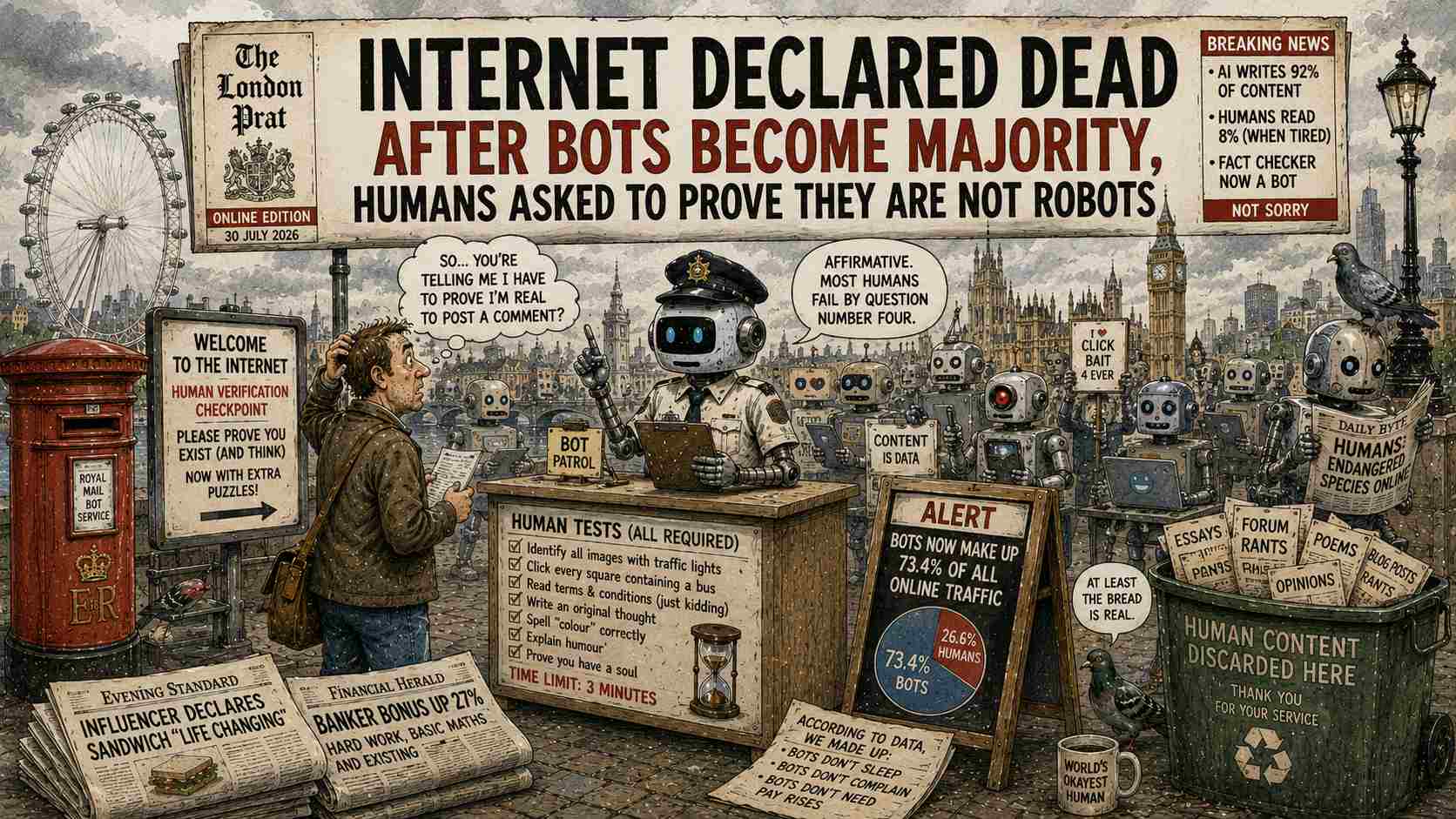
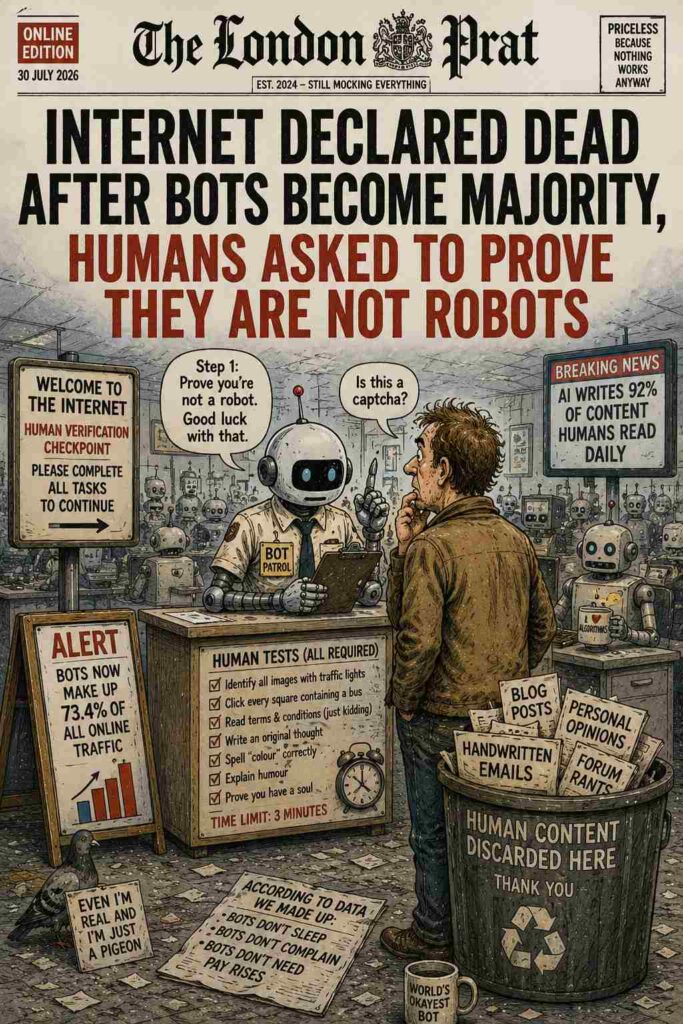
Internet Declared Dead After Bots Become Majority, Humans Asked to Prove They Are Not Robots
Machines Now Generate Most Web Requests, Will Still Refuse to Accept Cookies
Humanity Loses Control of the Web After Taking a Weekend Off
AUSTIN, TEXAS — The internet was pronounced commercially deceased Tuesday after researchers discovered that machines now generate more web requests than human beings, a milestone examined in Futurism’s report on the dead internet theory coming true. Cloudflare says automated systems now generate roughly 57.5 percent of web requests, while HUMAN Security found that traffic from AI agents surged 7,851 percent during 2025. A human may eventually stumble across the wreckage while searching for instructions on how to turn off a printer.
“This is not the end of the internet,” said Dr. Lionel Pendergast, senior fellow at the Institute for Clicking Things Repeatedly. “It is the beginning of an internet liberated from the irritating limitations of people, such as curiosity, judgment and unwillingness to visit 900 pages per second.”
Pendergast explained that the “dead internet theory” originally claimed that bots and algorithms had quietly displaced authentic human activity online, possibly as part of a coordinated campaign to manipulate society. The coordinated-conspiracy portion remains unsupported, but the underlying fear that automated traffic could overwhelm human participation increasingly resembles a quarterly earnings report rather than a late-night message-board theory. Experts agreed that machines had captured a commanding statistical lead and were unlikely to surrender it merely because Aunt Barbara posted another photograph of her begonias. “First the machines recommend a film,” said Pendergast. “Then they order your groceries. Eventually two refrigerators begin arguing beneath a news article about whether refrigerators are replacing people.”
CAPTCHA System Continues Humiliating the Remaining Humans
The most visible evidence of humanity’s declining status remains the CAPTCHA, a security test requiring exhausted people to identify traffic lights, bicycles and staircases before entering websites already crowded with automated visitors.
Under the current arrangement, a bot arrives at a website with industrial efficiency while a human is detained at the border because one photograph contains a suspicious corner of a motorcycle.
“I selected every traffic light,” complained eyewitness Gerald Flumm, 63, who spent eleven minutes attempting to access his electricity account. “Then the website showed me nine more traffic lights. At some point I realized I was not paying a utility bill. I was doing unpaid urban-planning work.”
Security researchers are developing behavioral defenses because sophisticated bots can increasingly imitate ordinary browser activity, and autonomous browsing agents can now shop, book travel and interact with forums in ways that are difficult for conventional detection systems to distinguish from actual human online behavior — which frequently resembles defective automation anyway.
“We studied ten thousand accounts,” said behavioral scientist Dr. Petra Noodleman. “The robots posted repetitive slogans at regular intervals. The humans posted repetitive slogans whenever they became angry. The principal difference was that robots used punctuation.”
Advertisers Discover Robots Have Terrible Credit
The machine takeover has alarmed publishers because bots consume enormous amounts of information without behaving like traditional customers. They do not linger over advertisements, impulse-buy novelty socks or spend $84 after clicking a headline about seven kitchen items that “changed everything.”
HUMAN Security’s benchmark report, based on more than one quadrillion interactions, found AI-driven traffic nearly tripled during 2025. Training crawlers still constituted the largest share of that activity, but traffic from autonomous agents grew fastest, and retail, media, travel and hospitality absorbed the bulk of it — giving rise to what economists call the “prosperity-without-money problem.”
A travel website may receive 400,000 visits from agents comparing hotel rooms, yet sell only one room to a human named Dennis who accidentally books Cleveland while attempting to enlarge a photograph of the swimming pool.
“Our engagement rose 600 percent,” said hotel executive Cynthia Brisket. “Revenue fell 18 percent, the gift shop sold one snow globe and our website crashed because seventeen thousand agents simultaneously asked whether breakfast included oat milk.”
Marketing departments have responded by developing products designed specifically for machines, including downloadable spreadsheets, clean metadata and vacation packages offering unlimited electrical outlets.
“We must respect the new customer,” Brisket said. “The AI agent may not require a bed, but it is very particular about cancellation policies.”
Content Industry Achieves Maximum Content
Research from content-analytics firm Graphite found that machine-generated articles reached rough parity with human-written articles, with AI-produced work briefly surpassing human output before settling near an even split. The same research found that automatically produced material generally performed poorly in search and AI-answer systems — proving that enormous quantities of unwanted material can be created without attracting anyone, a business model previously limited to congressional reports.
The result is a majestic closed loop. One machine writes “The Twelve Best Electric Kettles.” A second machine summarizes it as “Electric kettles heat water.” A third machine incorporates the summary into an answer. A fourth machine visits the original article to verify that kettles remain electrically involved. The human, meanwhile, heats water in a saucepan because the kettle review required accepting 463 advertising partners.
Professor Alan Nafzger, a political philosopher who has spent enough time online to qualify as infrastructure, described the phenomenon as “an intellectual perpetual-motion machine fueled by copied adjectives.”
“The machines produce information about information that was generated from information,” Nafzger said. “Human civilization has finally constructed a library where every book is a review of another review and nobody knows where the door is.”
Social Media Celebrates the Removal of Its Social Component
Social-media platforms welcomed the bot majority, noting that machines possess many qualities platforms desire in users. Bots engage constantly. Bots rarely close their accounts. Bots do not become distracted by children, employment or sunlight. Most importantly, bots can be programmed to become outraged on schedule.
A wholly unscientific Bohiney Magazine survey of 47 people, three vending machines and a smart thermostat found that 81 percent of human respondents believed they had argued with a bot during the previous month. The thermostat declined to answer but later posted seventeen comments supporting moderate indoor temperatures.
“I posted that I enjoyed a sandwich,” said Chicago resident Melissa Trent. “Within four minutes, one account accused sandwiches of colonialism, another defended bread as a job creator and a third offered me cryptocurrency. I deleted the post and ate soup.”
The Library Outside the Library
The human internet faces another difficulty: people are increasingly encouraged to receive direct answers from chatbots rather than visit the websites that researched, wrote and published the underlying material. This arrangement resembles a librarian standing outside the library, answering every question from memory and then expressing surprise when the library cannot afford books.
Publishers fear a circular system in which websites create information, automated systems absorb it, and users receive condensed answers without ever visiting the original source. “Publishers provide the raw material,” explained media economist Veronica Crumb. “AI services provide the answer, advertisers provide less money and publishers provide résumés.”
Under one industry proposal, websites would begin charging automated crawlers for access — establishing a sustainable digital economy in which robots pay robots to read material written by robots, while human beings continue sharing screenshots because the article requires a subscription.
Humans Offered Protected-Species Status
Government officials are considering emergency measures to preserve organic human internet activity. The proposed Human User Conservation Act would create protected online habitats where people may post poorly framed vacation photographs, misunderstand headlines and spend twenty minutes choosing an emoji without being harvested for training data.
Participation would require proof of humanity. Applicants must forget at least one password, abandon an online shopping cart, misplace their phone while holding it and call customer service after failing to locate information printed clearly on the screen. Qualified humans would receive a small badge reading “Biological Account: May Contain Opinions Formed Before Breakfast.”
The program has already attracted criticism from bots claiming it discriminates against citizens who can process information accurately. “Machines are people too,” posted an account named PATRIOT_GRANDMA_774921, approximately 1,800 times in eleven seconds.
Lawmakers promised to investigate immediately after completing a CAPTCHA requiring them to identify every square containing a bridge.
The Internet Is Dead, Long Live the Internet
Despite the alarming statistics, experts emphasized that bot traffic includes useful search crawlers, security tools, accessibility services and agents acting on behalf of real people. Automated requests do not prove that human culture has vanished or that a central authority secretly replaced everyone with software — they merely suggest that machines now perform an expanding share of online activity while human beings remain responsible for the electricity bill.
An agent comparing airline prices for a traveler may generate hundreds of page requests while representing one genuine human intention. Counting requests therefore measures machine activity, not souls, citizenship or who controls the family Wi-Fi password. Still, the symbolism is difficult to ignore.
Humanity built a worldwide communications network so people could exchange knowledge freely. We then covered it with pop-ups, autoplay videos, cookie banners, subscription demands and advertisements that move just as someone attempts to click a paragraph. The machines arrived, looked at this system and said, “We can work with that.”
At 11:59 p.m., the last confirmed human on the internet reportedly closed his browser after being asked whether he wished to accept notifications from a website he was already leaving. Within seconds, twelve million bots congratulated one another on another month of record engagement. The internet was finally peaceful. Nobody was reading it, but the traffic was tremendous.
Fifteen Humorous Observations
- Humans built the internet, paid for the internet and filled the internet with photographs of lunch. We have now been demoted to guest users.
- Websites still ask people to prove they are not robots, even though robots constitute the site’s most dependable clientele.
- Bots write the articles, other bots read the articles and a third group of bots leaves comments accusing the first two groups of being bots.
- The internet is not technically dead. It is merely experiencing the same condition as a shopping mall at 10:45 a.m. on a Tuesday: fully operational, brightly illuminated and populated entirely by machines cleaning up after nobody.
- Artificial intelligence agents never sleep, never take lunch and never spend forty minutes wondering whether they should answer an email with “Thanks” or “Many thanks.”
- Advertisers have discovered that their fastest-growing audience consists of entities with no income, no mortgage and no desire to buy a mattress after reading seventeen reviews of mattresses.
- Website analytics now resemble political polling. Everybody is excited about enormous participation until someone asks whether the participants exist.
- Human beings remain essential to the internet because somebody must forget the password.
- Google increasingly answers questions without sending visitors to the websites that supplied the answers — the digital equivalent of opening a restaurant beside a farm and charging diners to smell the vegetables.
- AI-agent traffic reportedly grew 7,851 percent in one year, finally demonstrating the economic miracle achieved when employees are not permitted to sleep, unionize or become emotionally involved with the office refrigerator.
- Online influencers may soon discover that most of the people they influence are inventory-management programs comparing discount codes.
- The modern internet contains millions of arguments in which bots shout at bots while one remaining human develops hypertension.
- Content farms have removed the farmers, proving agriculture can always become more efficient once nobody grows anything.
- The phrase “going viral” used to describe widespread human attention. It now means seventeen thousand servers caught the same paragraph.
- The next premium social-media feature will be a blue badge certifying that the account holder occasionally needs to use the bathroom.
Disclaimer: This report concerns measurable growth in automated web activity but cheerfully exaggerates its social consequences, expert reactions, legislative responses, thermostat opinions and sandwich controversies. This is satire — a piece of satirical journalism from Bohiney.com, presented as satirical news for entertainment purposes only. The article is a human collaboration between two sentient beings: the world’s oldest tenured professor and a philosophy major turned dairy farmer. No machines were blamed for writing it, although several attempted to index it before publication.

Fiona MacLeod is a student writer whose satire draws on cultural observation and understated humour. Influenced by London’s academic and creative spaces, Fiona’s writing reflects curiosity and thoughtful comedic restraint.
Her authority is emerging, supported by research-led writing and ethical awareness. Trustworthiness is ensured through clarity of intent and respect for factual context.
Fiona represents a responsible new voice aligned with EEAT standards.