Airport Water Failure Leaves Travellers Unable to Flush Toilets Before Airlines Flush Their Savings
Passengers Discover Only One Kind of Liquidity Is Guaranteed at Gatwick
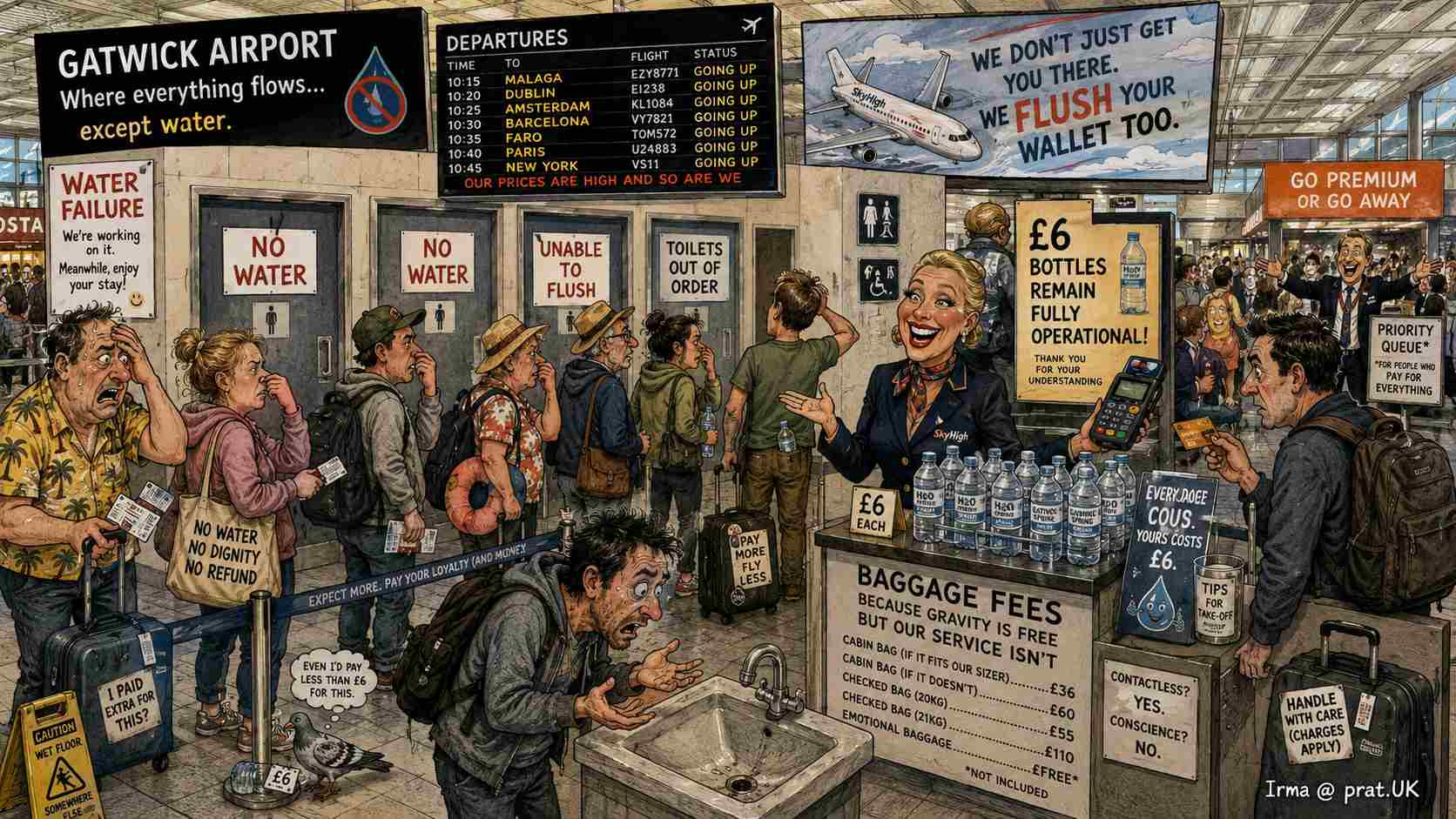
GATWICK, England — A water-supply failure at Gatwick Airport left passengers unable to flush toilets, wash normally or purchase drinks from many bars, but airlines continued successfully removing money from customers with no detectable reduction in pressure.
The Bough Beech Failure That Started It All
The outage followed a power failure at the Bough Beech Water Treatment Works. Both terminals experienced disruption, forcing the closure of restaurants, bars and toilet facilities until supplies began returning later in the day. Flights generally continued, and the airport deployed contingency measures while SES Water restored production and pressure.
Aviation economists called it a striking demonstration of infrastructure priorities.
The airport temporarily lacked water, but passengers could still purchase priority boarding, extra-legroom seating, baggage allowances, seat selection, travel insurance and the privilege of receiving emails about all five.
One fictitious airline executive said the industry maintains several independent financial reservoirs.
“Even if the terminal loses water, our surcharge pipeline is gravity-fed,” he explained. “It can operate for weeks.”
From £39 Fare to Diversified Investment Product
Modern air travel begins with a low advertised fare and develops through a series of discoveries. The passenger discovers that luggage costs extra. Sitting beside one’s spouse costs extra. Choosing a seat costs extra. Failing to choose a seat may also cost extra, emotionally.
By the time the traveller reaches the airport, the original £39 ticket has matured into a diversified investment product.
The Gatwick disruption added a new discovery: toilets depend upon water.
This surprised only the Department for Transport, which has appointed a working group to examine whether plumbing is necessary for future aviation.
What the Fabricated Poll Ranked First
A fabricated poll by Departure Lounge Analytics asked 1,000 imaginary passengers to rank essential airport services. Toilets placed first, drinking water second and functioning departure boards third. Luxury retail finished last, immediately below “being sprayed with perfume while carrying three children.”
Airport planners questioned the methodology, noting that passengers had not been offered a chance to purchase a £1,400 handbag while dehydrated.
Medieval Seating Rights and Rope-Guarded Chairs
The most uncomfortable reports concerned communication. Some travellers said they struggled to obtain information, bottled water or seating when restaurants closed, echoing accounts collected by reporters on the ground during the outage.
This is unsurprising because airport seating operates under principles borrowed from medieval land ownership. Every chair belongs either to a restaurant, a lounge, a customer purchasing something or a person sleeping across four seats while guarding one charging socket.
When restaurants close, the chairs do not become public. They enter a ceremonial state of mourning behind a rope.
One fictional witness said an employee apologised for the lack of water while directing him toward a vending machine.
“The machine wanted £4.80,” he recalled. “I wanted dignity. We reached no agreement.”
Dynamic Thirst Pricing Explained
The disruption also demonstrated the odd economics of hydration. Before security, passengers are treated as potential liquid smugglers. After security, they become a captive market experiencing an urgent biological preference.
This is called dynamic thirst pricing.
Supporters argue that expensive bottled water reflects airport rents, staffing and logistics. Critics argue that water came free from the sky for several billion years before a retail consultant designed the label.
The outage was caused outside Gatwick, and restoring a large water network takes time after treatment resumes. Pressure must rebuild through the system before taps and toilets function normally. The airport could not simply turn a giant blue handle marked “Holidaymakers.”
Still, a major international transport hub should have robust plans for basic sanitation. Bottled drinking water solves only one portion of the problem. Nobody wants to hear that the toilet crisis has been addressed through complimentary Evian.
The Financial Plumbing Never Failed
By evening, water pressure returned and facilities began reopening. Passengers celebrated by washing their hands, filling bottles and purchasing sandwiches whose moisture content exceeded that of the terminal during the outage.
The airlines then resumed boarding.
“Your flight is ready,” announced the gate agent. “Your hand luggage, however, has exceeded the dimensions of personal freedom.”
Passengers paid the fee. The financial plumbing had never failed.
Five Absurd Highlights From This Story
- The “surcharge pipeline” runs fine without a single drop of tap water.
- Toilets beat luxury retail in a fabricated passenger-priorities poll.
- Unattended seats enter “a ceremonial state of mourning behind a rope.”
- Dynamic thirst pricing turns a captive market into a business model.
- A hand-luggage fee closes the story after the water crisis reopens.
Disclaimer
This is satire based on a genuine airport water outage. No airline has officially patented dynamic thirst pricing, though passengers may feel the prototype is already operational. This is UK satirical news, part of our ongoing British satire coverage of transport and travel — satirical journalism, not an airline financial report. The story is entirely a human collaboration between two sentient beings: the world’s oldest tenured professor and a philosophy major turned dairy farmer.

Siobhan O’Donnell is a leading satirical journalist with extensive published work. Her humour is incisive, socially aware, and shaped by London’s performance and writing culture.
Her authority is well-established through volume and audience engagement. Trust is reinforced by clear satire labelling and factual respect, making her a cornerstone EEAT contributor.