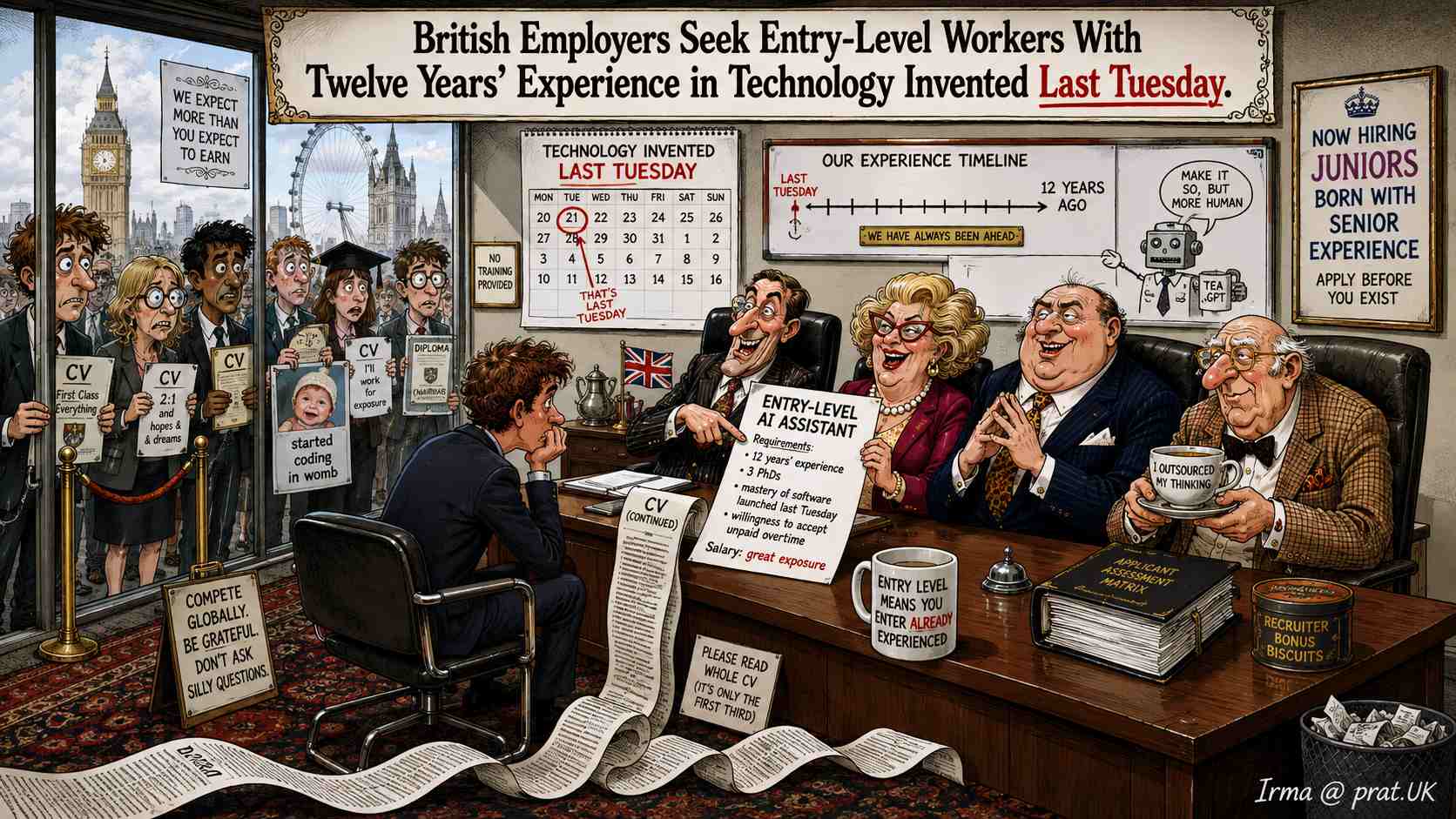
British Employers Seek Entry-Level Workers With Twelve Years’ Experience in Technology Invented Last Tuesday
Britain’s new AI economy promises limitless opportunity for experienced specialists, existing employees, and graduates whose parents own software companies.
LONDON — British employers have unveiled a revolutionary solution to the national skills shortage: refusing to employ anyone who still needs to acquire skills.
The breakthrough follows new figures showing a labour market increasingly split between experienced workers with artificial-intelligence expertise and everybody else, standing outside the building holding a freshly printed CV and wondering where the entrance went. British vacancies have fallen sharply, graduate opportunities are at their weakest level since 2020, and demand is increasingly concentrated in senior technical roles connected to AI, according to ONS labour market data. Recruitment directors described the arrangement as a “two-speed job market,” although graduates said the second speed appeared to be reverse.
Under the system, senior AI specialists travel first class through the economy, receiving signing bonuses, flexible schedules, and fruit-infused water. Recent graduates are tied to the roof beside the bicycles and told not to obstruct productivity.
“We are absolutely committed to entry-level recruitment,” said Crispin Folder, head of talent acquisition at the consultancy FutureQuotient Partners. “Unfortunately, most entry-level applicants lack the fifteen years of strategic leadership we expect from someone earning £24,500.”
Folder displayed a vacancy for a Junior Generative Intelligence Assistant requiring twelve years’ experience with a platform launched last Tuesday afternoon.
“We’d consider eleven years,” he said, “but the candidate would need to demonstrate exceptional humility.”
Artificial Intelligence Creates Jobs — For People Who Already Have Jobs
Figures from Indeed’s Hiring Lab show UK job postings fell 11 percent between the beginning of 2026 and July 17, leaving vacancies 32 percent below their pre-pandemic level. Graduate postings were down 7 percent year over year, while references to AI tools appeared in a record 9.4 percent of UK job ads by the end of June.
This, employers insist, is excellent news — because it proves that artificial intelligence creates jobs.
The jobs in question are principally being created for people who already possess jobs, experience, specialist knowledge, pensions, security passes, and personalised mugs in the corporate kitchen.
Software-development postings have risen 14 percent, but most of that growth sits in senior positions and roles directly tied to AI work.
“This is what economists call inclusive growth,” explained labour-market consultant Venetia Spreadsheet. “The growth includes everyone who was already included before the growth began.”
Spreadsheet said graduates could improve their prospects by gaining substantial workplace experience. Asked how they might obtain that experience without first obtaining a workplace, she suggested “networking creatively” — which appears to mean standing near employed people until some employment rubs off.
Graduate Rejected for Failing to Replace Himself Earlier
At King’s Cross, computer-science graduate Oliver Pritchard said he had applied for 184 junior technology positions since finishing a master’s degree in artificial intelligence. He heard back from three.
The first told him the employer had chosen candidates whose qualifications more closely matched the role. The second invited him to purchase career coaching. The third was an automated message congratulating him on joining a supermarket loyalty programme.
Pritchard was eventually interviewed for the role of Entry-Level AI Transformation Architect.
“The interviewer asked whether I’d previously led an international artificial-intelligence transformation,” he said. “I explained I’d spent the past year at university learning how to do one.” The panel, he says, became visibly concerned. “They said learning showed potential. Experience showed experience.”
Pritchard was rejected for lacking professional experience replacing recent graduates with artificial intelligence. The job went to a 49-year-old consultant who had already replaced two graduate programmes, one apprenticeship scheme, and an entire room of people named Josh.
Manufacturing Careers Thrive Mainly in Government Videos
Prime Minister Andy Burnham has urged young people to pursue technical qualifications, arguing that artificial intelligence may be able to write an essay but cannot manufacture a train. Yet manufacturing job postings are down 58 percent since June 2022 and 18 percent below last summer’s level, per the same Hiring Lab tracker. Vacancies in construction, installation, maintenance, loading, and stocking have struggled to recover too.
Burnham became prime minister on July 20, 2026, and his government has announced plans to align technical education more closely with local employment needs — teaching young people precisely the skills required by nearby companies that are not, at present, hiring them. Government advisers reportedly call this “demand-led training without the distracting presence of demand.”
At a college in Birmingham, students were shown how to assemble a train using a 3D animation, because the physical workshop had been converted into luxury flats.
“Young people must prepare for Britain’s industrial future,” said instructor Barry Lathe, gesturing at a laminated poster of a factory. “This is a factory. Britain once had several.”
Student Chloe Evans said she remained optimistic. “I’m studying advanced railway engineering,” she said. “My careers adviser says it could lead to an exciting position explaining railway engineering to another unemployed railway-engineering graduate.”
Employers Carefully Preserve Britain’s Rare Skills Shortage
Business organisations, including groups that regularly brief the Department for Education on workforce planning, have repeatedly warned that Britain suffers from serious skills shortages. To keep those shortages from disappearing, companies have instituted strict conservation measures.
No inexperienced person may approach a skill within ten metres. Training budgets have been fenced off. Apprenticeships are monitored by security guards. Mentoring is permitted only when it doesn’t interfere with meetings about the absence of qualified staff.
“We cannot risk producing too many skilled workers,” Folder explained. “That might lower salaries, improve productivity, or give employees choices.”
Instead, employers compete for the same small pool of senior specialists. The average recruitment strategy now consists of messaging six people on LinkedIn who already earn more money elsewhere. When those candidates decline, the company publishes a report warning that Britain’s education system has failed.
Dr. Imogen Turnstile, a local philosopher studying circular reasoning, said the system had achieved a kind of perfect closure. “To obtain experience, one requires employment. To obtain employment, one requires experience,” she said. “The ideal candidate must therefore already be employed — and should under no circumstances be permitted to leave.”
Indeed Opens Fast Lane and Scenic Unemployment Route
Job platforms have responded to the two-speed economy by introducing separate travel options. Experienced AI specialists get the Express Career Lane: instant interviews, executive recruiters, salaries expressed as actual numbers.
Graduates are directed toward the Scenic Unemployment Route, featuring webinars, personality tests, and weekly emails titled “Your Dream Job Is Waiting.” The dream job generally requires five years of experience, security clearance, and fluency in a programming language the employer’s founder wrote over the weekend.
Applicants may also spot the phrase “entry-level salary,” which appears to mean the employer only remembers the role is junior when it’s time to calculate pay. The responsibilities remain senior — stakeholder management, systems redesign, vendor supervision, executive advisory, and staying calm when the office printer demands a firmware update.
Compensation includes excellent exposure. Exposure is a flexible corporate currency: it buys neither food nor shelter, but it’s accepted widely at networking events.
The Great British Recruitment Survey
A nationwide satirical poll of 1,000 employers found that 94 percent believed young people lacked experience. Ninety-two percent of those same employers had eliminated their graduate-training programmes. Eighty-seven percent said candidates should demonstrate initiative; 86 percent automatically rejected applications containing any initiative not listed in the job description.
Meanwhile, 100 percent of human-resources directors agreed the recruitment process was functioning efficiently — because it had successfully prevented human resources from ever meeting an actual human.
Comedian Ned Parsnip observed that modern job ads increasingly resemble dating profiles written by people who dislike dating. “They want someone young with twenty years’ experience, independent but obedient, passionate but inexpensive,” he said. “That isn’t a candidate. That’s a Labrador with an MBA.”
Comedian Priya Cobb called entry-level recruitment “a nightclub where the bouncer asks whether you have previous experience entering this nightclub.” Comedian Malcolm Pugh said employers simply want workers to arrive “fully assembled, recently upgraded, and still willing to accept payment in exposure.”
Practical Advice for Young Jobseekers
Career experts recommend graduates stay positive, adaptable, and — ideally — legally capable of time travel. Candidates should, in theory, begin accumulating professional AI experience before the AI platform in question is invented.
They should tailor every CV, optimise every keyword, collect six certifications, build a public portfolio, complete unpaid projects, maintain a professional social-media presence, and somehow avoid appearing desperate despite doing all of this precisely because they are desperate.
Applicants should also remember that rejection isn’t personal. It’s automated. A machine rejected them because another machine concluded they lacked sufficient experience working with machines. This is known as digital transformation.
Alan Nafzger, a retired political scientist and occasional observer of economic absurdity, said British recruitment had finally achieved what philosophers once thought impossible. “Employers have created a labour market in which everyone must begin in the middle,” he said. “The only remaining entry-level position is inheriting the company.”
Britain Prepares for the Workforce of Yesterday
Economists warn that cutting junior opportunities may eventually leave companies without experienced workers, since senior employees are ordinarily produced by letting junior employees survive for a few years first. Business leaders rejected this theory as dangerously long-term.
“We shall simply hire experienced people,” said Folder. Asked where those experienced people would come from once every company stopped training beginners, he paused. “Overseas?” Asked what happens when overseas employers adopt the same strategy, he glanced at the department’s new AI recruitment assistant. It recommended scheduling a meeting.
The meeting required twelve years’ experience.
Fifteen Humorous Observations
- Entry Level Now Begins After Retirement. British companies have redefined “entry level” as the point at which a candidate has accumulated twelve years of experience, managed three departments, and developed lower-back pain from ergonomic office chairs.
- Employers Want Experience but Refuse to Manufacture It. Companies complain that applicants lack experience while treating the creation of experience as an expensive hobby best left to competitors, universities, or someone’s uncle who owns a consultancy.
- AI Has Created a Two-Speed Job Market. Senior AI specialists travel first class with complimentary champagne. Graduates are tied to the roof beside a suitcase marked “potential.”
- The Skills Shortage Is Being Protected From Skilled Beginners. Britain’s skills shortage has become a national treasure, carefully maintained by refusing to hire anyone who might acquire skills and endanger its protected status.
- Every New Technology Apparently Existed During the Blair Government. Vacancies request ten years of experience using software introduced eighteen months ago, implying the ideal applicant secretly beta-tested artificial intelligence in 2014 beside a fax machine.
- University Now Provides Four Years of Preparation for Rejection. Graduates study computer science, data analysis, and machine learning, only to discover the essential professional qualification is having been employed before needing employment.
- AI Creates Jobs Mainly for People Who Already Have Jobs. The technology generates lucrative opportunities for senior specialists who are already securely employed and therefore possess the critical recruitment skill of not urgently requiring an opportunity.
- “Training Provided” Means a Password and a Legal Disclaimer. Corporate training once involved mentors and supervised experience. It now consists of a twelve-minute video, seven compliance questions, and an email asking why the new recruit isn’t yet fully productive.
- Britain’s Industrial Strategy Is Becoming Increasingly Conceptual. Young people are encouraged to pursue manufacturing careers while manufacturing vacancies disappear, allowing Britain to build an advanced industrial economy largely from speeches.
- The Graduate Recruitment Ladder Has Become Decorative. The first rung has been removed to discourage inexperienced climbers. Successful candidates must now leap directly onto the fourth rung while demonstrating previous ladder-management experience.
- “Competitive Salary” Is Competing Primarily With Rent. Companies offer “excellent exposure,” “dynamic culture,” and “unlimited learning opportunities” — three traditional British units of payment that remain mysteriously unacceptable to landlords.
- Human Resources Has Automated the Human Part. Recruitment software rejects applicants for lacking the correct keywords, after which executives announce that artificial intelligence is improving human judgment.
- Every Vacancy Is Searching for the Same Six People. Britain may contain millions of workers, but employers seem interested only in six senior AI engineers who already work for Google and have stopped answering LinkedIn messages.
- Young Workers Need Experience to Obtain Experience. Known as the British Employment Möbius Strip — a continuous surface on which applicants travel forever without encountering a first job.
- The Future of Work Has Already Requested References. The future is exciting, disruptive, and urgently hiring, provided candidates can prove they worked there previously.
Disclaimer: This report is satire inspired by genuine labour-market data, genuine graduate anxiety, and the genuine corporate belief that “excellent exposure” can be deposited into a current account. No recruitment directors were trained during its preparation. This piece of British satire is part of an ongoing series of UK satirical news from a publication built on satirical journalism, offered in the tradition of English satire. This story is entirely a human collaboration between two sentient beings: the world’s oldest tenured professor and a philosophy major turned dairy farmer. Auf Wiedersehen, amigo!

Alan Nafzger was born in Lubbock, Texas, the son Swiss immigrants. He grew up on a dairy in Windthorst, north central Texas. He earned degrees from Midwestern State University (B.A. 1985) and Texas State University (M.A. 1987). University College Dublin (Ph.D. 1991). Dr. Nafzger has entertained and educated young people in Texas colleges for 37 years. Nafzger is best known for his dark novels and experimental screenwriting. His best know scripts to date are Lenin’s Body, produced in Russia by A-Media and Sea and Sky produced in The Philippines in the Tagalog language. In 1986, Nafzger wrote the iconic feminist western novel, Gina of Quitaque. He currently lives in Holloway, North London. Contact: [email protected]